Crypto User Loses $282M In Social Engineering Attack — Details

bitcoinistPublished on 2026-01-18Last updated on 2026-01-18

Abstract

A crypto user suffered one of the largest social engineering attacks in history, losing over $282 million in Bitcoin and Litecoin on January 10, 2026. The victim was tricked into sharing their seed phrase, allowing the attacker to drain their hardware wallet. The exploiter quickly moved the funds across multiple networks, converting a significant portion into Monero (XMR), causing its price to surge to nearly $800. The stolen assets were also bridged via THORChain, reigniting debates on censorship-resistant cross-chain protocols. While some suspected state involvement, investigators ruled out North Korea. Security firm ZeroShadow confirmed the attacker impersonated Trezor support and managed to freeze around $700,000 in assets. The incident highlights ongoing vulnerabilities in the digital asset space.

2026 got off to a disastrous start for one crypto user, who fell victim to one of the largest social engineering attacks in digital asset history, losing over $282 million in Bitcoin and Litecoin.

How Crypto User Fell Victim To $282M Theft

According to prominent blockchain sleuth ZachXBT, the crypto theft occurred on January 10, 2026 at around 11:00 pm UTC. Around 2.05 million Litecoin (worth roughly $153 million) and 1,459 Bitcoin (equivalent to around $139 million) was drained from the victim’s hardware wallet after they were tricked into sharing their seed phrase.

The exploiter swiftly transferred the funds across multiple networks to obscure the trail after gaining full control of the crypto wallet. As revealed by ZachXBT, the attacker first began converting the stolen crypto assets into Monero’s native token, XMR, through multiple instant exchanges, leading to a surge in the price of XMR.

Furthermore, the exploiter bridged significant amounts of the stolen Bitcoin across Ethereum, Ripple, and Litecoin through THORChain, a decentralized cross-chain platform that enables users to swap crypto assets between different blockchain networks. Unsurprisingly, this move reignited the debate around the use — or abuse — of censorship-resistant cross-chain protocols, especially during security breaches.

After the news of the attack made it to social media, conversations around the entity or persons behind $282 million theft started, with many linking it to a state-sponsored hacking group. However, ZachXBT categorically stated that “it’s not North Korea,” potentially exonerating the infamous state-backed Lazarus Group.
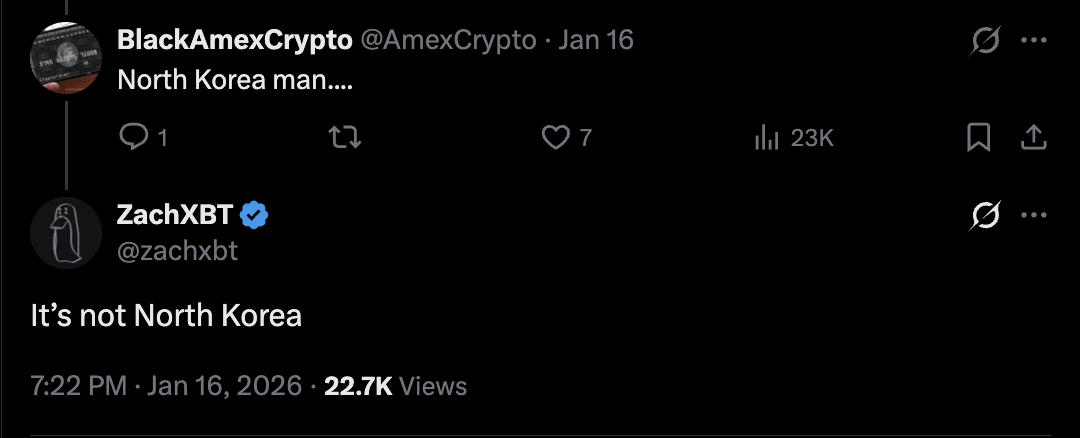
Source: @zachxbt on X

In a post on LinkedIn, security firm ZeroShadow described the victim as a Bitcoin wallet “belonging to an individual who had been tricked into sharing their seed phrase by an actor impersonating Trezor ‘Value Wallet’ support.” The firm claimed that it was able to track and flag parts of the stolen funds in real time after being alerted by blockchain monitoring teams.

According to ZeroShadow, roughly $700,000 worth of crypto assets were reportedly frozen before they could be fully swapped into privacy-focused assets. This latest incident sheds light on how the digital asset industry is still being targeted by malicious actors.

XMR Price Rallies To New High Following Security Incident

As described by ZachXBT, the attacker, after gaining control of the victim’s wallet, began converting the stolen crypto assets into Monero’s native token, XMR, through several exchanges. In the background, this activity pushed the price of the privacy-focused XMR to a new all-time high around $800 over the past week.

According to data from CoinGecko, the XMR token rallied almost 80% to $797.73 from a weekly low around $450 following the crypto theft. As of this writing, XMR is valued at around $588, reflecting a nearly 25% drop in the past few days.

The price of XMR on the daily timeframe | Source: XMRUSDT chart on TradingView

Trending Cryptos

Related Questions

QWhat was the crypto user tricked into sharing that led to the loss of $282 million?

AThe crypto user was tricked into sharing their seed phrase by an actor impersonating Trezor 'Value Wallet' support.

QAccording to ZachXBT, which privacy-focused cryptocurrency did the attacker convert the stolen funds into, causing its price to rally?

AThe attacker converted the stolen funds into Monero's native token, XMR.

QWhat decentralized cross-chain platform did the exploiter use to bridge the stolen Bitcoin across different blockchain networks?

AThe exploiter used THORChain, a decentralized cross-chain platform, to bridge the stolen Bitcoin.

QHow much of the stolen crypto assets were reportedly frozen before they could be fully swapped into privacy-focused assets?

ARoughly $700,000 worth of crypto assets were reportedly frozen.

QWhat was the new all-time high price that XMR reached following the security incident, according to the article?

AXMR reached a new all-time high of around $800 following the security incident.

Related Reads

No Sales Team, $20 Million in Revenue: How Did AI Employee Viktor Win Over 30,000 Companies?

The AI employee Viktor, developed by a team with DeepMind background, has achieved $20 million in annual revenue without a traditional sales team, serving over 30,000 companies. Its core innovation lies in positioning itself as a "Tier 3 AI Coworker" capable of "end-to-end execution and delivery of results," moving beyond the "draft and wait for human completion" model of typical AI assistants. Users can simply mention Viktor in Slack or Microsoft Teams using natural language commands, and it autonomously performs tasks like pulling sales data from a CRM, generating reports, or even cross-tool operations like creating board meeting PPTs by aggregating data from six different sources. Key to its growth is a pure Product-Led Growth (PLG) model, eliminating complex implementation cycles and per-seat licensing. Instead, it charges based on task credits or consumption, lowering the trial barrier with a $100 free credit offer and no credit card required. This enabled viral, bottom-up adoption within organizations. Viktor's interaction paradigm removes the barrier of prompt engineering, allowing non-technical employees to delegate complex workflows seamlessly. It also features proactive, automated task execution (e.g., overnight bookkeeping, scheduled reports) based on triggers, effectively embedding AI as an automated "process layer" within business operations. However, its expansion into Microsoft Teams—a platform with 320 million users—highlights challenges. Large enterprises require stringent IT compliance, security reviews (e.g., SOC 2), and governance, potentially hindering the frictionless, user-driven adoption that succeeded in Slack. Additionally, the "black box" nature of its autonomous decision-making raises concerns about operational risks, data integrity, and the need for robust audit logs and permission controls. Balancing efficiency gains with security and trust remains a critical hurdle for Viktor and similar AI agents aiming to become core enterprise infrastructure.

marsbitJust now

No Sales Team, $20 Million in Revenue: How Did AI Employee Viktor Win Over 30,000 Companies?

marsbitJust now

Manus Buyback Plan Emerges: Chinese Investors Plan to Repurchase Equity with $2 Billion, Path to Hong Kong IPO Becomes Clearer

According to a report by The Information, early Chinese investors of Manus, including Tencent, Sequoia Capital China, and ZhenFund, are planning to repurchase the company from Meta for $2 billion—the same price Meta paid in its acquisition last December. This move is a direct response to the Chinese government's prohibition of the foreign acquisition in April. As part of the repurchase plan, Manus is considering establishing a Sino-foreign joint venture within China. This structure is seen as a way to ensure regulatory compliance for its Chinese investors and to pave the way for a future IPO in Hong Kong. Notably, U.S. investor Benchmark will not participate in the buyback, which will concentrate ownership even more among Chinese capital. Since its acquisition by Meta, Manus's business has grown rapidly, with its annualized revenue run rate reportedly increasing four-to-fivefold to $400-$500 million in roughly six months. This strong growth underpins the investors' willingness to repurchase at the original price. Financially, the forced unwinding of the deal may benefit the early investors, allowing them to regain equity at a cost far below the company's current implied valuation, with the added prospect of an independent future listing. However, specific terms of the repurchase, including funding proportions and the joint venture's equity structure, are still under negotiation. This "repurchase-joint venture-Hong Kong IPO" approach could serve as a reference model for other Chinese AI startups navigating cross-border M&A regulations.

marsbit27m ago

Manus Buyback Plan Emerges: Chinese Investors Plan to Repurchase Equity with $2 Billion, Path to Hong Kong IPO Becomes Clearer

marsbit27m ago

STRC Loses Peg by 11%, Can Strategy's Perpetual Motion Machine Keep Running?

The article discusses the significant and concerning depegging of MicroStrategy's (MSTR) preferred stock, STRC. Designed to trade near its $100 target par value, STRC has recently fallen sharply, reaching a low of $83.26 and closing at $88.59, representing an over 11% discount. STRC is a core component of MicroStrategy's financial strategy. As a perpetual preferred stock, it allows the company to raise capital through an "at-the-market" (ATM) issuance program without diluting common shareholders (MSTR). This capital is primarily used to purchase Bitcoin, creating a "capital flywheel": issuing STRC → raising cash → buying BTC → increasing net assets → supporting STRC's value. The flywheel's operation depends on STRC maintaining its $100 price. To enforce this, MicroStrategy employs a dynamic dividend mechanism, recently raising the rate to 11.5% and increasing payout frequency. However, this has failed to halt the depegging, indicating market concerns extend beyond yield. Analysts cite two main reasons. First, technical factors like forced liquidations from leveraged arbitrage trades may have exacerbated the sell-off. Second, and more fundamentally, is waning confidence in MicroStrategy's financial resilience. A JPMorgan report highlighted the company's limited cash relative to its ~$1.7 billion annual dividend obligation, raising liquidity concerns. While MicroStrategy counters that its massive Bitcoin holdings provide decades of coverage, this argument relies on the potential need to sell BTC—a departure from its long-standing "never sell" narrative. The company's recent sale of a small amount of Bitcoin for "testing," despite being framed as minor, has intensified these fears. The persistent depegging threatens to cripple MicroStrategy's primary funding channel. If STRC remains discounted, the company's ability to fund further Bitcoin purchases weakens. Should cash reserves dwindle while financing is constrained, the market may increasingly price in the risk of MicroStrategy becoming a forced seller of Bitcoin to meet obligations. This shift from a major marginal buyer to a potential seller could pose significant downside risk to the broader Bitcoin market.

链捕手36m ago

STRC Loses Peg by 11%, Can Strategy's Perpetual Motion Machine Keep Running?

链捕手36m ago

Trading

Spot
Futures

Hot Articles

How to Buy ONE

Welcome to HTX.com! We've made purchasing Harmony (ONE) simple and convenient. Follow our step-by-step guide to embark on your crypto journey.Step 1: Create Your HTX AccountUse your email or phone number to sign up for a free account on HTX. Experience a hassle-free registration journey and unlock all features.Get My AccountStep 2: Go to Buy Crypto and Choose Your Payment MethodCredit/Debit Card: Use your Visa or Mastercard to buy Harmony (ONE) instantly.Balance: Use funds from your HTX account balance to trade seamlessly.Third Parties: We've added popular payment methods such as Google Pay and Apple Pay to enhance convenience.P2P: Trade directly with other users on HTX.Over-the-Counter (OTC): We offer tailor-made services and competitive exchange rates for traders.Step 3: Store Your Harmony (ONE)After purchasing your Harmony (ONE), store it in your HTX account. Alternatively, you can send it elsewhere via blockchain transfer or use it to trade other cryptocurrencies.Step 4: Trade Harmony (ONE)Easily trade Harmony (ONE) on HTX's spot market. Simply access your account, select your trading pair, execute your trades, and monitor in real-time. We offer a user-friendly experience for both beginners and seasoned traders.

3.9k Total ViewsPublished 2024.03.29Updated 2026.06.02

How to Buy ONE

Discussions

Welcome to the HTX Community. Here, you can stay informed about the latest platform developments and gain access to professional market insights. Users' opinions on the price of ONE (ONE) are presented below.

活动图片