Crypto Shockwave: Circle Sued As $280 Million Drift Hack Unravels

bitcoinistPublished on 2026-04-17Last updated on 2026-04-17

Abstract

A class action lawsuit has been filed in a Massachusetts federal court against Circle Internet Financial, alleging the stablecoin issuer was negligent and aided in the theft of $280 million from the Drift Protocol. The plaintiffs, representing over 100 investors, argue Circle had the means to stop the stolen USDC from being moved across blockchains using its Cross-Chain Transfer Protocol but failed to act. They point to Circle's prior action of freezing wallets in a separate civil case as proof it could have intervened. The April 1st hack is attributed to North Korean state-backed actors who moved the funds to Ethereum and laundered them through Tornado Cash. The case raises significant questions about the responsibility of centralized entities in the decentralized crypto ecosystem.

North Korean hackers likely pocketed hundreds of millions in stolen crypto — and now a US court is being asked to decide whether a stablecoin giant should have stopped them.

Circle’s Own Track Record Becomes A Key Weapon

A class action lawsuit filed in a Massachusetts federal court this week names Circle Internet Group as the defendant, with plaintiffs arguing the company had both the means and the opportunity to stop roughly $280 million in stolen USDC from moving across blockchains — and did nothing.

The case was brought by Drift Protocol investor Joshua McCollum, representing more than 100 affected members. Their attorneys put it plainly: Circle allowed criminal use of its own technology.
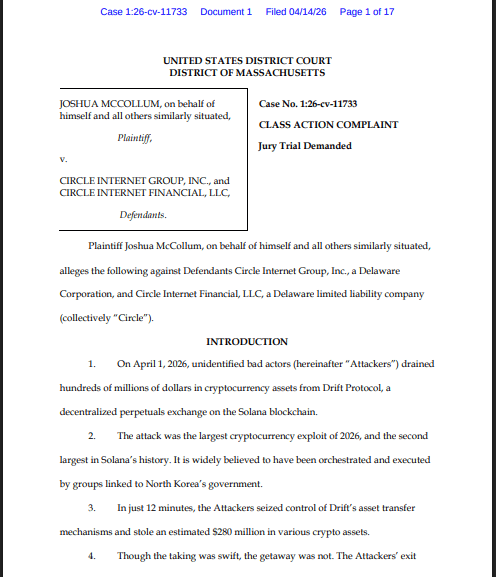
The complaint was filed Wednesday in a Massachusetts US district court by Drift investor Joshua McCollum, representing more than 100 members.

The April 1 attack on Drift Protocol saw attackers drain funds and route them from Solana to Ethereum using Circle’s Cross-Chain Transfer Protocol, a bridging tool the company operates. The transfers happened over several hours, according to reports. The window was wide open.

What makes the lawsuit particularly pointed is what happened just days before the hack. About a week prior, Circle froze 16 USDC wallets tied to a sealed US civil case. Plaintiffs seized on that detail. If Circle could move fast for a court-adjacent matter, they argue, it could have acted here too. That single fact sits at the center of the legal fight.

Accusations Range From Negligence To Aiding The Crime

The suit carries two main charges: negligence and aiding and abetting conversion — a legal term for helping someone unlawfully take another person’s property. The law firm Mira Gibb is handling the case for McCollum and the other Drift investors. Damages have not yet been set and will be determined at trial.

BTCUSD trading at $75,081 on the 24-hour chart: TradingView

Circle has not responded to requests for comment.

Crypto analytics firm Elliptic flagged the attack as the work of North Korean state-backed operatives. Based on Elliptic’s analysis, the hackers executed more than 100 transactions through Circle’s bridging infrastructure during regular US business hours. After moving the funds to Ethereum, the stolen assets were converted and pushed through Tornado Cash, a privacy protocol used to obscure transaction trails.
Image: SOPA Images/Getty Images

ARK Invest Defends Circle, But The Moral Stakes Remain High

Not everyone is pointing fingers at Circle. Lorenzo Valente, ARK Invest’s director of digital asset research, argued that Circle made the right call by not acting without a legal order.

His concern: give a company like Circle the power to freeze funds on judgment alone, and every decision becomes political. He questioned aloud where the line would be drawn — between a North Korean hacker and a suspicious wallet elsewhere in the world.

Featured image from B&G Lawyers, chart from TradingView

Trending Cryptos

Related Questions

QWhat is the main allegation against Circle Internet Group in the class action lawsuit?

AThe plaintiffs allege that Circle had both the means and the opportunity to stop roughly $280 million in stolen USDC from moving across blockchains but did nothing, thereby allowing criminal use of its technology.

QWhich hacking group is suspected to be behind the $280 million attack on Drift Protocol?

ACrypto analytics firm Elliptic flagged the attack as the work of North Korean state-backed operatives.

QWhat key precedent from just days before the hack do the plaintiffs use to strengthen their case against Circle?

AThe plaintiffs point out that about a week prior to the hack, Circle froze 16 USDC wallets tied to a sealed US civil case, arguing that if Circle could act quickly in that instance, it could have acted to stop the stolen funds.

QWhat are the two main legal charges brought against Circle in the lawsuit?

AThe two main charges are negligence and aiding and abetting conversion, which is a legal term for helping someone unlawfully take another person's property.

QWhat was the primary method the hackers used to obscure the trail of the stolen funds after the attack?

AAfter moving the funds to Ethereum, the stolen assets were converted and pushed through Tornado Cash, a privacy protocol used to obscure transaction trails.

Related Reads

South Korean Stock Market Sees Sharp Rebound After Forceful De-leveraging, SK Hynix Rises 30%

On July 31, South Korean stocks staged a historic rebound. The benchmark KOSPI index surged 18.27%, with chipmaker SK Hynix hitting a 30% gain limit. This followed a brutal, near-40% decline in the KOSPI over the previous month, driven largely by a deleveraging spiral involving leveraged ETFs. Analysts attributed the sharp sell-off to structural liquidity issues rather than deteriorating corporate fundamentals. The rally was triggered by a confluence of positive catalysts. Firstly, strong earnings from U.S. cloud giants Microsoft and Amazon alleviated fears of an "AI bubble burst," boosting global tech sentiment. Secondly, SK Group Chairman Chey Tae-won made a rare personal purchase of SK Hynix shares, seen as a strong vote of confidence. Thirdly, the South Korean government announced a 20 trillion won ($139 billion) AI investment fund. In response to the market turmoil, South Korean regulators are tightening controls on leveraged ETFs, admitting oversight shortcomings. Measures include raising minimum cash保证金 requirements for散户 investors and suspending new product launches. While the rebound signals eased liquidity pressure, analysts note deep structural issues remain. The market's future stability is seen as dependent on global tech capital expenditure trends and memory chip price cycles, with some viewing the surge as a technical correction rather than a definitive trend reversal.

marsbit14m ago

South Korean Stock Market Sees Sharp Rebound After Forceful De-leveraging, SK Hynix Rises 30%

marsbit14m ago

Cryptocurrency Company Wintermute Makes Pessimistic Statements Regarding Expected Altcoin Growth! Here are the Details

Crypto market maker Wintermute has made a pessimistic assessment regarding the anticipated altcoin season, suggesting that any upcoming rally may benefit only a limited number of projects. The company reports a record 72% of its spot OTC trading volume in H1 2026 came from institutional clients, whose capital is becoming more selective and concentrated. Data shows institutional traders act quickly on price spikes, while retail interest lasts longer. This selective behavior indicates the classic altcoin season, where hundreds of tokens rise simultaneously, may be changing. Wintermute believes only projects with strong use cases, high liquidity, and institutional appeal will stand out. Supporting this view, CryptoQuant data shows altcoin trading volume against Bitcoin is near its lowest since 2021, with the top 10 altcoins (excluding stablecoins) holding about 80.5% of the total altcoin market cap. Similarly, Kaiko reports that the top 10 altcoins now account for 63% of total altcoin trading volume, up from ~50% a few months ago, indicating capital concentration. Analysts suggest that in the current cautious institutional climate, projects with advanced technology, liquidity, and robust ecosystems will attract disproportionate attention. Therefore, any potential new altcoin season may be less broad than past bull markets, with gains concentrated in a narrower set of promising tokens.

cryptonews.ru14m ago

Cryptocurrency Company Wintermute Makes Pessimistic Statements Regarding Expected Altcoin Growth! Here are the Details

cryptonews.ru14m ago

UNI Activates Fee Switch: Uniswap Completes Commercial Debut, Faces First Test in September

Uniswap's Fee Switch activation on V4 has driven a surge in protocol revenue, with daily income jumping from $118,000 to $318,000. The newly launched Robinhood Chain has become the primary contributor, accounting for over 52% of total revenue, largely fueled by meme coin trading. This revenue fuels a new tokenomic "flywheel": fees accumulate in a pool, incentivizing arbitrageurs to buy and burn UNI tokens, creating deflationary pressure and boosting the token's price. However, concerns loom beneath the surface. Uniswap's revenue is now highly concentrated and dependent on the speculative, volatile activity on Robinhood Chain, which is currently subsidized by free gas fees. This subsidy is set to expire in late September, posing a significant test for sustained transaction volume and, consequently, protocol revenue. Furthermore, UNI's high valuation faces pressure if growth expectations aren't met. Debate also centers on the Fee Switch's impact. While Uniswap founder Hayden Adams clarified that the protocol fee is an "add-on" for traders and does not cut into Liquidity Providers' (LPs) existing share, questions remain about whether higher overall trading costs could indirectly reduce volume and LP earnings over time. Despite these challenges, Uniswap's Fee Switch marks a major step in protocol monetization, with its long-term success hinging on cultivating more sustainable usage beyond speculative trading.

marsbit22m ago

UNI Activates Fee Switch: Uniswap Completes Commercial Debut, Faces First Test in September

marsbit22m ago

Trading

Spot

Hot Articles

How to Buy DRIFT

Welcome to HTX.com! We've made purchasing Drift Protocol (DRIFT) simple and convenient. Follow our step-by-step guide to embark on your crypto journey.Step 1: Create Your HTX AccountUse your email or phone number to sign up for a free account on HTX. Experience a hassle-free registration journey and unlock all features.Get My AccountStep 2: Go to Buy Crypto and Choose Your Payment MethodCredit/Debit Card: Use your Visa or Mastercard to buy Drift Protocol (DRIFT) instantly.Balance: Use funds from your HTX account balance to trade seamlessly.Third Parties: We've added popular payment methods such as Google Pay and Apple Pay to enhance convenience.P2P: Trade directly with other users on HTX.Over-the-Counter (OTC): We offer tailor-made services and competitive exchange rates for traders.Step 3: Store Your Drift Protocol (DRIFT)After purchasing your Drift Protocol (DRIFT), store it in your HTX account. Alternatively, you can send it elsewhere via blockchain transfer or use it to trade other cryptocurrencies.Step 4: Trade Drift Protocol (DRIFT)Easily trade Drift Protocol (DRIFT) on HTX's spot market. Simply access your account, select your trading pair, execute your trades, and monitor in real-time. We offer a user-friendly experience for both beginners and seasoned traders.

5.5k Total ViewsPublished 2024.05.17Updated 2026.06.02

How to Buy DRIFT

Discussions

Welcome to the HTX Community. Here, you can stay informed about the latest platform developments and gain access to professional market insights. Users' opinions on the price of DRIFT (DRIFT) are presented below.

活动图片