Crypto Push In Korea: Hana Financial And Standard Chartered Unveil New Deal

bitcoinistPublished on 2026-03-16Last updated on 2026-03-16

Abstract

One of South Korea's largest financial groups, Hana Financial, has partnered with UK-based Standard Chartered to strengthen cooperation in global finance and crypto assets. The two institutions signed a memorandum of understanding (MOU) on March 15, aiming to develop stablecoins and digital assets as new growth drivers alongside their traditional banking operations. The agreement covers areas including stablecoins, deposit tokens, and tokenized financial instruments. Hana’s Chairman, Ham Young-joo, emphasized the importance of building a comprehensive ecosystem for won-denominated stablecoins, from issuance to circulation. Standard Chartered’s CEO, Bill Winters highlighted South Korea’s key role in Asian financial markets. This partnership reflects a broader trend among major Korean banks to develop regulated digital asset infrastructure—such as stablecoins and tokenized bonds—rather than focusing on retail crypto speculation. Both institutions have prior experience in the digital asset space, with Hana having established a crypto custody venture and Standard Chartered actively involved in tokenization projects and stablecoin initiatives in Asia.

One of the largest South Korean financial conglomerates has partenerd up with a major UK-based global bank to deepen cooperation in global finance and crypto assets.

A Transnational Crypto Deal

Incumbents are keen not to be left behind on the crypto curve, so much so that some of them are now joining forces. That seems to be the case for Hana Financial Group and Standard Chartered Group as on March 15th they announced the signing of a MOU (memorandum of understanding). By teaming up, the two lenders aim to turn stablecoins and other digital assets into a new growth engine alongside their existing international banking business.
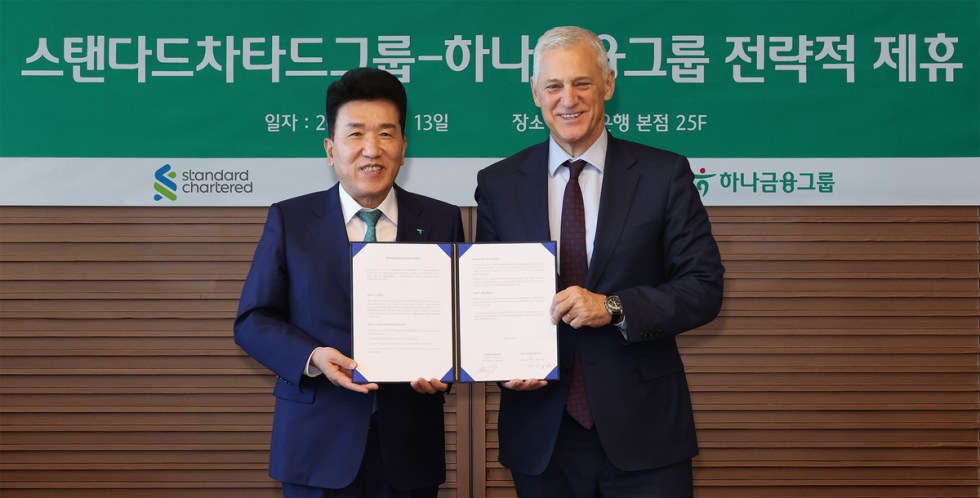
Chairman Ham of Han Financial Group and Bill Winters, CEO of Standard Chartered Group, at the signing ceremony in Seoul. Source: Seoul Economic Daily.

According to The Korea Times, the signing ceremony took place at Hana’s Bank’s headquarters on March 13th. It was attended by Ham Young-joo, Chairman of Hana Financial Group, and Bill Winters, CEO of Standard Chartered Group. Seoul Economic Daily reports that Ham and Winters exchanged views on cooperation in global and digital assets. Chairman Ham stated that:

The partnership between Hana Financial Group and Standard Chartered Group, leveraging their extensive global networks and diverse financial know-how, will serve as a strong competitive edge in the global financial sector. We will create new growth opportunities by generating synergies in future financial domains, including digital assets.

Winters emphasized on the capital importance that South Korea has in Asian financial markets, regarding the country as a “key hub”.

Shared Goals

The MOU covers stablecoins, deposit-token experiments, and future tokenized instruments, tying in Hana’s domestic stablecoin plans and pilots.

The Seoul Economic Daily contextualizes this move with Chairman Ham views of stablecoins as “core future business”. His goal with Hana Financial points to the building of an “ecosystem encompassing the issuance, distribution, use and circulation of (won-denominated stable) coins”, as he stated in his New Year’s address in January. In 2024, Hana Bank, BitGo, and SK Telecom set up BitGo Korea as the local arm focused on institutional crypto custody. In 2025, the Korean lender had an all-time high net profit of ₩4 trillion.
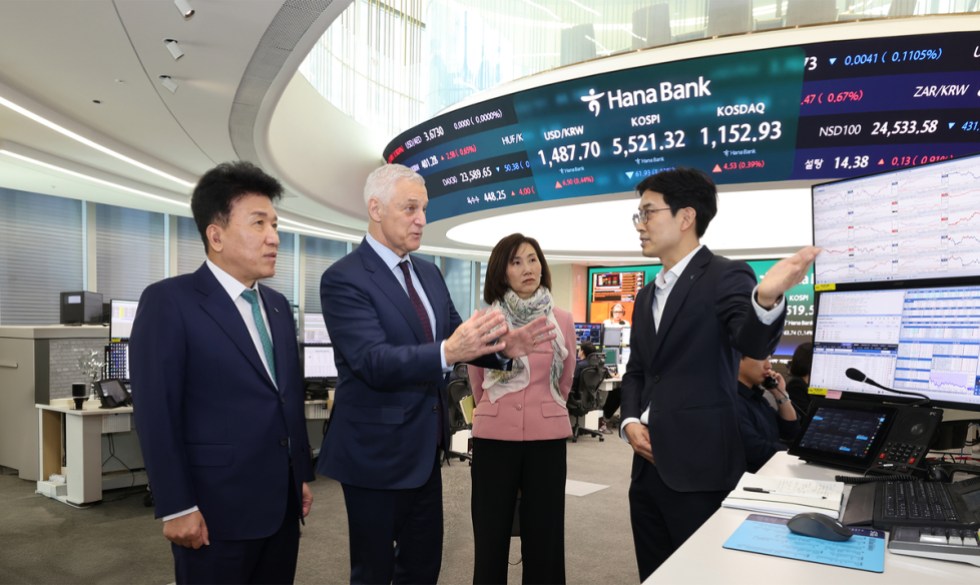
Chairman Ham and Bill Winters at Hana’s Bank’s headquarters, Source: Seoul Economic Daily.

Standard Chartered already has a growing crypto footprint, from institutional custody services to pilots with tokenized bonds and other blockchain-based assets. The bank has also backed several stablecoin ventures in markets like Hong Kong.

This is not the first time Hana Bank and Standard Chartered team up. In December 2025, the UK-based global bank announced that it was facilitating Hana Securities first venture with digital assets.

A Crypto Race

Instead of chasing pure spot exposure, the South Korea’s big banks are now racing to build compliant rails around stablecoins, tokenized notes, and digital bonds that can plug directly into the regulated financial system, nudging the market away from retail speculation toward more structured corporate and banking participation.

This new deal marks another milestone in the latest wave of efforts by TradFi institutions to keep up with a rapidly evolving digital financial system.
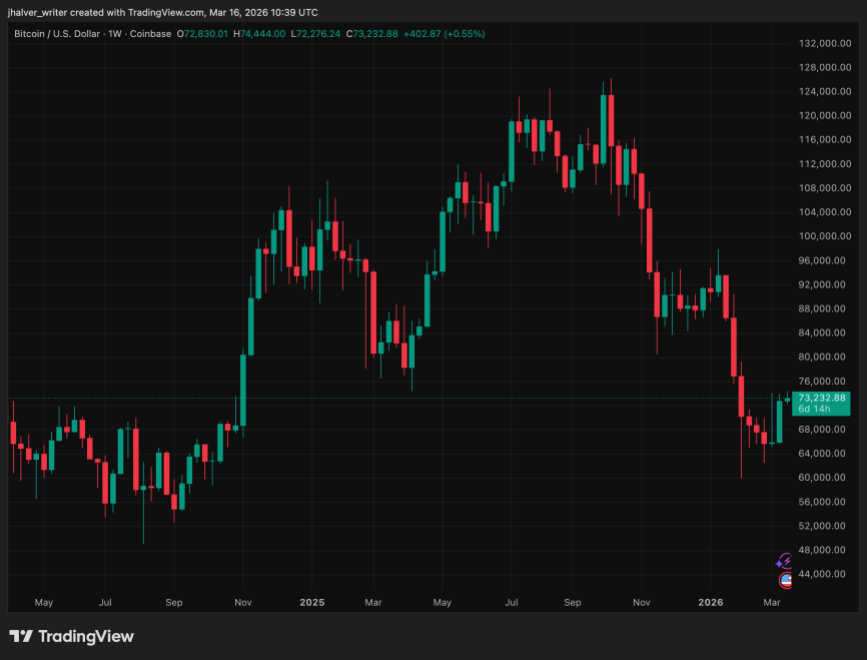
BTC’s price trends to the upside on the daily chart, reaching the $73K. Source: BTCUSD on Tradingview

Cover image from Perplexity, BTCUSD chart from Tradingview

Trending Cryptos

Related Questions

QWhat is the main purpose of the partnership between Hana Financial Group and Standard Chartered Group?

AThe partnership aims to deepen cooperation in global finance and crypto assets, turning stablecoins and other digital assets into a new growth engine alongside their existing international banking business.

QWhen and where did the signing ceremony of the MOU between Hana Financial Group and Standard Chartered take place?

AThe signing ceremony took place on March 13th at Hana Bank's headquarters in Seoul.

QWhat specific areas does the MOU between the two financial institutions cover?

AThe MOU covers stablecoins, deposit-token experiments, and future tokenized instruments, tying in Hana's domestic stablecoin plans and pilots.

QWhat did Chairman Ham of Hana Financial Group identify as a 'core future business' in his New Year's address?

AChairman Ham identified stablecoins as a 'core future business' and expressed his goal to build an ecosystem encompassing the issuance, distribution, use, and circulation of won-denominated stablecoins.

QHow is Standard Chartered Bank involved in the crypto space, according to the article?

AStandard Chartered has a growing crypto footprint, including institutional custody services, pilots with tokenized bonds and other blockchain-based assets, and backing several stablecoin ventures in markets like Hong Kong.

Related Reads

Annual Salary of Millions Competing for Electricians, Meta Rushes to Open Its Own Technical School

The AI boom is facing an unexpected bottleneck: a severe shortage of skilled construction workers and electricians. As tech giants like Meta, OpenAI, and Alphabet race to build massive data centers—such as OpenAI's $16 billion "Stargate" project—they are hitting a critical labor wall. The U.S. needs an estimated 130,000 more electricians, 240,000 construction workers, and 150,000 supervisors by 2030 for AI infrastructure alone, but tens of thousands of electrician jobs go unfilled each year. While AI companies offer high premiums, with electricians earning up to $280,000 annually, worker scarcity still causes massive losses—delays on a single project can cost $14.2 million per month. The complexity of building AI data centers, which require immense power (equivalent to powering hundreds of thousands of homes), sophisticated electrical systems, and advanced liquid cooling solutions, demands highly skilled technicians who are in short supply. To combat this, companies are investing heavily in training. Meta has committed $115 million to a free training school offering tuition, housing, and stipends, targeting 5,000 new workers. OpenAI is partnering with unions to secure skilled labor. These efforts are paying off, with a significant rise in Gen Z interest in trade schools over college. However, the power demands are staggering. AI data centers are driving a rapid surge in electricity consumption, projected to account for up to 12% of U.S. power use by 2028 and raising costs for consumers. Furthermore, the construction boom is project-based, leading to a potential future glut of trained workers once building peaks, which could depress wages industry-wide. The race for AI supremacy now depends as much on skilled hands as on advanced chips.

marsbit1h ago

Annual Salary of Millions Competing for Electricians, Meta Rushes to Open Its Own Technical School

marsbit1h ago

OpenAI No Longer Sells Its Most Expensive Model for Profit

OpenAI is shifting its business strategy away from promoting its most expensive, flagship models for every task. Recent price cuts—80% for GPT-5.6 Luna and 20% for Terra—signal a deeper change: the company now actively advises users that many tasks don't require the most powerful model. Instead, OpenAI recommends a tiered approach: use the high-end GPT-5.6 Sol for complex planning and analysis, then delegate execution to cheaper models like Luna. This mirrors moves by Anthropic, which recently launched Claude Opus 5 at half the price of its top model, Fable 5. Both companies are de-emphasizing flagship models as primary revenue drivers, using them instead for brand prestige and technological showcases. The industry is entering a "mass-market" phase, similar to automotive, where high-volume, cost-effective models handle daily operations and drive scale. OpenAI's price reductions are partly enabled by AI models themselves optimizing underlying code and infrastructure, creating a self-reinforcing cycle of efficiency gains and cost reduction. Competition is shifting from "who is smartest" to "who offers the best value." The goal is no longer selling individual models but fostering widespread API adoption and ecosystem lock-in. By making AI calls cheap and ubiquitous, companies like OpenAI aim to become the indispensable, utility-like infrastructure powering automated workflows—the "water and electricity" of software, quietly embedded everywhere.

marsbit1h ago

OpenAI No Longer Sells Its Most Expensive Model for Profit

marsbit1h ago

Trading

Spot

Hot Articles

How to Buy PUSH

Welcome to HTX.com! We've made purchasing Push Protocol (PUSH) simple and convenient. Follow our step-by-step guide to embark on your crypto journey.Step 1: Create Your HTX AccountUse your email or phone number to sign up for a free account on HTX. Experience a hassle-free registration journey and unlock all features.Get My AccountStep 2: Go to Buy Crypto and Choose Your Payment MethodCredit/Debit Card: Use your Visa or Mastercard to buy Push Protocol (PUSH) instantly.Balance: Use funds from your HTX account balance to trade seamlessly.Third Parties: We've added popular payment methods such as Google Pay and Apple Pay to enhance convenience.P2P: Trade directly with other users on HTX.Over-the-Counter (OTC): We offer tailor-made services and competitive exchange rates for traders.Step 3: Store Your Push Protocol (PUSH)After purchasing your Push Protocol (PUSH), store it in your HTX account. Alternatively, you can send it elsewhere via blockchain transfer or use it to trade other cryptocurrencies.Step 4: Trade Push Protocol (PUSH)Easily trade Push Protocol (PUSH) on HTX's spot market. Simply access your account, select your trading pair, execute your trades, and monitor in real-time. We offer a user-friendly experience for both beginners and seasoned traders.

4.1k Total ViewsPublished 2024.03.29Updated 2026.06.02

How to Buy PUSH

Discussions

Welcome to the HTX Community. Here, you can stay informed about the latest platform developments and gain access to professional market insights. Users' opinions on the price of PUSH (PUSH) are presented below.

活动图片













