Crypto Prediction Markets Face Existential Threat — 3 States Move To Shut Traders Out

bitcoinistPublished on 2026-04-03Last updated on 2026-04-03

Abstract

The U.S. federal government, through the CFTC and DOJ, is suing Illinois, Arizona, and Connecticut to block their attempts to shut down crypto prediction markets like Polymarket and Kalshi. The federal agencies argue they have exclusive jurisdiction to regulate these markets as derivatives, while the states classify them as illegal gambling. This legal clash represents a significant existential threat to the industry. A federal victory would centralize oversight under the CFTC, creating a single regulatory framework. If the states prevail, platforms would face a fragmented landscape of state gambling laws, potentially pushing markets offshore and increasing costs for traders.

Illinois, Arizona and Connecticut are trying to regulate crypto predictions markets, such as Polymarket and Kalshi. The Commodity Futures Trading Commission and the Justice Department are coming to the rescue.

For The First Time, The Scale Moves In Crypto Prediction Markets’ Favor

As contradictory as it may sound, the Trump administration is trying to save crypto prediction markets from the State itself. The coordinated lawsuits the CFTC and the DOJ have filed against the three states argue that only the federal derivatives regulator can police prediction markets.

The lawsuits go as far as to claim the three states are bypassing the CFTC’s authority by trying to shut down “federally regulated DCMs” (designated contract markets). Regarding Illinois, the federal regulator said the state spent the past year issuing cease‐and‐desist letters to Kalshi, Crypto.com, and Polymarket, which the complaint argues are all under CFTC authority:

Illinois’s attempt to shut down federally regulated DCMs intrudes on the exclusive federal scheme Congress designed to oversee national swaps markets.

Related Reading: Crypto Traders On Edge As Korea Stalls Key Law — Is The “Kimchi Premium” At Risk Next?

Put simply, Washington says prediction markets are federally regulated derivatives. States insist, however, that prediction markets are just unlicensed gambling products harming local consumers.

CFTC Chairman Michael Selig explained that this is not the first time states “have tried to impose consistent and contrary obligations on market participants”. Just this past month, a bipartisan Senate bill targeting sports‐style bets on platforms like Polymarket and Kalshi was introduced by Senators Adam Schiff (D-CA) and John Curtis (R-UT).

Also on March, democratic representative Seth Moulton of Massachusetts (MA-06) formally banned all his staff from participating in prediction markets. That same day, Congressman Adrian Smith (R-NE-03) and Congresswoman Nikki Budzinski (D-IL-13) from Nebraska introduced the PREDICT Act, banning members of Congress from trading on political and policy outcome markets.

These are the first lawsuits by the CFTC to block state gaming regulators ​from policing operators of prediction markets, according to Reuters. The outlet also highlighted the fact that all the defendants are Democrats.

Market Implications

The CFTC’s lawsuits build on its recent push to assert “exclusive jurisdiction” over event contracts, including sports and politics, reversing the Biden‐era move that tried to ban broad categories of prediction markets.

Prediction markets are morphing into an information layer and hedging tool for traders, with liquidity increasingly coming from crypto‐native capital and exchange integrations.

A federal win would likely centralize rule‐making at the CFTC, potentially clearing a single regulatory path for crypto prediction platforms, but also tightening surveillance and enforcement. Conversely, if states prevail, platforms may face a patchwork of gambling rules that fracture liquidity, push some markets offshore, and raise operational risk premia for traders.
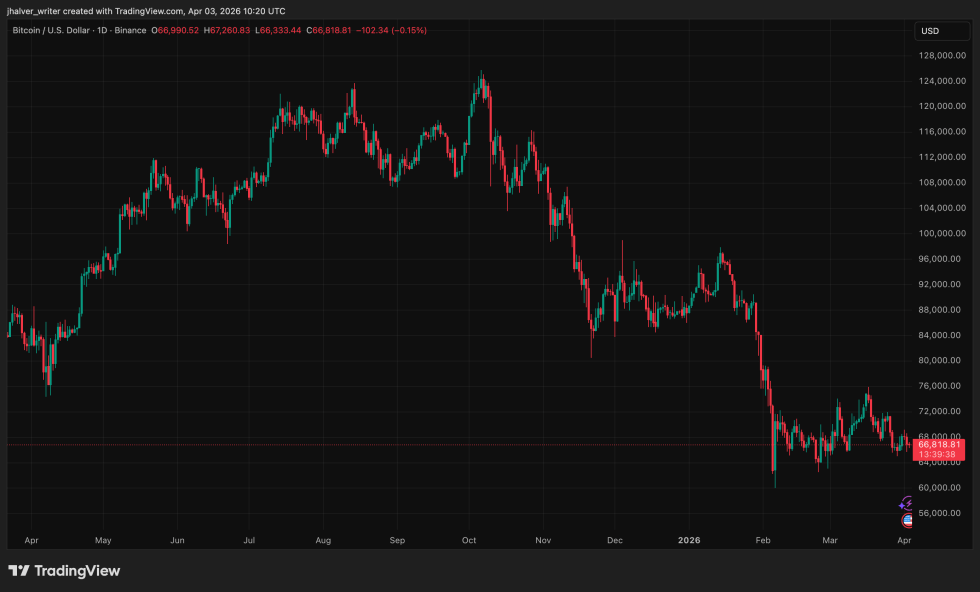
At the moment of writing, BTC trades for almost $67k on the daily chart. Source: BTCUSD on Tradingview.

Cover image from Perplexity. BTCUSD chart from Tradingview.

Related Questions

QWhich three states are mentioned as trying to regulate crypto prediction markets in the article?

AIllinois, Arizona, and Connecticut.

QWhat federal agencies are taking legal action against these states to protect crypto prediction markets?

AThe Commodity Futures Trading Commission (CFTC) and the Department of Justice (DOJ).

QAccording to the CFTC, what is the core legal argument against the states' actions?

AThe CFTC argues that it has exclusive federal jurisdiction to regulate prediction markets as derivatives, and the states are intruding on this federal regulatory scheme.

QWhat is the name of the bipartisan Senate bill mentioned that targets sports-style bets on platforms like Polymarket?

AThe article mentions a bipartisan Senate bill but does not provide its specific name. It was introduced by Senators Adam Schiff and John Curtis.

QWhat are the two potential outcomes for crypto prediction markets discussed, depending on who wins the legal battle?

AA federal win would centralize rule-making at the CFTC, creating a single regulatory path. If states prevail, platforms would face a patchwork of state gambling rules, fracturing liquidity and pushing some markets offshore.

Related Reads

Interview with Robinhood Executive: Meme + Tokenized US Stocks as "Barbell" Customer Acquisition Strategy, All Business Lines Achieve Hundreds of Millions in Revenue

Interview with Robinhood executive Johann Kerbrat reveals the company's "barbell" customer acquisition strategy for its new Robinhood Chain, combining meme tokens with tokenized stocks. Three weeks after mainnet launch, the chain has seen over $3B in weekly DEX volume and 105M transactions. Kerbrat explains the logic behind the permissionless chain: meme tokens attract DeFi users, while tokenized real-world assets (RWA), currently over 90 US stocks and ETFs accessible in 120+ countries, serve global users. The goal is to bring Robinhood's 27 million funded accounts on-chain by simplifying DeFi with a user-friendly interface, exemplified by features like Robinhood Earn which offers yield without requiring wallet management. Built on Arbitrum's technology stack for its speed, low cost, and Ethereum's security, the chain focuses on financial products like Earn, spot trading, and perpetuals. Kerbrat downplays direct competition with platforms like Base, emphasizing the goal of expanding the overall market for on-chain assets. He details selective partnerships (e.g., Morpho, Lighter) based on compliance, unique UX, and differentiation. While regulatory clarity is pending for US perpetuals, the expansion continues via Bitstamp in Europe. Finally, Kerbrat positions Robinhood as a "super app" integrating stocks, options, crypto, banking, and AI trading, with all major business lines generating hundreds of millions in revenue. For the chain, current priority is driving adoption over maximizing gas fee revenue.

marsbit1h ago

Interview with Robinhood Executive: Meme + Tokenized US Stocks as "Barbell" Customer Acquisition Strategy, All Business Lines Achieve Hundreds of Millions in Revenue

marsbit1h ago

Fidelity Q3 Report: BTC, ETH, and SOL Continue to Build Bottoms; How Much Further Will This Crypto Bear Market Go?

Fidelity's Q3 Crypto Signal Report analyzes the current bear market, noting Bitcoin (BTC), Ethereum (ETH), and Solana (SOL) are in a prolonged bottoming phase. Key indicators like the weighted Net Unrealized Profit/Loss (NUPL) have turned negative (-0.01), signaling the market is slightly below its aggregate cost basis, with BTC acting as the primary stabilizing asset. BTC's dominance has risen to 68%, indicating a lack of capital rotation to other digital assets. Performance has been weak across the board, with BTC, ETH, and SOL down significantly year-to-date. Market sentiment is depressed, exacerbated by substantial outflows from spot ETPs and a challenging macro environment. The report compares the current ~203-day downtrend to historical ~300-day bottoming cycles, suggesting the process may be two-thirds complete, with late 2026 as a potential timeframe to monitor. For Bitcoin, NUPL at 0.09 indicates cautious sentiment, while momentum signals remain negative. The Yardstick metric points to potential undervaluation relative to network security (hashrate). Ethereum's NUPL is deep in the "capitulation" zone at -0.43, a historically positive signal for future returns, though its momentum and network fee revenue are negative. Solana shows the deepest NUPL at -0.72 but demonstrates relative resilience in on-chain activity and stablecoin transfer volume. The report concludes that while several metrics are near historical capitulation levels, a definitive market bottom has not yet been established. The path forward likely involves continued consolidation, with BTC's relative strength and fundamental on-chain usage for ETH and SOL providing key areas for investor observation.

marsbit1h ago

Fidelity Q3 Report: BTC, ETH, and SOL Continue to Build Bottoms; How Much Further Will This Crypto Bear Market Go?

marsbit1h ago

Trading

Spot
活动图片