Crypto Morning Brief: Meta Plans to Relaunch Stablecoin Project, Ethereum Foundation Announces Staking of Treasury Funds

marsbitPublished on 2026-02-25Last updated on 2026-02-25

Abstract

Fed plans to permanently remove "reputation risk" from bank supervision, potentially easing crypto firms' "de-banking" issues. Emirates NBD explores adding Bitcoin to its portfolio, calling it "digital gold." White House denies Trump will pardon SBF. Ethereum Foundation begins staking 70K ETH from its treasury. Kraken launches regulated tokenized stock perpetual contracts for non-US users. Coinbase expands stock trading to all US users with 24/5 access. Meta plans to re-enter stablecoins in H2 2026, seeking third-party partners like Stripe, which is also considering acquiring PayPal. Crypto.com receives conditional US approval to form a national trust bank. Hong Kong’s RedotPay considers a US IPO aiming to raise over $1B. Cipher Mining shifts from Bitcoin mining to HPC data centers.

Author: Deep Tide TechFlow

Yesterday's Market Dynamics

Fed Plans to Permanently Remove "Reputational Risk" Regulatory Requirement, Potentially Easing Crypto Firms' "De-banking" Dilemma

According to The Block, the Federal Reserve recently proposed a plan to permanently remove the "reputational risk" consideration from the bank regulatory framework and has opened a 60-day public comment period. The proposal aims to ensure that bank regulatory decisions are based solely on substantive financial risks, preventing banks from denying services to clients due to their political views, religious beliefs, or involvement in legal but sensitive industries. Fed Vice Chair for Supervision Michelle W. Bowman stated that she has heard of multiple "de-banking" cases and that such discriminatory behavior should not exist within the Fed's regulatory framework. Senator Cynthia Lummis welcomed the proposal, saying it will help the U.S. become a global digital asset hub.

Emirates NBD Exploring Possibility of Adding BTC to Investment Portfolio

Maurice Gravier, Group Chief Investment Officer of Emirates NBD, one of the largest banks in the UAE, stated in an interview with CNBC that the bank views Bitcoin as "digital gold" and is exploring the possibility of adding BTC to its investment portfolio. However, he noted that reasonably valuing Bitcoin remains challenging against the backdrop of ongoing market volatility. He also mentioned that Bitcoin's positioning has evolved from initially being seen as an alternative currency to a store of value.

Fortune Magazine: White House Says President Trump Will Not Grant SBF a Pardon

According to Fortune, convicted FTX founder Sam Bankman-Fried is campaigning on social media for a presidential pardon, but a White House spokesperson reiterated to Fortune that President Trump has no intention of pardoning him.

Although Bankman-Fried was a major donor to the Democratic Party, his recent remarks on social platform X have noticeably shifted towards supporting the MAGA stance, criticizing the "deep state" and praising Trump. This strategy emerges against the backdrop of the Trump administration's lenient attitude towards cryptocurrency regulation and its previous pardons, including for Binance founder Changpeng Zhao.

Bankman-Fried is currently serving a 25-year sentence in federal prison while simultaneously challenging his conviction in a federal appeals court. The White House spokesperson cited Trump's statement from January of this year, confirming that the President does not intend to pardon Bankman-Fried or several other high-profile prisoners.

Ethereum Foundation Announces It Has Begun Staking Its Treasury Funds, Plans to Stake a Total of Approximately 70,000 ETH

The Ethereum Foundation announced that it has begun staking its treasury funds, with an initial deposit of 2016 ETH, and plans to stake a total of approximately 70,000 ETH. This move aligns with the Foundation's treasury policy announced last year, and all staking rewards will be returned to the Foundation's treasury.

The Foundation is using the open-source software Dirk and Vouch, developed by @AttestantIO, for operations, ensuring multi-jurisdictional operation through distributed signers to avoid single points of failure. The Foundation stated that this initiative not only helps secure the Ethereum network but will also provide funding support for core operations such as protocol research and development, ecosystem growth, and community grants.

Kraken Launches 24/7 Trading of Tokenized Assets

According to CoinDesk, cryptocurrency exchange Kraken announced the launch of the world's first regulated trading service for tokenized stock perpetual contracts. The product is available to non-U.S. users in over 110 countries, supporting 24/7 trading of tokenized assets such as the S&P 500, Nasdaq 100, Apple, Nvidia, Tesla, and the SPDR Gold ETF, with leverage of up to 20x.

Kraken stated that the underlying tokenized stocks are fully collateralized 1:1 by the reference assets, providing a pricing anchor even when U.S. exchanges are closed. The company plans to expand its product line in the coming months by adding more tokenized stocks and ETFs.

Coinbase Launches Stock Trading Service for All U.S. Users, Enabling 24-Hour Trading 5 Days a Week

Coinbase has opened its stock trading feature to all U.S. users, allowing customers to trade stocks and ETFs 24 hours a day, five days a week. The platform offers commission-free trading and supports fractional share trading, with purchases starting as low as $1. Users can fund their trading accounts using USD and USDC, and Coinbase One members can also earn rewards based on their USDC trading balances.

As part of this new offering, Coinbase has partnered with Yahoo Finance, enabling users to jump directly from asset research pages on Yahoo Finance to execute trades on Coinbase. This integration allows traders to discover and track assets on the Yahoo interface and then complete transactions directly. The company stated that it will start with mainstream market stocks initially and plans to expand 24/5 trading to more stocks in the coming months; it also plans to expand its stock perpetual product range this spring, enabling traders outside the U.S. to gain exposure to U.S. stocks around the clock.

Meta Plans to Relaunch Stablecoin Project in Second Half of 2026

According to CoinDesk, informed sources revealed that Meta, the parent company of Facebook, plans to re-enter the stablecoin arena in the second half of 2026 and is currently seeking partnerships with third-party vendors to manage stablecoin payments and implement new wallet features. Sources mentioned that Meta has sent out Requests for Proposal (RFPs) to several third-party companies, with payments giant Stripe seen as a potential partner; Stripe acquired stablecoin specialist Bridge last year.

This would be Meta's second attempt at a stablecoin following its 2019 effort to launch Libra (later renamed Diem). Unlike before, Meta is adopting an "arm's length" strategy this time, relying on third parties to manage the payment system to avoid potential regulatory risks.

Informed Sources: Stripe Considering Acquiring All or Part of Paypal's Business

According to informed sources, payment processing company Stripe is considering acquiring all or part of Paypal's (PYPL.O) business. Sources revealed that Stripe, one of the most valuable companies in the industry, has preliminarily expressed interest in acquiring this digital payments pioneer or its assets. Sources indicated that discussions are still in the early stages, and it is uncertain whether a deal will ultimately be reached.

Crypto.com Receives Conditional Approval from U.S. OCC to Establish National Trust Bank

According to an official announcement from Crypto.com, the company has received conditional approval from the U.S. Office of the Comptroller of the Currency (OCC) to establish the Foris Dax National Trust Bank (also known as Crypto.com National Trust Bank). Once fully approved, Crypto.com will operate as a federally regulated national trust bank, offering custody services, staking assets across various blockchain and digital asset protocols (including Cronos), and transaction settlement services, among others.

Crypto.com CEO Kris Marszalek stated that this milestone brings the company closer to meeting the demand from leading institutions for a one-stop, qualified custodian under federal regulation. The company submitted its application to the OCC in October 2025; this approval does not affect the ongoing operations of Crypto.com Custody Trust Company, which is regulated by the New Hampshire Banking Department as a qualified custodian.

Bloomberg: Hong Kong Stablecoin Payments Company RedotPay Considers U.S. IPO as Early as This Year, Potential Raise Exceeds $1 Billion

According to Bloomberg, Hong Kong-based stablecoin payments company RedotPay is considering an initial public offering (IPO) in the U.S., with a potential raise exceeding $1 billion.

Informed sources revealed that RedotPay is working with JPMorgan Chase & Co., Goldman Sachs Group Inc., and Jefferies Financial Group Inc. and plans to list in New York as early as this year. The company may seek a valuation of over $4 billion.

Cipher Digital Announces Strategic Pivot from Bitcoin Mining to High-Performance Computing Data Center Business

According to CoinDesk, Cipher Digital (formerly Cipher Mining) announced a strategic pivot from Bitcoin mining to the high-performance computing (HPC) data center business and is rebranding as Cipher Digital. The company's Q4 revenue was $60 million, below analysts' expectations of $84.4 million; adjusted loss per share was $0.14, a wider loss than the expected $0.06. The company has signed a 15-year, 300-megawatt lease with Amazon AWS, a 10-year, 300-megawatt lease with Fluidstack and Google, and has raised $3.73 billion through three bond issuances to fund the Barber Lake and Black Pearl data center projects. Affected by the earnings, the company's stock fell approximately 5% in pre-market trading.

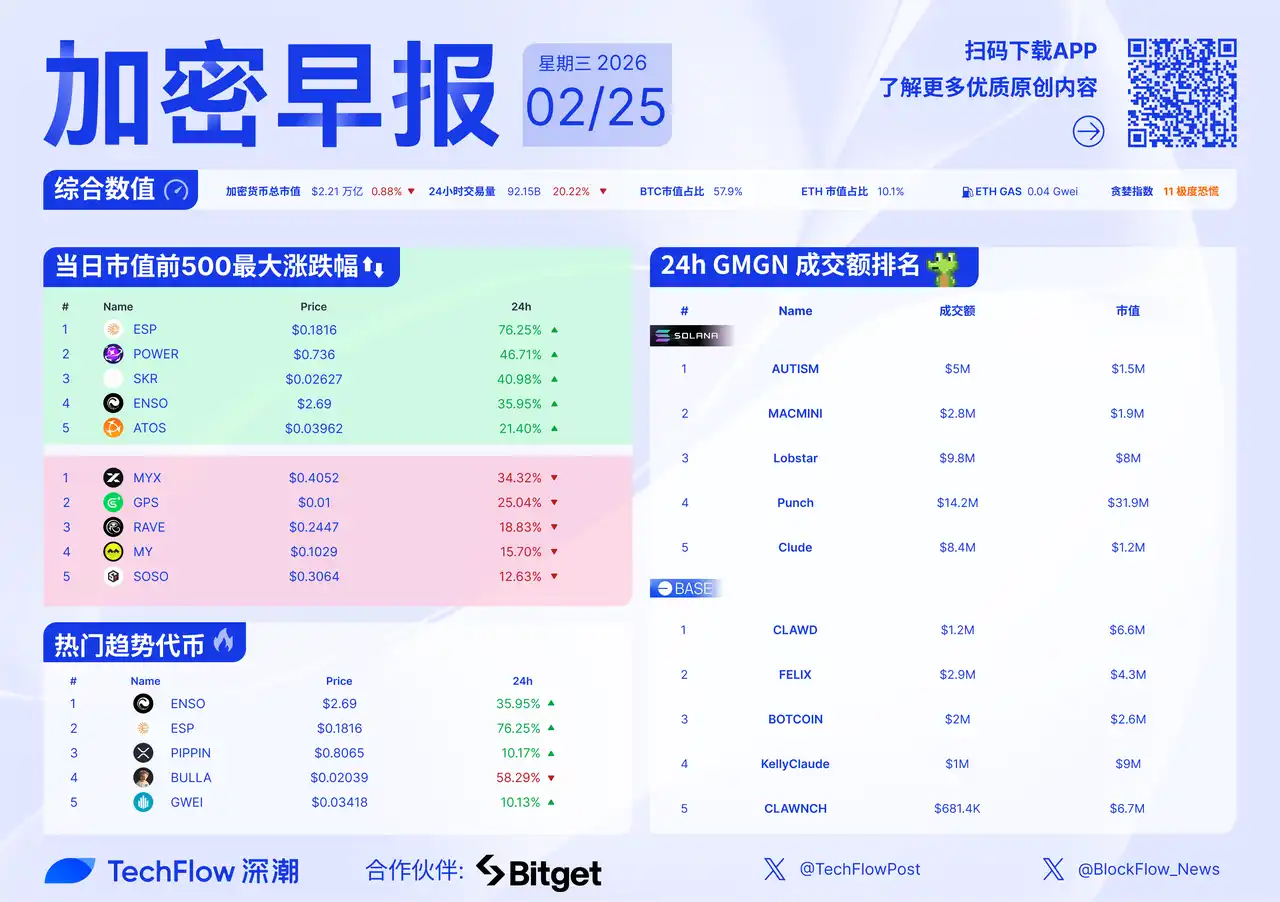
Market Dynamics
Recommended Reading

Waking Up: When the Dream Maker OpenAI Starts Counting Costs

This article provides a detailed analysis of OpenAI's journey from proposing the "Stargate" plan to encountering difficulties due to funding and management issues, ultimately forcing a strategic adjustment. Despite facing significant challenges, OpenAI is seeking survival and growth through partnerships and pragmatic strategies.

AI Doomsday Theory is a Massive Short

This article explores the potential impact of the rapid development of artificial intelligence (AI) technology on the economy, society, and geopolitics. It refutes the "AI Doomsday Theory," arguing that the reduction in cognitive costs brought by AI will usher in a new era of "abundance economy." Although short-term market volatility and industry restructuring may occur, in the long run, AI is expected to significantly increase productivity, reduce economic friction, and potentially promote global peace.

BackPack Token for Equity: A Brutal Self-Rescue in the Crypto Winter

This article analyzes the challenges of the cryptocurrency market in a bear market environment and how exchanges are conducting self-rescue through innovative token-to-equity linkage models, focusing on the background, mechanism, and potential impact of the token staking for equity scheme launched by Backpack exchange.

Bitcoin's "Narrative Crisis": Bloomberg is Right, But Only Half Right

This article discusses how Bitcoin's value and narrative functions are changing, with gold, stablecoins, and prediction markets encroaching on Bitcoin's traditional narratives. Nevertheless, Bitcoin's holder structure has changed due to the emergence of ETFs, and institutional investor participation provides some market support. The article also points out that Bitcoin is not dying but is undergoing a "shedding skin" process; narrative failure may reflect valuation regression rather than a true crisis.

February 24 Market Summary: IBM Becomes the New AI Sacrifice, Crypto Market Suffers Confidence Blow

This article summarizes recent major dynamics in the global market, including the impact of Trump's increased global tariffs on market confidence, the impact of Anthropic's new features on traditional tech companies like IBM, the prominent performance of gold as a safe-haven asset, and the volatility in the cryptocurrency market.


Trending Cryptos

Related Questions

QWhat is the Federal Reserve's new proposal regarding bank supervision, and how might it impact crypto businesses?

AThe Federal Reserve has proposed to permanently remove the 'reputation risk' factor from its bank supervision framework. This aims to ensure regulatory decisions are based solely on substantive financial risks, preventing banks from denying services to clients based on political views, religion, or involvement in legal but sensitive industries like crypto. This could help alleviate the 'debanking'困境 faced by crypto companies.

QWhat significant announcement did the Ethereum Foundation make regarding its treasury?

AThe Ethereum Foundation announced it has begun staking its treasury funds. It deposited an initial 2,016 ETH and plans to stake a total of approximately 70,000 ETH. All staking rewards will be returned to the foundation's treasury to fund protocol development, ecosystem growth, and community grants.

QWhat is Meta's reported plan for re-entering the stablecoin market, and how does it differ from its previous attempt?

AMeta plans to re-enter the stablecoin market in the second half of 2026. Unlike its previous Libra/Diem project, Meta is adopting an 'arm's length' strategy this time by seeking to partner with third-party vendors to manage stablecoin payments and wallet functions, aiming to avoid potential regulatory risks.

QWhich major cryptocurrency exchange received conditional approval from the OCC to form a national trust bank, and what services will it offer?

ACrypto.com received conditional approval from the Office of the Comptroller of the Currency (OCC) to form the Foris Dax National Trust Bank (Crypto.com National Trust Bank). Once fully approved, it will operate as a federally regulated national trust bank offering custody services, staking for assets across various blockchains, and transaction settlement.

QWhat new service did Kraken launch, and what are its key features?

AKraken launched the world's first regulated tokenized stock perpetual contracts trading service. It is available to non-US users in over 110 countries, supports 24/7 trading of assets like the S&P 500, Nasdaq 100, and stocks such as Apple and Tesla with up to 20x leverage. The tokenized stocks are fully collateralized 1:1 by the reference assets.

Related Reads

STAR 50 Soars 10.73%, Why Did A-Shares Stage a "V-Shaped Reversal"?

After a prolonged decline, the Chinese A-share market staged a strong rally on July 21. The STAR 50 index surged 10.73%, its largest single-day gain in nearly a year, leading a broad-based "V-shaped" reversal. The Shanghai Composite Index rose 1.79%, the Shenzhen Component Index gained 4.81%, and the ChiNext Index jumped 7.05%. Total market turnover reached 2.97 trillion yuan, an increase of 256.1 billion yuan from the previous session, with over 3,100 stocks advancing. The semiconductor sector spearheaded the rebound, with related ETFs posting significant gains. Analysts attribute the surge to three converging factors. First, coordinated capital inflows from "national team" institutions, insurance funds, listed company buybacks, and fund house self-purchases have bolstered market liquidity and confidence. Second, supportive policy signals, including commitments from regulators to ensure stable market operations, provided a favorable backdrop. Third, a stabilization and recovery in overseas markets, notably South Korea, created a positive external environment. Institutions suggest the most severe panic selling phase for the tech sector has likely passed, following a significant digestion of crowded positions and leveraged funds. While short-term volatility may persist, the medium to long-term outlook remains underpinned by enduring trends like AI computing demand expansion and semiconductor localization. The market's focus now shifts to the sustainability of supportive fund flows, earnings reports, and upcoming catalysts from the global AI industry chain.

marsbit11m ago

STAR 50 Soars 10.73%, Why Did A-Shares Stage a "V-Shaped Reversal"?

marsbit11m ago

U.S. Tech Momentum Stocks Post Largest Single-Day Gain Ever, But Is the Plunge Over?

US tech momentum stocks staged a sharp rebound on Tuesday (July 21st). Morgan Stanley's TMT Momentum Factor surged over 12%, marking its largest single-day gain on record, exceeding even peaks from the 2000 dot-com bubble. Key momentum indices from Goldman Sachs also posted their strongest daily performances in years. The rally was led by semiconductors, with the Philadelphia Semiconductor Index jumping 4.6%. This rebound followed three consecutive down days and a cumulative 33% plunge in momentum stocks, one of the steepest drawdowns since the dot-com era. Analysts attribute the surge largely to a short squeeze. Heavy selling had pushed high-beta momentum stocks into deeply oversold territory, forcing many short sellers, particularly in Asia, to cover their positions, creating a self-reinforcing buying spiral. However, the rebound's internals appear weak. Trading volume was notably low, and advancing stocks still lagged decliners on the S&P 500, indicating a narrow, concentrated rally rather than broad market participation. Diverging views emerge on the outlook. BTIG warns the bounce has hit key resistance and recommends selling into strength, citing extreme volatility and historical parallels to past market tops. Conversely, Goldman Sachs and UBS believe the momentum unwind is nearing its end, suggesting it may be time to gradually add exposure, as positioning has been significantly reduced. They caution, however, that high volatility warrants a measured approach, potentially using defined-risk strategies. The upcoming earnings season, particularly reports from major tech firms like Alphabet, is seen as a critical test for the rally's sustainability. Simultaneously, bond markets flashed a warning, with yields rising partly due to spiking oil prices. Analysts note that if long-term Treasury yields break decisively higher, it could pose a significant headwind for equities, especially growth stocks.

marsbit19m ago

U.S. Tech Momentum Stocks Post Largest Single-Day Gain Ever, But Is the Plunge Over?

marsbit19m ago

U.S. Tech Momentum Stocks Record Largest Single-Day Gain Ever, but Has the Rout Ended?

U.S. tech momentum stocks staged a dramatic rebound on Tuesday, July 21st. Key momentum indices like the Morgan Stanley TMT Momentum Factor and Goldman Sachs' High Beta Momentum Long Index posted historic or near-historic single-day gains, fueled largely by semiconductor stocks. This sharp rally followed a severe three-day sell-off that saw momentum stocks plunge 33%, marking one of the steepest pullbacks since the dot-com bubble. Analysts attribute the bounce primarily to a short squeeze, as forced covering from over-leveraged traders, particularly in Asia, created a buying spiral. However, the rally's health is questioned due to weak market breadth—overall trading volume was low, and decliners outnumbered advancers in the S&P 500 despite the index's gain—suggesting a narrow, concentrated surge rather than broad recovery. Opinions on the sustainability diverge. BTIG strategists warn the rebound has hit key resistance levels, citing extreme volatility and historic stock dispersion as signs of an ongoing broader correction, and recommend selling into strength. Conversely, Goldman Sachs and UBS view the aggressive momentum unwinding as nearing its end, noting reduced positioning and a lack of new fundamental catalysts. They suggest the sell-off presents a selective opportunity to add exposure, albeit cautiously and gradually using defined-risk strategies. The immediate trajectory hinges on the ongoing earnings season, with market focus on Alphabet's capital expenditure guidance for AI investment clarity. Meanwhile, bond markets present a risk, with rising Treasury yields—potentially heading toward 5.5%—and widening credit spreads for mega-cap tech companies posing a threat to equity valuations. The combination of technical factors, earnings results, and macro conditions leaves the durability of the rebound in doubt.

链捕手21m ago

U.S. Tech Momentum Stocks Record Largest Single-Day Gain Ever, but Has the Rout Ended?

链捕手21m ago

Long-Divided Must Unite, Long-United Must Divide: When L1 Becomes Its Own Rollup, What Is Ethereum's Endgame?

"The Inevitable Cycle: When L1 Becomes Its Own Rollup – What is Ethereum's Endgame?" For years, the Ethereum community grappled with concerns that L2s were fragmenting the ecosystem and eroding L1's value. While L2s provided cheaper execution, they also splintered liquidity and the unified user experience of a single chain. This has prompted a fundamental reassessment of the relationship between L1 and L2. Ethereum's roadmap is evolving. The "Scale" initiative merges L1 and L2 expansion into a holistic framework. L1 itself is advancing with higher gas limits, statelessness, and zkEVM verification, no longer content to be just a low-throughput settlement layer. Consequently, the primary value proposition of L2s is shifting from merely providing cheap blockspace to offering L1 cannot easily provide: application-specific optimizations, privacy features, and flexible governance models. L2s are becoming a spectrum of execution environments with varying degrees of security inheritance from Ethereum. A critical challenge in this multi-chain future is interoperability. The vision is to make Ethereum "feel like one chain again." This relies on advancements in native account abstraction (like EIP-7702) and intent-based architectures (Open Intents Framework), where users declare desired outcomes, and solvers handle the complex cross-chain execution. Furthermore, shortening Ethereum's finality time from minutes to seconds is crucial, as it underpins trust between chains for bridges, stablecoins, and cross-chain applications. Perhaps the most provocative idea is that Ethereum L1 itself could become a form of "its own Rollup." As zkEVM and proof systems mature, high-performance nodes could execute transactions and generate validity proofs. Regular validators would then verify these proofs instead of re-executing all transactions. This blurs the traditional L1/L2 hierarchy, making "Rollup" more of a general execution-verification architecture. Native Rollup aims to integrate L2 validation more directly into the Ethereum protocol, allowing L2s to inherit L1's security more fully and move away from reliance on security councils. In the end, L2s are not destined to replace L1 or be made obsolete by it. The likely future is a unified system where diverse execution environments—each optimized for specific use cases like DeFi, gaming, or privacy—coexist. They will share a common foundation of security, liquidity, and verifiable state, seamlessly connected to restore a cohesive user experience. The next phase for Ethereum is not just about scaling through separation, but about intelligently reintegrating what was separated back into a coherent whole.

链捕手37m ago

Long-Divided Must Unite, Long-United Must Divide: When L1 Becomes Its Own Rollup, What Is Ethereum's Endgame?

链捕手37m ago

Trading

Spot

Hot Articles

Discussions

Welcome to the HTX Community. Here, you can stay informed about the latest platform developments and gain access to professional market insights. Users' opinions on the price of ETH (ETH) are presented below.

活动图片














