Author: Deep Tide TechFlow
Yesterday's Market Dynamics
Economist: U.S. Unemployment Wave Imminent, May Force Fed to Cut Rates 5 Times This Year
According to Jinshi Data, David Rosenberg, who previously worked at Merrill Lynch and has been running his own firm Rosenberg Research since 2020, stated that the U.S. economy will face significant challenges in 2026, with the job market likely to contract sharply, weakening the economy and forcing the Federal Reserve to respond with substantial interest rate cuts.
The U.S. unemployment rate has risen from 4% at the beginning of 2025 to 4.6% in November 2025. Rosenberg believes the unemployment rate will soon break above 5% and "likely test 6% by the end." Rosenberg stated that the collapse of the labor market and the ensuing recession will force the Fed to cut rates by 125 basis points to 2.25% (i.e., five 25-basis-point cuts) by the end of the year.
Notably, Rosenberg's view differs significantly from the general consensus among Wall Street economists, who expect the labor market to remain stable in 2026, with the Fed implementing one or two rate cuts. The median forecast from Fed officials is for one rate cut this year. However, the central bank has emphasized that it sees downside risks in the labor market. The Fed's latest staff projections note that "weaker labor market conditions and heightened economic uncertainty increase the risk of a more pronounced slowdown than expected."
Semafor: New York Times and Washington Post Knew About U.S. Secret Operation in Venezuela Before It Happened
According to a report by U.S. media site Semafor, The New York Times and The Washington Post were informed about the U.S. secret raid operation in Venezuela before it began but agreed to delay publication at the government's request to avoid endangering U.S. troops. President Trump approved the operation at 10:46 PM on Friday, which ultimately succeeded in capturing the President of Venezuela. Despite the tense relationship between the Trump administration and mainstream U.S. media, American media maintained traditional restraint regarding high-stakes national security operations. The Washington Post's editorial strongly supported this operation.
Previous news indicated that three suspected insider wallets placed bets in advance on the ouster of Venezuelan President Maduro, profiting over $630,000 in total. Affected by this, U.S. Congressman Ritchie Torres plans to propose a bill to prohibit federal officials from using insider information for trading on prediction markets.
Short Positions in Trump Media Company Surge; Trump's Personal Stake Would Drop to ~20% Upon Merger with TAE
According to a Reuters report, data from financial analysis firm S3 Partners shows that short positions in Trump Media & Technology Group surged recently after the company announced last month that it was seeking a $6 billion all-stock merger with Google-backed nuclear fusion energy company TAE Technologies. Short positions increased by 31% to nearly 16 million shares,接近 the highest level since October. It is reported that Trump himself holds approximately 115 million shares of Trump Media & Technology Group, representing about 40% of the company's shares. Due to equity dilution from the merger, Trump's stake would drop to about 20% upon merging with TAE.
WLFI Community Passes Proposal to Use Treasury Funds to Incentivize USD1 Adoption with 77.75% Support Rate
Trump family crypto project WLFI announced on platform X that a governance proposal to use part of the unlocked treasury funds to accelerate USD1 adoption passed with a 77.75% approval vote.
Flow: Network Fully Restored, Detailed Technical Post-Mortem Report to Be Released Within 48 Hours
According to an official announcement, the Flow network has been fully restored. Currently, 99.9% of accounts have full operational permissions in both execution environments. The Flow ecosystem is gradually recovering. The decentralized finance ecosystem has begun to resume operations, with decentralized exchanges like KittyPunch and IncrementFi back online and processing trades. Bridge partners are actively working on recovery protocols and are expected to resume operations after final verification.
Flow officials stated that a detailed technical post-mortem report, including the full attack vector, forensic analysis, and remediation methods, will be released within 48 hours. The network is currently secure, operational, and processing transactions in both execution environments. A full ecosystem recovery is expected to be completed this week.
Ranger Announces ICO Launch on January 7th
According to an official announcement, Solana生态 crypto derivatives exchange Ranger will launch a 4-day ICO starting January 7, 2026, at 00:00 UTC+8, with a minimum fundraising target of $6 million. This ICO will be conducted through MetaDAO, allocating 10 million RNGR tokens, representing 39.02% of the total supply. Tokens for ICO participants will be 100% unlocked at TGE, while team tokens will be unlocked upon meeting price milestone triggers.
PwC Significantly Increasing Efforts in the Cryptocurrency Space
According to the Financial Times, as the Trump administration embraces digital assets, PwC, one of the 'Big Four' accounting firms, has decided to increase its investment in this领域 after years of caution towards cryptocurrency.
PwC US lead Paul Griggs stated in an interview that this strategic pivot occurred last year against the backdrop of the U.S. appointing pro-crypto regulatory officials and Congress passing several new laws regulating digital assets, such as stablecoins.
Griggs said: "The Genius Act and the regulatory details around stablecoins will, I believe, boost market confidence in this product and asset class. Asset tokenization will also inevitably continue to evolve, and PwC must be within this ecosystem."
SlowMist: Discovers Potential Critical Vulnerability in HitBTC Exchange
According to an official message from SlowMist, the organization has discovered a potential critical security vulnerability in the HitBTC exchange. SlowMist stated that it had privately disclosed the information to HitBTC in advance but has not yet received a response.
It is reported that HitBTC is an established cryptocurrency exchange founded in 2013. The exchange's trading volume in the past 24 hours was $111,487,461.
Market News: Bezos' Blue Origin Now Accepts Ethereum for Space Travel Payments
According to Solid Intel, Jeff Bezos' space company Blue Origin now accepts Ethereum as a payment method for space travel.
Shanghai Prosecution Discloses a Job-Related Crime Case Involving Virtual Currency Money Laundering, Amounting to 1.8 Billion Yuan
According to a disclosure on the Shanghai Procuratorate's official account, the Shanghai Baoshan District Procuratorate, while handling a job-related crime case, conducted穿透式审查 (penetrative review) of funds, tracked the capital flow chain, and successfully initiated supervision over 24 cases involving 24 individuals. The prosecutor stated that the underground banking团伙 (syndicate) involved had a large number of accounts, making the case difficult to handle, with huge transaction volumes and money laundering amounts reaching 1.8 billion yuan. Ultimately, through pursuit and prosecution, money laundering activities involving cross-border transfer of illicit proceeds via virtual currency were cracked down on. Targeting new and complex money laundering crimes such as those involving underground banks and virtual currency, the Baoshan District Procuratorate guided public security organs to穿透资金账户 (penetrate fund accounts), clarify the source and destination of funds, secure electronic data, ensure precise and effective charges, and fully guarantee the quality and efficiency of money laundering case investigations.
Michael Saylor Again Releases Bitcoin Tracker Information, Hinting at Possible Further BTC Purchases
MicroStrategy founder Michael Saylor again released information related to the Bitcoin Tracker, stating, "Orange or Green?"
Based on previous patterns, MicroStrategy has always disclosed Bitcoin purchase information the day after related messages are posted.
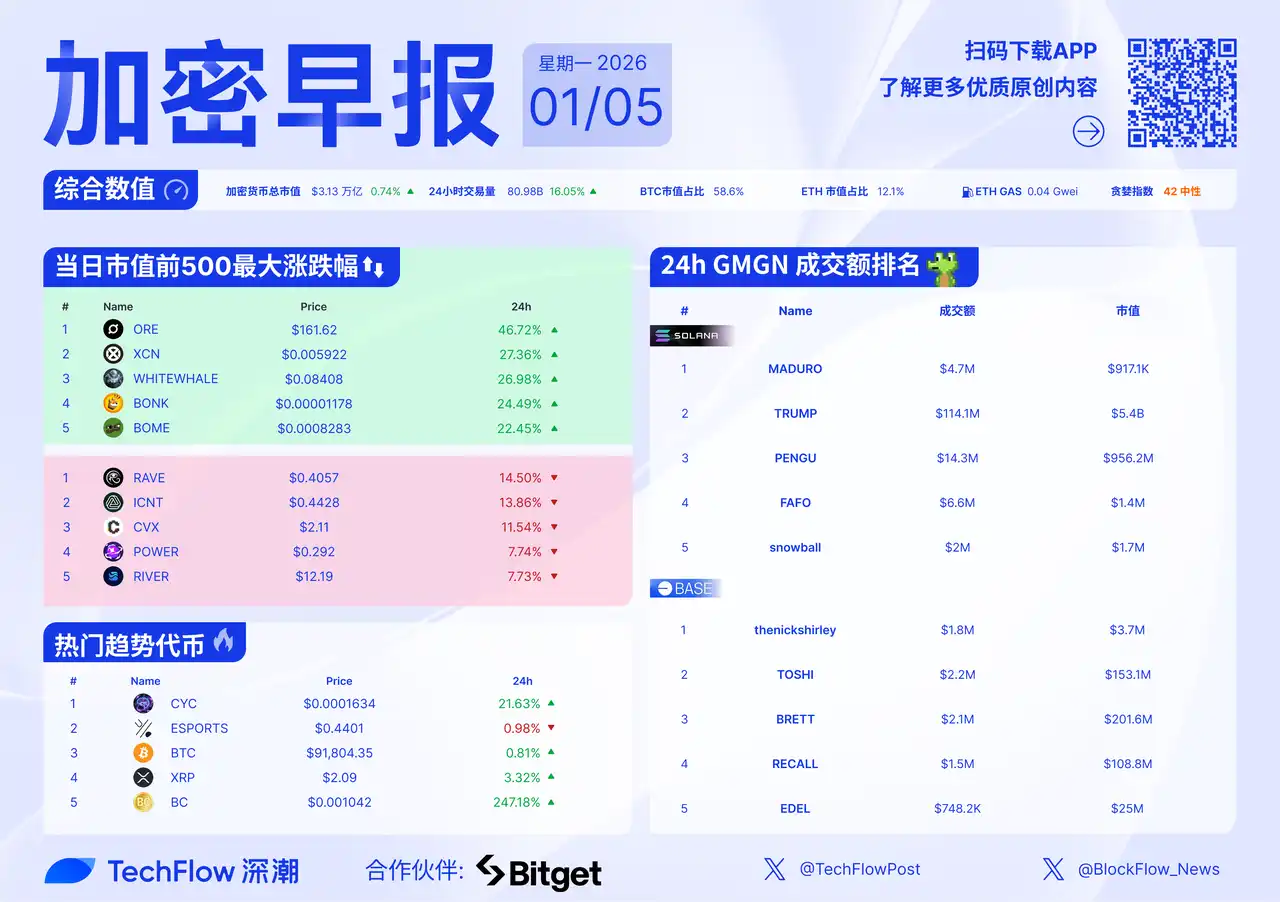
Market Trends
Recommended Reading
The Demise of the Petro: A Microcosm of Venezuela's Failure
This article recounts the failure of "Petro," the world's first sovereign state-backed digital currency launched by Venezuela. The Petro was initially held with high hopes to solve Venezuela's severe economic crisis and counter U.S. sanctions. However, due to technical issues, public indifference, external sanctions, internal corruption, and structural economic defects, the Petro ultimately failed, becoming a microcosm of national governance failure.
Pentagon's Pizza, Polymarket's Money
This article explores the phenomenon of predicting major military operations by analyzing changes in order volumes at pizzerias near the Pentagon. It reviews the history from Soviet agents monitoring Pentagon lights and vehicle numbers during the Cold War to using Google Maps and pizzeria customer traffic to predict war outbreaks today. It also mentions cases where individuals profited from such information on prediction markets and the ensuing discussions on information transparency and insider trading.
Analysis of All x402 Transaction Data in December: Nearly 60% Used for Practical Purposes, Not Speculation
This article primarily discusses the current state and development potential of the x402 protocol, analyzing transaction data from December 2025 and exploring trends in the micro-payment sector and its application potential in AI and blockchain. The article also mentions x402's solutions to payment issues, future challenges, and comparative advantages over other payment platforms.
Multicoin: Why We Are Bullish on Stablecoins Becoming FinTech 4.0?
This article delves into the development history of fintech and the revolutionary impact of stablecoins within it. It reviews the evolution from FinTech 1.0 to 4.0, analyzes the limitations of traditional financial infrastructure, and points out how stablecoins have changed the economic model of financial services through open, programmable networks. The emergence of stablecoins allows fintech companies to reduce operational costs, focus on serving specific niche markets, and achieve higher economic efficiency and deeper user understanding.
Four-Year Cycle Invalidated: 30 Institutions Bet on the New Crypto Landscape of 2026
This article discusses the major transformation the crypto industry will undergo in 2026, transitioning from "adolescent restlessness" to "adult steadiness," entering the so-called "industrialization phase." Various institutions have made predictions about future crypto trends, including decreased Bitcoin volatility, scaled commercial use of stablecoins and real-world assets (RWA), and deep integration of AI and blockchain. The article also mentions potential divergences and challenges, such as the quantum computing threat and competition in the AI payment layer.