Crypto Morning Brief: Kraken Plans to Launch Prediction Market, Trend Research to Purchase $1 Billion in ETH

marsbitPublished on 2025-12-25Last updated on 2025-12-25

Abstract

Crypto Exchange Kraken plans to launch a prediction market service in 2026, as revealed by its global head of consumer business. In market news, U.S. initial jobless claims fell to 214,000, below expectations. BlackRock strategists suggest the Fed may deliver only limited rate cuts in 2026 as it nears neutral rates. In funding developments, LD Capital founder Yili Hua announced that Trend Research is preparing an additional $1 billion to buy more ETH, following a recent $137 million purchase. Meanwhile, a ZK verification platform, disclosed its tokenomics: a 1 billion token supply with significant allocations for ecosystem development and community incentives. Sonic Labs adjusted its airdrop model, shifting from large distributions to more sustainable incentive strategies, while Curve DAO rejected a $6.2 million funding proposal for core development, raising governance concerns. Polymarket confirmed a security breach via a third-party authentication provider, though the issue has been resolved. Other notable events include Aave’s founder facing criticism over a large token purchase ahead of a governance vote, and Metaplanet approving plans to raise funds toward a goal of holding 210,000 BTC by 2027.

Author: Deep Tide TechFlow

Yesterday's Market Dynamics

US Initial Jobless Claims for the Week Ending Dec 20: 214K, Expected 224K

US Initial Jobless Claims for the week ending December 20 were 214,000, compared to an expectation of 224,000 and a previous reading of 224,000.

BlackRock: Fed's 2026 Rate Cuts May Be Limited

BlackRock strategists Amanda Lynam and Dominique Bly noted in a report that the Federal Reserve is expected to implement only limited rate cuts in 2026. With a total of 175 basis points of cuts already in this cycle, the Fed is approaching a neutral interest rate level. Unless there is a sharp deterioration in the labor market, there is very limited room for further cuts in 2026. According to LSEG data, the market currently expects two rate cuts from the Fed in 2026.

CNBC: Kraken Plans to Launch Prediction Market Service in 2026

According to CNBC, cryptocurrency exchange Kraken plans to launch a prediction market service in 2026. Kraken's Global Head of Consumer Business, Mark Greenberg, revealed this plan during an appearance on CNBC Crypto World.

Brevis Unveils Tokenomics Model: Total Supply 1 Billion, 32.20% for Community Incentives

According to an official announcement, ZK verifiable computing platform Brevis has released details of its ecosystem's native token, $BREV.

The total supply of $BREV is 1 billion tokens, with 37% allocated to ecosystem development, 32.20% for community incentives, 20% to the team, and 10.80% to investors.

The ecosystem development and community incentive portions will be linearly released over 24 months after initial unlock, with 14.50% and 10.50% of the tokens circulating at TGE, respectively. The team and investor allocations are fully locked for the first year with no initial unlock, followed by a linear release over 24 months.

Previously, Brevis Network raised $7.5 million in a seed round led by Polychain Capital and Binance Labs.

Sonic Adjusts Token Airdrop Model, Remaining 92.2 Million Tokens in Treasury for Future Incentives

According to the official Sonic Labs blog, Sonic is transitioning from its early distribution phase to a value creation phase, adjusting its token incentive strategy. Since minting 190.5 million S tokens in June 2025, approximately 89.5 million were distributed in Q1, about 6 million in Q2, and around 2.8 million in the Kaito event. The treasury currently holds approximately 92.2 million S tokens, which will be used for incentive programs in 2026 and 2027.

Sonic stated that while the "airdrop model" in the crypto industry over the past few years has driven short-term data growth, it is also a double-edged sword. The Q1 airdrop successfully brought Sonic over $1 billion in Total Value Locked (TVL), but large-scale incentives also attracted short-term participants and created selling pressure. Sonic will no longer conduct additional airdrop mints. The remaining tokens will be used for airdrops, incentives, or burns, while the tokenomics model will be re-evaluated to ensure network activity creates value for long-term participants.

Curve DAO Rejects $6.2 Million Funding Proposal for Swiss Stake

According to The Defiant, Curve DAO has rejected a governance proposal to grant 17.4 million CRV tokens (approximately $6.2 million) to Swiss Stake AG, the core development company for decentralized exchange Curve Finance.

The proposal, submitted by Curve Finance founder Michael Egorov, aimed to provide funding to the Swiss Stake team, which he manages, for software development, infrastructure, security work, and ecosystem support. Voting results showed 54.46% of participants opposed the proposal, while 45.54% supported it.

Voting data indicated that addresses associated with Yearn Finance and Convex Finance accounted for nearly 90% of the opposing votes. Community members commented on the forum that the proposal raised centralization concerns, questioning whether Curve's governance is overly reliant on a small group. Some members also suggested that Swiss Stake should better explain the use of past allocations before new funding is approved.

Hyper Foundation: HYPE Tokens in Aid Fund Officially Recognized as Burned

Hyper Foundation announced on social media that the HYPE tokens in the aid fund address have been officially recognized as burned. This governance vote used a staking-weight-based counting method, resulting in 85% of staked tokens supporting the burn, 7% opposed, and 8% abstained.

Polymarket Confirms User Accounts Hacked Due to Third-Party Authentication Vulnerability

According to The Block, crypto prediction market platform Polymarket confirmed on December 24 that multiple user accounts were hacked due to a security vulnerability in a third-party authentication provider. Affected users reported on social media that their funds were drained even with two-factor authentication enabled. The issue appeared to be related to the email login service provided by Magic Labs, a common registration method for many first-time crypto users.

Polymarket stated that this security issue has been resolved and there is no ongoing risk, but did not disclose the number of affected users or the amount of losses.

Aave Founder's $10 Million Token Purchase Accused of Potential Governance Vote Manipulation

According to Cointelegraph, Aave founder Stani Kulechov recently sparked community controversy by purchasing $10 million worth of AAVE tokens. Critics pointed out that this move may be intended to increase his influence in key governance proposal votes. The current controversy centers on a proposal to reclaim control of the protocol's brand assets, which is accused of being rushed to a vote without sufficient discussion. Data shows that the top three voters in Aave DAO control over 58% of the voting power, raising questions about the fairness of the governance mechanism.

Yi Lihua: Trend Research to Prepare Another $1 Billion to Continue Accumulating ETH

LD Capital founder Yi Lihua stated on social media, "I announce that Trend Research is preparing another $1 billion to continue buying and accumulating ETH on this basis. We practice what we preach and strongly advise against shorting. Without a doubt, this is a historic opportunity."

Previously, it was reported that Yi Lihua's Trend Research acquired 46,000 ETH today, approximately $137 million.

Metaplanet Board Approves Expanded Bitcoin Purchase Plan

According to Dlnews, Japanese company Metaplanet's board has approved several equity proposals aimed at raising funds to achieve the goal of holding 210,000 Bitcoin by the end of 2027. Based on the current Bitcoin price (approximately $87,250 per coin), these Bitcoins would be worth over $18 billion. The company will issue Class A and Class B shares with floating interest rates and quarterly dividends, while also opening investment channels to overseas institutional investors.

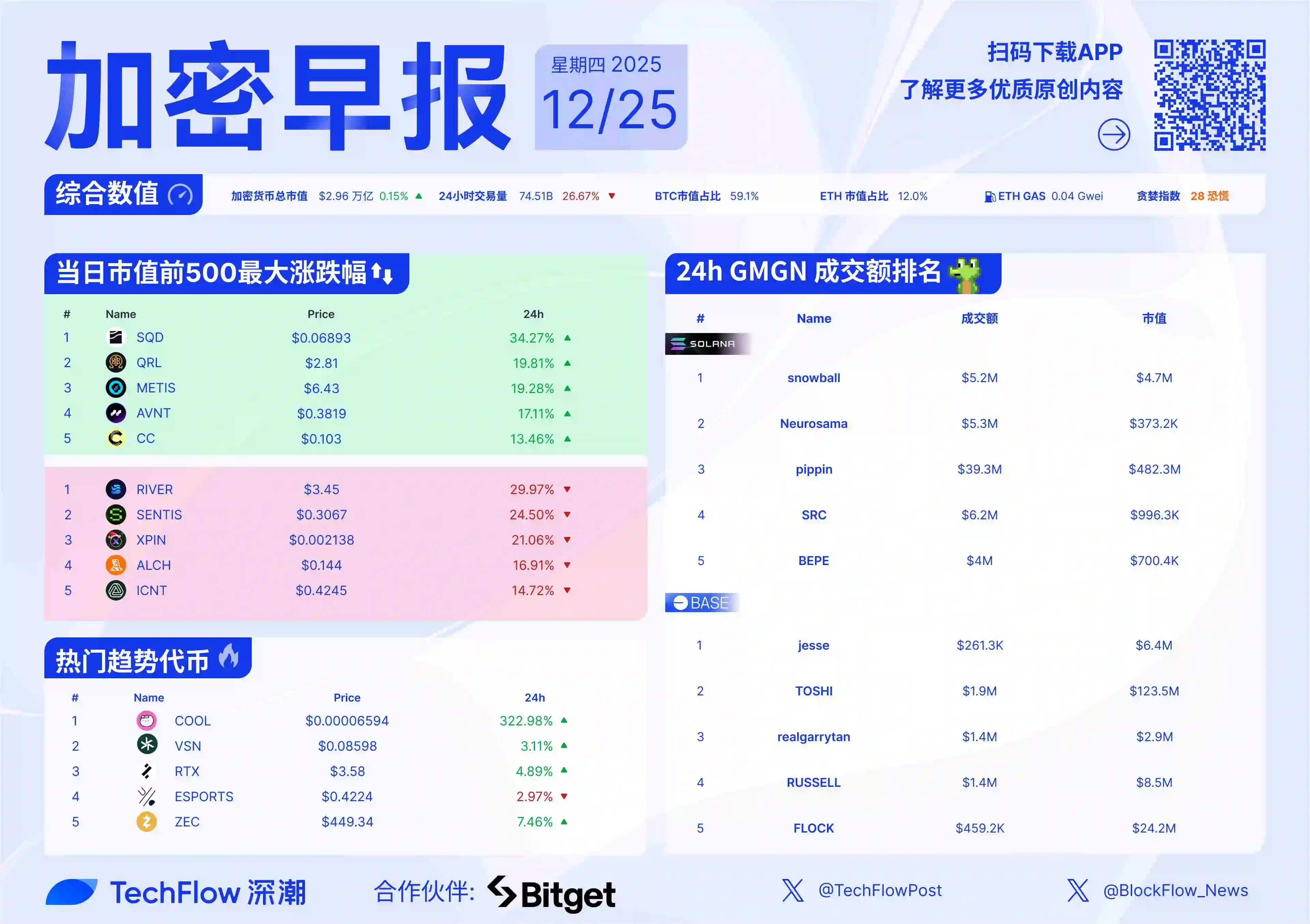
Market Trends
Recommended Reading

The Internet-Famous 'Execution Line': The American Dream Shatters, The Crypto Dream Awakens

This article explores the metaphor of the "execution line" from a gaming term to real society, revealing the underlying economic risks and fragility in both American society and the cryptocurrency market. The "execution line" represents the critical point of financial collapse in American society, while in the crypto market, it manifests as faster and more unpredictable fund liquidations and losses. The article points out that global economic turmoil intensified in 2025, with high US debt, and the crypto market experienced multiple major blows, including hacker attacks, project rug pulls, and market crashes, calling for rational investment and enhanced risk management.

Interview with Move Industries CEO Torab Torabi: After the Market Maker Scandal, How is Movement Rebuilding Trust?

This article covers the past controversies, current developments, and future plans of the crypto project Movement, particularly how its newly established company, Move Industries, is rebuilding trust and driving ecosystem growth in terms of community, technology, and tokenomics. It also includes predictions and opinions on crypto market trends.

Galaxy's 26 Predictions: Bitcoin Will Still Hit ATH Next Year, Reach $250K the Year After

This article provides an in-depth analysis of trends and predictions for the cryptocurrency market in the coming years, covering Bitcoin, Ethereum, stablecoins, decentralized finance (DeFi), privacy tokens, policies, and more. It offers detailed forecasts and reviews, exploring the future direction of the crypto market.

2025 Asset Review: Why Did Bitcoin Significantly Underperform Gold and US Stocks?

This article analyzes why Bitcoin underperformed compared to gold and US stocks in 2025, emphasizing deep-seated factors such as energy flow and information density. It points out that Bitcoin's short-term appeal has declined due to the AI-driven productivity revolution, gold's geopolitical demand, and ETF普及 (popularization of ETFs), but its long-term value remains.

Five Great Crypto Gifts for the Holiday Season

This article introduces five suitable gifts for cryptocurrency enthusiasts during the holiday season, including AI research tools, hardware wallets, security backup devices, themed whiskey, and fun mining equipment. It also mentions the latest dynamics and trend analysis in the crypto market.


Trending Cryptos

Related Questions

QWhat is Kraken planning to launch in 2026 according to the article?

AKraken is planning to launch a prediction market service in 2026.

QHow much ETH does Trend Research plan to purchase with its additional $1 billion funding?

ATrend Research plans to use the additional $1 billion to continue accumulating and buying more ETH.

QWhat was the outcome of the Curve DAO proposal to grant 17.4 million CRV to Swiss Stake AG?

AThe Curve DAO proposal was rejected, with 54.46% of participants voting against it.

QWhat reason did BlackRock strategists give for expecting limited Fed rate cuts in 2026?

ABlackRock strategists stated that with 175 basis points of cumulative rate cuts already in the cycle, the Fed is approaching a neutral rate, and unless the labor market deteriorates sharply, there is limited room for further cuts in 2026.

QWhat security issue did Polymarket confirm on December 24th that affected user accounts?

APolymarket confirmed that multiple user accounts were hacked due to a security vulnerability in a third-party authentication provider, specifically related to the email login service provided by Magic Labs.

Related Reads

After Three Consecutive Quarters of Decline, Can the Crypto Market Find a Window for Stabilization in Q3?

The cryptocurrency market has just concluded its worst-performing quarter since 2022, with total capitalization dropping 12.6% to $2.1 trillion. All core metrics indicate capital is leaving the sector, not just rotating within it. Bitcoin fell 14.2% and Ethereum dropped 25.4% in Q2, breaking their previous correlation with US tech stocks. A key driver is the reversal in US spot Bitcoin ETF flows, which saw a net outflow of approximately $4.67 billion in Q2, including a record monthly outflow near $4.5 billion in June. While recent data suggests long-term holders are accumulating again, sustained ETF outflows mean continued selling pressure. Market focus is now singularly on the Federal Reserve. The upcoming July FOMC meeting is seen as the most critical event for Q3. A dovish signal could support Bitcoin reclaiming a $68,000-$84,000 range, while a hawkish stance might establish a new trading band around $50,000-$56,000. Additionally, regulatory uncertainty persists, with the progress of the crucial *CLARITY Act* stalling in the Senate, reducing its perceived 2026 passage probability to 40-45%. Despite the broad downturn, a few sectors showed growth. Prediction markets saw nominal volume surge 48.7% year-over-year to $113.8 billion, and tokenized collectibles transaction volume rose 143% quarterly to $1.4 billion. The Real-World Asset (RWA) tokenization sector also continued steady growth, now representing ~$28.1 billion in on-chain value. The market's foundation for an extreme crash appears limited, with Bitcoin price hovering near its 200-week moving average. However, the trading paradigm has shifted from narrative-driven speculation to decisions based on price action, policy developments, and interest rate expectations, making a broad sentiment-driven rally unlikely in the near term.

marsbit35m ago

After Three Consecutive Quarters of Decline, Can the Crypto Market Find a Window for Stabilization in Q3?

marsbit35m ago

BIT Trading Moment: BTC Still Suppressed by Weekly 200 EMA, Rejection May Restart Decline; Storage and Semiconductors that Surged Last Night Begin Falling in Evening Trading

**Crypto & Stock Market Wrap: Bitcoin Tests Resistance, Stocks Retreat After AI Surge** Bitcoin consolidates around $66,000, facing key resistance near $68,000—an area seen as a major psychological and technical hurdle where previous rallies have failed. Analysts note the cryptocurrency is caught between its 200-week moving average (~$63,333) and 200-week EMA (~$68,328). A clear break above $68k is needed to signal a stronger bullish trend, while a rejection could lead to a retest of $63k support. Market sentiment remains cautious, with low futures open interest pointing to a low-liquidity rebound rather than a full bull market. Bitcoin spot ETFs saw another $203 million inflow. US stock futures pointed lower after a strong Tuesday session led by a massive rebound in semiconductors and memory stocks. The rally was fueled by renewed optimism about AI-driven hardware demand, with Micron, SanDisk, and SK Hynix surging. However, those gains reversed in pre-market trading. Super Micro Computer (SMCI) soared over 20% after hours on strong guidance and a record backlog. Other standouts included Rocket Lab and nuclear energy plays Oklo and X-Energy. Rising oil prices (Brent above $91) and climbing Treasury yields (10-year near 4.64%), however, are reigniting inflation concerns and acting as a headwind for equities. In Asia, markets were mixed. South Korea's KOSPI pared early gains to close slightly higher as semiconductor stocks like SK Hynix gave back initial surges. Japan's Nikkei edged lower as the yen hit a fresh 38-year low against the dollar, raising fears of potential market intervention. Key events to watch include the Samsung Galaxy launch, AMD's AI event, and a slew of major tech earnings from Alphabet, Tesla, and IBM after the close on Wednesday, followed by the ECB meeting and Intel's earnings on Thursday.

marsbit43m ago

BIT Trading Moment: BTC Still Suppressed by Weekly 200 EMA, Rejection May Restart Decline; Storage and Semiconductors that Surged Last Night Begin Falling in Evening Trading

marsbit43m ago

Former CFTC Chairman, Circle President Tarbert: Preaching Long-Termism While Cashing Out $30 Million Himself

Former CFTC Chairman and Circle President Heath Tarbert has consistently advocated for a long-term vision in public, urging patience from investors as Circle’s stock price has fallen significantly from its peak. However, it has been revealed that since Circle’s IPO, Tarbert has continuously sold his CRCL shares through pre-arranged trading plans, cashing out approximately $30 million, without making any public market purchases. This contrast between his public messaging and personal actions has drawn criticism. Tarbert joined Circle in July 2023 as Chief Legal Officer, leveraging his regulatory experience to help guide the company through its IPO and expansion. Despite promoting stablecoins as long-term infrastructure, he established a 10b5-1 trading plan just before Circle went public, leading to substantial stock sales over the following year. In March 2026, he initiated another plan to sell more shares. His career trajectory highlights a pattern of moving between high-level regulatory roles and influential positions in the financial sector. After resigning as CFTC Chairman in early 2021, he joined Citadel Securities as Chief Legal Officer just 27 days later, during a period of intense regulatory scrutiny for the firm. He later joined Circle, aiding its efforts to navigate regulatory challenges for its public listing. While Tarbert's expertise in policy and compliance is valuable to companies like Circle, his actions—advocating long-term confidence while personally divesting—raise questions about the alignment between his public statements and his private financial decisions, leaving investors who followed his advice to bear the market risks.

marsbit1h ago

Former CFTC Chairman, Circle President Tarbert: Preaching Long-Termism While Cashing Out $30 Million Himself

marsbit1h ago

Gate Research Institute: The 'Wall Street-ization' Wave of Crypto Financial Products – Competition or Integration?

The article titled "Gate Research Institute: Are Crypto Financial Products Sparking a 'Wall Street' Wave—Competition or Convergence?" explores the evolving relationship between the crypto ecosystem and traditional finance (TradFi). The piece begins by reflecting on Bitcoin's original 2009 vision of decentralization, disintermediation, and moving away from banks. It then contrasts this with the 2024 landscape, where key crypto assets like Bitcoin are increasingly held through Wall Street products like ETFs issued by giants like BlackRock. The article questions whether this signifies that TradFi is systematically taking over the rights to issue, price, custody, and distribute crypto financial assets. The core argument is that this is not a zero-sum takeover but rather a bidirectional convergence where each side addresses the other's weaknesses. Crypto offers 24/7 global markets, programmable settlement, and open access but lacks compliant channels, institutional-grade custody, deep fiat liquidity, and mainstream distribution. TradFi possesses these but is constrained by legacy systems, limited operating hours, and slow settlement. Two primary convergence paths are highlighted: * **Path A (CEX to TradFi):** Exemplified by Gate, which has progressed from offering tokenized stocks and CFDs to providing direct, real stock trading (US, Hong Kong, South Korea) within its platform, using USDT. * **Path B (TradFi to Crypto):** Exemplified by Robinhood, which has integrated crypto trading, acquired exchanges like Bitstamp, and is moving traditional assets like stocks onto the blockchain via tokenization and its own Layer 2. Both paths are ultimately competing to become the next-generation, unified financial account—a "super account" where users can seamlessly trade cryptocurrencies, stocks, ETFs, RWA (Real World Assets), and tokenized treasury products in one interface. The growth of RWA and tokenized treasuries (e.g., BlackRock's BUIDL) is presented as the asset-layer fusion, providing stable, yield-bearing assets on-chain and acting as a bridge between the two worlds. In conclusion, the "Wall Street-ization" of crypto is framed as a mutual transformation. Decentralized ideals persist in the protocol layer, while at the application layer, a more efficient, global, and accessible unified capital market is emerging from this convergence. The future competition lies not between crypto exchanges and stockbrokers, but between platforms vying to offer the most comprehensive asset coverage, liquidity, and user experience within a single account.

marsbit1h ago

Gate Research Institute: The 'Wall Street-ization' Wave of Crypto Financial Products – Competition or Integration?

marsbit1h ago

Trading

Spot

Hot Articles

Discussions

Welcome to the HTX Community. Here, you can stay informed about the latest platform developments and gain access to professional market insights. Users' opinions on the price of ETH (ETH) are presented below.

活动图片














