Crypto May No Longer Be Treated Like Penny Stocks Under SEC Plan

bitcoinistPublished on 2026-03-17Last updated on 2026-03-17

Abstract

The US Securities and Exchange Commission (SEC) has proposed amending Exchange Act Rule 15c2-11 to apply only to equity securities, a move that could significantly impact crypto market structure. The rule, historically used to prevent fraud in over-the-counter equity markets, would no longer broadly apply to other asset classes like cryptocurrencies. This change is seen as a meaningful shift away from forcing crypto into existing securities frameworks. By excluding crypto from these rules—originally designed for penny stocks—the SEC signals a more tailored regulatory approach. The proposal is open for public comment, reflecting the agency's growing willingness to treat crypto differently from traditional equities.

The US Securities and Exchange Commission has proposed narrowing Exchange Act Rule 15c2-11 so that it applies only to equity securities, a technical change that could carry outsized significance for crypto market structure. For digital assets, the proposal signals a more tailored regulatory approach after years of trying to force crypto into frameworks built for traditional securities.

In a press release issued March 16, the SEC said Rule 15c2-11 has historically focused on preventing manipulative and fraudulent schemes in over-the-counter equity markets. The proposed amendment would revise the rule so it refers only to equity securities, rather than leaving room for broader application to other asset classes.

Quiet But Meaningful Win For Crypto

That matters because Rule 15c2-11 governs certain information gathering and review requirements for broker-dealers that publish quotations for, or maintain a continuous quoted market in, securities in the OTC market. By explicitly tying the rule to equities, the SEC appears to be drawing a cleaner line around where those obligations begin and end.

SEC Chairman Paul S. Atkins framed the move as a matter of regulatory fit rather than ideology. “Regulations should be appropriately tailored to fit the asset class to which they apply,” Atkins said. “This proposal would clarify regulatory obligations when publishing quotations and affirm what was always understood: Rule 15c2-11 applies to equity securities.”

For crypto market participants, the proposal reads as more than a drafting cleanup. Marty Bent, writing on X (@TFTC), argued that the shift quietly reverses the posture that defined much of the prior SEC era. “The SEC just proposed excluding crypto assets from OTC market rules that govern broker-dealer quotations. These are regulations originally designed for penny stocks and thinly traded equities.”

He went further, casting the amendment as a subtle but meaningful break from the agency’s past playbook. “This is a quiet but meaningful shift. Instead of forcing Bitcoin and crypto into existing securities frameworks, the SEC is explicitly carving it out. The rules being amended (Rule 15c2-11) dictate how broker-dealers can publish quotes for securities. By clarifying that crypto doesn’t fall under these requirements, the SEC is signaling it doesn’t view these assets through the same lens as traditional equities.”

That interpretation is likely to resonate because Rule 15c2-11 was never designed with digital assets in mind. Its original function was tied to OTC equities, particularly the kind of thinly traded names that have historically been vulnerable to quote manipulation and fraud. In that context, the SEC’s proposal does not create a bespoke crypto regime, but it does something nearly as important: it narrows the set of legacy securities rules that might otherwise be stretched to cover crypto by default.

Bent also contrasted the proposal with the enforcement-heavy approach associated with former Chair Gary Gensler. “Under Gensler, the approach was the opposite, force everything into existing rules, then sue when companies couldn’t comply. This is the regulatory posture flipping from ‘prove you’re not a security’ to ‘these rules weren’t built for you.’”

The proposal is now headed to the standard public process. The SEC said the release will be published on SEC.gov and later in the Federal Register, with a 60-day comment period beginning after Federal Register publication. That leaves room for revisions, but the message is already clear enough: the agency is increasingly willing to distinguish crypto from the infrastructure and assumptions of legacy equity markets.

At press time, the total crypto market cap stood at $2.51 trillion.
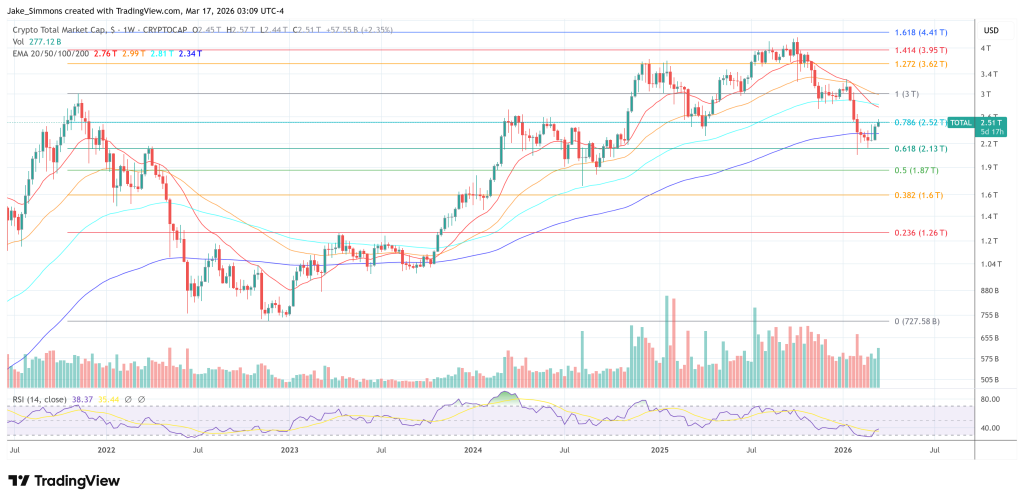
Total crypto market cap must reclaim the 0.786 Fib, 1-week chart | Source: TOTAL on TradingView.com

Related Questions

QWhat is the main change proposed by the SEC regarding Rule 15c2-11?

AThe SEC has proposed narrowing Exchange Act Rule 15c2-11 so that it applies only to equity securities, rather than having broader application to other asset classes like crypto.

QWhy is this proposal considered a significant shift for the crypto market?

AIt signals a more tailored regulatory approach, distinguishing crypto from traditional securities frameworks and reversing the previous posture of forcing crypto into existing rules designed for equities like penny stocks.

QHow did SEC Chairman Paul S. Atkins justify the proposed amendment?

AHe framed it as a matter of regulatory fit, stating that regulations should be appropriately tailored to the asset class they apply to, and that the proposal clarifies Rule 15c2-11 was always understood to apply to equity securities.

QWhat does Marty Bent suggest about the SEC's change in approach compared to the Gary Gensler era?

ABent argues this shifts from an enforcement-heavy approach that forced crypto into existing rules and then sued for non-compliance, to a posture that acknowledges these rules weren't built for crypto assets.

QWhat is the next step for this SEC proposal after its announcement?

AThe proposal will go through a standard public process with a 60-day comment period after being published in the Federal Register, leaving room for potential revisions.

Related Reads

Has Bitcoin Bottomed, or Is a 'Shakeout' Approaching? What's the Situation with XRP?

Cryptocurrency analytics platform Santiment shared key insights on Bitcoin and altcoin markets, highlighting significant signals from on-chain data. Analysis shows Bitcoin's 365-day MVRV ratio has fallen to -26%, indicating substantial losses for long-term holders, a level historically associated with market bottom formations and long-term buying opportunities. While short-term MVRV is near breakeven, suggesting no clear directional signal, the annual perspective points to a bottom before bullish cycles. On-chain data reveals divergent behavior: large wallets (10-10,000 BTC) have been accumulating, adding ~18,500 BTC in 10 days, while smaller retail investors continue buying dips. Analysts caution that high retail demand can sometimes create a risk of a final market shakeout or correction. The altcoin market shows a mixed picture. Ethereum's 365-day MVRV is around -33%, but recent monthly gains combined with overly optimistic social sentiment pose a short-term correction risk. XRP is in oversold territory with 30-day and 365-day MVRVs at -57.5% and -45.5% respectively, signaling potential for a strong mid-to-long term rebound. Social activity and optimism are rising for Solana, while investor sentiment remains calmer towards Cardano. Future direction for Bitcoin and altcoins depends not only on on-chain metrics but also on macroeconomic and regulatory developments. The Federal Reserve's interest rate decision and upcoming policy rulings are increasing market volatility expectations, while uncertainty around the U.S. Congressional clarity process continues to pressure pricing. *This is not investment advice.

cryptonews.ru12m ago

Has Bitcoin Bottomed, or Is a 'Shakeout' Approaching? What's the Situation with XRP?

cryptonews.ru12m ago

Bank of Korea Reveals Results of Tokenized Deposit Testing

The Bank of Korea has announced the results of its pilot test for tokenized deposits. Involving 28 central banks and international financial organizations, the project saw participation from major South Korean banks including KB Kookmin Bank, NH NongHyup Bank, Shinhan Bank, Woori Bank, and Hana Bank. Transactions, from payment orders to final settlement, were completed in real time, averaging just 80 seconds. The test involved 30 transactions across 17 different scenarios—such as corporate and interbank transfers—and was conducted in six currencies, including the Korean won, US dollar, and euro, with a total transaction value reaching approximately $995,000. The central bank reported that the platform operated stably throughout, despite being only partially connected to the existing banking infrastructure. Settlements using tokenized deposits were executed seamlessly, quickly, and transparently. An internal transfer of 20 million won (about $13,890) between NH NongHyup Bank and Shinhan Bank was also successfully processed via the Project Agora platform, which involved connecting to the Bank of Korea's CBDC test platform, Project Hangang. Additionally, KB Kookmin Bank and Japan's MUFG Bank tested cross-border payments using these deposit tokens—digital certificates issued by commercial banks within the pilot, not directly by the central bank. The Bank of Korea plans to continue testing payments with tokenized deposits. This follows last year's pledge by South Korean authorities to tighten regulations for won-based stablecoins, which will require approval from both the central bank and the Financial Services Commission.

cryptonews.ru2h ago

Bank of Korea Reveals Results of Tokenized Deposit Testing

cryptonews.ru2h ago

Trading

Spot
活动图片