Crypto Market Weekly Recap (12.08~12.14): Rate Cuts Support, Earnings Suppress, BTC Continues Narrow Fluctuations

marsbitPublished on 2025-12-15Last updated on 2025-12-15

Abstract

Summary of Crypto Market Review (Dec 08–Dec 14): Bitcoin experienced narrow-range volatility, with its price floor supported by the Fed’s 25 bps rate cut and short-term liquidity improvements, while upward momentum was capped by weaker-than-expected earnings from AI tech stocks like Oracle and Broadcom. Both BTC and ETH attempted to break their mid-term bearish trendlines but ultimately retreated. BTC closed at $88,171, down 2.47% for the week. Macro factors included a slightly dovish Fed stance emphasizing data dependency, though internal dissent and a higher long-term neutral rate outlook limited optimism. AI stock underperformance weighed on high-beta assets, shifting some capital toward consumer and cyclical equities. Liquidity improved but remained tight. Crypto-specific developments saw institutional accumulation, with Strategy adding over $900M in BTC and positive ETF/ETH ETF inflows exceeding $500M. However, long-term holder selling continued, with over 157k BTC sold. Regulatory progress included CFTC’s digital asset collateral pilot and bipartisan support for crypto structural legislation. The market remains in a consolidation phase, with direction dependent on upcoming U.S. CPI, jobs data, and the Bank of Japan’s rate decision. The EMC BTC Cycle Metrics indicator currently signals a bear market phase.

Author: 0xBrooker

The Federal Reserve's interest rate cuts and liquidity injection raised the price floor of BTC this week; disappointing earnings reports from AI tech stocks continued to squeeze the valuation of high-beta assets, suppressing BTC's upward momentum. Ultimately, after testing last week's highs, BTC continued its medium-term "bottom-seeking" trend.

ETH, which had experienced steeper declines earlier, showed a stronger rebound but eventually retreated along with the broader market.

Driven by the rate cuts and a slight improvement in short-term liquidity, both attempted to break through the descending trendline this week but ultimately failed, falling back within the upper bounds of the descending trendline.

Overall, BTC maintained its synchronized movement with the Nasdaq, awaiting the release of November's CPI and non-farm payroll data next week to provide direction for a market lacking trading catalysts, while also facing the impact of Japan's potential rate hike.

Policy, Macro Finance, and Economic Data

After a roller-coaster ride that severely impacted BTC's rally, the Federal Reserve's November meeting cut rates by 25 basis points to 3.50%~3.75% as expected. The Fed's statement emphasized: in the "balancing of dual mandate risks," downside risks on the employment side have increased, while inflation "remains slightly elevated"; future adjustments will depend on data, outlook, and risk balance to determine the "magnitude and timing of further adjustments." This indicates that, regarding its dual mandate, the Fed is currently slightly leaning toward the employment side.

This somewhat dovish statement was diluted by internal discord within the Fed—9 out of 12 voted in favor, while 3 opposed (1 advocated for a 50bp cut; 2 advocated for no cut).

The dot plot for 2026~2028 is significantly more dispersed, indicating disagreement on the balance between "sticky inflation vs. slowing employment"; the right-side "Longer run" dots are concentrated around 3% to slightly above 3%, suggesting a policy implication that the long-term neutral rate may be higher than pre-pandemic levels. This lowered the expected rate cuts for 2026 to 1~2 cuts totaling 50 basis points. This is a neutral guidance that may provide some support for employment but is insufficient to bolster high-beta assets in the current state.

To address short-term liquidity tightness, the Fed resumed short-term Treasury purchases. The press conference explained that, to maintain "ample reserves," it would conduct RMP (Reserve Management Purchases), with about $40 billion in the first month, and emphasized that RMP does not signal a change in monetary policy stance. The first purchase has already been completed.

After more than a month of valuation compression, high-beta assets represented by AI tech stocks have not stabilized. Earnings reports from Oracle and Broadcom this week further shook market confidence.

Following the stock price surge driven by Q3 spending expansion, the market is now more focused on the debt issues of AI stocks and whether high investments can quickly translate into profit growth. The earnings reports from these two companies delivered a "one-soft, one-hard" double blow, prompting the market to reassess the "AI return realization cycle," leading to AI-weighted stocks dragging down the Nasdaq and overall risk appetite. Both Nvidia and BTC lost their rebound gains, returning to this week's starting point.

The 10-year U.S. Treasury yield remains around 4.18%, suppressing long-duration assets.

Although the Fed has begun purchasing bonds and the Treasury's TGA account has started to decline due to spending, with SOFR returning to within the federal funds rate range, short-term liquidity is gradually easing out of tight conditions but remains insufficient. Amid doubts about AI stock debt and profit returns, there are signs of funds shifting from tech to consumer and cyclical stocks. Both the Dow Jones and Russell 2000 indices hit new highs this week.

Against the backdrop of unclear rate cut prospects for 2026 and the unresolved appointment of a new Fed chair, high-beta assets, including AI tech stocks and BTC, have yet to attract fund inflows. The most optimistic estimate is that the market might open a "Santa Claus rally" only after Japan's potential rate hike next week and the release of U.S. employment and inflation data.

Crypto Market

This week, BTC opened at $90,402.30 and closed at $88,171.61, down 2.47% with a 7.83% amplitude, and trading volume slightly decreased. Technically, BTC briefly broke through the descending trend channel before the rate cut but gave back all gains due to the impact of AI stock earnings.
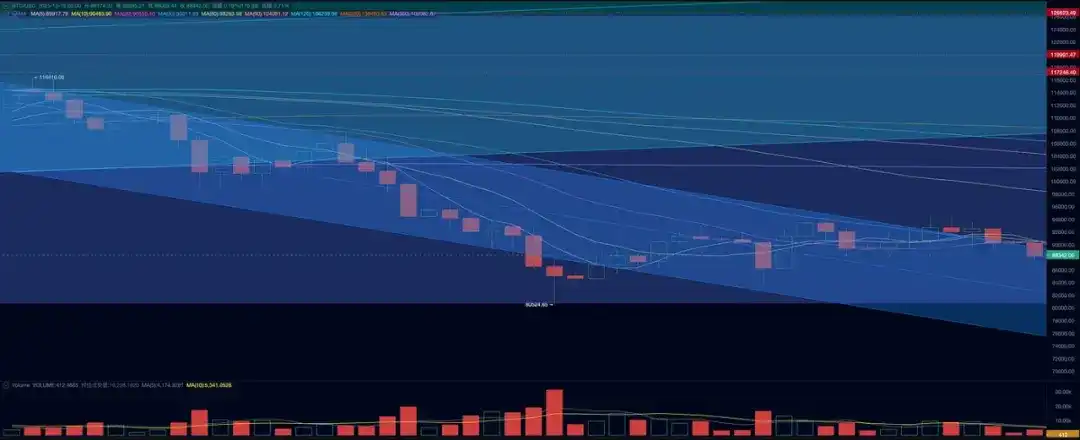
BTC Price Trend (Daily)

Currently, BTC is still in a consolidation phase after a sharp decline. Whether it will rebound upward with the stock market to usher in a "new cycle" or consolidate further and crash again to confirm the "old cycle" depends on the叠加 of internal and external factors and market reactions.

On the funding side, the situation is relatively optimistic. Available data show that inflows did not change significantly this week, but last week, Strategy increased its BTC holdings by over $900 million, and Bitmine also significantly increased its ETH holdings. This undoubtedly greatly boosted market confidence.
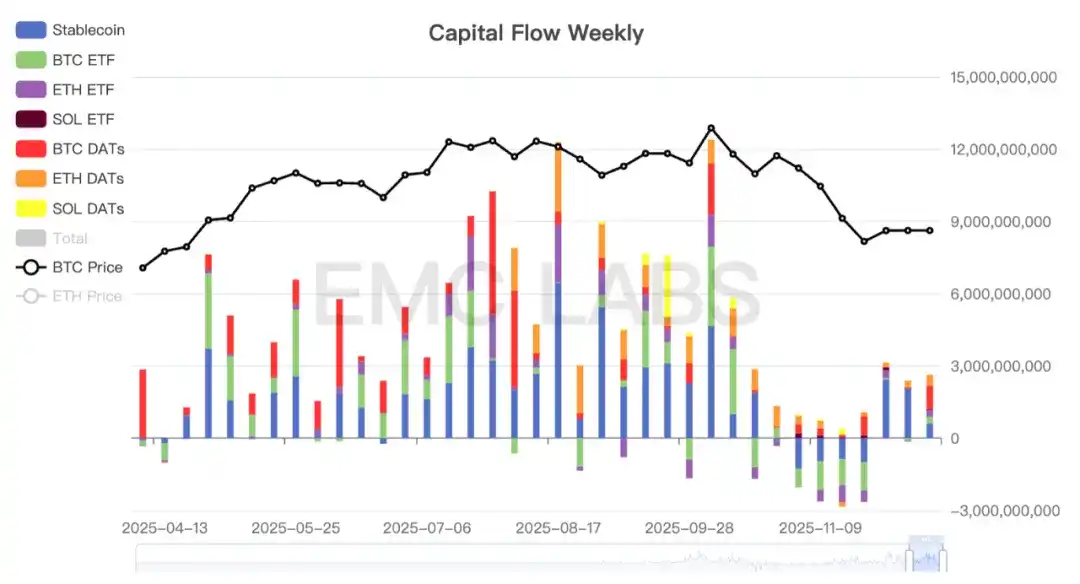
Crypto Market Fund Flows (Weekly)

Among them, the BTC ETF and ETH ETF channels, which have significant pricing power over crypto assets, both recorded positive inflows, totaling over $500 million.

On the selling side, the situation is slightly pessimistic. Last week, long and short hands collectively sold over 157,000 coins, exceeding the scale of the previous two weeks. As selling increased, exchange outflows also saw a slight decline.
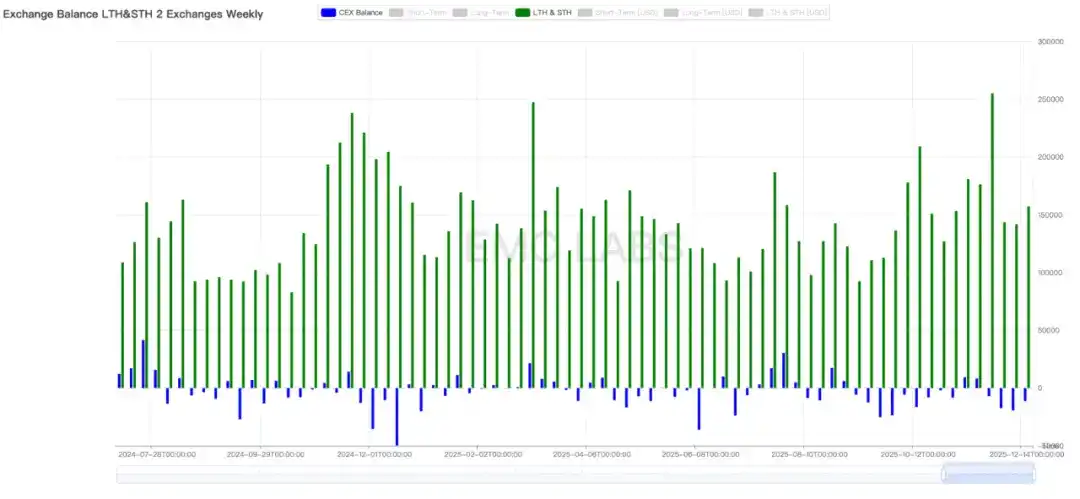
Exchange Selling and Inflow/Outflow Statistics (Weekly)

Moreover, the long-hand group continues to sell. The historical cycle curse still profoundly affects this group. If they do not return to accumulation, BTC prices may struggle to stabilize.

There are also positive developments at the industry level. The CFTC announced the launch of a digital asset pilot, allowing regulated derivative markets to use BTC, ETH, and USDC as collateral, accompanied by stricter monitoring and reporting mechanisms. This breakthrough in using crypto assets as collateral in derivative scenarios benefits the integration of DeFi and CeFi, expands Crypto's application scenarios, and is a long-term positive for Crypto. Additionally, the highly anticipated "structural solution" was reported to have made progress and received bipartisan support from Democrats and Republicans. The eventual passage of this bill would benefit the further development of the crypto industry in the U.S. and promote increased institutional allocation to crypto assets.

Cycle Indicators

According to eMerge Engine, the EMC BTC Cycle Metrics is at 0, entering a "downturn phase" (bear market).


Trending Cryptos

Related Questions

QWhat were the two main factors that influenced Bitcoin's price movement this week according to the article?

AThe Federal Reserve's interest rate cut and liquidity injection supported Bitcoin's price floor, while disappointing AI tech stock earnings reports suppressed its upside potential.

QHow did the Federal Reserve's policy decision and internal disagreement affect market expectations?

AThe Fed cut rates by 25 basis points but internal dissent (9/12 voted yes, with 3 against) and a dispersed dot plot for 2026-2028 indicated lack of consensus on inflation persistence versus employment slowdown, providing neutral guidance that didn't strongly support high-beta assets.

QWhat impact did AI tech stock earnings from Oracle and Broadcom have on the crypto market?

ATheir earnings reports raised concerns about AI companies' debt and profit realization timelines, causing a market repricing of 'AI return cycles' that dragged down Nasdaq and Bitcoin, erasing weekly gains.

QWhat were the contrasting signals from crypto market fund flows versus selling pressure this week?

AFund inflows remained stable with significant institutional buying (e.g., Strategy bought $900M+ BTC, ETFs saw $500M+ inflows), but selling pressure intensified with over 157,000 BTC sold by both short and long-term holders, exceeding the previous two weeks.

QWhat key developments in crypto regulation and infrastructure were highlighted as positive for the industry?

AThe CFTC launched a digital asset pilot allowing BTC, ETH, and USDC as collateral in regulated derivatives markets, and the 'structural proposal' gained bipartisan support, both seen as long-term positives for institutional adoption and crypto integration.

Related Reads

7 Months After the Collapse of Huiwang, Southeast Asia's Escrow Platforms Undergo a Major Reshuffle

Following the collapse of Huione Pay—dubbed the "Alipay of Southeast Asia"—seven months ago, the region's underground financial guarantee platform sector is undergoing a significant reshuffle. This power vacuum has been swiftly filled by emerging platforms such as XinBi, Tiger/Navigator, JinBei (renamed JinBo), Dali/Tiancheng, and FullyLight. These platforms, operating largely via Telegram and offering services like escrow for illicit transactions, have absorbed the vast user base and markets left behind by Huione. While positioning themselves as "trust intermediaries," their primary clientele consists of networks involved in online scams, money laundering, illegal gambling, and even human trafficking. For instance, the Tiger/Navigator platform explicitly provides "escrow" services for kidnapping-for-ransom operations ("强押车交易"). Data underscores the immense scale: Huione alone processed over $103 billion in cryptocurrency payments and facilitated over $31 billion through its escrow market before its downfall, linking it to Cambodia's notorious Prince Group. Since its collapse, competitors have seen explosive growth. For example, the XinBi platform has accumulated over $1.6 billion in total USDT revenue, while platforms like NewPay, OkPay (under Dali), and FullyLight Wallet collectively processed over $4.8 billion in USDT in a single year. This ecosystem thrives in regions like Cambodia and Myanmar, where regulatory gaps allow these platforms to act as critical financial infrastructure for sprawling cybercrime industries, from scam compounds to online casinos. The article concludes that the moniker "Southeast Asian Alipay" is a misnomer, obscuring the platforms' fundamental role in enabling serious criminal enterprises rather than representing legitimate financial innovation.

Odaily星球日报6m ago

7 Months After the Collapse of Huiwang, Southeast Asia's Escrow Platforms Undergo a Major Reshuffle

Odaily星球日报6m ago

The Changing Landscape: What Are Crypto VCs Experiencing?

Title: The Shifting Landscape of Crypto Venture Capital The era of dedicated crypto venture capital funds is undergoing a significant transformation. Once essential for navigating the sector's complexity and high risk, these specialized funds are now facing an identity crisis as the market matures. This shift mirrors historical patterns in other specialized investment classes like cleantech and SPACs, where initial information advantages dissipate as technologies become mainstream and integrated into existing industry frameworks. The article argues that crypto is reaching a critical inflection point, transitioning from a "building phase" to an "integration phase." Major players like Stripe, BlackRock, and Visa now engage with crypto not for its novel mechanics but as a foundational financial infrastructure. Their needs—regulatory compliance, banking partnerships, distribution channels—align with traditional fintech, a domain easily understood by large, generalist funds like Sequoia and Founders Fund. This evolution creates a "barbell effect" within the VC landscape. On one end are massive, diversified platforms that can incorporate crypto as one vertical among many. On the other are small, nimble funds focused on niche, experimental projects. The middle ground—medium-sized dedicated crypto funds—is being squeezed out. Their typical fund size makes it impossible to generate sufficient returns solely from early-stage crypto bets, yet they cannot compete with giants for later-stage deals. Consequently, leading crypto-native firms like Paradigm and Framework Ventures are expanding into AI, robotics, and other sectors, driven partly by LP pressure for better returns amid a broader VC DPI crisis. Others, like Dragonfly and a16z, have narrowed their crypto focus predominantly to financial infrastructure like stablecoins, reframing the sector's core narrative. For crypto entrepreneurs, this consolidation presents challenges. While generalist funds offer larger checks and broader resources, crypto projects now compete fiercely with AI for attention and capital within these firms. Furthermore, the long-term, non-commercial foundational work that built the ecosystem—funded by dedicated crypto VCs—is less likely to attract generalist capital focused on direct returns. The conclusion is that "crypto investor" as a standalone category is becoming obsolete, akin to "internet investor." Crypto is becoming a baseline infrastructure layer. The future will see a barbell structure: large-scale growth financing handled by generalist funds, while pioneering, speculative projects are funded by small, specialized vehicles. The dedicated crypto funds of the 2017-2021 boom, which incubated core infrastructure, are giving way to this new, bifurcated reality.

Foresight News24m ago

The Changing Landscape: What Are Crypto VCs Experiencing?

Foresight News24m ago

As Consensus Accelerates, What Are Young Investors Betting On?

Title: As Consensus Forms Faster, What Are Young Investors Betting On? In the rapid evolution of tech investment, a new generation of young investors is navigating a landscape where AI, robotics, commercial aerospace, and quantum computing are advancing simultaneously. Traditional investment logic based on financial models is giving way to a need for deep technical understanding and the ability to act before industry consensus forms. An analysis of trends from the "WAIC FUTURE TECH" list of young investment leaders reveals key shifts in focus. The first major trend is the movement of AI from the digital screen into the physical world. Investment is shifting from large language models and chatbots towards embodied AI, robotics, AI hardware, and edge computing. While demonstrations generate excitement, the real challenge lies in achieving scalable, reliable, and cost-effective delivery in complex real-world environments like factories and logistics. Success depends not just on algorithms but on the integration of sensors, actuators, and control systems. Second, the competitive focus for large models is moving beyond raw capability toward building an "intelligence flywheel." The goal is to create self-reinforcing systems where user interaction generates data, improving the model, which in turn enhances the user experience and attracts more engagement. Companies that successfully embed AI into workflows to create these closed-loop systems can build lasting value that isn't easily erased by the next model upgrade. Third, facing a potential bottleneck in high-quality human-generated data, investors are looking at new underlying technologies. Reinforcement learning and self-play, as demonstrated by AlphaGo Zero, offer paths for AI to generate its own experience. Scientific foundation models, which aim to build general AI capabilities for fields like life sciences and materials discovery, represent a non-consensus direction that could unlock new frontiers of knowledge and data. Finally, in deep-tech areas like quantum computing, commercial aerospace, and space-based infrastructure, patient capital is essential. These fields have long, uncertain development and validation cycles involving complex engineering, supply chains, and regulations. Investment here requires a long-term view, focusing on foundational team capabilities and the eventual emergence of market demand, even if commercial returns are distant. Collectively, these trends illustrate how young investors are adapting to a new era. They are learning to make earlier, technically-informed judgments, balance hype with real-world viability, and provide the patient capital needed to build the deep-tech foundations of the future.

marsbit51m ago

As Consensus Accelerates, What Are Young Investors Betting On?

marsbit51m ago

Trading

Spot

Hot Articles

What is $BITCOIN

DIGITAL GOLD ($BITCOIN): A Comprehensive Analysis Introduction to DIGITAL GOLD ($BITCOIN) DIGITAL GOLD ($BITCOIN) is a blockchain-based project operating on the Solana network, which aims to combine the characteristics of traditional precious metals with the innovation of decentralized technologies. While it shares a name with Bitcoin, often referred to as “digital gold” due to its perception as a store of value, DIGITAL GOLD is a separate token designed to create a unique ecosystem within the Web3 landscape. Its goal is to position itself as a viable alternative digital asset, although specifics regarding its applications and functionalities are still developing. What is DIGITAL GOLD ($BITCOIN)? DIGITAL GOLD ($BITCOIN) is a cryptocurrency token explicitly designed for use on the Solana blockchain. In contrast to Bitcoin, which provides a widely recognized value storage role, this token appears to focus on broader applications and characteristics. Notable aspects include: Blockchain Infrastructure: The token is built on the Solana blockchain, known for its capacity to handle high-speed and low-cost transactions. Supply Dynamics: DIGITAL GOLD has a maximum supply capped at 100 quadrillion tokens (100P $BITCOIN), although details regarding its circulating supply are currently undisclosed. Utility: While precise functionalities are not explicitly outlined, there are indications that the token could be utilized for various applications, potentially involving decentralized applications (dApps) or asset tokenization strategies. Who is the Creator of DIGITAL GOLD ($BITCOIN)? At present, the identity of the creators and development team behind DIGITAL GOLD ($BITCOIN) remains unknown. This situation is typical among many innovative projects within the blockchain space, particularly those aligning with decentralized finance and meme coin phenomena. While such anonymity may foster a community-driven culture, it intensifies concerns about governance and accountability. Who are the Investors of DIGITAL GOLD ($BITCOIN)? The available information indicates that DIGITAL GOLD ($BITCOIN) does not have any known institutional backers or prominent venture capital investments. The project seems to operate on a peer-to-peer model focused on community support and adoption rather than traditional funding routes. Its activity and liquidity are primarily situated on decentralized exchanges (DEXs), such as PumpSwap, rather than established centralized trading platforms, further highlighting its grassroots approach. How DIGITAL GOLD ($BITCOIN) Works The operational mechanics of DIGITAL GOLD ($BITCOIN) can be elaborated on based on its blockchain design and network attributes: Consensus Mechanism: By leveraging Solana’s unique proof-of-history (PoH) combined with a proof-of-stake (PoS) model, the project ensures efficient transaction validation contributing to the network's high performance. Tokenomics: While specific deflationary mechanisms have not been extensively detailed, the vast maximum token supply implies that it may cater to microtransactions or niche use cases that are still to be defined. Interoperability: There exists the potential for integration with Solana’s broader ecosystem, including various decentralized finance (DeFi) platforms. However, the details regarding specific integrations remain unspecified. Timeline of Key Events Here is a timeline that highlights significant milestones concerning DIGITAL GOLD ($BITCOIN): 2023: The initial deployment of the token occurs on the Solana blockchain, marked by its contract address. 2024: DIGITAL GOLD gains visibility as it becomes available for trading on decentralized exchanges like PumpSwap, allowing users to trade it against SOL. 2025: The project witnesses sporadic trading activity and potential interest in community-led engagements, although no noteworthy partnerships or technical advancements have been documented as of yet. Critical Analysis Strengths Scalability: The underlying Solana infrastructure supports high transaction volumes, which could enhance the utility of $BITCOIN in various transaction scenarios. Accessibility: The potential low trading price per token could attract retail investors, facilitating wider participation due to fractional ownership opportunities. Risks Lack of Transparency: The absence of publicly known backers, developers, or an audit process may yield skepticism regarding the project's sustainability and trustworthiness. Market Volatility: The trading activity is heavily reliant on speculative behavior, which can result in significant price volatility and uncertainty for investors. Conclusion DIGITAL GOLD ($BITCOIN) emerges as an intriguing yet ambiguous project within the rapidly evolving Solana ecosystem. While it attempts to leverage the “digital gold” narrative, its departure from Bitcoin's established role as a store of value underscores the need for a clearer differentiation of its intended utility and governance structure. Future acceptance and adoption will likely depend on addressing the current opacity and defining its operational and economic strategies more explicitly. Note: This report encompasses synthesised information available as of October 2023, and developments may have transpired beyond the research period.

972 Total ViewsPublished 2025.05.13Updated 2025.05.13

What is $BITCOIN

Discussions

Welcome to the HTX Community. Here, you can stay informed about the latest platform developments and gain access to professional market insights. Users' opinions on the price of BTC (BTC) are presented below.

活动图片














