Crypto Market Infrastructure Is Unprecedentedly Perfect, So Why Has the Investment Environment Hit Rock Bottom?

比推Published on 2026-01-28Last updated on 2026-01-28

Abstract

The crypto market infrastructure and regulatory environment are more robust than ever, yet the investment climate is arguably at its worst. Arca CIO Jeff Dorman critiques the industry's failed attempt to position cryptocurrencies as broad macro trading tools, which has led to extreme correlation among all crypto assets, eroding differentiation. While assets like gold and silver have recently outperformed Bitcoin, the industry continues to neglect token subtypes that function like equities—such as DePIN, DeFi, and CeFi tokens—which generate actual cash flows and could appeal to traditional investors managing over $600 trillion in assets. Dorman calls for a return to fundamental analysis, emphasizing that tokens are merely a "wrapper" and that their underlying value drivers, sectors, and economic models should be the focus, rather than treating all cryptocurrencies as a single asset class. The current high correlation and lack of dispersion in returns have made the investment landscape dull compared to the healthier, more nuanced market of 2020-2021.

Author: Jeff Dorman (Arca CIO)

Compiled by: Deep Tide TechFlow

Original title: The Crypto Market Five Years Ago Was Actually Healthier Than Now


Deep Tide Introduction:

Is the crypto market becoming increasingly dull? Arca Chief Investment Officer Jeff Dorman writes that although infrastructure and regulatory environments have never been stronger, the current investment environment is the "worst in history."

He sharply criticizes industry leaders' failed attempts to forcibly transform cryptocurrencies into "macro trading tools," leading to extreme convergence in correlations among various assets. Dorman calls for a return to the essence of "tokens as securities packaging," focusing on equity-like assets such as DePIN and DeFi that have cash flow generation capabilities.

At a time when gold is surging while Bitcoin is relatively weak, this in-depth reflective article provides an important perspective for re-examining Web3 investment logic.

Full text below:

Bitcoin is facing an unfortunate situation

Most investment debates exist because people are on different time horizons, so they often "talk past each other," even though technically both sides are correct. Take the debate between gold and Bitcoin as an example: Bitcoin enthusiasts tend to say that Bitcoin is the best investment because its performance over the past 10 years has far exceeded that of gold.
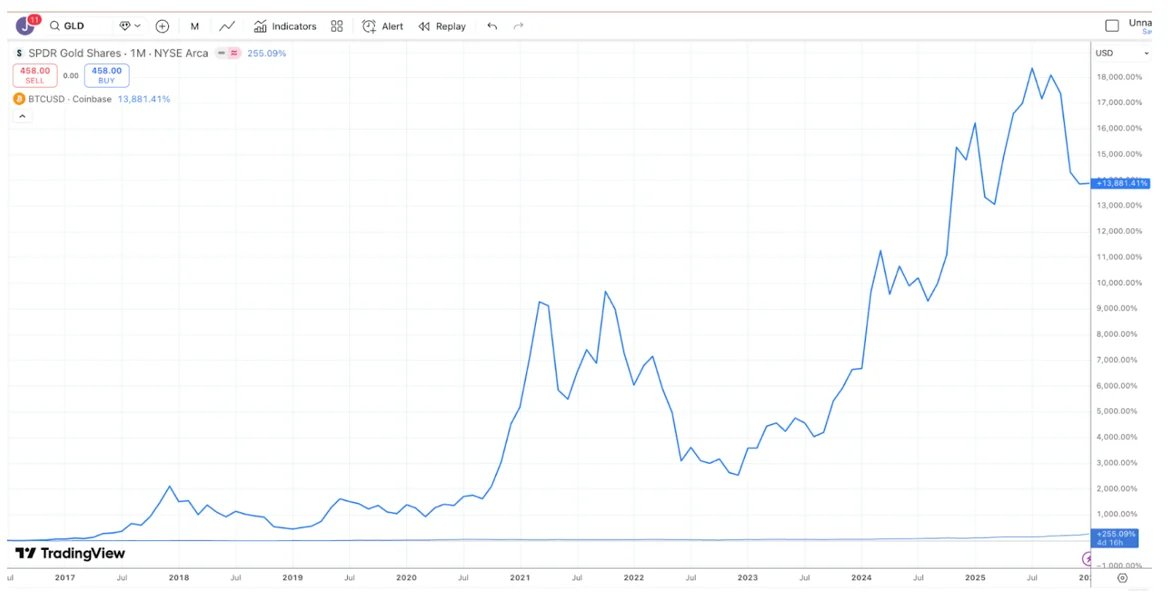
Caption: Source TradingView, comparison of Bitcoin (BTC) vs. gold (GLD) returns over the past 10 years

Gold investors, on the other hand, tend to believe that gold is the best investment and have recently been "mocking" Bitcoin's weakness, as gold has significantly outperformed Bitcoin over the past year (the same goes for silver and copper).
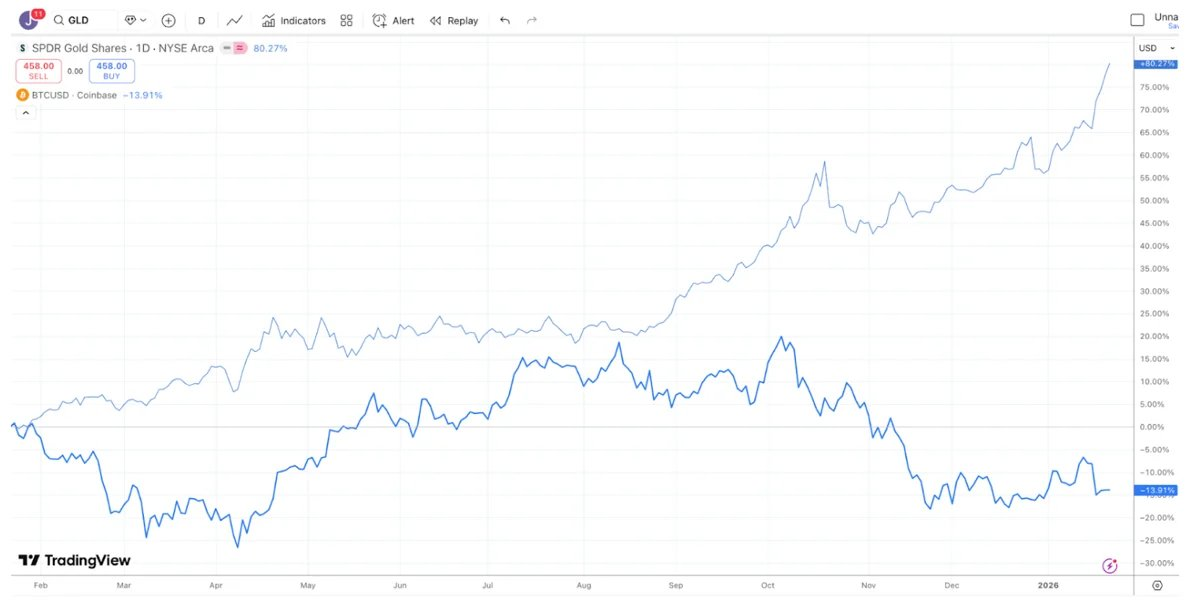
Caption: Source TradingView, comparison of Bitcoin (BTC) vs. gold (GLD) returns over the past 1 year

Meanwhile, over the past 5 years, the returns of gold and Bitcoin have been almost identical. Gold tends to do nothing for long periods, then skyrocket when central banks and trend followers buy; Bitcoin tends to have sharp rallies followed by significant crashes but ultimately moves higher.
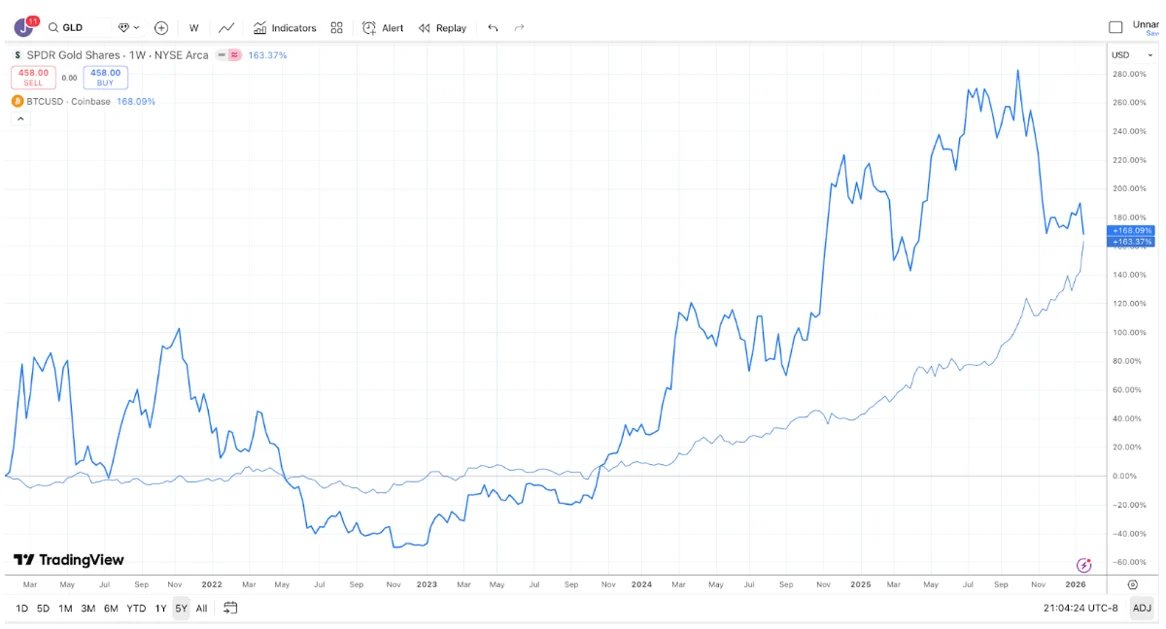
Caption: Source TradingView, comparison of Bitcoin (BTC) vs. gold (GLD) returns over the past 5 years

Therefore, depending on your investment horizon, you can almost win or lose any argument about Bitcoin vs. gold.

Even so, it's undeniable that recently gold (and silver) have shown strength relative to Bitcoin. To some extent, this is somewhat ironic (or pathetic). The largest companies in the crypto industry have spent the past 10 years trying to cater to macro investors rather than true fundamental investors, and now these macro investors are saying, "Never mind, we'll just buy gold, silver, and copper instead." We have long called for a shift in the industry's thinking. There are over $600 trillion in entrusted assets, and the buyers of these assets are a much stickier investor base. There are many digital assets that look more like bonds and stocks, issued by companies that generate revenue and conduct token buybacks, yet market leaders have, for some reason, decided to ignore this token sub-sector.

Perhaps Bitcoin's recent poor performance relative to precious metals will be enough for large brokers, exchanges, asset managers, and other crypto leaders to realize that their attempt to turn cryptocurrencies into an all-encompassing macro trading tool has failed. Instead, they might start focusing on and educating that $600 trillion pool of investors who prefer to buy cash-flow generating assets. It's not too late for the industry to start paying attention to those quasi-equity tokens that carry cash-flow generating tech businesses (like various DePIN, CeFi, DeFi, and token issuance platform companies).

Then again, if you just keep moving the "finish line," Bitcoin is still king. So, more likely than not, nothing will change.

Asset Differentiation

The "good old days" of crypto investing seem like a thing of the past. Back in 2020 and 2021, it seemed like every month brought a new narrative, sector, use case, and new type of token, with positive returns coming from all corners of the market. Although the growth engines of blockchain have never been stronger (thanks to legislative progress in Washington, stablecoin growth, DeFi, and RWA tokenization), the investment environment has never been worse.

A sign of market health is dispersion and low cross-market correlation. You want healthcare and defense stocks to move differently from tech and AI stocks; you want emerging market stocks to move independently of developed markets. Dispersion is generally seen as a good thing.

2020 and 2021 are largely remembered as "everything goes up" markets, but that wasn't entirely true. It was rare to see the entire market move in lockstep. More commonly, one sector would rise while another fell. Gaming surged while DeFi might have been falling; DeFi surged while "Dino" L1 tokens fell; Layer-1s surged while the Web3 sector fell. A diversified crypto portfolio actually smoothed returns and often lowered the overall portfolio's beta and correlation. Liquidity came and went as interest and demand shifted, but performance was diverse. This was very exciting. The massive inflow into crypto hedge funds in 2020 and 2021 made sense because the investable universe was expanding and returns were differentiated.

Fast forward to today, and the returns of all "crypto-wrapped" assets look identical. Since the flash crash on October 10th, the declines across sectors are almost indistinguishable. No matter what you hold, or how the token captures economic value, or what the project's trajectory is... the returns are largely the same. This is very frustrating.
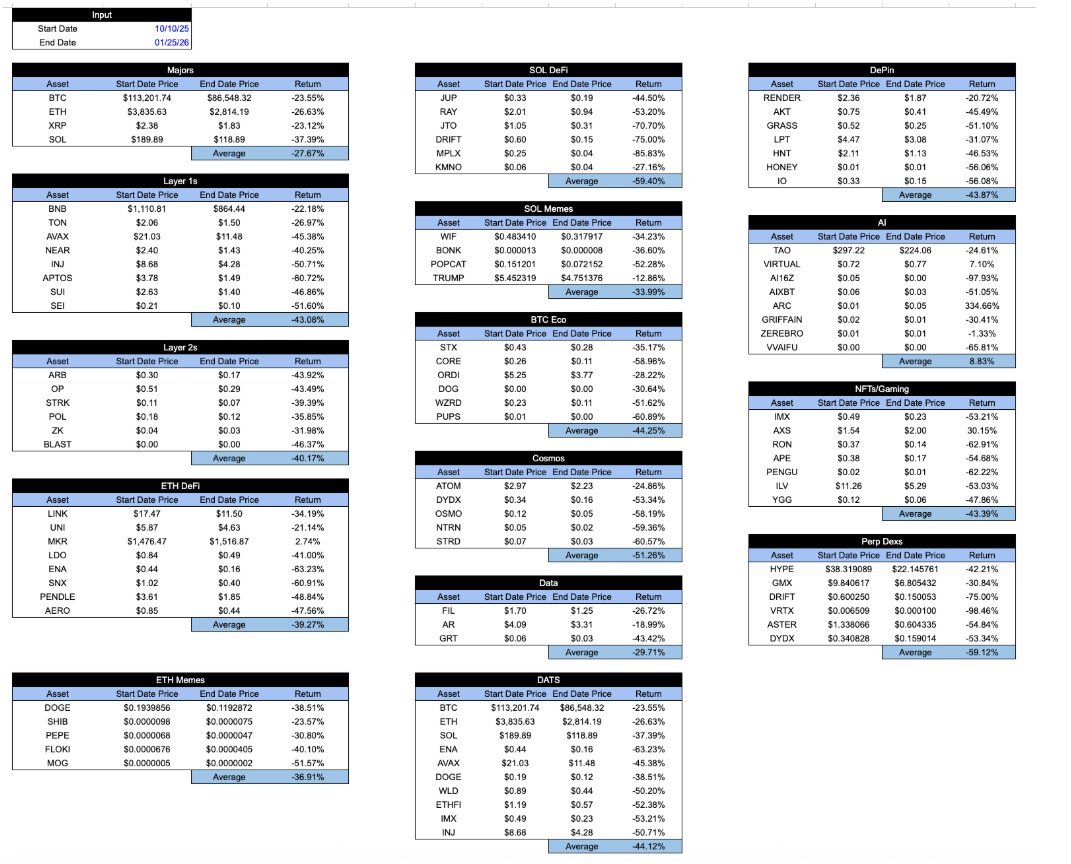
Caption: Arca internal calculations and CoinGecko API data for a sample of representative crypto assets

During market booms, this table looks slightly more encouraging. "Good" tokens tend to outperform "bad" tokens. But a healthy system should actually be the opposite: you want good tokens to perform better during bad times, not just during good times. Here is the same table from the low on April 7th to the high on September 15th.
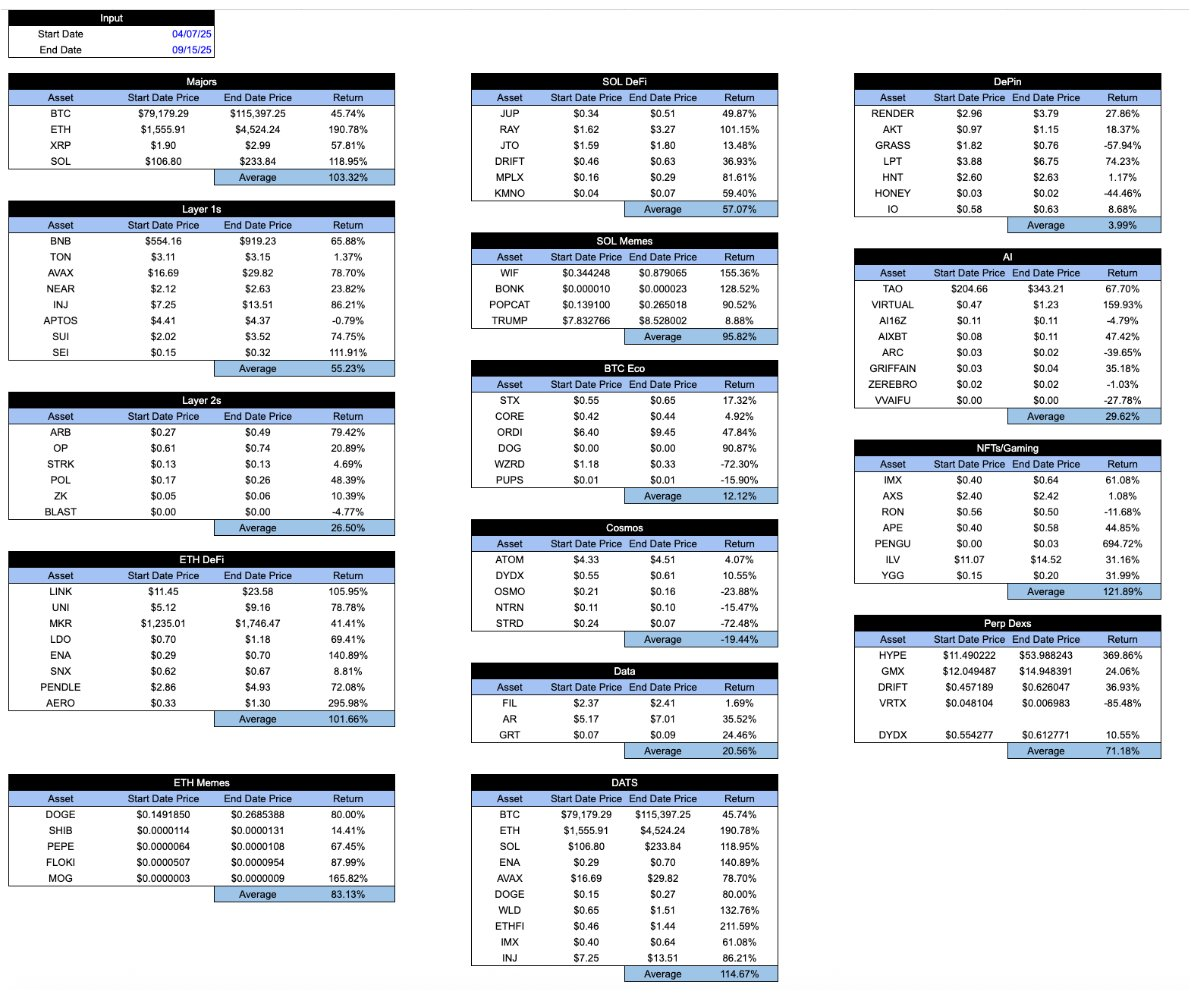
Caption: Arca internal calculations and CoinGecko API data for a sample of representative crypto assets

Interestingly, when the crypto industry was in its infancy, market participants worked very hard to differentiate between different types of crypto assets. For example, I published an article in 2018 where I categorized crypto assets into 4 types:

  1. Cryptocurrencies/money

  2. Decentralized protocols/platforms

  3. Asset-backed tokens

  4. Pass-through securities

At the time, this classification method was quite unique and attracted many investors. Importantly, crypto assets were evolving, from just Bitcoin, to smart contract protocols, asset-backed stablecoins, to equity-like pass-through securities. Researching different growth areas was a major source of alpha, and investors wanted to understand the various valuation techniques required to assess different asset types. Most crypto investors back then didn't even know when unemployment data was released or when FOMC meetings were held, and rarely looked to macro data for signals.

After the 2022 crash, these different types of assets still exist. Nothing has fundamentally changed. But there has been a huge change in how the industry markets itself. The "gatekeepers" decided that Bitcoin and stablecoins were the only things that mattered; the media decided they didn't want to write about anything except TRUMP tokens and other memecoins. Over the past few years, not only has Bitcoin outperformed most other crypto assets, but many investors have even forgotten these other asset types (and sectors) exist. The business models of the underlying companies and protocols haven't become less relevant, but the assets themselves have become more correlated due to investor flight and market makers dominating price action.

This is why Matt Levine's recent article about tokens was so surprising and well-received. In just 4 short paragraphs, Levine accurately described the differences and nuances between various tokens. It gives me some hope that this kind of analysis is still possible.
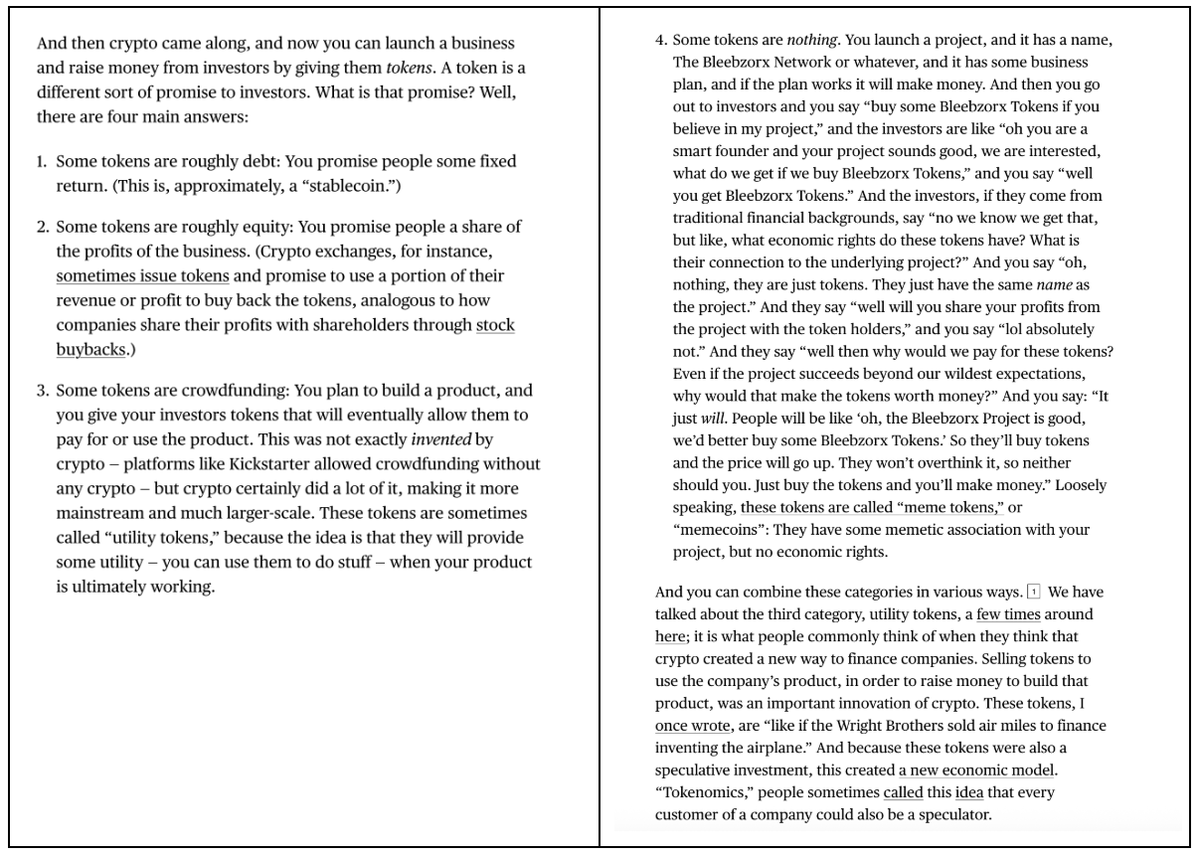
The leading crypto exchanges, asset managers, market makers, OTC desks, and pricing services still call everything besides Bitcoin an "altcoin" and seem to only write macro research, bundling all "cryptocurrencies" together as one giant asset. Take Coinbase, for example – they seem to have only a very small research team led by one primary analyst (David Duong) whose focus is primarily on macro research. I have nothing against Mr. Bitcoin (Mr. Duong) – his analysis is excellent. But who goes to Coinbase specifically for macro analysis?

Imagine if leading ETF providers and exchanges only wrote generically about ETFs, saying things like "ETFs are down today!" or "ETFs react negatively to inflation data." They would be laughed out of business. Not all ETFs are the same just because they use the same "wrapper," and those selling and promoting ETFs understand this. What's inside the ETF matters most, and investors seem to be able to intelligently differentiate between ETFs, mainly because industry leaders help their clients understand this.

Similarly, a token is just a "wrapper." As Matt Levine eloquently described, what's inside the token matters. The type of token matters, the sector matters, its properties (inflationary or amortizing) matter.

Perhaps Levine isn't the only one who understands this. But he does a better job explaining the industry than those who actually profit from it.


Twitter:https://twitter.com/BitpushNewsCN

Bitpush TG Discussion Group:https://t.me/BitPushCommunity

Bitpush TG Subscription: https://t.me/bitpush

Original link:https://www.bitpush.news/articles/7606655

Trending Cryptos

Related Questions

QWhy does the author believe the current crypto investment environment is the 'worst ever' despite strong infrastructure and regulation?

AThe author believes the investment environment is poor because all crypto assets have become highly correlated and move in lockstep, eliminating dispersion and differentiation. Market leaders have focused excessively on marketing crypto as a macro tool rather than educating investors about fundamental differences between asset types, causing a loss of alpha opportunities and making diversified portfolios ineffective.

QWhat is the main criticism the author has against crypto industry's attempt to appeal to macro investors?

AThe main criticism is that the industry's attempt to position crypto as a broad macro trading tool has failed, as macro investors are instead choosing traditional assets like gold and silver. The author argues the industry should instead focus on educating the massive $600 trillion pool of investors who prefer cash-flow generating, quasi-equity tokens that resemble stocks and bonds.

QHow does the author contrast the market behavior of 2020-2021 with the current market?

AIn 2020-2021, the market had healthy dispersion where different sectors (e.g., Gaming, DeFi, Layer-1s) moved independently, allowing for diversified portfolios to smooth returns. Today, all crypto assets are highly correlated and move uniformly, regardless of their fundamentals or value capture mechanisms, making the market monotonous and frustrating for investors.

QWhat does the author suggest is the key to improving the investment landscape for crypto assets?

AThe author suggests returning to the essence of tokens as 'securities wrappers' and focusing on fundamental analysis of what is inside the token—such as cash-flow generating businesses in DePIN, DeFi, or token issuance platforms—rather than treating all crypto as a homogeneous macro asset. Industry leaders should educate investors on these nuances.

QWhy does the author reference Matt Levine's article on tokens?

AThe author references Matt Levine's article because it accurately describes the differences and nuances between various token types in just a few paragraphs, highlighting that what matters is the content inside the token wrapper. This gives hope that nuanced analysis is still possible and needed, contrasting with the industry's current homogenized approach.

Related Reads

As Consensus Accelerates, What Are Young Investors Betting On?

Title: As Consensus Forms Faster, What Are Young Investors Betting On? In the rapid evolution of tech investment, a new generation of young investors is navigating a landscape where AI, robotics, commercial aerospace, and quantum computing are advancing simultaneously. Traditional investment logic based on financial models is giving way to a need for deep technical understanding and the ability to act before industry consensus forms. An analysis of trends from the "WAIC FUTURE TECH" list of young investment leaders reveals key shifts in focus. The first major trend is the movement of AI from the digital screen into the physical world. Investment is shifting from large language models and chatbots towards embodied AI, robotics, AI hardware, and edge computing. While demonstrations generate excitement, the real challenge lies in achieving scalable, reliable, and cost-effective delivery in complex real-world environments like factories and logistics. Success depends not just on algorithms but on the integration of sensors, actuators, and control systems. Second, the competitive focus for large models is moving beyond raw capability toward building an "intelligence flywheel." The goal is to create self-reinforcing systems where user interaction generates data, improving the model, which in turn enhances the user experience and attracts more engagement. Companies that successfully embed AI into workflows to create these closed-loop systems can build lasting value that isn't easily erased by the next model upgrade. Third, facing a potential bottleneck in high-quality human-generated data, investors are looking at new underlying technologies. Reinforcement learning and self-play, as demonstrated by AlphaGo Zero, offer paths for AI to generate its own experience. Scientific foundation models, which aim to build general AI capabilities for fields like life sciences and materials discovery, represent a non-consensus direction that could unlock new frontiers of knowledge and data. Finally, in deep-tech areas like quantum computing, commercial aerospace, and space-based infrastructure, patient capital is essential. These fields have long, uncertain development and validation cycles involving complex engineering, supply chains, and regulations. Investment here requires a long-term view, focusing on foundational team capabilities and the eventual emergence of market demand, even if commercial returns are distant. Collectively, these trends illustrate how young investors are adapting to a new era. They are learning to make earlier, technically-informed judgments, balance hype with real-world viability, and provide the patient capital needed to build the deep-tech foundations of the future.

marsbit29m ago

As Consensus Accelerates, What Are Young Investors Betting On?

marsbit29m ago

Can Japan Buy Growth with AI? Will the Bond Market Believe It?

Japan's cabinet has introduced the 2026 Basic Policy on Economic and Fiscal Management and Reform, shifting its primary fiscal target. The new framework moves away from the traditional annual primary balance goal and instead prioritizes a stable reduction of the debt-to-GDP ratio. This change is tied to a strategy of increased "responsible proactive fiscal" spending, aiming to boost long-term growth through investments in strategic sectors like AI, semiconductors, energy, and robotics. The government estimates total public and private investment in 62 key technologies could exceed 370 trillion yen by 2040. The market reaction has been mixed and cautious. While equity markets may respond to policy signals, bond markets are focused on fiscal credibility. Concerns center on whether the weakening of the clear primary balance anchor could lead to looser fiscal discipline. If investors doubt that these strategic investments will generate sufficient productivity gains, tax revenue, and nominal growth to outpace rising interest costs, they may demand higher yields on Japanese Government Bonds (JGBs). Recent volatility in the yen and JGB yields, with the 10-year yield briefly reaching 2.9%, reflects this skepticism. The success of this new framework hinges on two factors: whether Japan can achieve a nominal growth rate consistently higher than its long-term interest rates, and whether future budgets demonstrate disciplined control over bond issuance. The government's narrative is that strategic investment is essential to break Japan's cycle of low growth, aging, and labor shortages. However, the bond market will continuously assess the credibility of this plan, pricing the risk that it may represent fiscal expansion rather than a viable growth strategy.

marsbit1h ago

Can Japan Buy Growth with AI? Will the Bond Market Believe It?

marsbit1h ago

Misjudged A-Shares: Resilience, Expectations, and Confidence

China's A-share market recently faced selling pressure, especially in tech sectors, initially triggered by a global tech sell-off that began in South Korea. However, the article argues this is a case of "mistaken injury" and highlights the market's underlying resilience. This resilience stems from three main pillars: **1) Tech Sector Fundamentals:** Unlike Korea's market dominated by a few memory chip stocks, China's tech sector is diversified across computing, communications, electronics, and semiconductors, supported by dual narratives of global AI supply chains and domestic substitution. Core areas like optical modules and fiber optics continue to show strong earnings growth. **2) "National Team" Support:** State-backed institutions and large corporations have made significant market purchases and announced buybacks, providing liquidity and signaling confidence. This is seen as a stabilizing policy signal, often associated with market bottoms. **3) Broader Market Pillars:** Other major sectors are showing endogenous recovery momentum. Consumer stocks benefit from stabilizing CPI and signs of sector recovery (e.g., liquor price hikes). Cyclical sectors like aluminum have high earnings, potential price increases due to tight supply, and low valuations. The financial sector offers stable dividends and low valuations. The conclusion is that the sell-off was driven by external contagion, not a collapse in fundamentals. With strong policy support and recovering momentum across key sectors, the A-share market possesses the toughness to regain stability.

marsbit1h ago

Misjudged A-Shares: Resilience, Expectations, and Confidence

marsbit1h ago

Trading

Spot

Hot Articles

How to Buy ROCK

Welcome to HTX.com! We've made purchasing Rock Dao (ROCK) simple and convenient. Follow our step-by-step guide to embark on your crypto journey.Step 1: Create Your HTX AccountUse your email or phone number to sign up for a free account on HTX. Experience a hassle-free registration journey and unlock all features.Get My AccountStep 2: Go to Buy Crypto and Choose Your Payment MethodCredit/Debit Card: Use your Visa or Mastercard to buy Rock Dao (ROCK) instantly.Balance: Use funds from your HTX account balance to trade seamlessly.Third Parties: We've added popular payment methods such as Google Pay and Apple Pay to enhance convenience.P2P: Trade directly with other users on HTX.Over-the-Counter (OTC): We offer tailor-made services and competitive exchange rates for traders.Step 3: Store Your Rock Dao (ROCK)After purchasing your Rock Dao (ROCK), store it in your HTX account. Alternatively, you can send it elsewhere via blockchain transfer or use it to trade other cryptocurrencies.Step 4: Trade Rock Dao (ROCK)Easily trade Rock Dao (ROCK) on HTX's spot market. Simply access your account, select your trading pair, execute your trades, and monitor in real-time. We offer a user-friendly experience for both beginners and seasoned traders.

3.5k Total ViewsPublished 2024.03.29Updated 2026.06.02

How to Buy ROCK

Discussions

Welcome to the HTX Community. Here, you can stay informed about the latest platform developments and gain access to professional market insights. Users' opinions on the price of ROCK (ROCK) are presented below.

活动图片













