Crypto losses near $3.4B as hackers went ‘big game hunting’

cointelegraphPublished on 2025-12-18Last updated on 2025-12-18

Crypto hackers focused on large crypto entities and personal crypto wallets this year, resulting in $3.4 billion in crypto losses in 2025 — the highest figure since 2022.

Just three hacks in 2025, led by the $1.4 billion hack of crypto exchange Bybit, accounted for 69% of all losses from January through to early December, a Chainalysis report released on Thursday found, with the largest attacks a thousand times larger than the typical incident.

Andrew Fierman, the head of national security intelligence at Chainalysis, told Cointelegraph that while massive attacks drove this year’s uptick in losses, it’s unclear if 2026 will unfold in the same way.
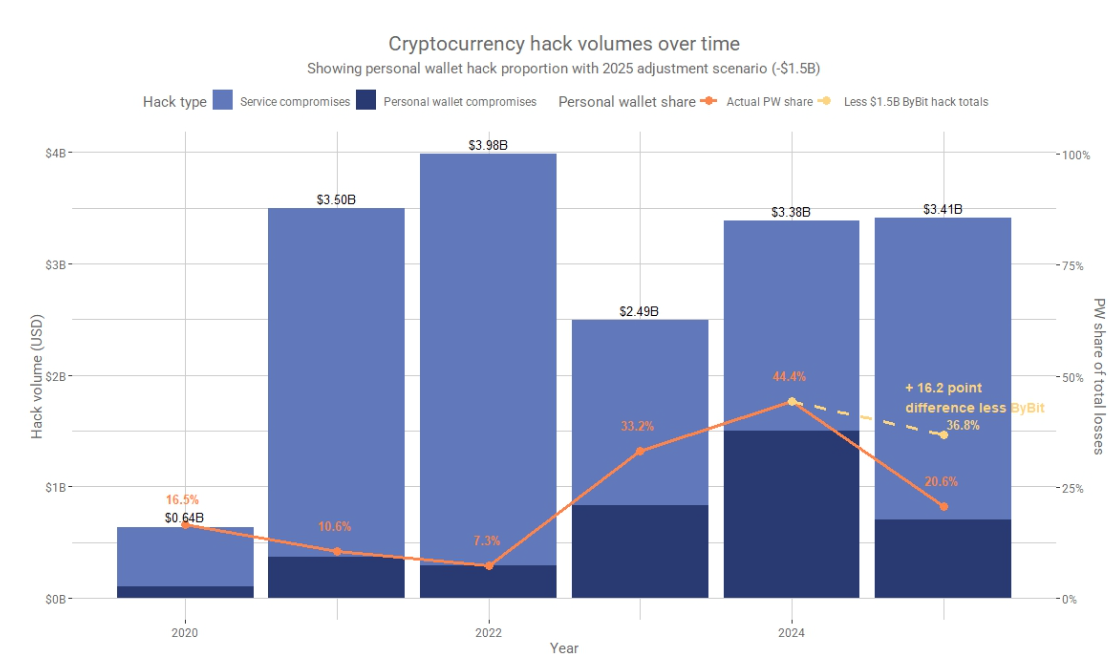
The $1.4 billion hack on Bybit contributed nearly half to 2025’s total losses. Source: Chainalysis

“It’s difficult to predict if it will get worse in 2026, as hacks are very outlier-driven — one or two big hacks can set records for a given year. But what I can say is that this trend of big game hunting seems to be continuing, and there’s no reason to believe hacks will decline next year,” he said.

Wallet and private key compromises are a popular target

Meanwhile, Fierman said that on the opposite end of the spectrum, personal wallets have also become a popular target for hackers.

They represented 7.3% of the total stolen value in 2022 and 44% in 2024. This year it’s around 20%, but ignoring the Bybit hack, the total would have been closer to 37%.

However, the overall amount stolen from individual hacks declined from $1.5 billion in 2024 to $713 million this year, despite the number of incidents nearly tripling compared to 2022.
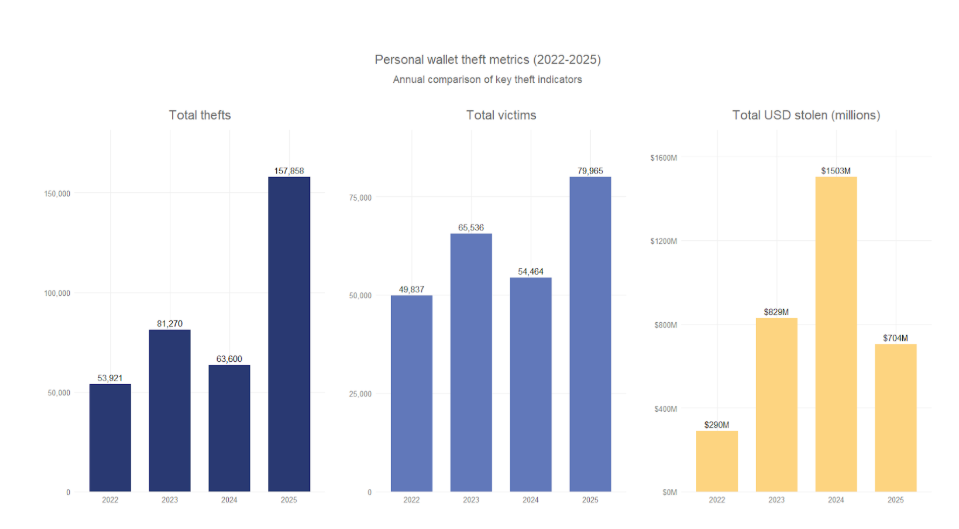
More personal wallets were hacked this year, but the total stolen was far less. Source: Chainalysis

“These amounts are smaller because individual personal wallets tend to hold less funds than large exchange wallets, which pool many users’ funds together,” Fierman added.

DeFi protocols adopted more effective security measures

DeFi total locked value is around $119 billion, according to the analytics platform DefiLlama, more than double from 2023 lows when it dropped to below $40 billion.

However, Chainalysis said the recovery in DeFi markets hasn’t led to a spike in hacks, which presents “a clear divergence from historical trends.”

Previously, areas of the industry flush with funds tended to suffer more hacks. However, in this case, Chainalysis points to DeFi protocols implementing more effective security measures and attackers shifting their focus to wallets and centralized services as possible causes.

“The sustained lower level of DeFi hacks, even as billions of dollars have returned to these protocols, represents a meaningful change,” the Chainalysis team said.

North Korea is becoming more sophisticated

North Korean hacker crews were responsible for $2.02 billion in stolen cryptocurrency in 2025, an additional $681 million over the total in 2024, through tactics such as embedding IT workers inside projects.
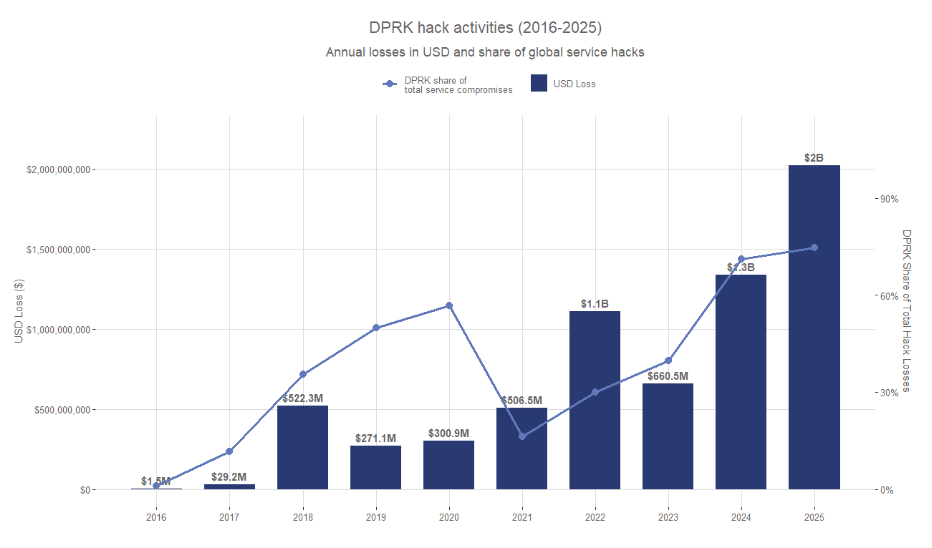
North Korean hackers stole more in 2025 than in previous years. Source: Chainalysis

Analysis found that North Korean hackers executed fewer but far more damaging attacks in 2025, which Chainalysis attributes to an increase in sophistication and patience as they focus more on achieving larger scores.

Related: Solana under ‘industrial scale’ DDoS attack: Co-founder says it’s ‘bullish’

“The regime is consistently training and developing new tactics by which their operators execute their strategies, whether infiltrating Web3 companies as IT workers or finding exploitable access points through third-party vendors,” Fierman said.

“While with every hack the industry learns more about DPRK tactics, and strengthens security measures to mitigate future risk, the DPRK is also evolving, in an ongoing attempt to find new attack vectors to continue yielding returns for the regime through their ill-gotten gains.”

Magazine: Do Kwon sentenced to 15 years, Bitcoin’s ‘choppy dance’: Hodler’s Digest, Dec. 7 – 13

Trending Cryptos

Related Questions

QWhat was the total value of cryptocurrency losses due to hacks in 2025, and how does this compare to previous years?

AThe total value of cryptocurrency losses due to hacks in 2025 was $3.4 billion, which is the highest figure since 2022.

QWhich single hack was the largest contributor to the total losses in 2025, and how much was stolen?

AThe $1.4 billion hack of the crypto exchange Bybit was the largest contributor, accounting for nearly half of the total losses for the year.

QAccording to the report, what significant trend has been observed in attacks on personal wallets?

AWhile the number of incidents targeting personal wallets nearly tripled compared to 2022, the total amount stolen from them declined from $1.5 billion in 2024 to $713 million in 2025.

QHow did the recovery in DeFi Total Value Locked (TVL) relate to the number of hacks on DeFi protocols in 2025?

ADespite the DeFi TVL recovering to around $119 billion, more than double its 2023 lows, there was no spike in hacks, which represents a clear divergence from historical trends due to improved security measures.

QHow much cryptocurrency did North Korean hacker crews steal in 2025, and what tactics did they using?

ANorth Korean hacker crews stole $2.02 billion in cryptocurrency in 2025, using more sophisticated tactics such as embedding IT workers inside projects and executing fewer but far more damaging attacks.

Related Reads

Michael Saylor: 110 Reasons to Oppose BIP-110

Michael Saylor presents 110 arguments against Bitcoin Improvement Proposal (BIP) 110, a soft fork aimed at restricting certain non-monetary data storage uses (like inscriptions) on the Bitcoin blockchain. He acknowledges the proponents' valid concerns—such as node costs, fee pressure, and preserving Bitcoin's monetary focus—but fundamentally disagrees with the proposed solution. Saylor argues that BIP 110 represents a dangerous precedent of using consensus rules to enforce value judgments on transaction validity, moving away from Bitcoin's core principles of neutrality and permissionless innovation. His key objections are organized into eleven categories: 1) It violates neutrality and hard consensus by banning currently valid transactions. 2) It fails to meet the high burden of proof required for a consensus change, lacking concrete data on the alleged crisis. 3) Its seven bundled technical restrictions are overly broad, targeting generic script functionalities and blocking future upgrade paths. 4) It sacrifices compatibility and future optionality by closing off designed upgrade hooks. 5) Its temporary rules add significant complexity (grandfathering, expiry states) without sufficient justification. 6) The economic and security impacts, particularly on miner revenue and fee markets, are uncertain and unmodeled. 7) Superior, market-based tools (fee markets, relay/mining policies) already exist to manage blockchain load. 8) It stifles innovation by creating a chilling effect for developers. 9) Its modified activation mechanism (55% threshold, forced signaling) is aggressive and risks network splits. 10) The precedent it sets—using consensus to suppress disliked but legal uses—is more dangerous than the problem it aims to solve. 11) A better path exists: improving measurements, refining resource-based policies, and allowing market forces to work. Saylor concludes that Bitcoin's strength lies in its neutral rules, open markets, and hard consensus. Changing these foundational elements to target specific use cases is an unnecessary and risky "iatrogenic" intervention. He advocates for guarding Bitcoin's neutrality rather than acting as its redeemer.

marsbit11m ago

Michael Saylor: 110 Reasons to Oppose BIP-110

marsbit11m ago

Trading

Spot

Hot Articles

How to Buy NEAR

Welcome to HTX.com! We've made purchasing NEAR Protocol (NEAR) simple and convenient. Follow our step-by-step guide to embark on your crypto journey.Step 1: Create Your HTX AccountUse your email or phone number to sign up for a free account on HTX. Experience a hassle-free registration journey and unlock all features.Get My AccountStep 2: Go to Buy Crypto and Choose Your Payment MethodCredit/Debit Card: Use your Visa or Mastercard to buy NEAR Protocol (NEAR) instantly.Balance: Use funds from your HTX account balance to trade seamlessly.Third Parties: We've added popular payment methods such as Google Pay and Apple Pay to enhance convenience.P2P: Trade directly with other users on HTX.Over-the-Counter (OTC): We offer tailor-made services and competitive exchange rates for traders.Step 3: Store Your NEAR Protocol (NEAR)After purchasing your NEAR Protocol (NEAR), store it in your HTX account. Alternatively, you can send it elsewhere via blockchain transfer or use it to trade other cryptocurrencies.Step 4: Trade NEAR Protocol (NEAR)Easily trade NEAR Protocol (NEAR) on HTX's spot market. Simply access your account, select your trading pair, execute your trades, and monitor in real-time. We offer a user-friendly experience for both beginners and seasoned traders.

6.9k Total ViewsPublished 2024.03.29Updated 2026.06.02

How to Buy NEAR

Discussions

Welcome to the HTX Community. Here, you can stay informed about the latest platform developments and gain access to professional market insights. Users' opinions on the price of NEAR (NEAR) are presented below.

活动图片










