Crypto losses near $3.4B as hackers went ‘big game hunting’

cointelegraphPublished on 2025-12-18Last updated on 2025-12-18

Crypto hackers focused on large crypto entities and personal crypto wallets this year, resulting in $3.4 billion in crypto losses in 2025 — the highest figure since 2022.

Just three hacks in 2025, led by the $1.4 billion hack of crypto exchange Bybit, accounted for 69% of all losses from January through to early December, a Chainalysis report released on Thursday found, with the largest attacks a thousand times larger than the typical incident.

Andrew Fierman, the head of national security intelligence at Chainalysis, told Cointelegraph that while massive attacks drove this year’s uptick in losses, it’s unclear if 2026 will unfold in the same way.
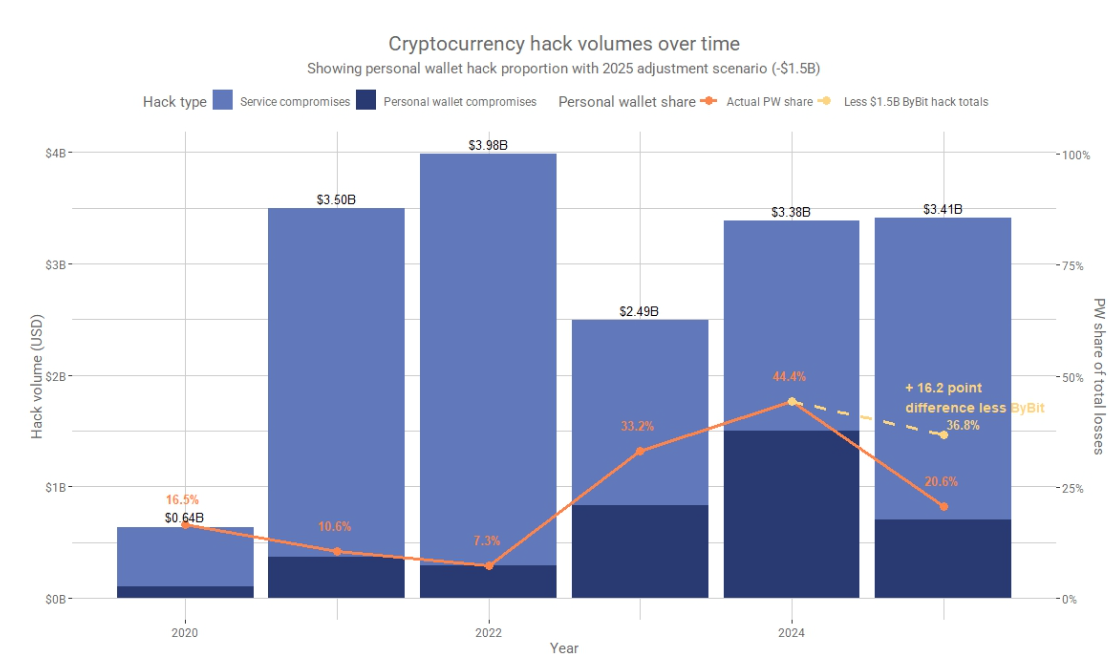
The $1.4 billion hack on Bybit contributed nearly half to 2025’s total losses. Source: Chainalysis

“It’s difficult to predict if it will get worse in 2026, as hacks are very outlier-driven — one or two big hacks can set records for a given year. But what I can say is that this trend of big game hunting seems to be continuing, and there’s no reason to believe hacks will decline next year,” he said.

Wallet and private key compromises are a popular target

Meanwhile, Fierman said that on the opposite end of the spectrum, personal wallets have also become a popular target for hackers.

They represented 7.3% of the total stolen value in 2022 and 44% in 2024. This year it’s around 20%, but ignoring the Bybit hack, the total would have been closer to 37%.

However, the overall amount stolen from individual hacks declined from $1.5 billion in 2024 to $713 million this year, despite the number of incidents nearly tripling compared to 2022.
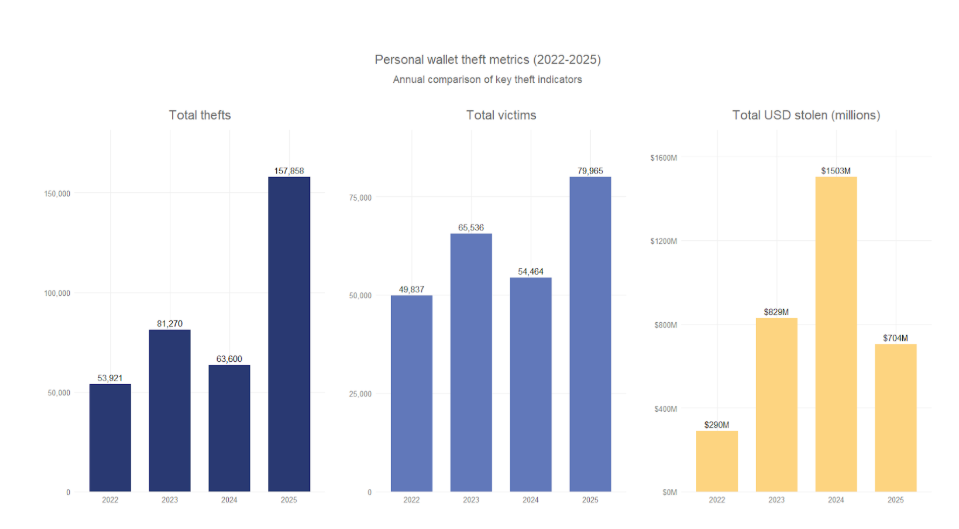
More personal wallets were hacked this year, but the total stolen was far less. Source: Chainalysis

“These amounts are smaller because individual personal wallets tend to hold less funds than large exchange wallets, which pool many users’ funds together,” Fierman added.

DeFi protocols adopted more effective security measures

DeFi total locked value is around $119 billion, according to the analytics platform DefiLlama, more than double from 2023 lows when it dropped to below $40 billion.

However, Chainalysis said the recovery in DeFi markets hasn’t led to a spike in hacks, which presents “a clear divergence from historical trends.”

Previously, areas of the industry flush with funds tended to suffer more hacks. However, in this case, Chainalysis points to DeFi protocols implementing more effective security measures and attackers shifting their focus to wallets and centralized services as possible causes.

“The sustained lower level of DeFi hacks, even as billions of dollars have returned to these protocols, represents a meaningful change,” the Chainalysis team said.

North Korea is becoming more sophisticated

North Korean hacker crews were responsible for $2.02 billion in stolen cryptocurrency in 2025, an additional $681 million over the total in 2024, through tactics such as embedding IT workers inside projects.
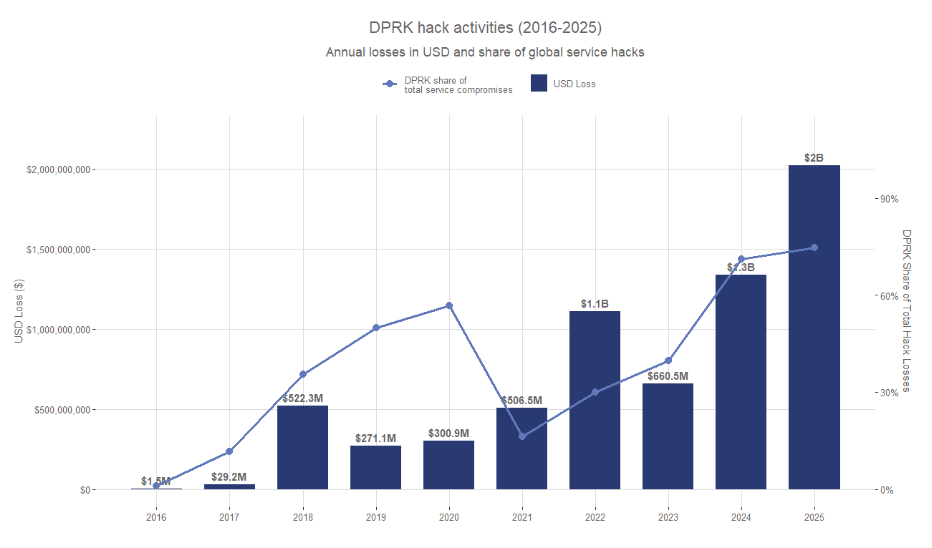
North Korean hackers stole more in 2025 than in previous years. Source: Chainalysis

Analysis found that North Korean hackers executed fewer but far more damaging attacks in 2025, which Chainalysis attributes to an increase in sophistication and patience as they focus more on achieving larger scores.

Related: Solana under ‘industrial scale’ DDoS attack: Co-founder says it’s ‘bullish’

“The regime is consistently training and developing new tactics by which their operators execute their strategies, whether infiltrating Web3 companies as IT workers or finding exploitable access points through third-party vendors,” Fierman said.

“While with every hack the industry learns more about DPRK tactics, and strengthens security measures to mitigate future risk, the DPRK is also evolving, in an ongoing attempt to find new attack vectors to continue yielding returns for the regime through their ill-gotten gains.”

Magazine: Do Kwon sentenced to 15 years, Bitcoin’s ‘choppy dance’: Hodler’s Digest, Dec. 7 – 13

Related Questions

QWhat was the total value of cryptocurrency losses due to hacks in 2025, and how does this compare to previous years?

AThe total value of cryptocurrency losses due to hacks in 2025 was $3.4 billion, which is the highest figure since 2022.

QWhich single hack was the largest contributor to the total losses in 2025, and how much was stolen?

AThe $1.4 billion hack of the crypto exchange Bybit was the largest contributor, accounting for nearly half of the total losses for the year.

QAccording to the report, what significant trend has been observed in attacks on personal wallets?

AWhile the number of incidents targeting personal wallets nearly tripled compared to 2022, the total amount stolen from them declined from $1.5 billion in 2024 to $713 million in 2025.

QHow did the recovery in DeFi Total Value Locked (TVL) relate to the number of hacks on DeFi protocols in 2025?

ADespite the DeFi TVL recovering to around $119 billion, more than double its 2023 lows, there was no spike in hacks, which represents a clear divergence from historical trends due to improved security measures.

QHow much cryptocurrency did North Korean hacker crews steal in 2025, and what tactics did they using?

ANorth Korean hacker crews stole $2.02 billion in cryptocurrency in 2025, using more sophisticated tactics such as embedding IT workers inside projects and executing fewer but far more damaging attacks.

Related Reads

Borrowing Money from a Hundred Years Later, Building Incomprehensible AI

Tech giants like Alphabet, Amazon, Meta, and Microsoft are undergoing a radical financial transformation due to AI. Their traditional "light-asset, high-free-cash-flow" model is being dismantled by staggering capital expenditures on AI infrastructure—data centers, GPUs, and power. Combined 2026 guidance exceeds $700 billion, a 4.5x increase from 2022, causing free cash flow to plummet (e.g., Amazon's fell 95%). To fund this, they are borrowing unprecedented sums through long-dated, multi-currency bonds (e.g., Alphabet's 100-year bond). The world's most conservative capital—pensions, insurers—is now funding Silicon Valley's most speculative bet. This shift makes these companies resemble heavy-asset industrials (railroads, utilities) rather than software firms, threatening their premium valuations. Historically, such infrastructure booms (railroads, fiber optics) followed a pattern: genuine technology, overbuilding fueled by competitive frenzy, aggressive debt financing, and a crash triggered by financial conditions—not technology failure. The infrastructure remained, but many original builders and financiers did not survive. The core gamble is a "time arbitrage": using cheap debt today to build scale and lock in customers before AI capabilities commoditize. They are betting that AI revenue will materialize before debt comes due. Their positions vary: Amazon is under immediate cash pressure; Meta's path to monetization is unclear; Alphabet has a robust core business buffer; Microsoft has the shortest path from infrastructure to revenue. The contract is set: the most risk-averse global capital has lent its time to Silicon Valley, awaiting a future that is promised but uncertain.

marsbit8m ago

Borrowing Money from a Hundred Years Later, Building Incomprehensible AI

marsbit8m ago

The 'VVV' Concept Soars 9x in Half a Year, The New AI Narrative on Base Chain

"The article explores the 'VVV' concept as the new AI-focused narrative within the Base ecosystem, centered around the token $VVV of the privacy-focused, uncensored generative AI platform Venice, led by crypto veteran Erik Voorhees. Venice has seen significant growth in 2026, with its API users surging, partly attributed to exposure from OpenClaw. The platform now boasts over 2 million total users and 55,000 paid subscribers. Correspondingly, the $VVV token price has risen over 9x this year. Key to its performance are tokenomics designed for value accrual: reduced annual emissions, subscription revenue used for buyback-and-burn, and a unique staking mechanism. Staking $VVV yields $sVVV, which can be used to mint $DIEM tokens. Each staked $DIEM provides a daily $1 credit for using Venice's API services, creating tangible utility. The article also highlights other tokens associated with the 'VVV' narrative. $POD, the token of distributed AI network Dolphin (which co-developed Venice's default AI model), saw a massive price surge. $cyb3rwr3n, a project for a Venice credit auction market, gained attention due to perceived connections to Venice's team despite official denials. Finally, $SR of robotics platform STRIKEROBOT.AI rose after announcing a partnership with Venice for robot vision-language model development. Overall, the 'VVV' ecosystem combines AI platform growth, deflationary tokenomics, and innovative utility mechanisms, driving significant investor interest and price action in related tokens."

marsbit17m ago

The 'VVV' Concept Soars 9x in Half a Year, The New AI Narrative on Base Chain

marsbit17m ago

Anthropic and OpenAI Have Single-Handedly Severed the Logic of Pre-IPO Stock Tokenization

The pre-IPO stock token market is experiencing significant turmoil following strong statements from AI giants Anthropic and OpenAI. Both companies have updated their official policies, declaring that any transfer of their company shares—including sales, transfers, or assignments of share interests—without prior board approval is "invalid" and will not be recognized in their corporate records. This means buyers in such unauthorized transactions would not be recognized as shareholders and would have no shareholder rights. A major point of contention is the use of Special Purpose Vehicles (SPVs), which are legal entities commonly used by pre-IPO token platforms to pool investor funds and indirectly acquire shares from employees or early investors. The companies explicitly state they do not permit SPVs to acquire their shares, and any such transfer violates their restrictions. They warn that third parties selling shares through SPVs, direct sales, forward contracts, or stock tokens are likely engaged in fraud or are offering worthless investments due to these transfer limits. This stance directly threatens the core model of many pre-IPO token platforms, which rely on SPV structures. The announcement revealed additional risks within this model, such as complex "SPV-within-SPV" layering that obscures legal transparency, increases management fees, and creates a chain reaction risk of invalidation. Following the news, tokens like ANTHROPIC and OPENAI on platforms like PreStocks fell sharply (over 20%). The market reaction highlights a divergence: while asset-backed pre-IPO tokens plummeted, purely speculative pre-IPO futures contracts, which are bilateral bets on future IPO prices with no claim to actual shares, remained relatively stable as they are unaffected by the transfer restrictions. The industry is split on the implications. Some believe the fundamental logic of pre-IPO token trading is broken if leading companies reject SPV-held shares, potentially causing a domino effect. Others, like Rivet founder Nick Abouzeid, argue that buyers of such unofficial tokens always knowingly accepted the risk of non-recognition by the company. The statements serve as a stark risk warning and a corrective measure for a market where valuations for some AI-related pre-IPO tokens had soared to irrational levels, far exceeding recent funding round valuations.

marsbit1h ago

Anthropic and OpenAI Have Single-Handedly Severed the Logic of Pre-IPO Stock Tokenization

marsbit1h ago

Anthropic and OpenAI Personally Sever the Logic of Pre-IPO Crypto-Stocks

The pre-IPO token market has been rocked by strong statements from Anthropic and OpenAI. Both AI giants have updated official warnings, declaring that any sale or transfer of their company shares without explicit board approval is "invalid" and will not be recognized on their corporate records. This directly targets Special Purpose Vehicles (SPVs), the common legal structure used by pre-IPO token platforms. These platforms typically use an SPV to acquire shares from employees or early investors, then issue blockchain-based tokens representing a claim on the SPV's economic benefits. Anthropic and OpenAI's position means that if an SPV's share purchase lacked authorization, the underlying asset could be deemed worthless, nullifying the token's value. Anthropic explicitly warned that any third party selling its shares—via direct sales, forwards, or tokens—is likely fraudulent or offering a valueless investment. The crackdown highlights risks in the popular SPV model, including complex multi-layered "Russian doll" SPV structures that obscure legal ownership, add fees, and concentrate risk. If one layer is invalidated, the entire chain could collapse. Following the announcements, tokens like ANTHROPIC and OPENAI on platforms like PreStocks fell sharply (over 20%). In contrast, purely speculative pre-IPO prediction contracts remained stable, as they involve no actual share ownership. The move is seen as a corrective measure amid a market frenzy where some pre-IPO token valuations (e.g., Anthropic's token hitting a $1.4 trillion implied valuation) far exceeded recent official funding rounds. Opinions are split: some believe this undermines the core logic of pre-IPO token trading if top companies reject SPVs, while others argue buyers always assumed this legal risk when accessing unofficial channels. The statements serve as a stark warning and a potential catalyst for market de-leveraging and clearer boundaries.

Odaily星球日报1h ago

Anthropic and OpenAI Personally Sever the Logic of Pre-IPO Crypto-Stocks

Odaily星球日报1h ago

The Waged Worker Driven to Poverty by AI Subscriptions

"AI Membership: The Hidden Cost Pushing Workers Toward 'Poverty'" The widespread corporate push for AI adoption is creating a hidden financial burden for employees. Companies, from giants like Alibaba to small firms, are mandating AI use, often tying token consumption to KPIs, but frequently refuse to cover the costs. Workers are forced to pay for subscriptions out of pocket to stay competitive and avoid being replaced. Front-end developer Long Shen spends up to 2000 RMB monthly on tools like Cursor and ChatGPT Plus, seeing it as a necessary 3% salary investment to handle 90% of his coding tasks. While it boosted his performance and led to promotions, he now faces idle time at work, pretending to be busy. Designer Peng Peng navigates strict company firewalls by using personal devices and accounts for AI image generation tools like Midjourney, spending hundreds monthly without reimbursement, while her boss demands faster, more numerous revisions. The pressure creates workplace anxiety and suspicion. Programmer Li Huahua, after a friend's experience of raised KPIs following AI success, fears being branded a "traitor" for using it yet worries about falling behind if she doesn't. The dynamic allows management to demand results without understanding the tools or covering expenses, treating employees like AI "agents." While some, like entrepreneur Jin Tu, find high value in paid AI, building entire systems and winning competitions, for most, it's a trap. Free tools like Kimi and Doubao are introducing fees, closing off alternatives. The initial efficiency gains individual advantage, but as AI becomes ubiquitous, the personal edge disappears, workloads increase, and a cycle of dependency begins. Workers like Long Shen realize they cannot maintain AI-generated code without AI, making stopping harder than continuing to pay. The tool promising liberation is instead becoming a compulsory, costly chain in the modern workplace.

marsbit2h ago

The Waged Worker Driven to Poverty by AI Subscriptions

marsbit2h ago

Trading

Spot
Futures

Hot Articles

How to Buy NEAR

Welcome to HTX.com! We've made purchasing NEAR Protocol (NEAR) simple and convenient. Follow our step-by-step guide to embark on your crypto journey.Step 1: Create Your HTX AccountUse your email or phone number to sign up for a free account on HTX. Experience a hassle-free registration journey and unlock all features.Get My AccountStep 2: Go to Buy Crypto and Choose Your Payment MethodCredit/Debit Card: Use your Visa or Mastercard to buy NEAR Protocol (NEAR) instantly.Balance: Use funds from your HTX account balance to trade seamlessly.Third Parties: We've added popular payment methods such as Google Pay and Apple Pay to enhance convenience.P2P: Trade directly with other users on HTX.Over-the-Counter (OTC): We offer tailor-made services and competitive exchange rates for traders.Step 3: Store Your NEAR Protocol (NEAR)After purchasing your NEAR Protocol (NEAR), store it in your HTX account. Alternatively, you can send it elsewhere via blockchain transfer or use it to trade other cryptocurrencies.Step 4: Trade NEAR Protocol (NEAR)Easily trade NEAR Protocol (NEAR) on HTX's spot market. Simply access your account, select your trading pair, execute your trades, and monitor in real-time. We offer a user-friendly experience for both beginners and seasoned traders.

5.8k Total ViewsPublished 2024.03.29Updated 2025.05.06

How to Buy NEAR

Discussions

Welcome to the HTX Community. Here, you can stay informed about the latest platform developments and gain access to professional market insights. Users' opinions on the price of NEAR (NEAR) are presented below.

活动图片













