Crypto Funds Extend Three-Week Run With $1B Inflows Despite Geopolitical Stress

bitcoinistPublished on 2026-03-17Last updated on 2026-03-17

Global crypto funds attracted a remarkable $1 billion in inflows last week, marking their third consecutive week of positive net flows and best performance in two months, while underscoring resilience amid geopolitical challenges.

Crypto Funds’ Positive Streak Extends

According to the latest CoinShares data, crypto funds drew $1.06 billion in inflows last week, continuing their positive net flows run for the third consecutive week and extending their best performance since the year started.

Notably, crypto Exchange-Traded Products (ETPs) had a five-week run of negative net flows from January 19 to February 20 amid market weakness and broader negative sentiment. The investment products had cumulative outflows of $4 billion, registering their worst performance since the October 10 crash.

The US market experienced most of the negative net flows during this period, while Bitcoin-based ETPs saw the weakest performance among major cryptocurrencies, with over $3.80 billion in outflows.

However, US investors’ renewed demand for digital asset investment products since the end of February, particularly Bitcoin Exchange-Traded Funds (ETFs), has reduced the prior one-month outflows streak, bringing the three-week run of inflows to $2.62 billion.
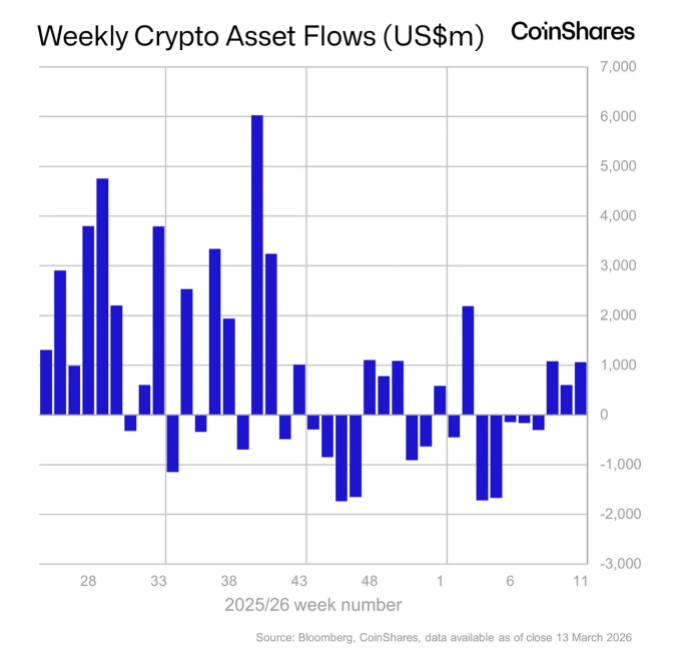
Crypto funds attract massive inflows for the third consecutive week.  Source: CoinShares

Regionally, 96% of the inflows originated from the US, with Canada and Switzerland following with $19.4 million and $10.4 million, respectively. Hong Kong also attracted $23.1 million in inflows, marking the best performance since August 2025. In contrast, Germany recorded outflows of $17.1 million, its first negative net flows in 2026, according to CoinShares’ data.

Funds based on the flagship cryptocurrency showed the strongest performance this week, with $793 million in inflows. This accounts for 75% of total inflows, bringing BTC’s three-week inflows to $2.2 billion.

The report noted that short Bitcoin investment products also attracted $8.1 million in inflows last week, highlighting that market opinion remains somewhat polarized.

Meanwhile, Ethereum funds also saw meaningful inflows worth $315 million, partially driven by BlackRock’s debut of its staked Ether ETF in the US. This brings the category’s year-to-date (YTD) flows, which are on a net outflow position, near a net-neutral position.

Digital Assets, Bitcoin’s ‘Safe Haven’ Narrative Reinforced

James Butterfill, head of research at CoinShares, highlighted crypto funds’ strong performance despite the increasing Middle East tensions, explaining that “significant geopolitical disruption has reinforced digital assets, particularly Bitcoin, as a relative safe haven compared with other asset classes.”

Since the beginning of the Iran crisis, total assets under management (AuM) in crypto ETPs have risen by 9.4% to $140 billion, Butterfill noted on Monday. Notably, Nate Geraci, co-founder of the ETF Institute, recently affirmed that ETF investors have “largely displayed diamond hands” since the October correction began.

The expert emphasized that 50% drawdowns “are a walk in the park for long-time BTC investors,” but observed that newer ETF investors also appear unfazed by the recent market volatility.

Bloomberg Intelligence Senior ETF Analyst Eric Balchunas also shared a similar perspective on the performance of spot Bitcoin ETFs, calling the investment products’ resilience “absurd” amid the market conditions.

The latest QCP Market Colour highlighted that crypto is rallying and institutional liquidity is also returning, while equities and gold remain under pressure. According to the Monday analysis, recent price actions suggest a resurgence of Bitcoin’s narrative as a “digital safe haven” or “geopolitical hedge,” with “markets stress-testing that thesis in real time.”

“If this pattern persists, it would be a late-quarter plot twist, given crypto’s underdog status and its familiar habit of correlating with traditional assets mostly on the way down,” the report stated.
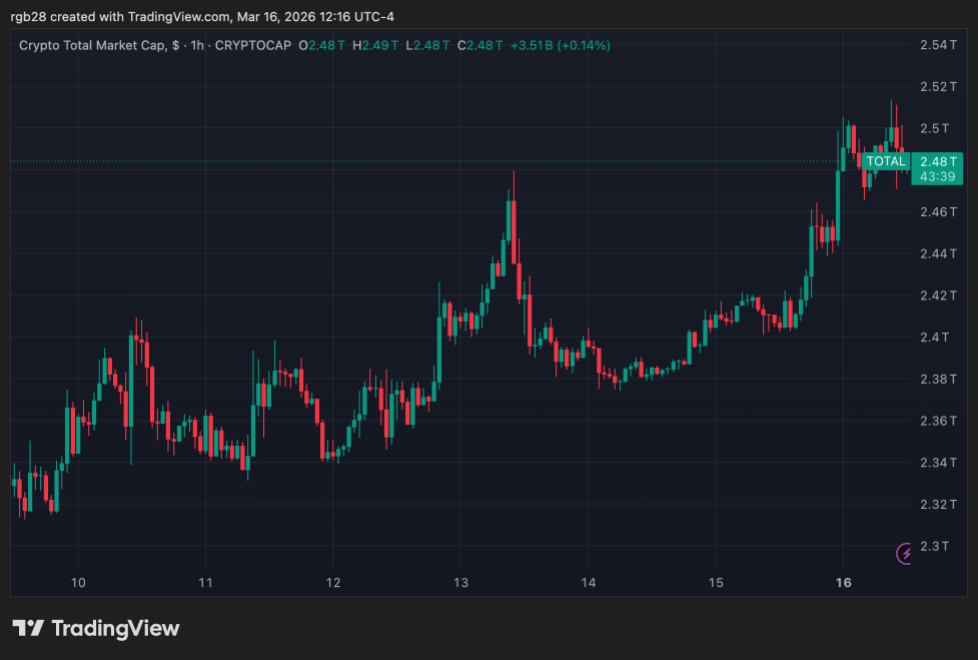
The total crypto market capitalization is at $2.48 trillion on the one-week chart. Source: TOTAL on TradingView


Related Questions

QHow much in inflows did crypto funds attract last week, and what does this represent?

ACrypto funds attracted $1.06 billion in inflows last week, marking their third consecutive week of positive net flows and their best performance in two months.

QWhich region was the primary source of the crypto fund inflows, and how much did it contribute?

AThe United States was the primary source, contributing 96% of the total inflows.

QWhat was the performance of Bitcoin-based funds specifically, and how much did they attract in inflows?

ABitcoin-based funds showed the strongest performance, attracting $793 million in inflows, which accounts for 75% of the total inflows for the week.

QAccording to the head of research at CoinShares, how has recent geopolitical disruption affected the perception of digital assets?

AJames Butterfill stated that significant geopolitical disruption has reinforced digital assets, particularly Bitcoin, as a relative safe haven compared to other asset classes.

QWhat notable inflow did Ethereum funds see, and what was a key driver behind this activity?

AEthereum funds saw inflows of $315 million, partially driven by BlackRock's debut of its staked Ether ETF in the US.

Related Reads

Within Strategy's Framework, STRC's Dividend Yield Remains at 12% as Share Price Stays Below Par Value

Michael Saylor, Executive Chairman of Strategy (MSTR), confirmed that the dividend rate for its STRC perpetual preferred shares will remain at 12.00% through August 2026. The rate has increased from 9% at its July 2025 launch to the current high via a "ratchet" mechanism, which permanently raises the rate by 0.5% whenever the share price falls below $95. This mechanism is intended to push the price back toward its $100 par value and support Strategy's "at-the-market" (ATM) program for issuing new shares to fund Bitcoin purchases. However, the mechanism has not worked as intended. STRC shares closed at $89.46 on July 31, remaining about 10-11% below par value despite the record-high dividend. Competition from rival Strive's higher-yielding SATA securities has pressured demand. The persistent discount has forced Strategy to suspend new STRC issuances via its ATM program, limiting this funding channel for Bitcoin acquisitions. STRC's struggles reflect Bitcoin's own volatility, as the preferred shares historically move in tandem. Analysts have warned the ratchet structure carries long-term, one-way risk. A law firm is investigating Strategy's ability to maintain dividend payments if Bitcoin's price stays low. Retail investors own roughly 83% of outstanding STRC shares, a group seen as prone to panic selling during downturns. In response, Strategy has established financial reserves, including a liquidity cushion covering about 26 months of dividend/interest obligations, and a $2 billion share buyback program alongside a Bitcoin monetization framework, though the company emphasized it is not obligated to sell any Bitcoin.

cryptonews.ru6m ago

Within Strategy's Framework, STRC's Dividend Yield Remains at 12% as Share Price Stays Below Par Value

cryptonews.ru6m ago

Analyst: Bitcoin's Price Will Drop to $60k in August, Then Rebound to $70k

Financial analyst Andrey Poroshin has provided a new forecast for Bitcoin's price dynamics in August. Poroshin, an analyst at the Bitbanker exchange, expects the cryptocurrency market to experience a downturn this month, with prices retesting the $60,000 level due to a lack of supportive macroeconomic catalysts. He noted that the recent US Federal Reserve decision to hold interest rates did not significantly impact the market, while inflation remains above the 2% target. Poroshin stated that Bitcoin is ending July under pressure from moderate volatility and a lack of new macroeconomic stimuli, leading to continued market caution. According to his base scenario, Bitcoin will drop to a range of $60,000 to $62,000 before recovering to $70,000. He pointed out that even $70,000 remains below the cost of mining in the US, which has prompted some miners to shift towards AI data center operations. Poroshin cited the winding down of BitMEX's operations as a potential catalyst for a price rebound, suggesting the exit of weaker players often coincides with market reversals and reduced short-term selling pressure. He believes Bitcoin is currently less susceptible to geopolitical shocks, such as the Iran-US conflict, and does not expect significant market changes in August related to the pending CLARITY Act. Looking ahead, Poroshin forecasts that September will bring more active price fluctuations driven by potential Fed rate decisions and possible discussions or approval of the CLARITY Act.

cryptonews.ru6m ago

Analyst: Bitcoin's Price Will Drop to $60k in August, Then Rebound to $70k

cryptonews.ru6m ago

Trading

Spot
活动图片




