Crypto Firms Propose Key Stablecoin Concessions To Advance CLARITY Act – Report

bitcoinistPublished on 2026-02-06Last updated on 2026-02-06

Abstract

Crypto firms are proposing key concessions to banks in an effort to advance the stalled CLARITY Act, a major US crypto market structure bill. The main point of contention is the treatment of stablecoin rewards. Banks argue that interest-bearing stablecoins threaten the financial system and distort credit creation. In response, crypto companies have offered compromises, such as giving community banks a larger role by having them hold a portion of stablecoin reserves or issue tokens. However, not all parties agree, and it's unclear if these proposals will resolve the dispute. The Senate Banking Committee's draft, which bans interest payments to passive token holders, has faced heavy criticism from crypto leaders who argue it would kill innovation. Recent White House-mediated talks ended without a resolution, but lawmakers remain hopeful a compromise can be reached.

Crypto firms are reportedly stepping up efforts to advance the highly anticipated market structure bill by proposing potential compromises to address some of the banking sector’s concerns on stablecoins.

Crypto Firms Offer Stablecoin Compromises

On Wednesday, Bloomberg reported that multiple crypto companies have been allegedly trying to “win over” banks to salvage the crypto market structure bill, known as the CLARITY Act.

The crypto bill has been stalled in the US Senate for weeks as crypto industry leaders and banks have been unable to reach an agreement on one of the bill’s main topics, stablecoin rewards, in the Senate Banking Committee’s portion of the legislation.

The US banking industry has repeatedly expressed concerns about stablecoin policies, claiming that interest payments will distort market dynamics and affect credit creation in the country. Bank of America CEO Brian Moynihan recently told investors that the banking sector, especially small- and medium-sized businesses, could face significant challenges if Congress does not prohibit interest-bearing stablecoins.

According to people familiar with the matter, industry participants are offering banks new concessions regarding these concerns, as part of their efforts to advance the long-awaited crypto legislation.

For instance, the firms have reportedly proposed giving community banks a larger role in the stablecoin system, allowing them to hold reserves or issue tokens through partnerships. Notably, they suggested requiring stablecoin issuers to maintain a portion of their reserves at community banks.

Not all crypto companies agree with the proposed ideas, Bloomberg sources noted, emphasizing that the two sides haven’t resolved their differences. Moreover, it remains unclear whether the concessions satisfactorily address banks’ concerns. However, it is “a sign that they’re redoubling efforts to keep the market-structure bill moving,” the report added.

The Stablecoin Rewards Dispute

As reported by Bitcoinist, banks have heavily criticized the landmark stablecoin legislation, the GENIUS Act, affirming that it has loopholes that could pose risks to the financial system.

For context, the crypto framework prohibits interest payments on the holding or use of payment-purpose stablecoins but only addresses stablecoin issuers. As a result, banking associations across the US pressed the Senate Banking Committee to add language to the CLARITY Act that also bans digital asset exchanges, brokers, dealers, and related entities.

The Senate Banking Committee published its draft last month, which received heavy backlash from crypto industry leaders for introducing key restrictions for stablecoin issuers.

Under the proposed draft, issuers would be able to offer rewards for specific actions, such as account openings and cashback. Nonetheless, they would be prohibited from providing interest payments to passive token holders. Coinbase’s CEO Brian Armstrong argued that “would kill rewards on stablecoins,” and allow banks to “ban their competition.”

This led to a delay of the Senate Banking Committee’s markup session, initially scheduled for mid-January, and an extended negotiation process between lawmakers and leaders from the two industries.

Earlier this week, the Trump administration oversaw a White House meeting with crypto and banking groups, including PayPal, Ripple, Coinbase, Multicoin, Circle, the American Bankers Association, and the Bank Policy Institute, to ease the regulatory debate.

The negotiation reportedly ended without an agreement on how to address the dispute but led to “constructive discussion on the risks and opportunities of stablecoin yield and rewards.”

Senate Banking Committee Chairman Senator Tim Scott recently affirmed that he is still hopeful the two sides can reach a balance. “We can protect consumers and community banks while still allowing innovation and competition to lower prices and expand access,” he stated. “Both sides are working toward a compromise that keeps innovation here in America.”
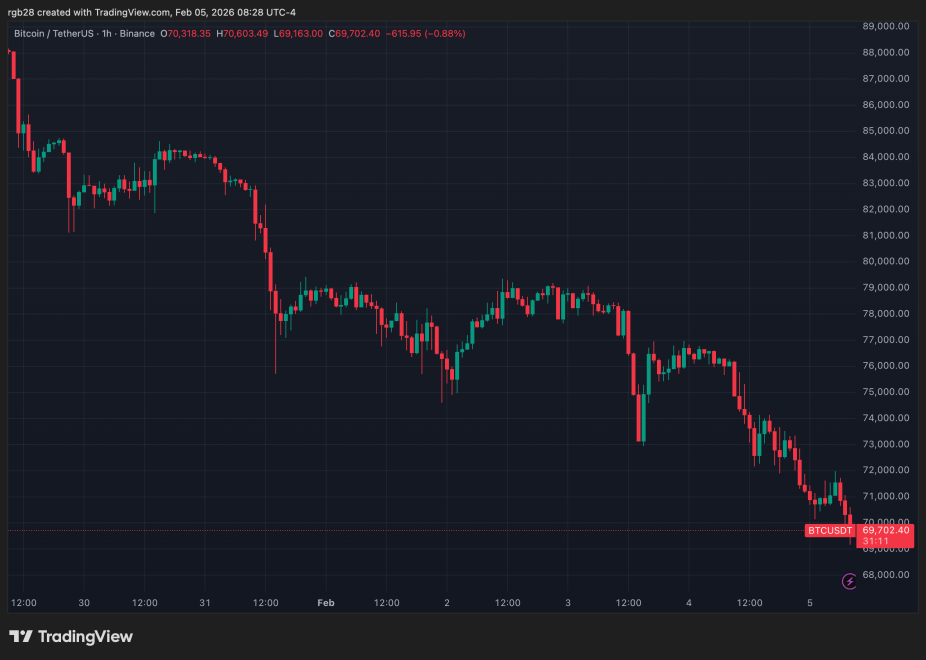
Bitcoin (BTC) trades at $69,702 on the one-week chart. Source: BTCUSDT on TradingView


Related Questions

QWhat is the main purpose of the proposed concessions by crypto firms regarding the CLARITY Act?

AThe main purpose is to address the banking sector's concerns about stablecoins, particularly regarding interest payments, in order to advance the stalled crypto market structure bill and win over banks' support.

QWhat specific compromise did crypto firms propose to involve community banks in the stablecoin system?

ACrypto firms proposed giving community banks a larger role by allowing them to hold reserves or issue tokens through partnerships, and requiring stablecoin issuers to maintain a portion of their reserves at community banks.

QWhy have banks expressed concerns about stablecoin policies, according to Bank of America CEO Brian Moynihan?

ABanks are concerned that interest payments on stablecoins will distort market dynamics and affect credit creation, potentially posing significant challenges to the banking sector, especially small- and medium-sized businesses.

QWhat key restriction in the Senate Banking Committee's draft legislation has drawn criticism from crypto industry leaders like Coinbase's CEO?

AThe draft prohibits stablecoin issuers from providing interest payments to passive token holders, which critics argue would kill rewards on stablecoins and allow banks to ban their competition.

QWhat was the outcome of the recent White House meeting between crypto and banking groups regarding the stablecoin dispute?

AThe meeting ended without an agreement on how to address the dispute but led to a constructive discussion on the risks and opportunities of stablecoin yield and rewards.

Related Reads

The "Impossible Triad" Is Fundamentally a Pseudo-Problem

The article argues that blockchain's fundamental limitation is not the scalability trilemma (decentralization, scalability, security), which has been largely solved, but the lack of **privacy** and, until recently, clear **legitimacy**. Blockchain is described as a slow, expensive, globally shared computer whose core value is censorship resistance and verifiability. While ideal for native digital assets like money (e.g., stablecoins), its default transparency acts as a **tax**, exposing all transactions and enabling MEV extraction, which deters serious institutional capital. Simultaneously, its permissionless nature created regulatory ambiguity. The piece contends that **privacy** is the missing critical feature. It rejects the false choice between total transparency and complete anonymity. Modern cryptography (like zero-knowledge proofs) enables **compliant privacy**: users can prove facts (solvency, KYC status, compliance) without revealing the underlying sensitive data (specific holdings, identities). This preserves auditability for regulators and eliminates the leak of financial information. With recent regulatory progress (e.g., the GENIUS Act) addressing legitimacy, adding default, provably compliant privacy becomes a pure upgrade. It transforms blockchain from a costly, public ledger into a confidential settlement layer, finally bridging the gap to mainstream institutional and individual adoption of on-chain finance.

链捕手12h ago

The "Impossible Triad" Is Fundamentally a Pseudo-Problem

链捕手12h ago

Optical Chips: Collective Capacity Expansion

The global optical chip industry is experiencing a massive wave of expansion driven by surging AI data center demand. Major players across the US, Japan, Europe, and China are aggressively investing to ramp up production capacity. In the US, Coherent is expanding its 6-inch Indium Phosphide (InP) semiconductor fab in Texas, supported by CHIPS Act funding and a $2 billion strategic investment from NVIDIA. Lumentum is building a new factory for InP optical devices, and Nokia is scaling its advanced photonic chip packaging and testing capabilities. NVIDIA's investments aim to secure future supply of critical lasers and optical interconnect products for AI infrastructure. Japan's JX Advanced Metals, a leading InP substrate supplier, plans a multi-billion yen investment to increase its capacity 7-10 times, strengthening its grip on the crucial upstream materials market. In Europe, IQE and Tower Semiconductor settled a patent dispute and signed a multi-year InP epitaxial wafer supply agreement, highlighting that next-generation silicon photonics platforms will integrate high-performance InP components. STMicroelectronics and Sivers Semiconductors are also expanding silicon photonics production and partnerships. China is rapidly building out its domestic supply chain. Dongshan Precision's subsidiary, Source Photonics, announced a $12 billion project to expand optical chip and module production. Companies like Sanan Optoelectronics and Yunnan Germanium are scaling up InP chip manufacturing and substrate production, moving towards vertical integration from materials to modules. While debate continues around the exact future architecture—whether CPO (Co-Packaged Optics), NPO, or pluggables will dominate—analysts like Morgan Stanley argue the underlying driver is unchangeable: the explosive growth in bandwidth demand. This will inevitably increase the volume of optical engines, lasers, and related content per GPU, regardless of the final technical path. The competition for "more light" in the AI era has intensified into a global, full-chain capacity race.

marsbit14h ago

Optical Chips: Collective Capacity Expansion

marsbit14h ago

Trading

Spot
Futures
活动图片