Crypto Courtroom Drama: Kevin O’Leary Wins Nearly $3M Against YouTuber ‘Bitboy’

bitcoinistPublished on 2026-02-16Last updated on 2026-02-16

Abstract

Kevin O'Leary, known as "Mr. Wonderful" from Shark Tank, has been awarded a $2.8 million default judgment by a US federal court against YouTuber Ben "BitBoy" Armstrong. The ruling stems from a defamation lawsuit after Armstrong failed to respond to allegations that he made false social media posts accusing O'Leary of involvement in a fatal 2019 boating incident. The damages include $78,000 for reputational harm, $750,000 for emotional distress, and $2 million in punitive damages. The case is unrelated to crypto, but highlights legal risks for influencers spreading unverified claims.

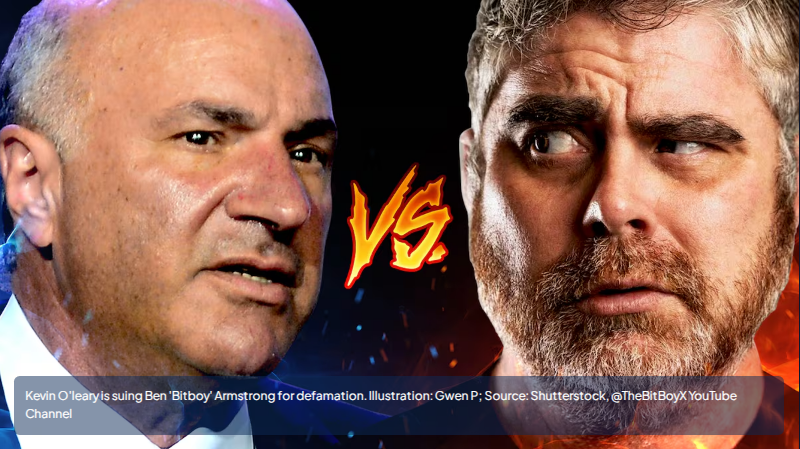
Businessman and TV personality Kevin O’Leary, known as “Mr. Wonderful” from Shark Tank, has won a $2.8 million judgment after a US federal court entered default against popular YouTuber Ben “BitBoy” Armstrong.

The ruling comes after Armstrong failed to respond to a defamation lawsuit related to false claims he made on social media, which accused O’Leary of involvement in a 2019 boating accident that resulted in fatalities.

Those claims were never proven in court, and reporters have noted the legal action focused on restoring reputation and seeking damages for harm caused by the statements.
Court Enters Default Judgment

The court award totals roughly $2.8 million in combined damages. That figure breaks down into about $78,000 for reputational injury, $750,000 for emotional distress, and $2,000,000 in punitive damages meant to punish the conduct.

Judge Beth Bloom presided over the matter in the US District Court for the Southern District of Florida, which handled filings and issued the judgment. The ruling came after procedural steps that allow a plaintiff to obtain judgment when a defendant fails to respond.

Allegations And Timeline

Reports say the posts at the center of the case appeared in March of last year. They accused the businessman of being connected to lethal conduct and alleged a cover-up. O’Leary has never been charged in relation to that incident, and later court records showed related parties were cleared at trial.

Total crypto market cap currently at $2.33 trillion. Chart: TradingView

The defamation suit alleged the statements crossed the line from opinion into false factual claims that damaged reputation and caused distress. Because Armstrong did not appear or meaningfully answer the complaint, the court treated the claims as conceded for purposes of final judgment.

Crypto Connection And Implications

Armstrong is a well-known personality in the world of cryptocurrency, operating the popular site BitBoy Crypto. His messages reach thousands of cryptocurrency fans and investors, which helped to spread the false claims.

Although the case itself is not related to cryptocurrency, it shows the legal danger that cryptocurrency influencers may face when posting unverified or defamatory information online. This decision may make other personalities in the cryptocurrency world more careful about what they post online.

Featured image from Getty Images, chart from TradingView

Related Questions

QWhat was the total amount of the default judgment awarded to Kevin O'Leary against Ben Armstrong?

AThe total default judgment awarded to Kevin O'Leary was approximately $2.8 million.

QWhat were the three categories of damages included in the court's award and what were their amounts?

AThe damages were broken down into $78,000 for reputational injury, $750,000 for emotional distress, and $2,000,000 in punitive damages.

QWhy did the US federal court enter a default judgment in this case?

AThe court entered a default judgment because Ben Armstrong failed to respond to the defamation lawsuit.

QWhat was the nature of the false claims that Ben Armstrong made about Kevin O'Leary?

AArmstrong made false claims on social media accusing Kevin O'Leary of involvement in and a cover-up of a fatal 2019 boating accident.

QWhat potential impact does this case have on other cryptocurrency influencers, according to the article?

AThe article suggests the ruling may make other cryptocurrency influencers more careful about posting unverified or defamatory information online due to the legal dangers it highlights.

Related Reads

Vitalik: We Need to Create Sanctuaries, Not Fight AI

In a recent interview, Vitalik Buterin, founder of Ethereum, addresses the central anxiety of the AI era. He argues the primary risk isn't AI's intelligence, but human passivity—ceding decisions, privacy, and agency to centralized systems or "super AIs" for a sense of "disempowering safety." His solution is not to fight AI, but to build "sanctuary technologies." These are optional, non-totalizing spaces that protect users while preserving their sovereignty and privacy. Ethereum is presented as a prime example, offering a parallel financial system one can freely choose, not a fix for the old one. Reflecting on his journey from a 19-year-old on "autopilot" to an active "pilot," Vitalik notes the world reinvents itself every 5-10 years. To keep up, individuals must actively pilot their lives, not be passive passengers. He stresses that active learning vastly outperforms passive learning, even with equal time invested. His practical advice for builders and individuals in the AI age includes: periodically forcing oneself to do tasks manually to keep the mind engaged; prioritizing active learning and verification over outsourcing answers; building tools that help retain human agency; not outsourcing all strategic thinking to AI; and preserving serendipity through real-world interactions. Ultimately, Buterin redefines Ethereum/crypto's role: not to win against or fix the old world, but to provide a free, optional alternative. The core message is that as AI grows more powerful, the truly scarce resource will be proactive humans who retain their sovereignty, privacy, and capacity for independent thought. The era demands not less tool use, but more intentional and active use of technology.

链捕手2h ago

Vitalik: We Need to Create Sanctuaries, Not Fight AI

链捕手2h ago

Conversation with Patagon Founder: Revealing the Inside Story of Anthropic's Secondary Market

**Summary: Inside Anthropic's Massive, Opaque Secondary Market** In a revealing interview, Patagon founder Dio Casares pulls back the curtain on the booming, high-risk secondary market for shares in companies like Anthropic. This private market, fueled by companies staying private longer and massive funding rounds, is estimated to involve hundreds of billions of dollars. Casares distinguishes between two types of "secondary" trading: 1. **Company-approved SPV (Special Purpose Vehicle) sales:** Where new capital flows into the company, often facilitated by select private equity firms. Anthropic supports this to manage liquidity and pre-IPO selling pressure. 2. **The "gray" market:** Platforms like Hive and Forge that match buyers and sellers, often creating pricing confusion and competing with official funding rounds. These intermediaries are widely disliked by companies. The market structure is complex and fragmented, relying heavily on personal connections. Brokers connect buyers and sellers, often layering multiple SPVs to pool capital, with single transaction fees as high as 10%. Strikingly, some finance professionals earn more from this trading than from their primary investment roles. **Key risks highlighted include:** * **High Fraud Rates:** An estimated 10-20% of transactions involve fake stock certificates or sellers who take payment without having the shares. * **Complex, Risky Structures:** Nested SPVs, "forward contracts" on employee equity, and tokenized private equity create layers of opacity. This is exemplified by a recent incident where an xAI employee's shares were revoked after an espionage allegation, leaving buyers empty-handed. * **Post-IPO "Settlement Hell":** After an IPO, delays in distributing shares through multiple SPV layers and decisions by fund managers to hold onto shares could trigger years of lawsuits as downstream investors are locked out. **For small investors** holding positions through tokenized vehicles or layered SPVs, it's often impossible to verify the underlying asset. Casares advises caution: if the investment feels wrong, consider exiting. As the private market now surpasses IPO fundraising, this "wild west" ecosystem faces a looming reckoning. While it will likely professionalize, the post-IPO period for a company like Anthropic could unleash a wave of disputes, exposing the vulnerabilities built into this frenzied, largely unregulated marketplace.

marsbit4h ago

Conversation with Patagon Founder: Revealing the Inside Story of Anthropic's Secondary Market

marsbit4h ago

Trading

Spot
Futures
活动图片





