Crypto Community Reacts as U.S. Strategy Push AI While Leaving Digital Assets Undefined

bitcoinistPublished on 2025-12-09Last updated on 2025-12-09

Abstract

The United States' new national security strategy, released by the Trump administration, has sparked debate in the crypto community by omitting any direct reference to digital assets or blockchain technology. The 33-page document instead prioritizes artificial intelligence, biotechnology, and quantum computing as core to the nation's technological ambitions. This silence on crypto contrasts with recent pro-crypto political statements and market momentum, creating policy uncertainty. While the strategy includes a vague reference to strengthening U.S. leadership in "digital finance," analysts see it as a broad gesture rather than concrete policy. The omission comes despite significant crypto-related actions this year, such as the GENIUS Act for stablecoins and the establishment of a national Bitcoin reserve. Following the release, Bitcoin's price briefly fell below $90,000, amid broader macroeconomic pressures. The industry is left navigating a familiar gap between political rhetoric and the lack of a comprehensive regulatory framework.

The United States’ new national security strategy has renewed debate across the crypto community after omitting any direct reference to digital assets or blockchain technology.

Released by the Trump administration, the document outlines the nation’s long-term security priorities and technological ambitions, yet its silence on crypto stands in contrast with both market momentum and recent political statements.

As global financial systems increasingly integrate digital assets, many observers see the absence as a signal of policy uncertainty at a time when regulatory clarity is becoming more important for industry growth.
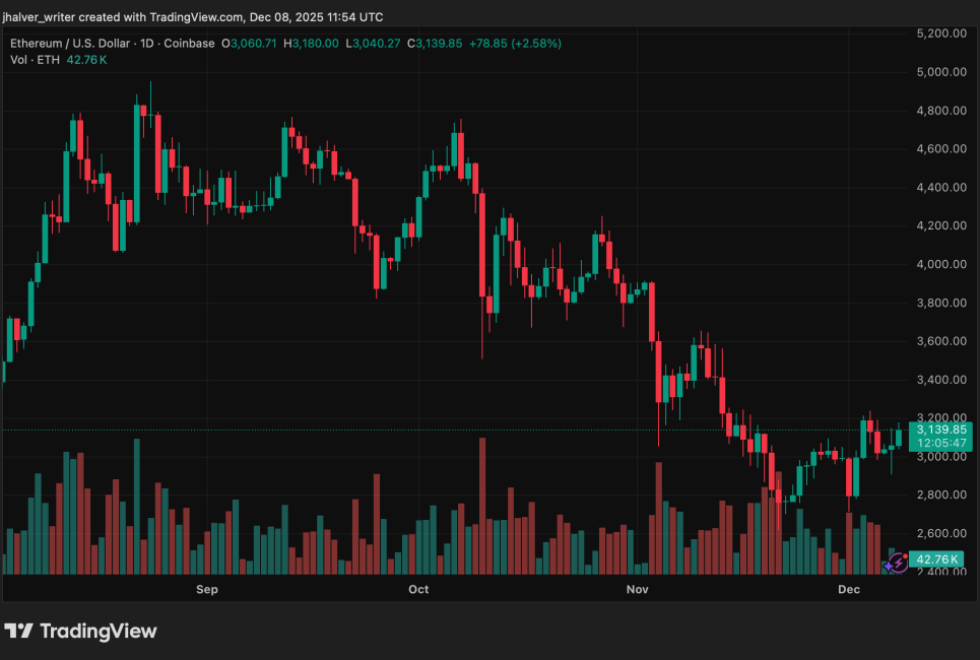
ETH's price records small profits on the daily chart. Source: ETHUSD on Tradingview

Why Has AI Taken the Spotlight

Across its 33 pages, the strategy places artificial intelligence, biotechnology, and quantum computing at the center of America’s next-generation competition.

The administration states that U.S. technology and standards must “drive the world forward,” underscoring a focus on advanced computing rather than decentralized finance. Digital assets, which had gained prominence through previous remarks from officials, receive no explicit mention.

This stands at odds with comments from President Trump in recent months. In a CBS 60 Minutes interview, he warned that China should not become the global leader in virtual assets and insisted that Bitcoin mining should remain within U.S. borders.

A Subtle Reference, but No Clear Policy

While crypto is not named in the strategy, the document does reference strengthening American “leadership in digital finance and innovation.”

Analysts view this as a broad gesture rather than a firm policy direction, but it leaves open the possibility that digital assets may still influence future regulatory or economic strategies.

This ambiguity comes despite a year of significant pro-crypto actions. Measures such as the GENIUS Act for stablecoin oversight, the formation of a crypto enforcement task force, reduced regulatory pressures on exchanges, and opposition to a central bank digital currency have all shaped expectations.

The establishment of a national Bitcoin reserve, funded through forfeited digital assets, further signals that crypto remains a strategic consideration even if not formally acknowledged in the latest blueprint.

Market Response and Broader Implications

Currently trading around $91,900, Bitcoin briefly fell below $90,000 following the release of the strategy, a move compounded by broader macroeconomic pressures and anticipation of a Federal Reserve rate decision.

The administration’s call for increased defense spending among NATO allies has also raised questions about inflation and monetary policy, factors that could influence investor appetite for digital assets.

For now, the omission leaves the industry navigating a familiar gap of strong political rhetoric, scattered policy initiatives, but no comprehensive framework. As the U.S. centers its priorities around AI and quantum computing, crypto’s position in national strategy remains undefined. Is this the end of the ‘Crypto Administration’?

Cover image from ChatGPT, ETHUSD chart from Tradingview

Trending Cryptos

Related Reads

Now the Greatest Regret Is to My Family: Crypto Experts Took a Stumble in the Stock Market

Summary: This article examines the significant losses recently suffered by cryptocurrency traders and influencers who ventured into the stock market, specifically by heavily investing in AI-related and semiconductor storage stocks. The narrative centers on the dramatic reversal in the Korean and US equity markets in late July, with stocks like SK Hynix and related leveraged ETFs experiencing historic plunges, erasing massive gains. The analysis highlights several key factors behind the "flip." Traders, accustomed to crypto's high volatility and frustrated by a stagnant market, chased the apparent momentum in AI-themed equities. Many made fatal mistakes: applying high-leverage strategies common in crypto (e.g., 2x ETFs, on-chain perpetual contracts) to stocks, and failing to understand the distinct rules of different stock markets (like Korean pre-market trading). This led to widespread liquidations, especially when a thin Korean pre-market trade triggered a cascading flash crash on a decentralized exchange. Post-crash reflections from prominent figures reveal deep regret and self-criticism. They acknowledge misjudging their expertise, overestimating their edge against sophisticated institutional players, and the dangers of leverage. The article concludes that while such setbacks are part of trading, surviving long-term requires recognizing one's limitations and the inherent risks of cross-market strategies.

marsbit55m ago

Now the Greatest Regret Is to My Family: Crypto Experts Took a Stumble in the Stock Market

marsbit55m ago

US Senate Makes Important Amendments to "Conflict of Interest" Section of Cryptocurrency Bill

The U.S. Senate has taken a key step regarding the CLARITY Act, which could shape the future of the U.S. crypto market. On July 29, Senators Tom Tillis and Ruben Gallego finalized amendments to the bill's "conflict of interest" rules, one of its most contentious aspects. The bipartisan bill aims to tighten restrictions on high-level federal officials' ties to digital assets. The new text, crafted as an alternative to a White House-endorsed ethics code, is expected to impose stricter rules limiting officials' ability to issue or directly participate in digital asset projects. However, with Congress entering an August recess and the revised text not yet reviewed by much of the Senate, the bill's timeline is uncertain. Senate Majority Leader John Thune indicated a procedural vote could occur between July 29 and August 1 but expressed doubt the full bill could pass before the break. The House-approved CLARITY Act, passed in July 2025, has been under Senate negotiation for over a year. Key goals of the CLARITY Act include clarifying jurisdictional boundaries between the SEC and CFTC, setting rules for digital commodity spot markets, and addressing topics like stablecoin yields, DeFi, and illicit financing. The stablecoin yield provisions could significantly impact U.S.-based DeFi protocols, exchanges, and issuers, affecting their global competitiveness. The outcome is being closely watched by both the U.S. and global digital asset markets.

cryptonews.ru1h ago

US Senate Makes Important Amendments to "Conflict of Interest" Section of Cryptocurrency Bill

cryptonews.ru1h ago

Pavel Durov Designated as a Terrorist in Russia. What Does This Mean for Telegram Users?

Pavel Durov, the founder of Telegram, has been added to Russia's list of terrorists and extremists by Rosfinmonitoring, as published on July 30. The entry includes his name and date of birth. The designation follows an announcement by the Russian Federal Security Service (FSB) on July 29, which charged Durov with aiding terrorist activity. The FSB alleges that a Telegram dating bot named "DaiVinchik" was used to recruit 46 individuals for attacks on police and arson, orchestrated by Ukrainian special services. The FSB also accuses Telegram's administration of failing to remove channels and bots used by Ukrainian intelligence and extremist groups. Durov is reportedly subject to an international arrest warrant. Inclusion on the Rosfinmonitoring list leads to significant restrictions: the freezing of Durov's bank accounts and assets, severe limitations on financial transactions, and a ban on election participation, media interaction, and event organization. Transfers to his accounts may be considered terrorism financing. For ordinary Russian Telegram users, purchasing Telegram Premium is not classified as financing terrorism, according to an IT expert. General use of the messenger—messaging, managing channels—does not automatically make a user a participant in extremist activity. There has been no official decision to ban Telegram itself. It is noted that French authorities are also investigating Durov over allegations of inadequate measures against criminal activity on the platform and insufficient cooperation with law enforcement. Durov denies all charges.

cryptonews.ru2h ago

Pavel Durov Designated as a Terrorist in Russia. What Does This Mean for Telegram Users?

cryptonews.ru2h ago

Trading

Spot

Hot Articles

How to Buy PUSH

Welcome to HTX.com! We've made purchasing Push Protocol (PUSH) simple and convenient. Follow our step-by-step guide to embark on your crypto journey.Step 1: Create Your HTX AccountUse your email or phone number to sign up for a free account on HTX. Experience a hassle-free registration journey and unlock all features.Get My AccountStep 2: Go to Buy Crypto and Choose Your Payment MethodCredit/Debit Card: Use your Visa or Mastercard to buy Push Protocol (PUSH) instantly.Balance: Use funds from your HTX account balance to trade seamlessly.Third Parties: We've added popular payment methods such as Google Pay and Apple Pay to enhance convenience.P2P: Trade directly with other users on HTX.Over-the-Counter (OTC): We offer tailor-made services and competitive exchange rates for traders.Step 3: Store Your Push Protocol (PUSH)After purchasing your Push Protocol (PUSH), store it in your HTX account. Alternatively, you can send it elsewhere via blockchain transfer or use it to trade other cryptocurrencies.Step 4: Trade Push Protocol (PUSH)Easily trade Push Protocol (PUSH) on HTX's spot market. Simply access your account, select your trading pair, execute your trades, and monitor in real-time. We offer a user-friendly experience for both beginners and seasoned traders.

4.1k Total ViewsPublished 2024.03.29Updated 2026.06.02

How to Buy PUSH

Discussions

Welcome to the HTX Community. Here, you can stay informed about the latest platform developments and gain access to professional market insights. Users' opinions on the price of PUSH (PUSH) are presented below.

活动图片