Crypto altseaon unlikely in 2026 as ‘blue-chip survivors’ to win out: Analyst

cointelegraphPublished on 2025-12-23Last updated on 2025-12-23

Abstract

CoinEx Research analyst Jeff Ko predicts a traditional altcoin season is unlikely in 2026, with liquidity becoming "ruthlessly selective" and flowing only to blue-chip cryptocurrencies with real adoption, rather than lifting all altcoins. He anticipates modest global liquidity tailwinds but notes Bitcoin's correlation to money supply growth has diminished post-ETF. His base case sees Bitcoin reaching $180,000 by 2026. Conversely, veteran analyst Peter Brandt expects another prolonged bear market, projecting the next bull market peak in September 2029, aligning with the four-year cycle theory. This could involve an 80% decline from the peak, potentially sending Bitcoin to $25,000. Bitcoin is currently trading around $88,000, down 30% from its October all-time high, and is experiencing its second-worst fourth quarter historically.

The typical altcoin rally is likely to wane next year, with only “blue chip” cryptocurrencies seeing the lion’s share of liquidity, says CoinEx Research chief analyst Jeff Ko.

“Retail investors expecting a rising tide to lift all boats will be disappointed,” Ko told Cointelegraph. “We predict no traditional altseason; instead, liquidity will be ruthlessly selective, flowing only to blue-chip survivors with real adoption.”

Ko anticipated “modest global liquidity tailwinds in 2026,” tempered by divergent central bank policies, but added that Bitcoin's historical sensitivity to the M2 money supply growth “has softened since the 2024 ETF launches, with correlation diminishing.”

He added that the company’s “base case sees Bitcoin targeting $180,000 by 2026.”

However, not all analysts agree, with veteran analyst Peter Brandt predicting another long, drawn-out bear market.

Bitcoin to next peak in 2029

Brandt, a veteran futures trader, said on Tuesday that in 15 years, Bitcoin has experienced five parabolic advances on a logarithmic scale followed by at least 80% declines, but the “current cycle is not done yet.”

However, when asked about the bottom of this cycle, he “projected the next bull market high to occur in September 2029.”

The prediction would line up perfectly with the four-year cycle theory and the peak coming a year after the halving event, which is due around April 2028. However, an 80% decline as seen in previous cycles could send BTC crashing back to $25,000 before that happens.
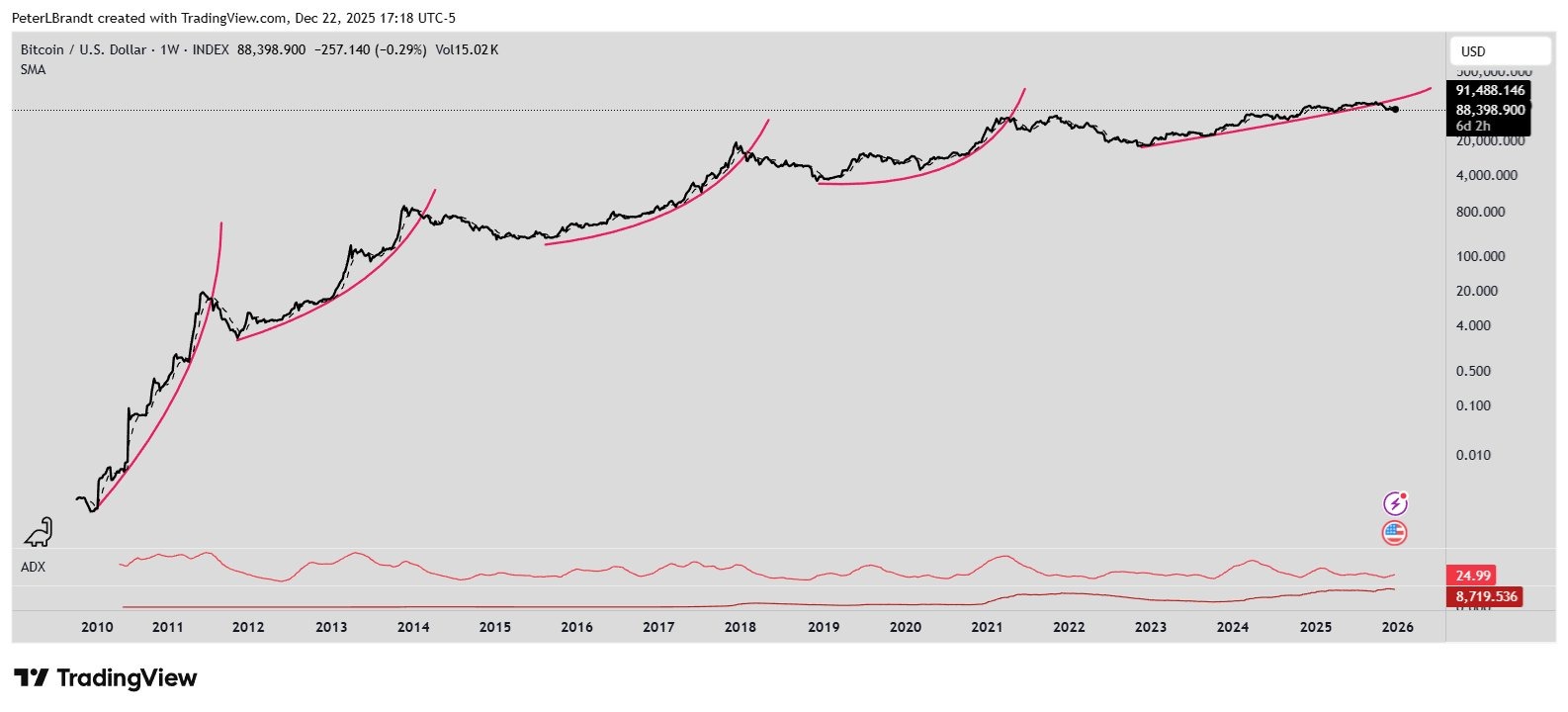
Bitcoin’s five parabolic advances. Source: Peter Brandt

Is the four-year cycle dead?

Historically, the fourth quarter of the year has often been one of Bitcoin’s strongest periods. Eight of the past 12 fourth quarters have seen Bitcoin's biggest quarterly gains, and only one of them was a single-digit gain, according to Coinglass.

Related: Bitcoin's apparent demand shrinks, signals new bear market: Analysts

However, Bitcoin is down more than 22% over the current quarter, marking its second-worst fourth quarter in history so far.

Macro investing feed Milk Road said on Monday that “this usually means the market has flushed a lot of excess risk and weak positioning.”

“So for 2026, it doesn’t automatically guarantee upside, but historically, cycles that finish with a heavy reset tend to have better conditions to build strength.”

Bitcoin (BTC) is currently trading around $88,000, down 30% from its October all-time high.

Magazine: Bitcoin’s critical level is $82.5K, Ethereum ‘not done yet’: Trade Secrets

Trending Cryptos

Related Questions

QAccording to CoinEx Research analyst Jeff Ko, what is unlikely to happen in 2026 and why?

AA traditional altseason is unlikely in 2026 because liquidity is expected to be 'ruthlessly selective,' flowing only to blue-chip cryptocurrencies with real adoption, rather than lifting all altcoins.

QWhat is Jeff Ko's base case price target for Bitcoin by 2026?

AJeff Ko's base case sees Bitcoin targeting $180,000 by 2026.

QWhat does veteran analyst Peter Brandt predict for the timing of the next Bitcoin bull market peak?

APeter Brandt projected the next bull market high for Bitcoin to occur in September 2029.

QHow does the current fourth quarter (Q4) performance of Bitcoin compare to its historical performance?

ABitcoin is down more than 22% in the current quarter, marking its second-worst fourth quarter in history, whereas historically, Q4 has often been one of Bitcoin's strongest periods.

QWhat is the significance of an 80% decline in previous Bitcoin cycles, according to the article?

AAn 80% decline, as seen in previous cycles, could send Bitcoin's price crashing back to around $25,000 before the next bull market peak.

Related Reads

7 Months After the Collapse of Huiwang, Southeast Asia's Escrow Platforms Undergo a Major Reshuffle

Following the collapse of Huione Pay—dubbed the "Alipay of Southeast Asia"—seven months ago, the region's underground financial guarantee platform sector is undergoing a significant reshuffle. This power vacuum has been swiftly filled by emerging platforms such as XinBi, Tiger/Navigator, JinBei (renamed JinBo), Dali/Tiancheng, and FullyLight. These platforms, operating largely via Telegram and offering services like escrow for illicit transactions, have absorbed the vast user base and markets left behind by Huione. While positioning themselves as "trust intermediaries," their primary clientele consists of networks involved in online scams, money laundering, illegal gambling, and even human trafficking. For instance, the Tiger/Navigator platform explicitly provides "escrow" services for kidnapping-for-ransom operations ("强押车交易"). Data underscores the immense scale: Huione alone processed over $103 billion in cryptocurrency payments and facilitated over $31 billion through its escrow market before its downfall, linking it to Cambodia's notorious Prince Group. Since its collapse, competitors have seen explosive growth. For example, the XinBi platform has accumulated over $1.6 billion in total USDT revenue, while platforms like NewPay, OkPay (under Dali), and FullyLight Wallet collectively processed over $4.8 billion in USDT in a single year. This ecosystem thrives in regions like Cambodia and Myanmar, where regulatory gaps allow these platforms to act as critical financial infrastructure for sprawling cybercrime industries, from scam compounds to online casinos. The article concludes that the moniker "Southeast Asian Alipay" is a misnomer, obscuring the platforms' fundamental role in enabling serious criminal enterprises rather than representing legitimate financial innovation.

Odaily星球日报40m ago

7 Months After the Collapse of Huiwang, Southeast Asia's Escrow Platforms Undergo a Major Reshuffle

Odaily星球日报40m ago

The Changing Landscape: What Are Crypto VCs Experiencing?

Title: The Shifting Landscape of Crypto Venture Capital The era of dedicated crypto venture capital funds is undergoing a significant transformation. Once essential for navigating the sector's complexity and high risk, these specialized funds are now facing an identity crisis as the market matures. This shift mirrors historical patterns in other specialized investment classes like cleantech and SPACs, where initial information advantages dissipate as technologies become mainstream and integrated into existing industry frameworks. The article argues that crypto is reaching a critical inflection point, transitioning from a "building phase" to an "integration phase." Major players like Stripe, BlackRock, and Visa now engage with crypto not for its novel mechanics but as a foundational financial infrastructure. Their needs—regulatory compliance, banking partnerships, distribution channels—align with traditional fintech, a domain easily understood by large, generalist funds like Sequoia and Founders Fund. This evolution creates a "barbell effect" within the VC landscape. On one end are massive, diversified platforms that can incorporate crypto as one vertical among many. On the other are small, nimble funds focused on niche, experimental projects. The middle ground—medium-sized dedicated crypto funds—is being squeezed out. Their typical fund size makes it impossible to generate sufficient returns solely from early-stage crypto bets, yet they cannot compete with giants for later-stage deals. Consequently, leading crypto-native firms like Paradigm and Framework Ventures are expanding into AI, robotics, and other sectors, driven partly by LP pressure for better returns amid a broader VC DPI crisis. Others, like Dragonfly and a16z, have narrowed their crypto focus predominantly to financial infrastructure like stablecoins, reframing the sector's core narrative. For crypto entrepreneurs, this consolidation presents challenges. While generalist funds offer larger checks and broader resources, crypto projects now compete fiercely with AI for attention and capital within these firms. Furthermore, the long-term, non-commercial foundational work that built the ecosystem—funded by dedicated crypto VCs—is less likely to attract generalist capital focused on direct returns. The conclusion is that "crypto investor" as a standalone category is becoming obsolete, akin to "internet investor." Crypto is becoming a baseline infrastructure layer. The future will see a barbell structure: large-scale growth financing handled by generalist funds, while pioneering, speculative projects are funded by small, specialized vehicles. The dedicated crypto funds of the 2017-2021 boom, which incubated core infrastructure, are giving way to this new, bifurcated reality.

Foresight News58m ago

The Changing Landscape: What Are Crypto VCs Experiencing?

Foresight News58m ago

As Consensus Accelerates, What Are Young Investors Betting On?

Title: As Consensus Forms Faster, What Are Young Investors Betting On? In the rapid evolution of tech investment, a new generation of young investors is navigating a landscape where AI, robotics, commercial aerospace, and quantum computing are advancing simultaneously. Traditional investment logic based on financial models is giving way to a need for deep technical understanding and the ability to act before industry consensus forms. An analysis of trends from the "WAIC FUTURE TECH" list of young investment leaders reveals key shifts in focus. The first major trend is the movement of AI from the digital screen into the physical world. Investment is shifting from large language models and chatbots towards embodied AI, robotics, AI hardware, and edge computing. While demonstrations generate excitement, the real challenge lies in achieving scalable, reliable, and cost-effective delivery in complex real-world environments like factories and logistics. Success depends not just on algorithms but on the integration of sensors, actuators, and control systems. Second, the competitive focus for large models is moving beyond raw capability toward building an "intelligence flywheel." The goal is to create self-reinforcing systems where user interaction generates data, improving the model, which in turn enhances the user experience and attracts more engagement. Companies that successfully embed AI into workflows to create these closed-loop systems can build lasting value that isn't easily erased by the next model upgrade. Third, facing a potential bottleneck in high-quality human-generated data, investors are looking at new underlying technologies. Reinforcement learning and self-play, as demonstrated by AlphaGo Zero, offer paths for AI to generate its own experience. Scientific foundation models, which aim to build general AI capabilities for fields like life sciences and materials discovery, represent a non-consensus direction that could unlock new frontiers of knowledge and data. Finally, in deep-tech areas like quantum computing, commercial aerospace, and space-based infrastructure, patient capital is essential. These fields have long, uncertain development and validation cycles involving complex engineering, supply chains, and regulations. Investment here requires a long-term view, focusing on foundational team capabilities and the eventual emergence of market demand, even if commercial returns are distant. Collectively, these trends illustrate how young investors are adapting to a new era. They are learning to make earlier, technically-informed judgments, balance hype with real-world viability, and provide the patient capital needed to build the deep-tech foundations of the future.

marsbit1h ago

As Consensus Accelerates, What Are Young Investors Betting On?

marsbit1h ago

Trading

Spot

Hot Articles

What is $BLUE

Blue on Base ($BLUE): The New Frontier in the Meme Economy Introduction In the continuously evolving landscape of digital technologies, the emergence of innovative projects in the realm of Web3 has captured the attention of many. Among these, Blue on Base, denoted by its ticker symbol $BLUE, stands out as a unique concept within the burgeoning world of cryptocurrencies. This project serves as a testament to the fusion of memes, art, and digital progress. Through its novel approach, it encapsulates the essence of what it means to ride the wave of the meme economy, while contributing significantly to the wider dialogue in the blockchain community. What is Blue on Base ($BLUE)? At its core, Blue on Base is described as the first-ever base metameme, a digital construct that captures the distinctive spirit of blue-themed memes. The project aspires to elevate these memes to what it refers to as “the blue sky,” symbolising an expansive horizon of possibilities within the digital landscape. The creators of Blue on Base envision a metameme representing the collective voice of the burgeoning blue meme culture—offering a spectrum from the deepest cobalt hues to the brightest cerulean shades. This project aims to provide a conduit for cultural expression, allowing participants to engage with an expansive library of memes that resonate across various digital platforms. Central to the ambition of Blue on Base is the understanding that memes are more than fleeting images—they embody social commentary, artistic expression, and cultural identities. By tapping into the vast potential of meme culture, the project hopes to engage users by providing a multifaceted platform that brings both entertainment and a sense of community. Who is the Creator of Blue on Base ($BLUE)? The information regarding the creator of Blue on Base ($BLUE) is regrettably sparse. As of now, details pertaining to the individuals or team behind this innovative project remain unknown. This lack of transparency raises questions about accountability and identity in a project that is standard in the crypto space, but it also emphasises the project's focus on the community rather than singular personalities. Who are the Investors of Blue on Base ($BLUE)? While investment dynamics are crucial for the success of any cryptocurrency project, explicit details regarding the financial backers or investment foundations associated with Blue on Base ($BLUE) are not readily available. This lack of defined investor identity raises a critical point regarding transparency in crypto projects—a vital aspect that keeps potential investors and participants apprised of the project’s sustainability. How Does Blue on Base ($BLUE) Work? Central to understanding Blue on Base is its operational framework, which revolves around the concept of being a metameme. This unique approach allows the project to harness the viral nature of memes and engage with a broad audience on Web3 platforms. The project does this by embracing various blue-themed meme constructs which serve as both community engagement tools and frameworks for digital expression. At its heart, Blue on Base works to establish itself as a pivotal player in the meme economy, inviting users to contribute, create, and engage with content defined by its blue theme. The project facilitates interactions among community members, thereby enhancing user experience while pushing the blue meme narrative forward. It's important to note that while the project hinges on community-generated content, specifics regarding its technological infrastructure, such as smart contract dynamics or tokenomics, are not extensively detailed in the current information set. As the project advances, clearer technical specifications will likely emerge, providing a more comprehensive understanding of its functionality. Timeline of Blue on Base ($BLUE) Although detailed chronological milestones of Blue on Base are limited, the conceptualisation and positioning of the project highlight its relevance in the timeline of Web3 innovations. As the atmosphere surrounding cryptocurrencies and meme cultures evolves, Blue on Base fits within the broader context of digital advancement. The timeline of Blue on Base can be inferred generally through key events typical of crypto projects, including conceptual announcement, initial community engagements, and launching phases. It would be critical for interested parties to remain vigilant for updates as the project's trajectory develops over time, possibly yielding significant milestones and growth phases. Key Points About Blue on Base ($BLUE) Concept: Blue on Base ($BLUE) is a digital project that represents the first-ever base metameme, reflecting the intertwining of memes, art, and digital progress. Objective: The project seeks to assemble the strength of various blue-themed memes and represent the collective voice of a new digital dawn. Creator: Currently unknown, emphasising a community-oriented ethos. Investors: Information about specific investors or backing foundations remains unspecified. Operation: Utilises its metameme concept to foster engagement and innovation within Web3, focusing on user participation and cultural significance. Additional Information While Blue on Base ($BLUE) has a unique identity within the cryptocurrency realm, it is paramount that engaging with such projects be conducted with due diligence. Clarity on the potential impacts and innovations of these emerging projects must be approached with discerning optimism. In conclusion, Blue on Base ($BLUE) emerges as an intriguing facet of the evolving digital and meme economies. By framing itself as a metameme, it seeks to challenge conventional interpretations of meme culture while embracing the collective creativity of its community. As the Web3 landscape continues to expand, projects like Blue on Base offer valuable insights into the future intersection of culture, technology, and digital interaction. As the project evolves, further examinations will be needed to provide insights into how it carves its niche in the meme economy and broader cryptocurrency space—ultimately shaping the conversation surrounding digital culture.

95 Total ViewsPublished 2024.04.22Updated 2024.12.03

What is $BLUE

What is VRJAM(BLUE)

VRJAM(BLUE): Revolutionising Live Experiences in the Virtual World Introduction to VRJAM(BLUE), $vrjam(blue) In an age where virtual experiences are becoming increasingly prevalent, VRJAM(BLUE), represented by the token $vrjam(blue), emerges as a pioneering project within the cryptocurrency space. Launched in 2022, VRJAM(BLUE) seeks to transform how live events are conducted in the digital realm by utilising the power of blockchain technology and the Hedera Hashgraph platform. As a unique blend of immersive social gaming and interactive virtual events, VRJAM(BLUE) strives to create a comprehensive, engaging experience that resonates with users worldwide. What is VRJAM(BLUE), $vrjam(blue)? At its core, VRJAM(BLUE) is a live experience platform harnessing blockchain to facilitate immersive interactions during virtual events. It stands out as a futuristic solution that allows users to engage with one another in real time, bridging the gap between the physical and digital worlds. The platform leverages advanced technologies, including AI-powered virtual humans, which introduce customisable digital representations of users. These entities serve as avatars that enhance the social dynamics of virtual gatherings. Coupling these virtual beings with the use of non-fungible tokens (NFTs) introduces a layer of security and authenticity, ensuring that unique digital assets can be traded and valued properly within the platform's ecosystem. Moreover, VRJAM(BLUE) integrates a native cryptocurrency, the VRJAM Coin, which acts as the medium of exchange within its virtual world. This digital currency facilitates transactions for services, content, and assets while enabling users to participate seamlessly in live events and interactive experiences. Creator of VRJAM(BLUE), $vrjam(blue) The specific identity of the creator of VRJAM(BLUE) remains undisclosed, though the project is under the leadership of CEO Sam Speaight. His vision for the platform aims at leveraging innovative technology and strategic partnerships to expand the reach and impact of VRJAM(BLUE) in the rapidly evolving web3 ecosystem. Investors of VRJAM(BLUE), $vrjam(blue) VRJAM(BLUE) has garnered considerable interest from various investors and funding rounds, successfully raising a total of $5.34 million throughout 12 funding events. These various initiatives, including Initial DEX Offerings (IDO) and token launches, have provided the necessary capital to propel the project forward. However, specific details regarding the individual investors or organisations backing VRJAM(BLUE) have not been disclosed. How Does VRJAM(BLUE), $vrjam(blue) Work? The innovative approach of VRJAM(BLUE) revolves around multiple cutting-edge technologies, notably artificial intelligence, virtual reality, and blockchain. AI-Powered Virtual Humans A distinguishing feature of VRJAM(BLUE) is its integration of AI-powered virtual humans. These customisable characters respond dynamically to user interactions, enriching the overall experience of virtual events. This personalisation allows users to create unique identities and facilitates more meaningful connections within the community. NFT Technology By incorporating NFT technology into its framework, VRJAM(BLUE) provides users with enhanced security and ownership of digital assets. Users can purchase, sell, or trade NFTs that represent virtual tickets, memorabilia, or other digital creations linked to live events, ensuring that ownership is verifiable and protected. Native Cryptocurrency The VRJAM Coin serves as the platform's native currency, allowing users to transact seamlessly within the virtual environment. This cryptocurrency not only supports traditional user activities but also bolsters a larger economic ecosystem tailored to the needs of VRJAM’s community. DeFi Solutions The project also embraces decentralised finance (DeFi) by incorporating trustless protocols. These solutions aim to stabilise token prices and enhance liquidity, allowing users to engage in financial transactions without intermediary restrictions. Timeline of VRJAM(BLUE), $vrjam(blue) To fully understand the evolution of VRJAM(BLUE), it's essential to take a closer look at its timeline: 2022: Launch of VRJAM(BLUE) – The platform made its debut, ushering in a new era for virtual event experiences. November 30, 2022: Completion of the Token Generation Event (TGE) – This marked a significant milestone, as the platform's native cryptocurrency became available for investor engagement. Post-TGE: Following the TGE, the distribution of tokens initiated, featuring a 20% immediate release, followed by a linear vesting phase of the remaining 80% over a period of six months. Key Features and Partnerships The success of VRJAM(BLUE) can also be attributed to its strategic partnerships and innovative features. Partnerships In its quest to bring life to the metaverse, VRJAM(BLUE) has formed alliances with prominent entities in the industry. Notably, its collaboration with Polygon aims to enhance the efficiency and reach of live events. Additional partnerships with organisations such as Agora and Enjin further bolster content distribution and the utilisation of NFT technology. These collaborations are enhancing VRJAM(BLUE)'s capabilities and expanding its influence in the web3 ecosystem. Token Liquidity Protocol Operating on the Hedera Hashgraph, VRJAM(BLUE) employs a token liquidity protocol that aggregates liquidity across various trading platforms. This initiative is designed to unify token pricing, thus enhancing user confidence in the VRJAM Coin and promoting stability within the ecosystem. Web3 Economy With the overarching aim of fostering a sustainable web3 economy, VRJAM(BLUE) is diligently working on its DeFi product suite. By providing users with tools for financial engagement, such as yield farming or staking, the project is paving the way for broader participation in its virtual economy. Conclusion VRJAM(BLUE), with its token $vrjam(blue), stands at the forefront of the revolution in virtual experiences and live interactions within the digital space. By intertwining advanced technologies such as AI, virtual reality, and blockchain, the project has developed a platform that not only facilitates immersive experiences but also builds a vibrant, interactive community. As the landscape of the crypto and web3 industries continues to evolve, VRJAM(BLUE) aims to play a critical role in shaping the future of virtual events and experiences. With its commitment to innovation and community engagement, VRJAM(BLUE) is well-positioned to pave a prosperous path for digital interactions in the years to come.

65 Total ViewsPublished 2024.12.03Updated 2024.12.03

What is VRJAM(BLUE)

Discussions

Welcome to the HTX Community. Here, you can stay informed about the latest platform developments and gain access to professional market insights. Users' opinions on the price of BLUE (BLUE) are presented below.

活动图片













