Coinbase opens Solana DEX access as CeFi and DeFi converge

cointelegraphPublished on 2025-12-11Last updated on 2025-12-11

Abstract

Coinbase is expanding its support for the Solana ecosystem by enabling users to trade native Solana tokens directly through a decentralized exchange (DEX) integration, bypassing traditional listing requirements. This move allows tokens with sufficient liquidity to become accessible to Coinbase’s user base without a formal listing process. The integration follows a similar rollout for Base blockchain tokens in August and is part of a broader strategy to incorporate DEX support across multiple networks. The announcement comes amid significant growth in Solana’s DeFi ecosystem, including new platform launches and increased on-chain lending and trading activity. Industry reports highlight Solana’s rising dominance in on-chain finance, with institutional-grade DeFi strategies gaining traction. This development reflects a larger trend of centralized exchanges like Coinbase, OKX, and Binance increasingly integrating DEX functionalities, acting as user-friendly frontends for decentralized trading amid growing DEX liquidity and improved user experience.

Coinbase is moving deeper into the Solana ecosystem, letting users trade native Solana tokens through a decentralized exchange integration rather than traditional listings.

Andrew Allen, Coinbase protocol specialist, said in an X post that Coinbase now allows its users to trade all Solana (SOL) tokens through a decentralized exchange (DEX) integration, “without listings,” he noted, adding that “very soon you will be able to open the Coinbase app and see native Solana assets on Coinbase.”

“For issuers and builders, if your token has sufficient liquidity, this means you can be accessible to the millions of users on Coinbase without getting listed,” Allen said.

The announcement follows Coinbase’s integration of tokens from its Base blockchain through a similar DEX integration in early August. The announcement noted that the exchange plans to “expand DEX support to include additional networks, starting with Solana.”
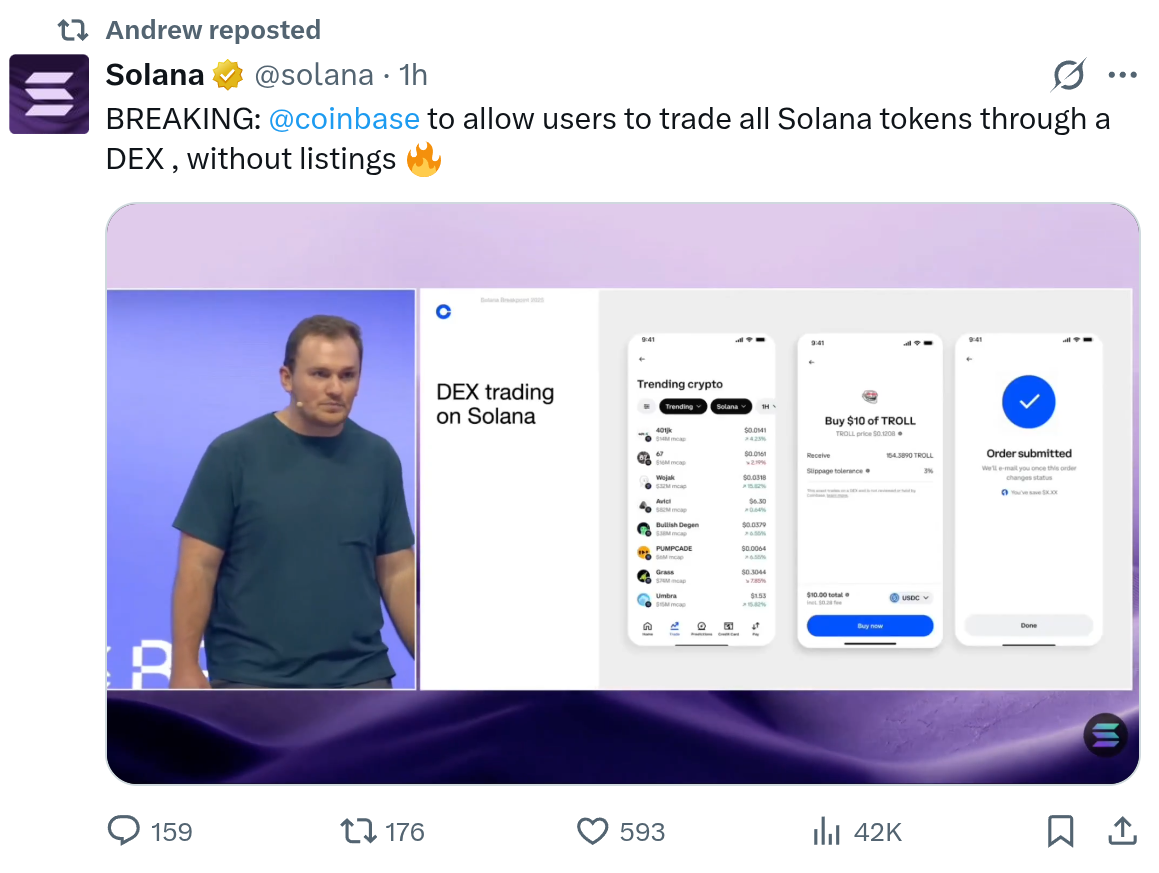
Source: Andrew Allen/Solana

Related: Coinbase to roll out its new ‘DeFi Mullet’ offering in Brazil

Solana’s DeFi ecosystem is booming

Coinbase’s integration comes amid a slew of developments in Solana's decentralized finance (DeFi) ecosystem.

Earlier Thursday, DeFi company Ellipsis Labs announced the launch of its Solana-based perpetual swap DEX. The announcement claims that the platform is fully onchain — including the risk and matching engine — allowing anyone to build on top of it. Still, the platform is currently in private beta and not yet open to the general public.

The launch coincides with a new “Solana Lending Markets Report 2025,” shared with Cointelegraph by DeFi infrastructure firm Redstone. The report argues that “DeFi strategies on Solana have reached institutional-grade sophistication” and points to strong growth in Solana’s onchain lending and trading activity.

Redstone claims that “Solana has become a dominant force in on-chain finance” and “processed $35.9 billion in peak daily DEX volume.” The company expects the next wave of growth to focus on “tokenized real-world assets and institutional capital deployment.”

“Bringing traditional finance onchain at scale can unlock trillions in Internet Capital Markets. Solana's infrastructure is positioned to capture a significant share of this expansion.“

Related: How perp DEXs quietly took over 26% of the futures market

Centralized and decentralized exchanges collide

The Coinbase integration is just the latest manifestation of a broader trend: centralized exchanges are increasingly integrating DEX platforms and serving as a user-friendly front end for them. In early October, Sergej Kunz, the co-founder of DEX aggregator 1inch, stated that centralized crypto exchanges will gradually fade and serve only as frontends for decentralized finance.

The landscape is shifting, with DEX platforms seeing growing liquidity, faster order execution times, lower fees, and an increasingly simplified user experience. DeFi data platform DefiLlama shows that all DEX platforms processed nearly $12 billion worth of trades over the last 24 hours — this is more than Coinbase’s 24-hour spot volume of $2.566 billion and comparable to Binance’s nearly $18 billion as reported by CoinMarketCap.

So far, Kunz’s prediction is holding up, with Coinbase far from the only centralized exchange to roll out similar integrations. In mid-November, crypto exchange OKX also began offering DEX trading on its platform. At the end of March, the world’s top cryptocurrency exchange, Binance, also introduced centralized-to-decentralized exchange trades on Ethereum, Solana, Base, and the BNB Smart Chain.


Trending Cryptos

Related Reads

Wall Street Morning Report: AI + Cloud Computing Takes Over the Market Again, Amazon Knocks on the Door of $3 Trillion

Wall Street's August began with a strong rally, driven by easing Middle East tensions as President Trump signaled progress on U.S.-Iran talks, prompting a sharp drop in oil prices. Major indices hit record or near-record highs, with the Dow Jones Industrial Average up 1.32%, the Nasdaq Composite surging 2.13%, and the S&P 500 rising 1.48%. The energy sector was the sole decliner. The AI and cloud computing narrative dominated the tech rally. The "Magnificent Seven" index jumped 3.6%. Amazon's market cap surpassed $3 trillion for the first time following robust AWS results, while Nvidia regained a $5 trillion valuation. Meta, Google, and Microsoft also posted significant gains. Other AI-related stocks like Palantir, CoreWeave, and various semiconductor and infrastructure companies saw strong advances. In other markets, gold held above $4,000, supported by central bank buying. Treasury yields fell as oil prices dropped. The U.S. dollar remained stable despite strong manufacturing data. Japan's substantial currency intervention raised concerns, but U.S. officials reassured markets about the mechanism used. Key events ahead include major industry conferences (Ai4 2026, FMS Summit) and earnings reports from companies like SpaceX, AMD, and Pfizer. The White House is also set to host a meeting with leading AI firms to discuss regulatory frameworks.

marsbit37m ago

Wall Street Morning Report: AI + Cloud Computing Takes Over the Market Again, Amazon Knocks on the Door of $3 Trillion

marsbit37m ago

The July Tech Stock Pullback: Which Funds Are Paying the Price for Buying High?

In July, China's technology stocks experienced a sharp correction, causing significant pain for actively managed mutual funds that aggressively increased their holdings in the sector during the second quarter. The sell-off saw major indices like the ChiNext and STAR 50 fall over 25% and 28% for the month, respectively. Funds that piled into tech at its June peak faced steep losses. Notably, several veteran "value investor" fund managers, known for long-term holdings in consumer staples, made dramatic shifts. Star managers like Zhang Kun (E Fund Blue Chip Selected) and Liu Yanchun (Invesco Great Wall Dingyi) drastically reduced positions in liquor stocks like Kweichow Moutai, switching instead to semiconductor and AI hardware companies like SMIC and Ingenic International. Data shows active equity funds' allocation to the electronics sector reached a historical high of 42.64% by end-Q2. Around 67 funds saw their TMT (Technology, Media, Telecom) weighting surge from an average of 6.75% to 54.99%. The consequences were severe in July: these high-TMT funds fell an average of over 20%, with 12 plunging more than 40%. Examples include Jinhua High-Quality Growth and Guoshou Anbao Wenhui, which fell 26.34% and nearly 40% respectively after raising TMT weights above 70%. The article also highlights issues of "style drift," where funds with names like "high-dividend" held high-P/E tech stocks instead, confusing investors. Newly launched funds suffered even more. For instance, Guotai Haitong New Energy RuiXuan Hybrid, launched in mid-June, saw its net asset value plummet to 0.5509 yuan by July 30, a loss of nearly 45%. Analysts note the extreme sector concentration mirrored past bubbles (e.g., 2021 new energy). The intense, crowded trade itself became a major risk. While tech stocks rebounded sharply on July 31, the funds that chased the high face a longer-term market test.

marsbit53m ago

The July Tech Stock Pullback: Which Funds Are Paying the Price for Buying High?

marsbit53m ago

Dalio's Warning: AI Bubble Is Here, Gold Is the Hard Asset

Ray Dalio, founder of Bridgewater Associates, warns that the AI sector is currently in a bubble, drawing parallels to historical examples like the 1929 crash and the dot-com bubble. He explains that revolutionary new technologies lead to excessive excitement and investment, often with investors ignoring price fundamentals and taking on debt, which ultimately creates unsustainable asset valuations. Dalio outlines three key signs that a bubble is about to burst: 1) Rising interest rates, which force asset sales for liquidity. 2) A significant increase in stock supply as companies issue more shares. 3) A shift in ownership from steadfast institutional investors to less knowledgeable, often leveraged, retail investors. To navigate the potential downturn, he strongly advocates for a diversified investment portfolio, criticizing cash as a poor long-term store of value due to inflation. He specifically recommends allocating 5-15% of a portfolio to gold, which he views as a unique "hard asset" and an effective hedge because it is no one else's liability. In contrast, he is skeptical of Bitcoin as "digital gold," citing potential vulnerabilities to future technologies like quantum computing and government intervention. Regarding the AI revolution, Dalio believes the primary beneficiaries will be capitalists who own the automating technology, potentially exacerbating wealth inequality as machines replace both physical and increasingly complex cognitive labor. However, he concludes that humans with exceptional intelligence and strong collaborative skills will continue to thrive by leveraging uniquely human traits like emotion and intuition that AI cannot replicate. Finally, touching on his theory of long-term cycles, Dalio suggests the world is currently approaching a significant inflection point in an approximate 80-year cycle of changing world orders.

marsbit1h ago

Dalio's Warning: AI Bubble Is Here, Gold Is the Hard Asset

marsbit1h ago

Trading

Spot

Hot Articles

Discussions

Welcome to the HTX Community. Here, you can stay informed about the latest platform developments and gain access to professional market insights. Users' opinions on the price of SOL (SOL) are presented below.

活动图片