Coinbase opens Solana DEX access as CeFi and DeFi converge

cointelegraphPublished on 2025-12-11Last updated on 2025-12-11

Abstract

Coinbase is expanding its support for the Solana ecosystem by enabling users to trade native Solana tokens directly through a decentralized exchange (DEX) integration, bypassing traditional listing requirements. This move allows tokens with sufficient liquidity to become accessible to Coinbase’s user base without a formal listing process. The integration follows a similar rollout for Base blockchain tokens in August and is part of a broader strategy to incorporate DEX support across multiple networks. The announcement comes amid significant growth in Solana’s DeFi ecosystem, including new platform launches and increased on-chain lending and trading activity. Industry reports highlight Solana’s rising dominance in on-chain finance, with institutional-grade DeFi strategies gaining traction. This development reflects a larger trend of centralized exchanges like Coinbase, OKX, and Binance increasingly integrating DEX functionalities, acting as user-friendly frontends for decentralized trading amid growing DEX liquidity and improved user experience.

Coinbase is moving deeper into the Solana ecosystem, letting users trade native Solana tokens through a decentralized exchange integration rather than traditional listings.

Andrew Allen, Coinbase protocol specialist, said in an X post that Coinbase now allows its users to trade all Solana (SOL) tokens through a decentralized exchange (DEX) integration, “without listings,” he noted, adding that “very soon you will be able to open the Coinbase app and see native Solana assets on Coinbase.”

“For issuers and builders, if your token has sufficient liquidity, this means you can be accessible to the millions of users on Coinbase without getting listed,” Allen said.

The announcement follows Coinbase’s integration of tokens from its Base blockchain through a similar DEX integration in early August. The announcement noted that the exchange plans to “expand DEX support to include additional networks, starting with Solana.”
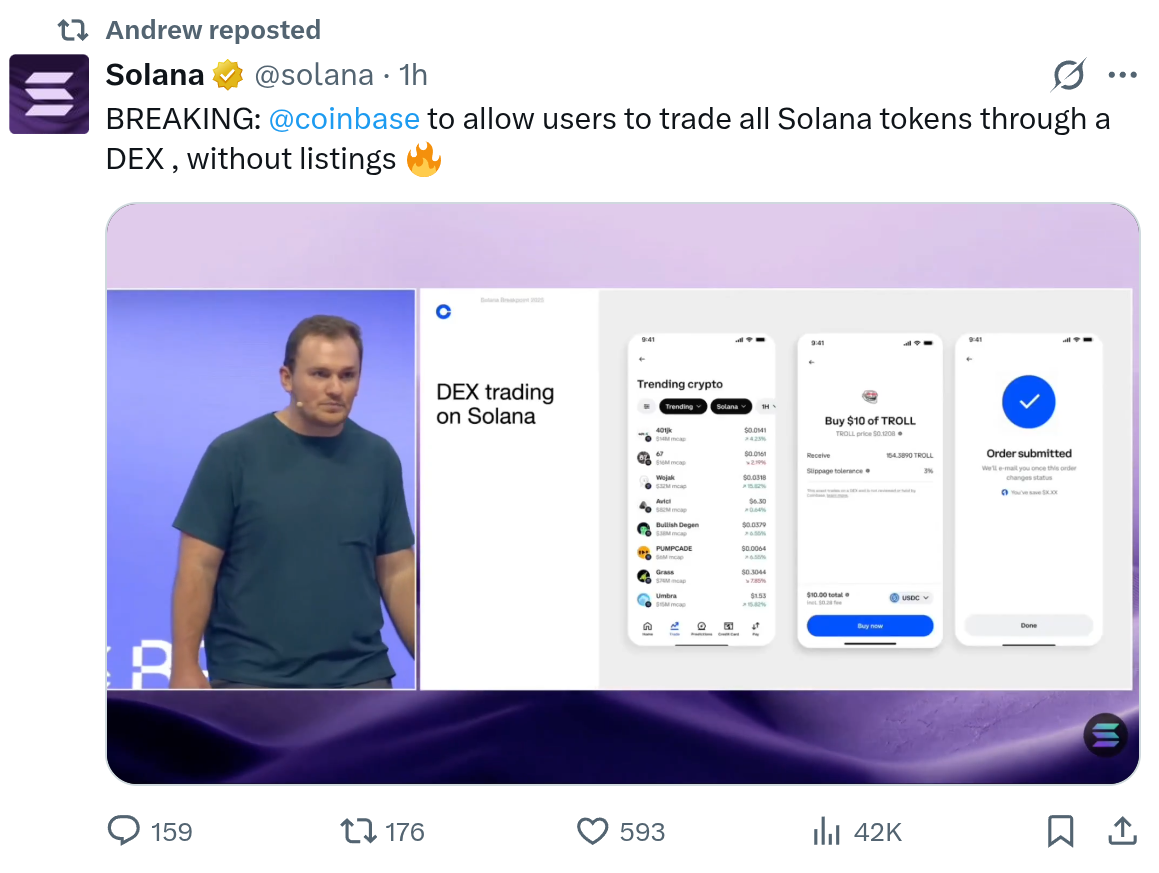
Source: Andrew Allen/Solana

Related: Coinbase to roll out its new ‘DeFi Mullet’ offering in Brazil

Solana’s DeFi ecosystem is booming

Coinbase’s integration comes amid a slew of developments in Solana's decentralized finance (DeFi) ecosystem.

Earlier Thursday, DeFi company Ellipsis Labs announced the launch of its Solana-based perpetual swap DEX. The announcement claims that the platform is fully onchain — including the risk and matching engine — allowing anyone to build on top of it. Still, the platform is currently in private beta and not yet open to the general public.

The launch coincides with a new “Solana Lending Markets Report 2025,” shared with Cointelegraph by DeFi infrastructure firm Redstone. The report argues that “DeFi strategies on Solana have reached institutional-grade sophistication” and points to strong growth in Solana’s onchain lending and trading activity.

Redstone claims that “Solana has become a dominant force in on-chain finance” and “processed $35.9 billion in peak daily DEX volume.” The company expects the next wave of growth to focus on “tokenized real-world assets and institutional capital deployment.”

“Bringing traditional finance onchain at scale can unlock trillions in Internet Capital Markets. Solana's infrastructure is positioned to capture a significant share of this expansion.“

Related: How perp DEXs quietly took over 26% of the futures market

Centralized and decentralized exchanges collide

The Coinbase integration is just the latest manifestation of a broader trend: centralized exchanges are increasingly integrating DEX platforms and serving as a user-friendly front end for them. In early October, Sergej Kunz, the co-founder of DEX aggregator 1inch, stated that centralized crypto exchanges will gradually fade and serve only as frontends for decentralized finance.

The landscape is shifting, with DEX platforms seeing growing liquidity, faster order execution times, lower fees, and an increasingly simplified user experience. DeFi data platform DefiLlama shows that all DEX platforms processed nearly $12 billion worth of trades over the last 24 hours — this is more than Coinbase’s 24-hour spot volume of $2.566 billion and comparable to Binance’s nearly $18 billion as reported by CoinMarketCap.

So far, Kunz’s prediction is holding up, with Coinbase far from the only centralized exchange to roll out similar integrations. In mid-November, crypto exchange OKX also began offering DEX trading on its platform. At the end of March, the world’s top cryptocurrency exchange, Binance, also introduced centralized-to-decentralized exchange trades on Ethereum, Solana, Base, and the BNB Smart Chain.


Trending Cryptos

Related Reads

Altcoin Hacked, Leading to Sharp Price Drop! Also Listed on Major Exchanges!

The price of the NES token plummeted significantly following suspicious activity and large sell-offs detected on the network. Blockchain observers suggested that one wallet minted approximately $55 million worth of NES tokens and began selling them on decentralized exchanges. This selling pressure caused the price of NES to drop by up to 40%. According to the data, the address in question still holds around $18 million worth of NES, indicating that market sell-off pressure may continue. Prior to the incident, it was reported that about $12.35 million worth (62.9 million NES tokens) were transferred to the Ethereum mainnet in the morning (Turkish time), with claims that liquidity was withdrawn and tokens were sold on the market later that evening. However, data regarding the $55 million token mint and the transfer of 62.9 million NES tokens has not been independently confirmed. The NESA team confirmed in a statement that they detected malicious activity exploiting a vulnerability in their Layer 1 network originating from Cosmos EVM. They stated they are working to contain the impact, responded promptly, and will restore services after implementing a software patch and additional measures to ensure secure network operation. Nesa also notified all cryptocurrency exchanges and stated deposit operations will resume after necessary work is completed. The article includes a chart showing the NES price decline following the exploit and concludes with a standard disclaimer that this is not investment advice.

cryptonews.ru2h ago

Altcoin Hacked, Leading to Sharp Price Drop! Also Listed on Major Exchanges!

cryptonews.ru2h ago

PeaqOS and World ID Integrate ZK Proofs into Autonomous Robots

The integration of PeaqOS and World ID now allows autonomous machines to verify they are interacting with real, unique individuals without collecting names, photos, or other personal data. This update, available via robotic.sh, enables connected devices to directly request and verify World ID proofs. The system leverages zero-knowledge technology, letting a person prove they are human while maintaining the privacy of their identity. This addresses a key challenge for operators of delivery robots, shared machines, and autonomous systems: how to authenticate a user as genuine without relying on insecure PINs, pickup codes, or traditional identity checks that require personal data collection. Instead of obtaining identifying information, a device receives a cryptographic proof that the user is a real person. PeaqOS acts as a coordination layer, allowing devices to utilize World ID via decentralized identifiers and a device marketplace. A robot can request verification, receive a zero-knowledge proof, and register an auditable record of the interaction—all without exposing underlying personal data. The system also supports uniqueness verification, enabling machines to enforce rules like "one item per person" without maintaining user identity databases. A demonstrated use case involves autonomous medicine delivery: a patient verifies via the World App when placing an order, a pharmacist verifies before loading the medication, and the patient verifies again upon delivery so the robot can confirm the recipient is linked to the order before unlocking the compartment. Similarly, promotional robots could ensure one item per person, and shared vending machines could grant access to verified individuals without requiring accounts or personal data. This integration for PeaqOS-powered robots and devices minimizes the identity information collected or stored while allowing autonomous systems to confirm they are interacting with real humans.

cryptonews.ru4h ago

PeaqOS and World ID Integrate ZK Proofs into Autonomous Robots

cryptonews.ru4h ago

Trading

Spot

Hot Articles

Discussions

Welcome to the HTX Community. Here, you can stay informed about the latest platform developments and gain access to professional market insights. Users' opinions on the price of SOL (SOL) are presented below.

活动图片