Coinbase opens Solana DEX access as CeFi and DeFi converge

cointelegraphPublished on 2025-12-11Last updated on 2025-12-11

Abstract

Coinbase is expanding its support for the Solana ecosystem by enabling users to trade native Solana tokens directly through a decentralized exchange (DEX) integration, bypassing traditional listing requirements. This move allows tokens with sufficient liquidity to become accessible to Coinbase’s user base without a formal listing process. The integration follows a similar rollout for Base blockchain tokens in August and is part of a broader strategy to incorporate DEX support across multiple networks. The announcement comes amid significant growth in Solana’s DeFi ecosystem, including new platform launches and increased on-chain lending and trading activity. Industry reports highlight Solana’s rising dominance in on-chain finance, with institutional-grade DeFi strategies gaining traction. This development reflects a larger trend of centralized exchanges like Coinbase, OKX, and Binance increasingly integrating DEX functionalities, acting as user-friendly frontends for decentralized trading amid growing DEX liquidity and improved user experience.

Coinbase is moving deeper into the Solana ecosystem, letting users trade native Solana tokens through a decentralized exchange integration rather than traditional listings.

Andrew Allen, Coinbase protocol specialist, said in an X post that Coinbase now allows its users to trade all Solana (SOL) tokens through a decentralized exchange (DEX) integration, “without listings,” he noted, adding that “very soon you will be able to open the Coinbase app and see native Solana assets on Coinbase.”

“For issuers and builders, if your token has sufficient liquidity, this means you can be accessible to the millions of users on Coinbase without getting listed,” Allen said.

The announcement follows Coinbase’s integration of tokens from its Base blockchain through a similar DEX integration in early August. The announcement noted that the exchange plans to “expand DEX support to include additional networks, starting with Solana.”
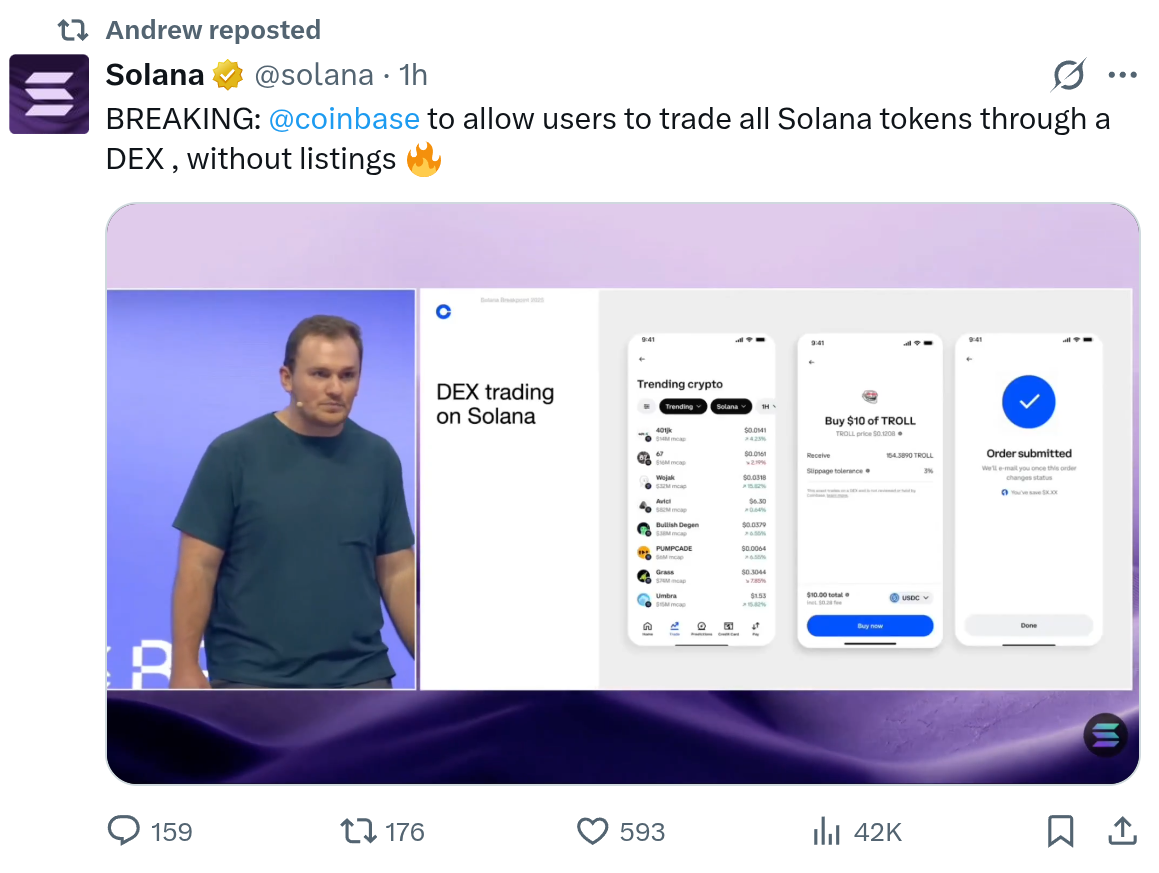
Source: Andrew Allen/Solana

Related: Coinbase to roll out its new ‘DeFi Mullet’ offering in Brazil

Solana’s DeFi ecosystem is booming

Coinbase’s integration comes amid a slew of developments in Solana's decentralized finance (DeFi) ecosystem.

Earlier Thursday, DeFi company Ellipsis Labs announced the launch of its Solana-based perpetual swap DEX. The announcement claims that the platform is fully onchain — including the risk and matching engine — allowing anyone to build on top of it. Still, the platform is currently in private beta and not yet open to the general public.

The launch coincides with a new “Solana Lending Markets Report 2025,” shared with Cointelegraph by DeFi infrastructure firm Redstone. The report argues that “DeFi strategies on Solana have reached institutional-grade sophistication” and points to strong growth in Solana’s onchain lending and trading activity.

Redstone claims that “Solana has become a dominant force in on-chain finance” and “processed $35.9 billion in peak daily DEX volume.” The company expects the next wave of growth to focus on “tokenized real-world assets and institutional capital deployment.”

“Bringing traditional finance onchain at scale can unlock trillions in Internet Capital Markets. Solana's infrastructure is positioned to capture a significant share of this expansion.“

Related: How perp DEXs quietly took over 26% of the futures market

Centralized and decentralized exchanges collide

The Coinbase integration is just the latest manifestation of a broader trend: centralized exchanges are increasingly integrating DEX platforms and serving as a user-friendly front end for them. In early October, Sergej Kunz, the co-founder of DEX aggregator 1inch, stated that centralized crypto exchanges will gradually fade and serve only as frontends for decentralized finance.

The landscape is shifting, with DEX platforms seeing growing liquidity, faster order execution times, lower fees, and an increasingly simplified user experience. DeFi data platform DefiLlama shows that all DEX platforms processed nearly $12 billion worth of trades over the last 24 hours — this is more than Coinbase’s 24-hour spot volume of $2.566 billion and comparable to Binance’s nearly $18 billion as reported by CoinMarketCap.

So far, Kunz’s prediction is holding up, with Coinbase far from the only centralized exchange to roll out similar integrations. In mid-November, crypto exchange OKX also began offering DEX trading on its platform. At the end of March, the world’s top cryptocurrency exchange, Binance, also introduced centralized-to-decentralized exchange trades on Ethereum, Solana, Base, and the BNB Smart Chain.


Trending Cryptos

Related Reads

Bitcoin Withdrawals Continue: 8 Years of Storage in a Coldcard Cold Wallet Ended in Zero

Coldcard Hardware Wallet Hacked: Losses Mount Due to Vulnerable Seed Generation A critical vulnerability in Coldcard hardware wallets has led to a continued wave of fund thefts. According to Galaxy Research, the total stolen has reached 1,367.05 BTC (approx. $88.6 million) from 4,585 addresses, a significant increase from the initial 594.5 BTC reported on July 30, 2026. Most of the stolen funds remain on the attackers' addresses. The issue is not with the current firmware, which Coinkite has updated, but with seed phrases generated on vulnerable devices between March 2021 and the release of fixed firmware versions. Due to a programmer error, devices switched from using a hardware random number generator to the software-based Yasmarang generator, which was initialized with publicly accessible data like the chip's serial number. This made the seed phrases predictable through offline brute-force attacks, meaning wallets remain at risk until funds are moved to a new wallet generated with the patched firmware. Affected devices include Mk2/Mk3 with firmware 4.0.1–4.1.9 (and up to 5.0.3), Mk4/Mk5 up to version 5.6.0, and Q models up to 1.5.0Q. The only exceptions are seeds created with a high-entropy method like at least 50 independent dice rolls or a strong unique BIP-39 passphrase. All other owners must generate a new seed on the fixed firmware and transfer their assets. A case highlighting the human impact involves a 39-year-old long-term investor who lost 2 BTC (approx. $130,000) in minutes. He had accumulated the Bitcoin over eight years through physical labor, viewing it as a financial lifeline and a retirement plan in a country suffering from hyperinflation. His story underscores that even conservative "buy and hold in cold storage" strategies can be compromised by such underlying technical flaws. From a technical perspective, this incident echoes historical failures where weak random number generators undermined cryptographic security, challenging the assumption that offline storage is automatically foolproof.

cryptonews.ru49m ago

Bitcoin Withdrawals Continue: 8 Years of Storage in a Coldcard Cold Wallet Ended in Zero

cryptonews.ru49m ago

Trading

Spot

Hot Articles

Discussions

Welcome to the HTX Community. Here, you can stay informed about the latest platform developments and gain access to professional market insights. Users' opinions on the price of SOL (SOL) are presented below.

活动图片














