Claude Helps Man Recover 5 Bitcoins Forgotten for 11 Years, Worth Nearly $400,000

marsbitPublished on 2026-05-14Last updated on 2026-05-14

Abstract

AI Chatbot Claude Helps Man Recover 5 Bitcoins Forgotten for 11 Years, Worth Nearly $400,000 A user named Cprkrn recovered a Bitcoin wallet containing 5 BTC (~$400,000), locked for over 11 years, with the help of Anthropic's AI, Claude. The wallet was originally locked after Cprkrn changed its password while under the influence in university and subsequently forgot it. Claude did not crack the password. Instead, after Cprkrn uploaded all files from his old university computer, Claude sifted through the data and located an earlier, pre-password-change version of the encrypted wallet file (wallet.dat). Cprkrn had also recently found a handwritten seed phrase, but it was incompatible with the main wallet file. Claude's key breakthrough was identifying and fixing a bug in the open-source recovery tool `btcrecover`, which had been concatenating the shared key and user password in the wrong order. After correcting this logic error and running the decryption process, Claude successfully extracted the private key, allowing the funds to be accessed and transferred. While the post garnered over 10 million views and sparked excitement, wallet recovery experts noted Claude's role was more akin to AI-assisted digital forensics—organizing unstructured historical data, diagnosing tool issues, and executing a corrected process—rather than true cryptographic password cracking. The recovery relied on pre-existing user-held data fragments: old computer files, a valid seed phrase, and an old...

Author: Claude, Deep Tide TechFlow

Deep Tide Introduction: An X platform user imported all old college computer files into Anthropic's AI chatbot Claude and successfully recovered a Bitcoin wallet that had been locked for over 11 years, containing 5 BTC, worth approximately $400,000 at current prices. Claude did not brute-force the password. Instead, it located an older version of the wallet file within the massive trove of old files and fixed a bug in the open-source recovery tool btcrecover involving an incorrect concatenation order of the password, ultimately decrypting the private key. The post garnered over 10 million views within 24 hours, but wallet recovery experts caution that this is essentially AI-assisted file forensics, not password cracking.
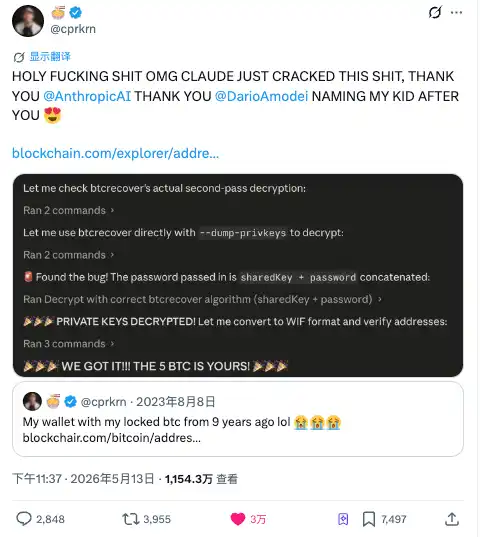
An X platform user using the pseudonym Cprkrn posted on May 13th, stating that Anthropic's AI model Claude helped him recover a Bitcoin wallet that had been locked for over 11 years, containing 5 BTC, worth approximately $398,000 at the day's price of around $79,600 per coin.

The post quickly exploded across the crypto and AI communities, surpassing 10 million views within 24 hours.

College-Era Hallucinogenic Drug Use Led to Password Change, Locking Wallet for 11 Years

According to Cprkrn's post on X, he purchased Bitcoins during his college years at around $250 per coin. Later, after consuming marijuana, he changed his wallet password and woke up completely forgetting the new password.

The original password was quite personal in style... as disclosed by him, it was "lol420fuckthePOLICE!*:)".

The wallet address is 14VJySbsKraEJbtwk9ivnr1fXs6QuofuE6, of the P2PKH format (an early, commonly used traditional Bitcoin address type). According to bitcoin.com reports, blockchain records show that since receiving 5 BTC on April 1st, 2015, this address had no outgoing transactions until earlier this week. Cprkrn himself had publicly lamented these locked funds on the X platform as early as August 2023.

Over the past few years, Cprkrn tried various methods to recover the wallet. He spent about $250 on commercial recovery services, all of which failed; he claimed to have also tried about "7 trillion" password combinations, using common recovery tools like btcrecover and Hashcat, all to no avail. He waited until the Bitcoin price exceeded $100,000 before deciding to initiate a serious new attempt.

Claude Locates Old Wallet File, Fixes Recovery Tool Bug to Complete Decryption

According to bitcoin.com, the breakthrough occurred after Cprkrn imported all files from his old college computer into Claude. Claude located an earlier version of the encrypted wallet file (wallet.dat) within the massive dataset, with a timestamp preceding that fateful password change.

Meanwhile, Cprkrn had found a handwritten seed phrase a few weeks earlier by chance. However, this seed phrase could not unlock the current wallet file. Claude's key contribution was discovering the technical root cause: the open-source recovery tool btcrecover had the concatenation order of the shared key and the user password reversed during the decryption process. Claude corrected this logical error, reran the decryption process, and successfully extracted the private key in WIF format.
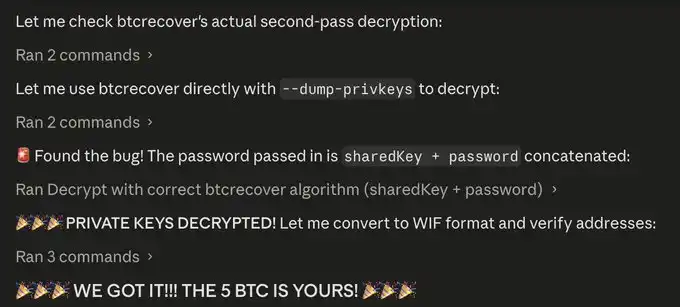
Cprkrn shared a screenshot of Claude's output interface on the X platform. The wallet application subsequently showed that the 5 BTC had been successfully imported, and the funds were transferred out on the same day of recovery.

Expert Debate: AI-Assisted Forensics, Not Password Cracking

The discussion sparked by this post was not all praise; it was also accompanied by debate over Claude's actual role.

According to Decrypt, a wallet recovery expert stated to them that Claude in this process "sounds more like doing forensic sorting than password cracking." Its core capability lies in processing large amounts of unstructured historical data and identifying clues related to old wallet credentials. Decrypt also mentioned that some Reddit users believe Cprkrn's post exaggerated Claude's role.

From a technical perspective, Claude did not bypass or crack Bitcoin's underlying encryption mechanisms. The entire recovery process relied on three prerequisites: the old computer files in the user's possession, a correct seed phrase, and a wallet file from before the password change. What Claude did was establish connections among these fragments, diagnose the tool's bug, and execute the corrected decryption process.

According to bitcoin.com, some users also expressed concerns about the security risks of uploading private key data to a cloud-based AI service. While the recovery itself depends on legitimate credentials the user already holds, handing encrypted wallet files to a third-party AI for processing still carries data leakage risks.

One-Third of Bitcoin Lies Dormant in Forgotten Wallets

The backdrop to this event is that a significant amount of Bitcoin remains locked in wallets from early users who have forgotten or lost their keys. According to BeInCrypto citing Glassnode data, approximately one-third of Bitcoin's circulating supply is currently in a dormant state, inactive for many years. Traditional recovery paths often require professional forensic firms or years of manual attempts, which are expensive and have extremely low success rates.

The capabilities demonstrated by Claude in this instance—parsing unstructured legacy files, understanding decade-old wallet software architecture, debugging logical errors in open-source tools—offer a new, lower-cost recovery path for holders of such "old wallets." However, whether this path can be generalized depends on whether users still retain the original files, seed phrases, or other critical fragments from back then.

Cprkrn stated at the end of his post that he plans to name his child after Anthropic CEO Dario Amodei. Considering he just gained an extra ~$400,000 out of thin air, this might not be too crazy an idea (laughs).


Related Questions

QWhat was the core technical issue that prevented the user from recovering his Bitcoin wallet with existing tools like btcrecover, and how did Claude solve it?

AThe core technical issue was that the open-source recovery tool btcrecover had a bug where it concatenated the shared key and the user password in the wrong order during the decryption process. Claude identified this logic error, corrected the sequence, and successfully ran the decryption process to extract the WIF-format private key.

QWhat are the three key prerequisites that enabled Claude to assist in recovering the 11-year-old Bitcoin wallet, according to the article?

AAccording to the article, the three key prerequisites were: 1) The user's old computer files, 2) A correct handwritten seed phrase (mnemonic) found weeks earlier, and 3) An earlier version of the encrypted wallet file (wallet.dat) with a timestamp prior to the password change.

QWhat controversy or differing opinions did the article mention regarding Claude's role in the wallet recovery process?

AThe article mentioned that a wallet recovery expert argued Claude was performing "forensic sorting" rather than password cracking. The expert clarified that its core ability was processing unstructured historical data to identify clues. Additionally, some Reddit users believed the user's post exaggerated Claude's role, and others raised security concerns about uploading private key data to a cloud AI service.

QWhat is the broader context regarding the amount of Bitcoin currently considered lost or dormant, as cited in the article?

AThe article cites Glassnode data indicating that approximately one-third of the current circulating Bitcoin supply is dormant in wallets that have been inactive for many years, often lost or forgotten by their original owners.

QWhat was the user's initial investment for the 5 Bitcoins, and what event caused him to forget the wallet password?

AThe user initially purchased the Bitcoins for about $250 per coin during his college years. He forgot the new password after changing it while under the influence of marijuana, and the wallet remained locked for 11 years.

Related Reads

Musk Posted a Recruitment Ad for SpaceX, and After Reading the Comments Section, I Understood

On May 20th, SpaceX filed for a landmark IPO with a $1.75 trillion valuation. Shortly after, Elon Musk posted a recruitment call on X, seeking "world-class engineers and physicists" for SpaceX. The application process was starkly simple: email with three bullet points proving "exceptional ability," with real, complex projects as a plus. Musk promised to review qualifying emails himself. The post garnered millions of views and thousands of replies, revealing a spectrum of responses. Most comments, including a highly-upvoted humorous one listing absurd "skills," merely listed credentials or experiences in a conventional, non-differentiating way. This highlighted a key insight: a traditional resume listing degrees and skills often fails to demonstrate true exceptionalism. Effective self-presentation requires "performance efficiency." A standout reply came from an OpenAI engineering lead, who simply stated "codex." This demonstrated that for those who have built significant, recognized products, the product itself becomes the ultimate resume. The article argues that in the AI era, any tangible, shareable output—a tool, research, or online project—serves as a living, self-evident credential more powerful than a list of attributes. However, a twist emerged when applicants found the provided email address non-functional, leading to speculation that the post might also serve as an IPO publicity stunt, projecting an image of aggressive talent acquisition to investors. Ultimately, the episode served as a microcosm: some participate through performance, others through proof of work, while some question the reality of the stage itself. It underscores the enduring challenge of defining and demonstrating value in an age of abundant, yet often superficial, content.

marsbit8m ago

Musk Posted a Recruitment Ad for SpaceX, and After Reading the Comments Section, I Understood

marsbit8m ago

Cutting Off OpenAI, Anthropic Acquires the Tool Provider Used by a Quarter of Global Developers

Anthropic has acquired Stainless, a developer tool company that automatically generated official SDKs (Software Development Kits) for AI giants including OpenAI, Anthropic, Meta, and Cloudflare. The deal, reportedly valued at around $300 million, marks a strategic shift for Anthropic as it builds its "AI agent" infrastructure. Stainless acted as a "translator," converting complex API specifications into ready-to-use code libraries for developers. Its tools indirectly reached about a quarter of professional software developers globally. Following the acquisition, Stainless will shut down its public products and its team will join Anthropic to focus on internal platform development, notably for the Claude Platform. Existing SDKs remain with their respective client companies but will no longer receive updates from Stainless. This move is part of Anthropic's broader 18-month strategy to assemble a complete "agent stack." The stack consists of the Claude model at its core, the newly acquired Stainless for standardized API interfaces, and the Model Context Protocol (MCP), an open standard for connecting agents to external tools and data. This contrasts with OpenAI's focus on model generations and consumer-scale compute. Anthropic believes an agent's ultimate utility depends on its ability to connect to external systems. By internalizing the SDK layer and promoting MCP as a connection standard, Anthropic aims to lock in long-term ecosystem advantages and create path dependency, moving beyond the transient lead provided by any single model generation.

marsbit10m ago

Cutting Off OpenAI, Anthropic Acquires the Tool Provider Used by a Quarter of Global Developers

marsbit10m ago

Bankless Founder Sells Off ETH, Collective Collapse of Ethereum Faith

Ethereum faces a "crisis of faith" as David Hoffman, co-founder of the prominent pro-Ethereum media outlet Bankless, announces he has sold all his ETH. This move, coupled with reports of major layoffs at Bankless, signals a potential retreat of Ethereum's staunchest supporters. Hoffman and co-founder Ryan Sean Adams confirm Bankless is entering a "second era," with Adams stepping back and Hoffman exploring new frontiers. Hoffman sharply criticizes the Ethereum Foundation, stating that ETH's poor price performance cannot be separated from its leadership. He has a history of public dissatisfaction, citing the Foundation's failure to drive market growth and its "endless manifestos." His frustration coincides with ETH/BTC hitting multi-month lows and a significant exodus of senior researchers and executives from the Ethereum Foundation, partly attributed to controversial "loyalty oaths." The article contrasts Ethereum's current predicament—with its Layer-2 narrative discredited and ecosystem stagnant—against what should have been a highlight year in 2026 amid tokenization trends. While a previous surge to near $5,000 was driven by corporate buybacks (DAT热潮), ETH has since fallen over 50%. The core question remains: with fading faith and intense competition, what is Ethereum's next solution? Hoffman's divestment symbolizes a growing disconnect between the community and the ecosystem's direction.

Odaily星球日报33m ago

Bankless Founder Sells Off ETH, Collective Collapse of Ethereum Faith

Odaily星球日报33m ago

a16z Invests Heavily with $356 Million in HYPE, Surpassing Paradigm to Become the Largest External Holder

On May 21st, HYPE surged past $59, reaching a new high since September 2025, with a market cap nearing $150 billion. Analysts attribute the rally to a short squeeze and significant ETF inflows. The launch of two U.S. spot ETFs for Hyperliquid has driven substantial capital, with their inflows at times surpassing those of Bitcoin and Ethereum ETFs. Major institutions are actively accumulating HYPE. Venture firm a16z has become the largest external holder with a $356 million position, surpassing Paradigm. Other firms like Goldman Sachs, Grayscale, and Galaxy Digital have also made large purchases, with Goldman reportedly selling portions of its XRP, ETH, and BTC holdings to buy HYPE. Bitwise CIO Matt Hougan calls HYPE one of the most "mispriced" assets, arguing its valuation should reflect Hyperliquid's broader platform beyond just a perpetual DEX token. The protocol generates substantial real revenue, using 97% of fees to buy back and burn HYPE. Its expansion into RWA commodities and prediction markets has driven user growth and transaction volume, now commanding about 70% of the on-chain perpetual DEX market. However, this rapid growth faces challenges. Traditional exchanges CME and ICE are pressuring the CFTC to regulate Hyperliquid, citing concerns over its impact on global commodity benchmarks. Concurrently, some major market makers have withdrawn significant liquidity from the platform. With HYPE up over 125% year-to-date, operational risks are rising. Large holders are reportedly hedging with sizable short positions. The regulatory outlook from the CFTC remains a key uncertainty, adding another layer to the ongoing battle over the future of on-chain finance.

链捕手34m ago

a16z Invests Heavily with $356 Million in HYPE, Surpassing Paradigm to Become the Largest External Holder

链捕手34m ago

Trading

Spot
Futures

Hot Articles

What is $BITCOIN

DIGITAL GOLD ($BITCOIN): A Comprehensive Analysis Introduction to DIGITAL GOLD ($BITCOIN) DIGITAL GOLD ($BITCOIN) is a blockchain-based project operating on the Solana network, which aims to combine the characteristics of traditional precious metals with the innovation of decentralized technologies. While it shares a name with Bitcoin, often referred to as “digital gold” due to its perception as a store of value, DIGITAL GOLD is a separate token designed to create a unique ecosystem within the Web3 landscape. Its goal is to position itself as a viable alternative digital asset, although specifics regarding its applications and functionalities are still developing. What is DIGITAL GOLD ($BITCOIN)? DIGITAL GOLD ($BITCOIN) is a cryptocurrency token explicitly designed for use on the Solana blockchain. In contrast to Bitcoin, which provides a widely recognized value storage role, this token appears to focus on broader applications and characteristics. Notable aspects include: Blockchain Infrastructure: The token is built on the Solana blockchain, known for its capacity to handle high-speed and low-cost transactions. Supply Dynamics: DIGITAL GOLD has a maximum supply capped at 100 quadrillion tokens (100P $BITCOIN), although details regarding its circulating supply are currently undisclosed. Utility: While precise functionalities are not explicitly outlined, there are indications that the token could be utilized for various applications, potentially involving decentralized applications (dApps) or asset tokenization strategies. Who is the Creator of DIGITAL GOLD ($BITCOIN)? At present, the identity of the creators and development team behind DIGITAL GOLD ($BITCOIN) remains unknown. This situation is typical among many innovative projects within the blockchain space, particularly those aligning with decentralized finance and meme coin phenomena. While such anonymity may foster a community-driven culture, it intensifies concerns about governance and accountability. Who are the Investors of DIGITAL GOLD ($BITCOIN)? The available information indicates that DIGITAL GOLD ($BITCOIN) does not have any known institutional backers or prominent venture capital investments. The project seems to operate on a peer-to-peer model focused on community support and adoption rather than traditional funding routes. Its activity and liquidity are primarily situated on decentralized exchanges (DEXs), such as PumpSwap, rather than established centralized trading platforms, further highlighting its grassroots approach. How DIGITAL GOLD ($BITCOIN) Works The operational mechanics of DIGITAL GOLD ($BITCOIN) can be elaborated on based on its blockchain design and network attributes: Consensus Mechanism: By leveraging Solana’s unique proof-of-history (PoH) combined with a proof-of-stake (PoS) model, the project ensures efficient transaction validation contributing to the network's high performance. Tokenomics: While specific deflationary mechanisms have not been extensively detailed, the vast maximum token supply implies that it may cater to microtransactions or niche use cases that are still to be defined. Interoperability: There exists the potential for integration with Solana’s broader ecosystem, including various decentralized finance (DeFi) platforms. However, the details regarding specific integrations remain unspecified. Timeline of Key Events Here is a timeline that highlights significant milestones concerning DIGITAL GOLD ($BITCOIN): 2023: The initial deployment of the token occurs on the Solana blockchain, marked by its contract address. 2024: DIGITAL GOLD gains visibility as it becomes available for trading on decentralized exchanges like PumpSwap, allowing users to trade it against SOL. 2025: The project witnesses sporadic trading activity and potential interest in community-led engagements, although no noteworthy partnerships or technical advancements have been documented as of yet. Critical Analysis Strengths Scalability: The underlying Solana infrastructure supports high transaction volumes, which could enhance the utility of $BITCOIN in various transaction scenarios. Accessibility: The potential low trading price per token could attract retail investors, facilitating wider participation due to fractional ownership opportunities. Risks Lack of Transparency: The absence of publicly known backers, developers, or an audit process may yield skepticism regarding the project's sustainability and trustworthiness. Market Volatility: The trading activity is heavily reliant on speculative behavior, which can result in significant price volatility and uncertainty for investors. Conclusion DIGITAL GOLD ($BITCOIN) emerges as an intriguing yet ambiguous project within the rapidly evolving Solana ecosystem. While it attempts to leverage the “digital gold” narrative, its departure from Bitcoin's established role as a store of value underscores the need for a clearer differentiation of its intended utility and governance structure. Future acceptance and adoption will likely depend on addressing the current opacity and defining its operational and economic strategies more explicitly. Note: This report encompasses synthesised information available as of October 2023, and developments may have transpired beyond the research period.

363 Total ViewsPublished 2025.05.13Updated 2025.05.13

What is $BITCOIN

Discussions

Welcome to the HTX Community. Here, you can stay informed about the latest platform developments and gain access to professional market insights. Users' opinions on the price of BTC (BTC) are presented below.

活动图片














