Chinese Young Man's AI Short Goes Viral Abroad! Hollywood Director Searches Online: Wants to Hire Him

marsbitPublished on 2026-05-14Last updated on 2026-05-14

Abstract

A young Chinese creator, Mx-Shell, an amateur filmmaker from Yunnan with no formal film training, has gone viral internationally with his AI-generated short film "Zombie Scavenger." Created independently in about 10 days using the Chinese AI video tool Seedance 2.0 at a minimal cost, the film features a robot cowboy in a post-apocalyptic world. Its unique atomic-punk style and cinematic quality caught the attention of Hollywood. The film initially gained little traction on Chinese platform Bilibili. However, after PJ Ace, founder of LA-based AI studio Genre.ai, shared it on X (formerly Twitter), praising it as "one of the best short films I've seen in recent years," it quickly garnered millions of views overseas. PJ Ace then publicly sought to hire the unknown director, sparking a cross-platform search. The creator, who doesn't speak English, was unaware of the overseas buzz until Chinese internet users relayed the message. Connection was eventually made via a QQ email address shared in Bilibili comments, and Mx-Shell received a job offer from the Hollywood director. The article highlights this as a case of "talent export." It argues that while China's competitive AI tool market lowers technical barriers, true success still relies on individual creativity, aesthetic judgment, and narrative skill—qualities Mx-Shell demonstrated. His story exemplifies how AI tools can empower previously unseen creators with compelling ideas to reach a global audience, even if initial recogni...

Author: David, Shenchao TechFlow

Hollywood is searching the internet for a Chinese person. But the person being sought didn't even leave a usable contact method.

On the evening of May 10th, PJ Ace, founder of the Los Angeles AI film studio Genre.ai, reposted an AI short film called "The Scavenger" on X. PJ Ace is probably one of the most influential figures in the AI video circle, with his own content garnering over 300 million views across platforms.

His evaluation of this short film was extremely high, "This is one of the best short films I've seen in recent years."

The concept of the short is roughly this: a robot cowboy rides an ostrich through a post-apocalyptic wasteland, battles zombies, and has a romance with a plastic mannequin. Besides the sufficiently cyberpunk and fantastical theme, the visuals and music also have a distinct blockbuster quality.

(Viewers who haven't seen it can click here to experience it.)

A few hours after PJ's post went up, the view count reached 5 million.
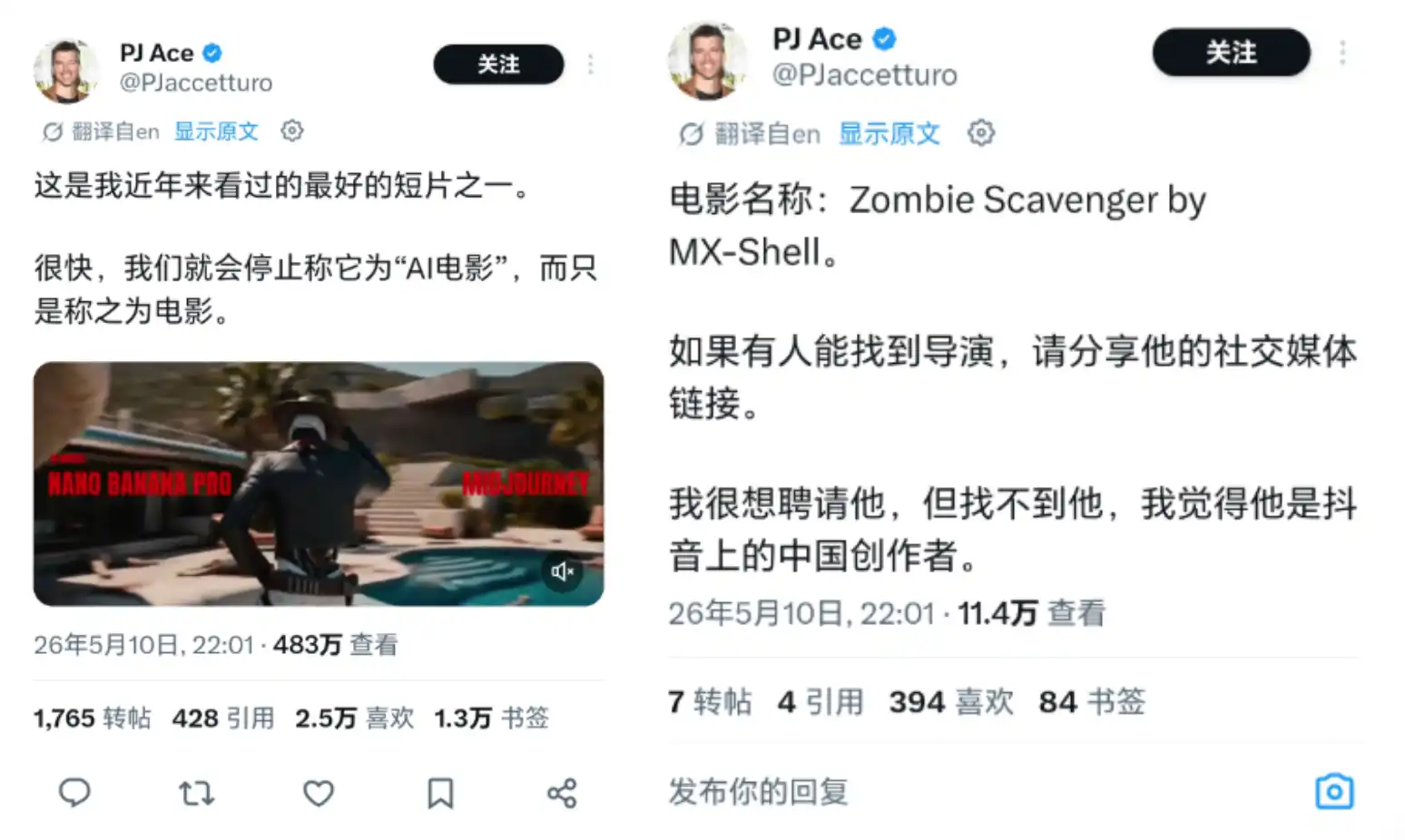
He immediately followed up with a missing person post: "I would love to hire the director of this short, but I can't find him. I think he's a Chinese creator on Douyin."

A person holding Hollywood content production resources, posting on Twitter like a lost and found notice to find a Chinese person? The author feels this scene itself is more surreal than the short film...

His reasoning was that, before AI, something of this quality would have cost at least $500,000 and six months to produce, yet this author achieved this level using only his own creative effort. The replies to the post quickly turned into a search party, with people searching for the author ID MX-Shell, and others tracing clues to Bilibili.

A massive cross-platform search from Hollywood to Bilibili's comment section had begun.

However, on the same day PJ Ace was anxiously posting missing person notices on Twitter, this short film hadn't made much of a splash on Bilibili or Douyin yet, lying quietly in the information feeds.

A short film made by a Chinese person using Chinese AI tools had to first become popular across the Pacific, before being noticed back home. The process of this large-scale cross-platform search returning to China itself became a case of reimported goods.

Making a Hobby Visible

The person PJ Ace was looking for had labeled himself with five words on Bilibili: amateur hobbyist.

The author, Mx-Shell, commented claiming to be a vocational school graduate from Yunnan, having never attended university or worked for any film company. The "non-professional amateur hobbyist" written in his Bilibili bio seems like genuine humility.

It is reported that "The Scavenger" was made by him using ByteDance's AI video tool Seedance 2.0. Alone, without a team or investment, he independently completed it from conception to final product, even creating the background music himself.

The production cycle was about 10 days, with Token costs roughly equivalent to about 3,000 RMB.

Then comes what the author finds the most fascinating part of the whole story.

PJ Ace's missing person post was seen by millions on X, but Mx-Shell himself couldn't see it at all, unaware that a Hollywood director across the Pacific was looking for him.

When the news eventually made its way back to China, the comments section under the video exploded, but Mx-Shell himself didn't understand English, lacked channels to connect with overseas media, and even posted his QQ email address, asking netizens to forward it to the other side.
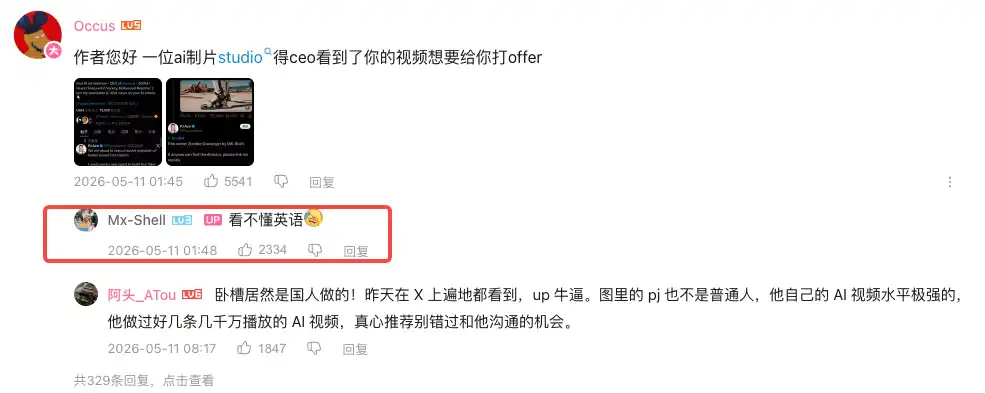

Hollywood was looking for him in English on Twitter, he was looking for Hollywood with a QQ email address in the Bilibili comments section. With the help of netizens, this cross-platform conversation had a happy ending.

Currently, PJ has already sent him an email via the address. In the letter, PJ Ace said he runs a film studio in Los Angeles, the short film garnered over 4 million views on the day it was shared, and then asked, "Would you be interested in becoming a Hollywood director?"

An amateur hobbyist receiving an olive branch extended by Hollywood—perhaps this is also a kind of wonderful, serendipitous discovery of talent in the AI era.

Talent Going Global, Reimported Goods

Back to why this short film was quiet on Bilibili initially but exploded when posted on X.

On Bilibili, a short film labeled "Contains AI-Generated Content" has to compete for the same information feed as professional animations from million-follower UP owners, game live streams, and popular fan creations. Mx-Shell had only a few thousand followers at the time, no recommendation spots—a grain of sand falling into the desert.

X is a completely different world. The overseas AI creator community has grown its own ecosystem over the past two years, with top bloggers, evaluation consensus, and mature dissemination networks.

PJ Ace is a core node in this ecosystem. What he saw in "The Scavenger" was the work itself; AI was just the tool. The fan base amplified the spread, exploding this piece of content in a matter of hours.

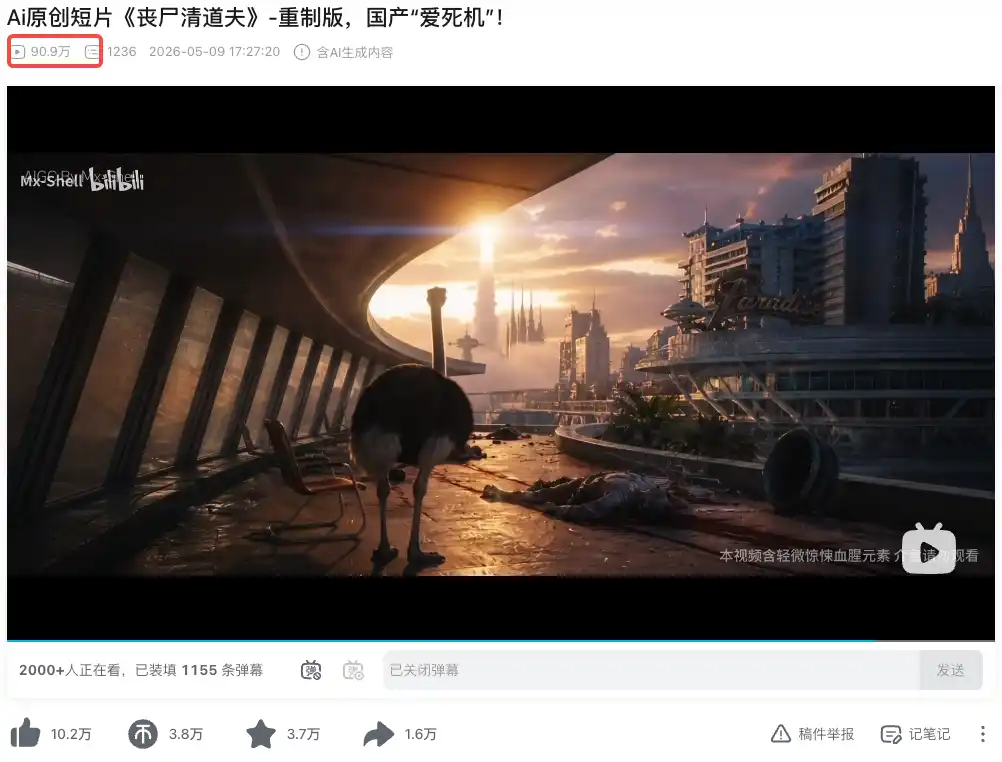
The later reimported data also illustrates this point. Domestic viewers recognized its merit too, with over 900,000 plays and 100,000 likes on Bilibili. In the AI era, content is never the primary problem; the problem is whether it gets delivered to the right people.
This reminds the author of a similar phenomenon: Token export.

Chinese large language models sell computing power globally via APIs. The electricity never leaves China's power grid, but value is delivered cross-border through Tokens. Mx-Shell's story is the creative version of the same logic. Talent and aesthetics never left his computer, but the work also achieved cross-border delivery through a short film. Seedance is ByteDance's, the computing power is from Chinese data centers, the creator is from Yunnan, but the first large-scale audience to see this film was across the Pacific.

If Token export is power export, "The Scavenger" is talent export.

Why did this path start from China? Probably because China simultaneously has two things. The world's most fiercely competitive AI video tool market—ByteDance, Alibaba, Kuaishou trampling over each other to drive generation costs to the floor. Mx-Shell's use of Seedance 2.0 was relatively low-cost in terms of spending.

And a large number of creative people who previously had no outlet—people with taste and ideas, lacking only a handy tool.

The former gave the latter a key. Once the door opened, the global market was outside.

AI is a Good Shovel, But You Have to Dig Yourself

The story isn't over yet.

After Mx-Shell connected with PJ Ace, he posted a lengthy article responding to the external attention. Thirteen points, each one substantial. The author feels this text itself is worth a closer look.

He said the style of "The Scavenger" is called atompunk, a form of retro sci-fi. Creative inspiration came from Pixar's "WALL-E," and it was made to the standard of the popular Netflix series "Love, Death & Robots."

One of the creative intentions was to show overseas audiences the current level of domestic AI production.

Shot control relied on text prompts, the prompts were basically crafted manually. Post-production was done by one person. Even the background music was original. Looking at these details together, one realizes Mx-Shell is far from just being "lucky to encounter AI tools."

He has visual aesthetics, being a photographer by background. He has auditory aesthetics, being an independent musician. He has a sense for narrative, setting a high bar for himself with the "Love, Death & Robots" standard.

AI tools gave him production capacity, but the taste and judgment were his own.

So the author feels the saying "AI allows everyone to make movies" is only half right. AI indeed pushes production barriers to the floor, but computing power can be bought, taste cannot.

Anyone can use Seedance 2.0. Why was it Mx-Shell who made something that prompted a Hollywood missing person post? The tools are equal, but the people using them are vastly different.

This leads to another interesting angle.

ByteDance's investment in Seedance 2.0 is unknown to the outside world, but so far, the best advertisement for this tool might be what a Yunnan vocational school graduate created.

ByteDance's marketing department couldn't have planned such a story because the story's persuasiveness lies precisely in it being spontaneous, organic, and unplanned.

The strongest proof for a platform product is always users creating things that exceed the platform's expectations. Taobao's early benchmark stories were rural women earning millions selling local specialties. YouTube's benchmark was bedroom teenagers making shows better than TV. Seedance 2.0's benchmark story is more creators like Mx-Shell.

According to DataEye data, the overseas AI short drama and comic drama market size is expected to reach $650 million in 2026, a sixfold year-on-year increase. Currently, two paths are running in this market:

One is the industrialization route. Domestic teams produce AI short dramas in bulk—zombies, werewolves, underdog revenge stories—packaged into genre shells familiar to Western audiences, monetizing through TikTok ad campaigns. Reports say several works have already achieved tens of millions of views. This path competes on capital, team, and production capacity, somewhat like the short video factories of the past.

The other is the path Mx-Shell took. One person, one computer, not relying on ad campaigns or scale; the content itself is the transmission force. Token costs a few thousand, cycle less than two weeks, exchanged not for platform revenue share, but for Hollywood actively reaching out.

Both paths can work, but the author finds the second path more noteworthy.

Because the barrier for the first path is money—if you have money, you can do it, not much related to the individual creator. The barrier for the second path is the person—the taste, the judgment of content. These things AI can't give you, and money can't buy them either.

He won't be the last person to walk this path.

China has a large number of creators with taste, ideas, and a desire to express. Previously, what blocked them was equipment, funds, teams, academic qualifications. Now, these barriers are being dismantled one by one by AI tools. The remaining problem is only one: how to be seen.

Mx-Shell's answer was a QQ email address and a group of enthusiastic netizens. The next person might have other methods.

But before the domestic ecosystem for AI creation truly matures, this detour of reimported goods will probably have to continue for a while longer.


Related Questions

QWho is PJ Ace, and why did he start searching for a Chinese creator online?

APJ Ace is the founder of the Los Angeles-based AI film studio Genre.ai. He is a prominent figure in the AI video community with content that has garnered over 300 million views. He searched for the Chinese creator online after being deeply impressed by the AI-generated short film 'Zombie Scavenger,' which he called one of the best shorts he had seen in years. He wanted to hire its director for his studio.

QWhat is the title and basic plot of the AI-generated short film that sparked this international search?

AThe AI-generated short film is titled 'Zombie Scavenger.' Its plot involves a robot cowboy riding an ostrich through a post-apocalyptic wasteland, battling zombies, and having a romantic encounter with a plastic mannequin. The film is noted for its cyberpunk and fantastical themes, as well as its high-quality visuals and music.

QWho is Mx-Shell, the creator of 'Zombie Scavenger,' and what are some key details about his background and the film's production?

AMx-Shell is a self-described amateur enthusiast from Yunnan, China, with a background as a secondary technical school graduate, no university degree, and no prior experience in film companies. He created 'Zombie Scavenger' independently using ByteDance's AI video tool Seedance 2.0. The entire process, from conception to final edit, including composing the original background score, took him about 10 days and cost approximately 3,000 RMB in token expenses.

QWhy did the short film gain massive attention overseas on platform X before becoming popular domestically on Bilibili?

AThe film initially went unnoticed on Bilibili, a platform saturated with content from established creators. However, on platform X, it entered a well-established AI creator ecosystem with influential figures like PJ Ace. When PJ Ace shared and praised the film, his large following and the platform's effective content dissemination network caused it to go viral rapidly, reaching millions of views within hours. The attention later flowed back to Bilibili, where it also gained significant traction.

QWhat broader implications does the article suggest about AI tools and creative opportunities for individuals like Mx-Shell?

AThe article suggests that AI tools like Seedance 2.0 drastically lower the technical and financial barriers to high-quality content creation, such as filmmaking. This empowers individuals with creativity, aesthetic sense, and storytelling ability—qualities that AI cannot provide—to produce compelling work and reach a global audience. It highlights a potential path for talented creators who previously lacked resources or formal training, enabling 'talent export' where creative value is delivered internationally through digital作品, similar to the concept of 'Token出海' (Token export).

Related Reads

Morning Post | Michael Saylor Releases Bitcoin Tracker Info; Aave Publishes Kelp rsETH Bridge Attack Post-Incident Investigation; Gravity Bridge Announces Service Suspension Following Attack

ChainCatcher Daily Summary - June 1, 2026 In regulatory news, the U.S. OCC granted preliminary conditional approval for Laser Digital to establish a federally regulated trust bank. In Vietnam, a draft law amendment proposes allowing SMEs to use digital and virtual assets as loan collateral. Hong Kong's SFC chairman reported that trading volume on the city's 12 licensed virtual asset platforms grew nearly 300% YoY in Q1 2026. Notable incidents include the Cosmos ecosystem cross-chain bridge Gravity Bridge pausing services after an attack. Aave published a post-mortem on the April 18th Kelp rsETH bridge attack, attributing it to a third-party bridge infrastructure vulnerability via an RPC poisoning attack, not the Aave protocol itself. In market developments, MicroStrategy's Michael Saylor hinted at a potential upcoming Bitcoin purchase announcement. Fed Governor Waller commented that widespread stablecoin adoption could amplify the impact of U.S. monetary policy. Meanwhile, sentiment analysis from Santiment indicates a record-high Bitcoin long/short ratio of 2.23, potentially signaling a short-term price correction, while Ethereum shows signs of FUD among commentators. In legal matters, the SEC sued the founder of Privvy Investments for an alleged $12.3 million crypto AI trading bot scam. In China, a Qingdao man was sentenced to 10 years and 9 months for stealing 107 BTC by obtaining a victim's wallet seed phrase. Top trending meme tokens on ETH, Solana, and Base networks for the past 24 hours are also listed.

链捕手26m ago

Morning Post | Michael Saylor Releases Bitcoin Tracker Info; Aave Publishes Kelp rsETH Bridge Attack Post-Incident Investigation; Gravity Bridge Announces Service Suspension Following Attack

链捕手26m ago

Alibaba 'Stocks Up', ByteDance 'Trains'

"In late May, two closely timed events in China's AI industry clearly revealed the divergent strategic approaches of two tech giants: Alibaba and ByteDance. Alibaba is aggressively integrating AI into its existing commercial ecosystem, prioritizing immediate monetization. Its Qwen App now fully integrates with Taobao, leveraging the platform's 4-billion-item database for AI-powered shopping features like virtual try-on and price comparison. Internally, Alibaba has reorganized to incentivize AI-driven business growth, notably through the 'Agentic Commerce Trust Protocol' to enable AI-agent transactions. Financially, it emphasizes ROI, with CEO Daniel Wu stating every AI chip purchased is generating revenue. Alibaba's strategy bets that foundational AI model capabilities won't be leapfrogged in the next five years, allowing its 'AI-as-a-utility' approach to succeed. In stark contrast, ByteDance's Seed division focuses on pushing the frontiers of AGI with a long-term, research-oriented mindset. Its video generation model, Seedance 2.0, topped international benchmarks. The division, led by researchers Wu Yonghui and product head Zhu Wenjia, is tasked with 'exploring the upper limits of intelligence,' even considering open-sourcing its models—a rare move among Chinese firms. ByteDance is investing heavily, with reports of its 2026 capital expenditure plan being nearly triple that of 2024, funded by its substantial private profits. This allows it to pursue projects like an 8-month research paper questioning if video models are true 'world models,' devoid of immediate commercial pressure. The core divergence is less about corporate philosophy and more about structural constraints. As a publicly traded company, Alibaba is bound to quarterly financial expectations, forcing a pragmatic, revenue-focused AI integration. As a private entity, ByteDance has the luxury to fund long-term, high-risk foundational research without answering to public markets. The article concludes that the true determinant of a Chinese company's AI path is its IPO status, suggesting that if ByteDance were public, or if Alibaba were private, their strategies might well be reversed."

marsbit1h ago

Alibaba 'Stocks Up', ByteDance 'Trains'

marsbit1h ago

Why More AI Agents Does Not Equal Higher Productivity?

Editor's Note: As AI Agents become cheaper and easier to use, a new constraint emerges: the cost isn't in launching more Agents, but in the human attention required to manage, judge, and integrate their outputs. This hidden cost is called the "orchestration tax." The article argues that a developer's cognitive bandwidth is the key bottleneck—a serial, non-parallelizable resource akin to a Global Interpreter Lock (GIL). While many Agents can run concurrently, their results ultimately require human judgment for review, conflict resolution, and final integration. Therefore, more Agents don't automatically mean higher productivity; they can simply create longer queues, lead to cognitive fatigue, and create the illusion of busyness without real output. The core solution is to design workflows around this scarce human attention. Key strategies include: scaling the number of Agents to match review capacity (not UI capacity), categorizing tasks (delegating independent ones, keeping complex judgment-heavy ones serial), batch reviewing results to minimize context-switching costs, automating verifiable checks to reserve human judgment for critical decisions, and protecting focused, uninterrupted thinking time. Ultimately, the critical skill is not launching many Agents, but architecting systems that respect the fundamental limit of human attention. Unpaid "orchestration tax" accumulates as both technical and cognitive debt, undermining system understanding and quality. True productivity comes from thoughtfully managing the single-threaded resource—your focus.

marsbit3h ago

Why More AI Agents Does Not Equal Higher Productivity?

marsbit3h ago

Trading

Spot
Futures

Hot Articles

What is SONIC

Sonic: Pioneering the Future of Gaming in Web3 Introduction to Sonic In the ever-evolving landscape of Web3, the gaming industry stands out as one of the most dynamic and promising sectors. At the forefront of this revolution is Sonic, a project designed to amplify the gaming ecosystem on the Solana blockchain. Leveraging cutting-edge technology, Sonic aims to deliver an unparalleled gaming experience by efficiently processing millions of requests per second, ensuring that players enjoy seamless gameplay while maintaining low transaction costs. This article delves into the intricate details of Sonic, exploring its creators, funding sources, operational mechanics, and the timeline of significant events that have shaped its journey. What is Sonic? Sonic is an innovative layer-2 network that operates atop the Solana blockchain, specifically tailored to enhance the existing Solana gaming ecosystem. It accomplishes this through a customised, VM-agnostic game engine paired with a HyperGrid interpreter, facilitating sovereign game economies that roll up back to the Solana platform. The primary goals of Sonic include: Enhanced Gaming Experiences: Sonic is committed to offering lightning-fast on-chain gameplay, allowing players and developers to engage with games at previously unattainable speeds. Atomic Interoperability: This feature enables transactions to be executed within Sonic without the need to redeploy Solana programmes and accounts. This makes the process more efficient and directly benefits from Solana Layer1 services and liquidity. Seamless Deployment: Sonic allows developers to write for Ethereum Virtual Machine (EVM) based systems and execute them on Solana’s SVM infrastructure. This interoperability is crucial for attracting a broader range of dApps and decentralised applications to the platform. Support for Developers: By offering native composable gaming primitives and extensible data types - dining within the Entity-Component-System (ECS) framework - game creators can craft intricate business logic with ease. Overall, Sonic's unique approach not only caters to players but also provides an accessible and low-cost environment for developers to innovate and thrive. Creator of Sonic The information regarding the creator of Sonic is somewhat ambiguous. However, it is known that Sonic's SVM is owned by the company Mirror World. The absence of detailed information about the individuals behind Sonic reflects a common trend in several Web3 projects, where collective efforts and partnerships often overshadow individual contributions. Investors of Sonic Sonic has garnered considerable attention and support from various investors within the crypto and gaming sectors. Notably, the project raised an impressive $12 million during its Series A funding round. The round was led by BITKRAFT Ventures, with other notable investors including Galaxy, Okx Ventures, Interactive, Big Brain Holdings, and Mirana. This financial backing signifies the confidence that investment foundations have in Sonic’s potential to revolutionise the Web3 gaming landscape, further validating its innovative approaches and technologies. How Does Sonic Work? Sonic utilises the HyperGrid framework, a sophisticated parallel processing mechanism that enhances its scalability and customisability. Here are the core features that set Sonic apart: Lightning Speed at Low Costs: Sonic offers one of the fastest on-chain gaming experiences compared to other Layer-1 solutions, powered by the scalability of Solana’s virtual machine (SVM). Atomic Interoperability: Sonic enables transaction execution without redeployment of Solana programmes and accounts, effectively streamlining the interaction between users and the blockchain. EVM Compatibility: Developers can effortlessly migrate decentralised applications from EVM chains to the Solana environment using Sonic’s HyperGrid interpreter, increasing the accessibility and integration of various dApps. Ecosystem Support for Developers: By exposing native composable gaming primitives, Sonic facilitates a sandbox-like environment where developers can experiment and implement business logic, greatly enhancing the overall development experience. Monetisation Infrastructure: Sonic natively supports growth and monetisation efforts, providing frameworks for traffic generation, payments, and settlements, thereby ensuring that gaming projects are not only viable but also sustainable financially. Timeline of Sonic The evolution of Sonic has been marked by several key milestones. Below is a brief timeline highlighting critical events in the project's history: 2022: The Sonic cryptocurrency was officially launched, marking the beginning of its journey in the Web3 gaming arena. 2024: June: Sonic SVM successfully raised $12 million in a Series A funding round. This investment allowed Sonic to further develop its platform and expand its offerings. August: The launch of the Sonic Odyssey testnet provided users with the first opportunity to engage with the platform, offering interactive activities such as collecting rings—a nod to gaming nostalgia. October: SonicX, an innovative crypto game integrated with Solana, made its debut on TikTok, capturing the attention of over 120,000 users within a short span. This integration illustrated Sonic’s commitment to reaching a broader, global audience and showcased the potential of blockchain gaming. Key Points Sonic SVM is a revolutionary layer-2 network on Solana explicitly designed to enhance the GameFi landscape, demonstrating great potential for future development. HyperGrid Framework empowers Sonic by introducing horizontal scaling capabilities, ensuring that the network can handle the demands of Web3 gaming. Integration with Social Platforms: The successful launch of SonicX on TikTok displays Sonic’s strategy to leverage social media platforms to engage users, exponentially increasing the exposure and reach of its projects. Investment Confidence: The substantial funding from BITKRAFT Ventures, among others, emphasizes the robust backing Sonic has, paving the way for its ambitious future. In conclusion, Sonic encapsulates the essence of Web3 gaming innovation, striking a balance between cutting-edge technology, developer-centric tools, and community engagement. As the project continues to evolve, it is poised to redefine the gaming landscape, making it a notable entity for gamers and developers alike. As Sonic moves forward, it will undoubtedly attract greater interest and participation, solidifying its place within the broader narrative of blockchain gaming.

1.6k Total ViewsPublished 2024.04.04Updated 2024.12.03

What is SONIC

What is $S$

Understanding SPERO: A Comprehensive Overview Introduction to SPERO As the landscape of innovation continues to evolve, the emergence of web3 technologies and cryptocurrency projects plays a pivotal role in shaping the digital future. One project that has garnered attention in this dynamic field is SPERO, denoted as SPERO,$$s$. This article aims to gather and present detailed information about SPERO, to help enthusiasts and investors understand its foundations, objectives, and innovations within the web3 and crypto domains. What is SPERO,$$s$? SPERO,$$s$ is a unique project within the crypto space that seeks to leverage the principles of decentralisation and blockchain technology to create an ecosystem that promotes engagement, utility, and financial inclusion. The project is tailored to facilitate peer-to-peer interactions in new ways, providing users with innovative financial solutions and services. At its core, SPERO,$$s$ aims to empower individuals by providing tools and platforms that enhance user experience in the cryptocurrency space. This includes enabling more flexible transaction methods, fostering community-driven initiatives, and creating pathways for financial opportunities through decentralised applications (dApps). The underlying vision of SPERO,$$s$ revolves around inclusiveness, aiming to bridge gaps within traditional finance while harnessing the benefits of blockchain technology. Who is the Creator of SPERO,$$s$? The identity of the creator of SPERO,$$s$ remains somewhat obscure, as there are limited publicly available resources providing detailed background information on its founder(s). This lack of transparency can stem from the project's commitment to decentralisation—an ethos that many web3 projects share, prioritising collective contributions over individual recognition. By centring discussions around the community and its collective goals, SPERO,$$s$ embodies the essence of empowerment without singling out specific individuals. As such, understanding the ethos and mission of SPERO remains more important than identifying a singular creator. Who are the Investors of SPERO,$$s$? SPERO,$$s$ is supported by a diverse array of investors ranging from venture capitalists to angel investors dedicated to fostering innovation in the crypto sector. The focus of these investors generally aligns with SPERO's mission—prioritising projects that promise societal technological advancement, financial inclusivity, and decentralised governance. These investor foundations are typically interested in projects that not only offer innovative products but also contribute positively to the blockchain community and its ecosystems. The backing from these investors reinforces SPERO,$$s$ as a noteworthy contender in the rapidly evolving domain of crypto projects. How Does SPERO,$$s$ Work? SPERO,$$s$ employs a multi-faceted framework that distinguishes it from conventional cryptocurrency projects. Here are some of the key features that underline its uniqueness and innovation: Decentralised Governance: SPERO,$$s$ integrates decentralised governance models, empowering users to participate actively in decision-making processes regarding the project’s future. This approach fosters a sense of ownership and accountability among community members. Token Utility: SPERO,$$s$ utilises its own cryptocurrency token, designed to serve various functions within the ecosystem. These tokens enable transactions, rewards, and the facilitation of services offered on the platform, enhancing overall engagement and utility. Layered Architecture: The technical architecture of SPERO,$$s$ supports modularity and scalability, allowing for seamless integration of additional features and applications as the project evolves. This adaptability is paramount for sustaining relevance in the ever-changing crypto landscape. Community Engagement: The project emphasises community-driven initiatives, employing mechanisms that incentivise collaboration and feedback. By nurturing a strong community, SPERO,$$s$ can better address user needs and adapt to market trends. Focus on Inclusion: By offering low transaction fees and user-friendly interfaces, SPERO,$$s$ aims to attract a diverse user base, including individuals who may not previously have engaged in the crypto space. This commitment to inclusion aligns with its overarching mission of empowerment through accessibility. Timeline of SPERO,$$s$ Understanding a project's history provides crucial insights into its development trajectory and milestones. Below is a suggested timeline mapping significant events in the evolution of SPERO,$$s$: Conceptualisation and Ideation Phase: The initial ideas forming the basis of SPERO,$$s$ were conceived, aligning closely with the principles of decentralisation and community focus within the blockchain industry. Launch of Project Whitepaper: Following the conceptual phase, a comprehensive whitepaper detailing the vision, goals, and technological infrastructure of SPERO,$$s$ was released to garner community interest and feedback. Community Building and Early Engagements: Active outreach efforts were made to build a community of early adopters and potential investors, facilitating discussions around the project’s goals and garnering support. Token Generation Event: SPERO,$$s$ conducted a token generation event (TGE) to distribute its native tokens to early supporters and establish initial liquidity within the ecosystem. Launch of Initial dApp: The first decentralised application (dApp) associated with SPERO,$$s$ went live, allowing users to engage with the platform's core functionalities. Ongoing Development and Partnerships: Continuous updates and enhancements to the project's offerings, including strategic partnerships with other players in the blockchain space, have shaped SPERO,$$s$ into a competitive and evolving player in the crypto market. Conclusion SPERO,$$s$ stands as a testament to the potential of web3 and cryptocurrency to revolutionise financial systems and empower individuals. With a commitment to decentralised governance, community engagement, and innovatively designed functionalities, it paves the way toward a more inclusive financial landscape. As with any investment in the rapidly evolving crypto space, potential investors and users are encouraged to research thoroughly and engage thoughtfully with the ongoing developments within SPERO,$$s$. The project showcases the innovative spirit of the crypto industry, inviting further exploration into its myriad possibilities. While the journey of SPERO,$$s$ is still unfolding, its foundational principles may indeed influence the future of how we interact with technology, finance, and each other in interconnected digital ecosystems.

54 Total ViewsPublished 2024.12.17Updated 2024.12.17

What is $S$

What is AGENT S

Agent S: The Future of Autonomous Interaction in Web3 Introduction In the ever-evolving landscape of Web3 and cryptocurrency, innovations are constantly redefining how individuals interact with digital platforms. One such pioneering project, Agent S, promises to revolutionise human-computer interaction through its open agentic framework. By paving the way for autonomous interactions, Agent S aims to simplify complex tasks, offering transformative applications in artificial intelligence (AI). This detailed exploration will delve into the project's intricacies, its unique features, and the implications for the cryptocurrency domain. What is Agent S? Agent S stands as a groundbreaking open agentic framework, specifically designed to tackle three fundamental challenges in the automation of computer tasks: Acquiring Domain-Specific Knowledge: The framework intelligently learns from various external knowledge sources and internal experiences. This dual approach empowers it to build a rich repository of domain-specific knowledge, enhancing its performance in task execution. Planning Over Long Task Horizons: Agent S employs experience-augmented hierarchical planning, a strategic approach that facilitates efficient breakdown and execution of intricate tasks. This feature significantly enhances its ability to manage multiple subtasks efficiently and effectively. Handling Dynamic, Non-Uniform Interfaces: The project introduces the Agent-Computer Interface (ACI), an innovative solution that enhances the interaction between agents and users. Utilizing Multimodal Large Language Models (MLLMs), Agent S can navigate and manipulate diverse graphical user interfaces seamlessly. Through these pioneering features, Agent S provides a robust framework that addresses the complexities involved in automating human interaction with machines, setting the stage for myriad applications in AI and beyond. Who is the Creator of Agent S? While the concept of Agent S is fundamentally innovative, specific information about its creator remains elusive. The creator is currently unknown, which highlights either the nascent stage of the project or the strategic choice to keep founding members under wraps. Regardless of anonymity, the focus remains on the framework's capabilities and potential. Who are the Investors of Agent S? As Agent S is relatively new in the cryptographic ecosystem, detailed information regarding its investors and financial backers is not explicitly documented. The lack of publicly available insights into the investment foundations or organisations supporting the project raises questions about its funding structure and development roadmap. Understanding the backing is crucial for gauging the project's sustainability and potential market impact. How Does Agent S Work? At the core of Agent S lies cutting-edge technology that enables it to function effectively in diverse settings. Its operational model is built around several key features: Human-like Computer Interaction: The framework offers advanced AI planning, striving to make interactions with computers more intuitive. By mimicking human behaviour in tasks execution, it promises to elevate user experiences. Narrative Memory: Employed to leverage high-level experiences, Agent S utilises narrative memory to keep track of task histories, thereby enhancing its decision-making processes. Episodic Memory: This feature provides users with step-by-step guidance, allowing the framework to offer contextual support as tasks unfold. Support for OpenACI: With the ability to run locally, Agent S allows users to maintain control over their interactions and workflows, aligning with the decentralised ethos of Web3. Easy Integration with External APIs: Its versatility and compatibility with various AI platforms ensure that Agent S can fit seamlessly into existing technological ecosystems, making it an appealing choice for developers and organisations. These functionalities collectively contribute to Agent S's unique position within the crypto space, as it automates complex, multi-step tasks with minimal human intervention. As the project evolves, its potential applications in Web3 could redefine how digital interactions unfold. Timeline of Agent S The development and milestones of Agent S can be encapsulated in a timeline that highlights its significant events: September 27, 2024: The concept of Agent S was launched in a comprehensive research paper titled “An Open Agentic Framework that Uses Computers Like a Human,” showcasing the groundwork for the project. October 10, 2024: The research paper was made publicly available on arXiv, offering an in-depth exploration of the framework and its performance evaluation based on the OSWorld benchmark. October 12, 2024: A video presentation was released, providing a visual insight into the capabilities and features of Agent S, further engaging potential users and investors. These markers in the timeline not only illustrate the progress of Agent S but also indicate its commitment to transparency and community engagement. Key Points About Agent S As the Agent S framework continues to evolve, several key attributes stand out, underscoring its innovative nature and potential: Innovative Framework: Designed to provide an intuitive use of computers akin to human interaction, Agent S brings a novel approach to task automation. Autonomous Interaction: The ability to interact autonomously with computers through GUI signifies a leap towards more intelligent and efficient computing solutions. Complex Task Automation: With its robust methodology, it can automate complex, multi-step tasks, making processes faster and less error-prone. Continuous Improvement: The learning mechanisms enable Agent S to improve from past experiences, continually enhancing its performance and efficacy. Versatility: Its adaptability across different operating environments like OSWorld and WindowsAgentArena ensures that it can serve a broad range of applications. As Agent S positions itself in the Web3 and crypto landscape, its potential to enhance interaction capabilities and automate processes signifies a significant advancement in AI technologies. Through its innovative framework, Agent S exemplifies the future of digital interactions, promising a more seamless and efficient experience for users across various industries. Conclusion Agent S represents a bold leap forward in the marriage of AI and Web3, with the capacity to redefine how we interact with technology. While still in its early stages, the possibilities for its application are vast and compelling. Through its comprehensive framework addressing critical challenges, Agent S aims to bring autonomous interactions to the forefront of the digital experience. As we move deeper into the realms of cryptocurrency and decentralisation, projects like Agent S will undoubtedly play a crucial role in shaping the future of technology and human-computer collaboration.

700 Total ViewsPublished 2025.01.14Updated 2025.01.14

What is AGENT S

Discussions

Welcome to the HTX Community. Here, you can stay informed about the latest platform developments and gain access to professional market insights. Users' opinions on the price of S (S) are presented below.

活动图片












