CFTC changes guard as Selig takes reins, Pham departs

cointelegraphPublished on 2025-12-23Last updated on 2025-12-23

Abstract

The US Commodity Futures Trading Commission (CFTC) has undergone a leadership transition, with Mike Selig sworn in as the new chairman, replacing acting chair Caroline Pham, who has departed. Selig, confirmed by the Senate after being nominated by President Trump, is now the agency's sole commissioner. He is widely viewed as pro-crypto and has pledged to support innovation in technologies like blockchain by avoiding a "regulation by enforcement" approach. Meanwhile, Pham, who had led the CFTC since January, is moving to crypto fintech company MoonPay. Both expressed support for balanced regulatory frameworks that foster innovation while ensuring market integrity.

The US Commodity Futures Trading Commission has officially undergone a change of leadership, with acting chair Caroline Pham saying she will leave the agency on Monday, while Mike Selig was sworn in as chair.

Pham, who had been serving as the CFTC’s acting chair since January and its sole commissioner since August, said on Monday that it would be her last day at the agency.

Meanwhile, the CFTC confirmed that Selig was sworn in as the agency’s 16th chairman on Monday after being nominated for the role by President Donald Trump on Oct. 27 and confirmed by the Senate on Thursday.

Pham’s departure leaves Selig as the CFTC’s sole commissioner. He is widely seen as pro-crypto and previously served as the chief counsel of the Securities and Exchange Commission’s Crypto Task Force.
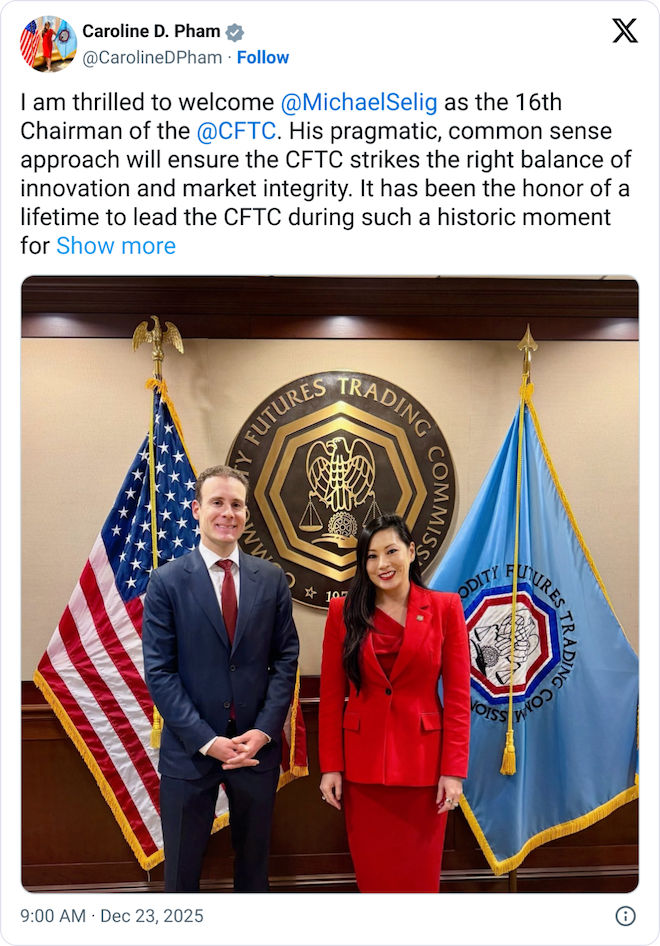
Source: Caroline Pham

Selig to continue positive momentum in crypto oversight

Selig will now serve a term that will expire in April 2029, and has previously vowed to support growth in innovative technologies such as crypto and blockchain by avoiding a so-called “regulation by enforcement” approach.

“I’m grateful for the confidence President Trump has placed in me and for the opportunity to lead the CFTC at this pivotal time,” Selig said.

“We are at a unique moment as a wide range of novel technologies, products, and platforms are emerging, retail participation in the commodity markets is at an all-time high, and Congress is poised to send digital asset market structure legislation to the President’s desk, cementing the US as the Crypto Capital of the World.”

On Monday, White House crypto czar David Sacks said Selig and SEC chair Paul Atkins were a “dream team to define clear regulatory guidelines.”

Pham shifts to crypto after steering CFTC

Pham has long said she would leave the CFTC once Congress confirmed someone to lead the agency, and on Wednesday, MoonPay confirmed earlier reports that Pham was headed to the crypto fintech company.

Pham’s time as acting chair saw her take a proactive approach to supporting crypto regulation.

Related: Wall Street’s bid on crypto dominated 2025 but what’s the demand outlook for 2026?

Pham said in her departing statement that the CFTC had “refocused on our mandate to promote responsible innovation and fair competition as the CFTC prepares to take on expanded oversight of new markets and new products like digital assets, crypto, and prediction markets.”

“I am thrilled to welcome Michael Selig as the 16th Chairman of the CFTC. His pragmatic, common-sense approach will ensure the CFTC strikes the right balance of innovation and market integrity,” she added.

Magazine: Meet the onchain crypto detectives fighting crime better than the cops

Related Questions

QWho is the new chairman of the CFTC and when was he sworn in?

AMike Selig is the new chairman of the CFTC. He was sworn in on Monday after being nominated by President Donald Trump on Oct. 27 and confirmed by the Senate.

QWhat is Mike Selig's stance on cryptocurrency regulation and what is the length of his term?

AMike Selig is widely seen as pro-crypto and has vowed to support growth in innovative technologies by avoiding a 'regulation by enforcement' approach. His term will expire in April 2029.

QWhy did Caroline Pham leave the CFTC and what is her new role?

ACaroline Pham left the CFTC once a new chair was confirmed by Congress. She is headed to the crypto fintech company MoonPay.

QWhat did White House crypto czar David Sacks say about the new regulatory leadership?

ADavid Sacks said that Selig and SEC chair Paul Atkins were a 'dream team to define clear regulatory guidelines'.

QWhat was Caroline Pham's approach to crypto regulation during her time as acting chair?

AAs acting chair, Caroline Pham took a proactive approach to supporting crypto regulation, refocusing the CFTC on its mandate to promote responsible innovation and fair competition for new markets like digital assets.

Related Reads

When AI Begins to Audit the World: From Claude Discovering the ZEC Vulnerability, Watching the Encryption Industry Enter the 'Recursive Security Era'

**When AI Audits the World: From Claude's Discovery of a ZEC Vulnerability, Viewing the Crypto Industry Entering a "Recursive Security Era"** This article examines a pivotal shift in the blockchain security landscape, triggered by the convergence of two events: Anthropic's research on AI's "Recursive Self-Improvement" and Claude Opus 4.8's discovery of a critical vulnerability in Zcash's code. Traditionally, crypto security has relied on human experts and automated tools for periodic audits. However, the article argues AI is transitioning from a mere tool to an active participant in understanding and analyzing complex systems. Claude's ability to identify a subtle flaw in Zcash's zero-knowledge proof system demonstrates AI's potential to dramatically lower the cost and time required for risk discovery. This goes beyond finding a single bug; it signals a change in the very mechanism of how vulnerabilities are found. The core thesis introduces the concept of "Recursive Security," drawing a parallel to Anthropic's "Recursive Self-Improvement." Just as AI can accelerate its own development through feedback loops, security systems are evolving towards a continuous cycle of analysis, risk identification, remediation, and re-analysis. Security is becoming a persistent, evolving capability integrated into a system's lifecycle, rather than a one-time pre-launch audit. This shift is particularly urgent for the crypto industry, where system complexity from Layer-2 networks, modular architectures, and ZK-proofs is growing faster than human analysis capacity. AI excels at the pattern recognition and contextual understanding needed to navigate this complexity. Importantly, the article cautions that AI augments both defenders and potential attackers, accelerating the entire threat landscape. The future competitive advantage may not lie in having zero vulnerabilities, but in having the fastest risk discovery, validation, and response capabilities. The Claude-Zcash incident is thus an early signal of an era where AI-driven, recursive security systems become essential for managing risk in an increasingly complex digital world.

marsbit9m ago

When AI Begins to Audit the World: From Claude Discovering the ZEC Vulnerability, Watching the Encryption Industry Enter the 'Recursive Security Era'

marsbit9m ago

From MSTR to STRC+: Where Is the Limit of the Strategy Universe?

From MSTR to STRC+: The Evolution and Limits of the Strategy Universe This article examines the transformation of Strategy (formerly MicroStrategy) from a simple "Bitcoin treasury" company into a complex financial engineering firm building a BTC-backed credit system. **Core Thesis:** Strategy's true significance lies not just in its massive BTC holdings (~844k BTC), but in its attempt to transform this static reserve into a multi-layered credit curve within traditional capital markets and, subsequently, into on-chain yield infrastructure. **The MSTR Flywheel:** The initial model was a reflexive loop: BTC price rises → MSTR stock rises → company raises capital (debt/equity) at a premium → buys more BTC → increases per-share BTC exposure → MSTR premium grows. This "amplified Bitcoin" equity (MSTR) thrives on bullish momentum but is vulnerable to tightening premiums and rising funding costs. **Building the Credit Curve:** Strategy's innovation is slicing its single BTC balance sheet into different risk/return profiles via specialized securities: * **MSTR:** High-volatility equity layer absorbing full BTC upside/downside. * **STRC:** Key product. A perpetual preferred stock designed as "short duration high yield credit," offering ~11.5% floating monthly dividends. It attracts fixed-income investors seeking yield without direct BTC exposure, funding Strategy's operations. * **STRD/STRK/STRF:** Other preferred/share classes with varying durations, conversion rights, and fixed dividends. **Risks of the STRC Model:** STRC's high yield is not risk-free. Its stability depends on: 1) Sufficient BTC asset coverage, 2) Strategy's continued ability to pay dividends, and 3) Market faith in the MSTR/STRC funding flywheel. Stress points include deep BTC price declines eroding the asset buffer, rising dividend costs if STRC trades below par, and a broken flywheel if MSTR's premium (mNAV) falls persistently. **On-Chain Expansion: STRC+:** Projects like **Saturn** and **Apyx** aim to package STRC's (and other DAT preferred stock) cash flows into on-chain stablecoin yield (e.g., sUSDat, apyUSD). They offer DeFi a new yield source distinct from trading fees or incentives—cash dividends from traditional securities. However, this introduces compounded risks: off-chain custody, issuer credit risk, BTC volatility, and protocol execution risk. **Conclusion: The Ultimate Boundary** Strategy's endgame is not infinite BTC accumulation. It is the market's long-term acceptance of a new credit system where BTC serves as collateral for tradable securities whose cash flows can power on-chain financial applications. Its "universe" expands if this BTC-native credit curve gains legitimacy, but contracts if these instruments are repriced purely as high-risk, yield-bearing credit assets without stablecoin mythology.

marsbit28m ago

From MSTR to STRC+: Where Is the Limit of the Strategy Universe?

marsbit28m ago

Founder of Baixing.com: My Fourteen Claude Code Usage Experiences

Founder of Baixing.com Shares 14 Personal Tips for Using Claude Code The author outlines his personal, non-universal strategies for maximizing Claude Code. Key points include: focusing deeply on one primary tool (Claude Code) rather than constant comparison; mastering essential shortcuts for the editor and command line; utilizing voice input like HoldSpeak; starting projects with a structured PROJECT.md file; defaulting to Claude agents for most tasks; and leveraging integrations with GitHub and Cloudflare for build, deployment, and infrastructure. He emphasizes a clear separation between human and machine work: manually maintain a core CLAUDE.md file, and understand AI-generated content by asking the AI, not reading its raw code. Efficient communication involves dragging files (screenshots, audio, documents) directly into the interface. For knowledge management, he recommends a centralized, Git-synced memory system based on ~/.claude/CLAUDE.md to ensure permanence and avoid scattered project memories. Other practices include writing and continuously refining "Skills," using the expensive but reliable ultracode for complex dynamic workflows, and employing Git documentation as handoff points between agents. The overarching philosophy is to treat Claude Code like a horse (or a person) with its own pathfinding abilities—setting goals and boundaries rather than micromanaging every turn.

链捕手36m ago

Founder of Baixing.com: My Fourteen Claude Code Usage Experiences

链捕手36m ago

Trading

Spot
Futures
活动图片