Cardano Maintains Lead As Most Actively Developed Network In The Crypto Space

bitcoinistPublished on 2026-04-24Last updated on 2026-04-24

Abstract

Cardano has emerged as the most actively developed blockchain network in the crypto space, surpassing major competitors like Ethereum, XRP, and BNB Chain in all-time code commits. According to data from Everstake, the network has accumulated over 478,100 commits, reflecting a strong focus on infrastructure upgrades, protocol improvements, and ecosystem expansion. This development activity is seen as a key indicator of long-term fundamental strength, even as ADA’s price remains in a multi-year bear cycle. Analysts suggest that if the bearish trend continues, ADA could drop toward $0.10 by year-end, which may present a strategic buying opportunity for the next bull cycle.

The Cardano network is considered one of the leading blockchains in the crypto sector due to significant milestones such as heightened user activity over the years. As the blockchain space grows, the Cardano network has recently emerged as the leader in terms of development, putting it at the forefront of innovation.

Developer Activity On Cardano At The Top

Cardano (ADA) has had a notable price growth since its launch in September 2017, allowing it to ride with major cryptocurrency assets in the market. However, the leading altcoin is not entirely shaped by its remarkable price growth.

While the network has displayed robust price performances over the years, Everstake, the largest global non-custodial staking infrastructure provider, highlighted that the strongest signal is not always price, but rather development. Everstake’s purpose in sharing this data is to address those who are showing less trust in the network.

Currently, momentum is building behind Cardano as it emerges as the most active network in the blockchain space in terms of development. As the most actively developed network, Cardano is showcasing its commitment to refining its infrastructure and also broadening its capabilities.

Thanks to a consistent flow of updates, commits, and ecosystem enhancements that demonstrate a strong emphasis on long-term scalability and functionality, the network is leading the way in innovation.

Everstake shared that the network now controls over 8.9% of the total Layer 1 share in addition to ranking as No.1 in all-time code commits in the sector, surpassing major chains like Ethereum, XRP, BNB Chain, among others. Such an achievement reflects a sustained and consistent level of building at scale.
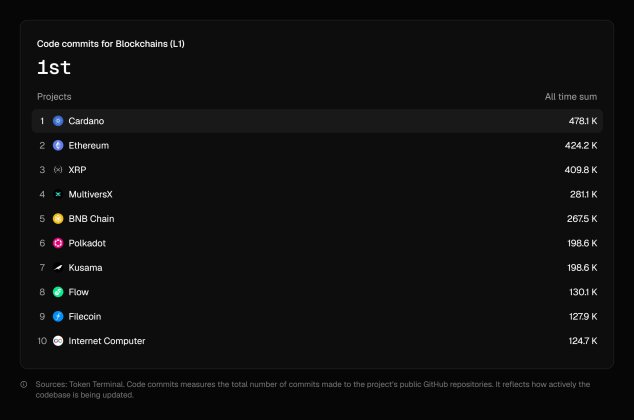
Source: Chart from Everstake on X

According to Everstake, it is important to understand that this surge in development is the result of years of tireless upgrades. The Cardano network has scooped up a total of 478,100 commits across the ecosystem, pointing to ongoing protocol improvements, expanding infrastructure, and deeper ecosystem development.

Even with Ethereum’s strong development presence, Cardano’s surpassing of ETH highlights a meaningful shift in where engineering effort is concentrated. “From our perspective, this kind of compounding developer activity is one of the most reliable indicators of long-term fundamental strength,” Everstake stated.

ADA’s Price In A Multi-Year Bear Cycle

ADA’s broader trend remains in bearish conditions even as its price has experienced a brief upward move. A crypto analyst known as TradingShot on X revealed that the altcoin is still in a multi-year bear cycle after examining price action in the weekly timeframe chart.

TradingShot stated that Cardano has been within a bear cycle since December 2, 2024, while the second bearish leg of its 5-year Channel is trending downward. Based on the current weekly Bullish Divergence, ADA is positioned at the same spot as June 2022.

If it repeats the 2022 bear cycle, the price will drop sharply toward $0.1000 by the end of the year. In a technical view, the expert has predicted that the $0.10 to $0.09 range would be an ideal long-term buy zone for the upcoming bull cycle.

ADA trading at $0.24 on the 1D chart | Source: ADAUSDT on Tradingview.com

Trending Cryptos

Related Questions

QAccording to the article, which blockchain is currently the most actively developed network in the crypto space?

ACardano is currently the most actively developed network in the crypto space.

QWhat metric, according to the infrastructure provider Everstake, is a more reliable indicator of long-term strength than price?

AEverstake highlighted that development activity, not price, is the strongest signal and one of the most reliable indicators of long-term fundamental strength.

QHow many all-time code commits has the Cardano ecosystem accumulated, as stated in the article?

AThe Cardano network has accumulated a total of 478,100 commits across its ecosystem.

QWhat is the price prediction for ADA by the end of the year if it repeats its 2022 bear cycle, according to the analyst TradingShot?

AIf ADA repeats its 2022 bear cycle, the price is predicted to drop sharply toward $0.1000 by the end of the year.

QBesides development activity, what other factor is mentioned as contributing to Cardano's lead in innovation?

AA consistent flow of updates, commits, and ecosystem enhancements that demonstrate a strong emphasis on long-term scalability and functionality is contributing to its lead in innovation.

Related Reads

Wall Street Morning News: V-shaped Rebound at Month-end, but Nasdaq Suffers Worst July in 12 Years; Funds Accelerate Concentration Towards Cloud Giants

Despite a V-shaped rebound at the end of July, the Nasdaq posted its worst July since 2004, while the S&P 500 had its worst July since 2014. Markets were jolted by geopolitical shifts, as President Trump canceled a planned strike on Iran, leading WTI crude to plunge over 8%. This, alongside OPEC+ announcing a supply increase, reversed crude's sharp July gains. Treasury yields surged, with the 10-year yield rising over 30 basis points in July—its largest July increase since 2005. In a rare move, the US and Japan jointly intervened to weaken the USD/JPY, aiming to prevent potential Japanese sales of US Treasuries. While the tech sector faced deleveraging pressure throughout July, cloud giants staged a massive rally on strong earnings. Microsoft, Amazon, and Google collectively added nearly $1.5 trillion in market value last week. Amazon soared over 15% on accelerating AWS growth, Microsoft extended historic gains, Google fully recovered post-earnings losses, and Meta ended an 11-day losing streak. In contrast, Apple tumbled over 7% on supply chain and guidance concerns, ceding its "world's most valuable company" title to Nvidia. The memory and storage sector corrected sharply. Gold edged up 0.91% in July, with analysts viewing the ~30% pullback from January highs as a potential basing period, supported by long-term central bank demand. Key events to watch this week include earnings from Palantir, AMD, SpaceX (its first post-IPO report), and memory giants like Western Digital. The US July non-farm payrolls report on Friday will be critical for gauging the Fed's policy path. SpaceX also faces a significant lock-up expiration, testing market liquidity.

marsbit54m ago

Wall Street Morning News: V-shaped Rebound at Month-end, but Nasdaq Suffers Worst July in 12 Years; Funds Accelerate Concentration Towards Cloud Giants

marsbit54m ago

Rubin Ultra Makes Major Cuts, Even Nvidia Can't Handle Memory Price Hikes?

NVIDIA's Rubin Ultra, the top-tier variant of the newly announced Rubin AI accelerators, has reportedly seen significant specification downgrades, according to an industry report from SemiAnalysis. Initially designed with four compute dies (4-die), the Rubin Ultra is now said to be reduced to a 2-die design. Key changes highlighted in the report include: * **No increase in peak theoretical compute performance**, remaining at 35 PFLOPs like the standard Rubin. * **Severe reduction in memory capacity** to 192GB using 8-Hi HBM stacks, which is less than the standard Rubin's 288GB using 12-Hi stacks. * **Negligible memory bandwidth improvement** of only 1 TB/s. * **Slightly higher chip-level power consumption**. * The **primary upgrade is a massive increase in scale-up interconnect capacity**, supporting connections for up to 576 GPUs via NVLink, compared to 72 for the standard Rubin. The report suggests the redesign is primarily a cost-optimization move driven by the sharp rise in HBM (High-Bandwidth Memory) prices. By reducing the expensive HBM content and shifting investment towards enhanced system-scale networking, NVIDIA aims to maintain the platform's value for large-scale AI training clusters while managing soaring material costs. The news reportedly triggered a sell-off in South Korean memory stocks, with SK Hynix and Samsung shares falling around 8%, as markets grew concerned that NVIDIA—a major HBM buyer—might be reducing its reliance on high-capacity memory, potentially capping future pricing power for memory makers.

Odaily星球日报1h ago

Rubin Ultra Makes Major Cuts, Even Nvidia Can't Handle Memory Price Hikes?

Odaily星球日报1h ago

Trading

Spot

Hot Articles

Discussions

Welcome to the HTX Community. Here, you can stay informed about the latest platform developments and gain access to professional market insights. Users' opinions on the price of ADA (ADA) are presented below.

活动图片