Cardano Gets Filecoin-Backed Storage Upgrade

bitcoinistPublished on 2026-04-23Last updated on 2026-04-23

Abstract

Cardano's ecosystem has integrated a significant storage upgrade through a collaboration between Blockfrost and Filecoin. This new premium storage tier offers Cardano builders a decentralized, verifiable backup solution without requiring any changes to their existing workflows. The integration, which was initially announced in late 2024, has now been productized, providing enhanced data resilience for applications on Cardano. Charles Hoskinson endorsed the move, welcoming Filecoin as "one of the OGs" to the ecosystem. The service leverages Filecoin's decentralized storage network to strengthen app reliability and underscores a commitment to decentralization by coordinating two major layer-1 blockchain ecosystems.

A new storage offering is moving from partnership language to product language inside the Cardano stack. Filecoin said Blockfrost has added a premium storage tier for developers backed by Filecoin, giving builders a distributed, verifiable backup layer without requiring changes to existing workflows.

Hoskinson Backs Filecoin Move Into Cardano

Cardano developers using Blockfrost already rely on the API provider to avoid running their own infrastructure. Filecoin posted via X: “Blockfrost added a premium storage tier for Cardano developers backed by Filecoin. Distributed across independent providers, verifiable, with no infrastructure overhead. For data-driven apps on Cardano, that’s a reliability upgrade with no workflow changes required.”

Charles Hoskinson amplified the announcement with a short but pointed endorsement, calling Filecoin “one of the OGs” and welcoming it to the Cardano ecosystem. The comment was brief, but it gave the rollout added visibility across Cardano circles and framed the integration as more than a quiet backend feature.

Philip DiSarro, the founder and CEO of Anastasia Labs, a Cardano-focused smart contract development and security firm, added via X: “This is a beast of a collaboration / announcement.”

The older press release behind the announcement fills in what the product actually does. In December 2024, Filecoin Foundation and Blockfrost said they were collaborating to integrate Filecoin as a decentralized storage backup layer for apps built with Blockfrost. At the time, the framing centered on redundancy, quality assurance and decentralization. The new development is that those ideas now appear to have been packaged into a “premium storage tier” for developers rather than remaining a general infrastructure collaboration.

A premium tier implies a concrete service offering developers can select as part of their stack, with clearer user value: preserve data across a decentralized storage network, keep access seamless, and do it without forcing teams to rework their application flow.

Filecoin’s wording around the launch was explicit: “For data-driven apps on Cardano, that’s a reliability upgrade with no workflow changes required.” That is the core pitch. Not a new chain, not a migration, not another middleware maze. Just a harder-to-break storage layer sitting behind the tools many builders already use.

The original release also made clear why Filecoin was the chosen layer. “By archiving its IPFS Gateway clusters on Filecoin, the world’s largest decentralized storage network, Blockfrost will introduce a new service tier for builders that includes both IPFS and Filecoin storage. This integration not only strengthens the resilience of future Cardano apps but also highlights a commitment to decentralization by prioritizing the coordination of two leading layer-1 blockchain ecosystems.”

At press time, ADA traded at $0.2555.
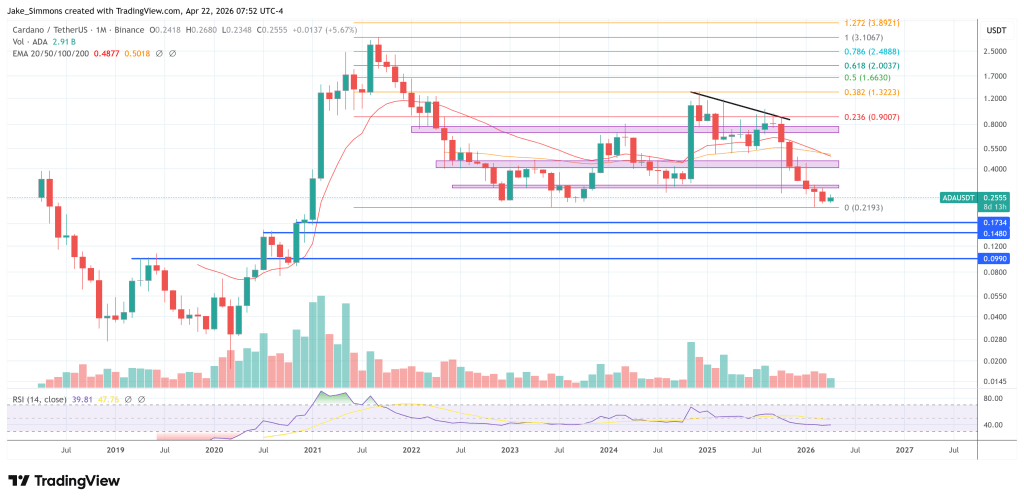
ADA remains below key resistance, 1-monthly chart | Source: ADAUSDT on TradingView.com

Related Questions

QWhat is the new storage offering for Cardano developers announced by Filecoin and Blockfrost?

ABlockfrost has added a premium storage tier for Cardano developers backed by Filecoin, providing a distributed, verifiable backup layer without requiring changes to existing workflows.

QHow did Charles Hoskinson respond to Filecoin's integration into the Cardano ecosystem?

ACharles Hoskinson gave a short but pointed endorsement, calling Filecoin 'one of the OGs' and welcoming it to the Cardano ecosystem, which increased the visibility of the rollout.

QWhat are the key benefits of the Filecoin-backed premium storage tier for Cardano developers?

AThe key benefits include distributed storage across independent providers, verifiability, no infrastructure overhead, enhanced reliability for data-driven apps, and no required workflow changes.

QWhy was Filecoin chosen as the storage layer for Blockfrost's integration?

AFilecoin was chosen because it is the world's largest decentralized storage network, and integrating it with Blockfrost's IPFS Gateway clusters strengthens the resilience of Cardano apps and highlights a commitment to decentralization by coordinating two leading layer-1 blockchain ecosystems.

QWhat was the price of ADA at the time of the article's publication?

AAt press time, ADA traded at $0.2555.

Related Reads

What Are Some Good Paths for Chinese Web3 Entrepreneurship? (Part 5)

This article explores pathways for Chinese Web3 teams to pivot toward AI, building on a previous discussion. It focuses on two specific team profiles: **Security & Risk Control Teams:** These teams, skilled in smart contract auditing, wallet security, and on-chain monitoring, can transition to providing **Agent behavior auditing and AI security governance**. As AI Agents automate tasks, access data, and trigger payments, enterprises will need solutions to monitor permissions, audit logs, control data access, and prevent anomalies—creating a strong B2B demand. **Application & Community-Focused Teams:** Instead of completely rebranding as AI companies, these teams should use AI to **enhance their existing products**. For example, research platforms can use AI to summarize information and identify signals; community tools can automate user support and analysis; and educational products can create personalized learning paths. The key is integrating AI to solve existing user pain points, like information overload or high operational costs. The article also advises against certain AI directions for Chinese Web3 teams, such as building general-purpose large language models (too resource-intensive), creating overly broad Agent platforms (hard to monetize), developing AI traders/automated yield products (high regulatory and risk sensitivity), or simply adding superficial AI features without genuine value. The core conclusion: Successful migration depends not on chasing AI hype, but on **identifying how a team's existing Web3 capabilities—be it in data, payments, security, or user operations—can address real needs in new AI application scenarios.**

marsbit1h ago

What Are Some Good Paths for Chinese Web3 Entrepreneurship? (Part 5)

marsbit1h ago

Trading

Spot
Futures

Hot Articles

Discussions

Welcome to the HTX Community. Here, you can stay informed about the latest platform developments and gain access to professional market insights. Users' opinions on the price of ADA (ADA) are presented below.

活动图片