Cardano Founder Unveils Midnight Rollout Plan As Mainnet Launch Begins

bitcoinistPublished on 2026-03-24Last updated on 2026-03-24

Abstract

Cardano founder Charles Hoskinson has announced the start of the federated mainnet phase for Midnight, a privacy-focused blockchain. The launch is being conducted gradually with daily operational checkpoints to ensure network stability. Initially, the mainnet is running in a guarded mode with limited transactions and dApp deployments. Federated node operators, including Google Cloud, Telegram, and MoneyGram, are managing the rollout. The first user-facing feature is DUST generation, accessible via Lace wallet. Hoskinson emphasized Midnight's complex architecture, which integrates zero-knowledge proofs and spans both public and private ledgers. Future upgrades will introduce composable contracts, cross-chain intents, and governance features, though full decentralization is expected to take 6–12 months due to the broad distribution of tokens via a "glacier drop."

Cardano founder Charles Hoskinson says Midnight has entered its federated mainnet phase, marking the start of a guarded rollout that he described as the first step in turning on one of the most technically ambitious networks in crypto.

In a March 23 livestream, the Cardano founder framed the week as “Midnight Week” and said the network was being activated gradually with daily operational checkpoints. “What’s happening this week is the federated launch and this is basically the mainnet network and it’s turning on step by step,” Hoskinson said. “Every day we have a go no-go meeting and based upon what we’re getting back from the federated mainnet nodes, they tell us a whole bunch of stuff. ... Basically the goal here is to get to a stable network.”

Cardano’s Midnight Launch Week Begins

That first phase is intentionally restrictive. Hoskinson said Midnight is live as a mainnet rather than a testnet, but operating in a guarded mode where transactions and decentralized application deployments are limited until the team is satisfied that consensus, block production, and core cryptographic components are working as intended. The immediate user-facing milestone, he said, is DUST generation, which should become visible through an update to Lace after the earlier Glacier Drop period ended.

The rollout is being handled by federated node operators, or FNOs, rather than an open validator set from day one. Hoskinson said those operators include firms such as Google Cloud, Telegram and MoneyGram, drawing a parallel to Cardano’s Byron era, when a small group of entities initially ran the network before control was broadened over time. Once the network proves stable, Midnight plans to lower its guardrails in stages and begin deploying applications in waves.

“So you go from just dust generation to Lace plus DApps and you can actually start using some of these experiences,” he said. “You’re basically looking for a stable consensus. You’re looking for stable block generation in the mainnet environment. And then as that gets stable, everybody’s happy, you go from guarded to less guarded to less guarded to less guarded.”

Hoskinson argued that Midnight’s launch path is more complicated than Cardano’s because the system spans both Cardano and Midnight, with separate roles for its assets and multiple address formats across public and private ledgers. He also pointed to its layered design, naming consensus components such as Aura, Grandpa and Beefy, while describing Compact as “basically Zcash with smart contracts.”

That framing is central to the pitch. Midnight, in Hoskinson’s telling, is not just another chain launch but a privacy-preserving smart contract system being opened in phases. The first version shipping with the federated mainnet includes zero-knowledge tooling such as Plonk and Halo 2, while later upgrades are expected to bring composable contracts, Nightstream-related infrastructure, capacity exchange, crosschain intents and the Midnight passport system.

The decentralization roadmap comes later. Hoskinson said Midnight is now entering phase two, with phase three set to introduce an incentivized testnet for stake pool operators, allowing them to begin making blocks in parallel with ongoing federated mainnet upgrades. Governance experiments are also expected to begin in that phase, although he cautioned that Midnight’s broad token distribution through its “glacier drop” means the ecosystem needs time to mature before full governance can be safely turned on.

“One of the problems with Midnight, and this is why you need at least 6 to 12 months to stabilize, is that Midnight was distributed with a glacier drop,” he said. “That’s a huge benefit because you get lots of people. The problem is that those people haven’t decided whether they want to be a good-faith member of the Midnight ecosystem community or if they just want to dump their NIGHT or be adversarial.”

Hoskinson also used the livestream to make a much broader claim about Midnight’s long-term role, describing it as infrastructure for privacy, compliance and AI-driven commerce. He said the system’s mix of zero-knowledge proofs, multi-party computation and trusted execution environments could make it a natural framework for autonomous software agents to transact and verify one another.

At press time, Cardano traded at $0.2611.
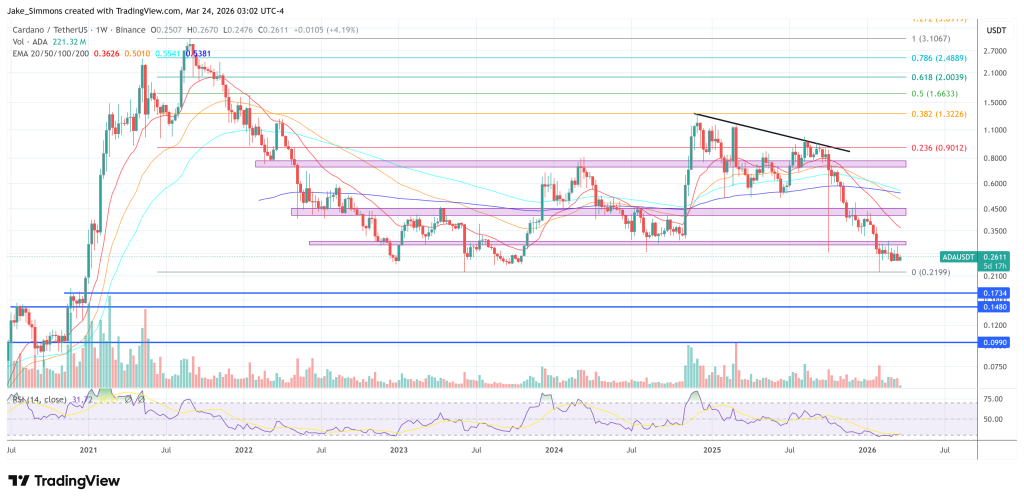
ADA hovers below key resistance, 1-week chart | Source: ADAUSDT on TradingView.com

Trending Cryptos

Related Questions

QWhat is the current phase of Midnight's launch as announced by Charles Hoskinson?

AMidnight has entered its federated mainnet phase, which is the start of a guarded rollout.

QWhich companies are mentioned as federated node operators (FNOs) for the initial launch?

AGoogle Cloud, Telegram, and MoneyGram are mentioned as federated node operators.

QWhat is the first user-facing milestone expected after the Glacier Drop period?

AThe first user-facing milestone is DUST generation, which should become visible through an update to Lace.

QAccording to Hoskinson, why does Midnight need 6 to 12 months to stabilize after launch?

AIt needs time to stabilize because the broad token distribution through the 'glacier drop' means the ecosystem needs to mature before determining if participants will be good-faith members or adversarial.

QWhat broader long-term role did Hoskinson claim for Midnight beyond being a blockchain?

AHe described Midnight as infrastructure for privacy, compliance, and AI-driven commerce, using zero-knowledge proofs, multi-party computation, and trusted execution environments for autonomous software agents.

Related Reads

Misjudged A-Shares: Resilience, Expectations, and Confidence

China's A-share market recently faced selling pressure, especially in tech sectors, initially triggered by a global tech sell-off that began in South Korea. However, the article argues this is a case of "mistaken injury" and highlights the market's underlying resilience. This resilience stems from three main pillars: **1) Tech Sector Fundamentals:** Unlike Korea's market dominated by a few memory chip stocks, China's tech sector is diversified across computing, communications, electronics, and semiconductors, supported by dual narratives of global AI supply chains and domestic substitution. Core areas like optical modules and fiber optics continue to show strong earnings growth. **2) "National Team" Support:** State-backed institutions and large corporations have made significant market purchases and announced buybacks, providing liquidity and signaling confidence. This is seen as a stabilizing policy signal, often associated with market bottoms. **3) Broader Market Pillars:** Other major sectors are showing endogenous recovery momentum. Consumer stocks benefit from stabilizing CPI and signs of sector recovery (e.g., liquor price hikes). Cyclical sectors like aluminum have high earnings, potential price increases due to tight supply, and low valuations. The financial sector offers stable dividends and low valuations. The conclusion is that the sell-off was driven by external contagion, not a collapse in fundamentals. With strong policy support and recovering momentum across key sectors, the A-share market possesses the toughness to regain stability.

marsbit24m ago

Misjudged A-Shares: Resilience, Expectations, and Confidence

marsbit24m ago

The Clarity Act's Journey Through Congress: The Thorny Path of Bipartisan Compromise in the U.S.

The U.S. Congress is struggling to advance the crypto market structure bill known as the Clarity Act, with bipartisan compromise proving difficult. Key hurdles include unresolved disputes over "yield" products and, more critically, the inclusion of strong ethics provisions for elected officials—a non-negotiable demand for many Democrats. While a compromise on yield was reached in May, securing only limited Democratic support in committee, the separate Senate Agriculture Committee version later passed with no Democratic votes due to the ethics impasse. As Republicans push for a full Senate vote in July, demands for ethics rules have expanded, and other contentious issues like developer protections and concerns from law enforcement and large banks further complicate negotiations. Despite consensus on the need for legislation, the path forward is unclear. Recent discussions between senators and White House officials aim to find acceptable ethics language. Some lawmakers question whether a compromise text can garner enough bipartisan support, with one Democrat stating the current proposal lacks the strong ethics provisions required for their vote. Potential short-term goals for the crypto community include symbolic Senate action before the August recess, a longer-term aim for passage by 2026, or establishing a detailed framework that addresses ethics and other compromises. The process remains arduous, relying on the traditional, vote-by-vote effort to build bipartisan support.

marsbit43m ago

The Clarity Act's Journey Through Congress: The Thorny Path of Bipartisan Compromise in the U.S.

marsbit43m ago

Are Kalshi and Polymarket Founders at Odds? This Business Rivalry Is More Brutal Than You Think

"The Rivalry Between Kalshi and Polymarket Founders Turns Bitter and Litigious" The intense feud between Tarek Mansour, CEO of Kalshi, and Shayne Coplan, founder of Polymarket, has escalated far beyond typical business competition into personal animosity and regulatory battles. Both lead billion-dollar prediction market platforms, but their approaches differ sharply. Kalshi positions itself as the compliant operator, securing U.S. regulatory approval before launching. In contrast, Polymarket initially operated offshore, allowing U.S. users to access its platform via VPN, which drew regulatory scrutiny. The conflict reached a peak in November 2024 when FBI agents raided Coplan's New York apartment. While Coplan publicly blamed political motives, his team privately suspected Kalshi was involved. According to sources, Kalshi's lawyers had previously reported Polymarket's operations to federal prosecutors, highlighting its accessibility to U.S. users despite a ban. This incident fueled mutual accusations and underhanded tactics, including social media smear campaigns and attempts to sabotage each other's major business deals. Their rivalry also played out in Washington, influencing regulatory debates. Kalshi actively lobbied against Polymarket's practices, framing them as illegal and unethical. Polymarket, after facing a CFTC fine and investigation, later acquired a licensed U.S. firm to launch a domestic app, regaining a foothold. Despite the hostility, both companies have seen massive growth, with combined trading volumes soaring. However, increased regulatory scrutiny, particularly around insider trading on Polymarket's platform, continues to pose challenges. The founders' deep-seated mutual disdain ensures their battle for market dominance remains as much a personal vendetta as a commercial one.

marsbit52m ago

Are Kalshi and Polymarket Founders at Odds? This Business Rivalry Is More Brutal Than You Think

marsbit52m ago

Trading

Spot

Hot Articles

Discussions

Welcome to the HTX Community. Here, you can stay informed about the latest platform developments and gain access to professional market insights. Users' opinions on the price of ADA (ADA) are presented below.

活动图片