Cardano Founder To Leave X Permanently, Details Next Steps

bitcoinistPublished on 2025-12-29Last updated on 2025-12-29

Abstract

Cardano founder Charles Hoskinson has announced he will permanently leave X (formerly Twitter) by the end of December, with a "digital twin" set to take over his account in January. He plans to shift his communication to platforms like Discord for weekly AMAs, YouTube for livestreams, and long-form writing on his personal blog. Hoskinson cited X's tendency to "reward outrage" as a key reason for leaving, emphasizing that his focus will remain on building meaningful projects like Cardano's development, Africa initiatives, and Midnight. He also hinted at past conflicts on the platform, thanking supportive followers while dismissing critics. Further details about the digital twin will be explained in his first YouTube stream of the new year. At the time of writing, ADA was trading at $0.3779.

Cardano founder Charles Hoskinson says he will stop using X at the end of December, with a “digital twin” set to take over his account in January, an unusual handoff that reshapes how one of crypto’s most visible founders communicates with the Cardano community. “Five more days on X,” Hoskinson wrote in a Dec. 27 post. “Come January, a digital twin takes over this account—I’ll explain what that means on the first YouTube stream of the new year.”

Here’s Why The Cardano Founder Will Leave X

Hoskinson pointed followers to where he intends to be active next. “Where to find me: Midnight Discord for weekly AMAs, YouTube for livestreams, and the long-form writing I’ve owed myself for a decade,” he wrote, tying the shift to Midnight and to a renewed emphasis on longer-form communication.

The motivation, he said, is incentive design. “Why leave? X rewards outrage,” Hoskinson wrote, adding that “the work that matters—Africa, Basho, Midnight 1.0, Cardano governance—rewards building.” He framed it as a conclusion drawn from a full decade on the platform: “Ten years taught me which game is worth playing.”

The farewell also carried a sharper edge that nodded to the disputes he has been drawn into on X. “To everyone who made this decade worthwhile: thank you. To the rest: I won’t miss you,” he wrote. Hoskinson has been a prolific and often combative presence on the platform, frequently engaging critics directly and weighing in on Cardano’s technical direction, governance arguments, and broader industry controversies.

Hoskinson’s writing pivot is already underway. On Dec. 25, he published a long post titled “What the Horizon Kept” on his personal Blogger site, opening with a vignette in which “The old fisherman said, ‘The ocean’s too quiet,’” before moving into a surreal narrative about instruments failing, maps not matching reality, and an island appearing where none was marked. The site’s profile bio describes him, bluntly, as a “Guy who writes stuff that makes people angry.”

He also continued posting in a more typically terse mode in recent days. In one message, Hoskinson wrote: “Before Crypto and After Crypto. Friends don’t let friends do crypto.”

Hoskinson has not provided details about the “digital twin” beyond promising an explanation in his first YouTube livestream of the year. For Cardano and Midnight followers, the near-term question is how that handoff works in practice, and whether the conversation he has historically driven on X consolidates on Discord, YouTube, and whatever long-form writing comes next.

At press time, ADA traded at $0.3779.
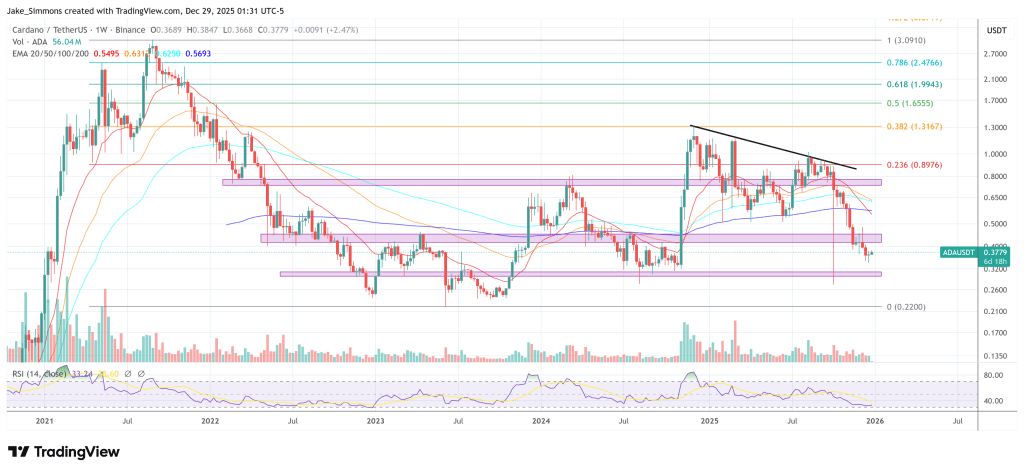
ADA falls below key support, 1-week chart | Source: ADAUSDT on TradingView.com

Trending Cryptos

Related Questions

QWhy is Cardano founder Charles Hoskinson leaving X (formerly Twitter)?

ACharles Hoskinson is leaving X because he believes the platform rewards outrage, while the work that matters, such as the development of Africa, Basho, Midnight 1.0, and Cardano governance, rewards building. He concluded from his ten years on the platform that building is the game worth playing.

QWhat is the 'digital twin' that Charles Hoskinson mentioned?

AHoskinson has not provided specific details about the 'digital twin' yet. He has only promised to explain what it means during his first YouTube livestream of the new year in January.

QWhere does Charles Hoskinson plan to be active after leaving X?

AAfter leaving X, Hoskinson plans to be active on the Midnight Discord for weekly AMAs, on YouTube for livestreams, and he will focus on long-form writing that he has wanted to do for a decade.

QWhat was the tone of Hoskinson's farewell message on X?

AHis farewell message had a sharp edge. He thanked those who made his decade on the platform worthwhile but also stated, 'To the rest: I won’t miss you,' nodding to the many disputes he has been involved in on the platform.

QWhat is the trading price of ADA (Cardano's token) mentioned at the end of the article?

AAt the time the article was written, ADA was trading at $0.3779.

Related Reads

Annual Salary of Millions Competing for Electricians, Meta Rushes to Open Its Own Technical School

The AI boom is facing an unexpected bottleneck: a severe shortage of skilled construction workers and electricians. As tech giants like Meta, OpenAI, and Alphabet race to build massive data centers—such as OpenAI's $16 billion "Stargate" project—they are hitting a critical labor wall. The U.S. needs an estimated 130,000 more electricians, 240,000 construction workers, and 150,000 supervisors by 2030 for AI infrastructure alone, but tens of thousands of electrician jobs go unfilled each year. While AI companies offer high premiums, with electricians earning up to $280,000 annually, worker scarcity still causes massive losses—delays on a single project can cost $14.2 million per month. The complexity of building AI data centers, which require immense power (equivalent to powering hundreds of thousands of homes), sophisticated electrical systems, and advanced liquid cooling solutions, demands highly skilled technicians who are in short supply. To combat this, companies are investing heavily in training. Meta has committed $115 million to a free training school offering tuition, housing, and stipends, targeting 5,000 new workers. OpenAI is partnering with unions to secure skilled labor. These efforts are paying off, with a significant rise in Gen Z interest in trade schools over college. However, the power demands are staggering. AI data centers are driving a rapid surge in electricity consumption, projected to account for up to 12% of U.S. power use by 2028 and raising costs for consumers. Furthermore, the construction boom is project-based, leading to a potential future glut of trained workers once building peaks, which could depress wages industry-wide. The race for AI supremacy now depends as much on skilled hands as on advanced chips.

marsbit1h ago

Annual Salary of Millions Competing for Electricians, Meta Rushes to Open Its Own Technical School

marsbit1h ago

OpenAI No Longer Sells Its Most Expensive Model for Profit

OpenAI is shifting its business strategy away from promoting its most expensive, flagship models for every task. Recent price cuts—80% for GPT-5.6 Luna and 20% for Terra—signal a deeper change: the company now actively advises users that many tasks don't require the most powerful model. Instead, OpenAI recommends a tiered approach: use the high-end GPT-5.6 Sol for complex planning and analysis, then delegate execution to cheaper models like Luna. This mirrors moves by Anthropic, which recently launched Claude Opus 5 at half the price of its top model, Fable 5. Both companies are de-emphasizing flagship models as primary revenue drivers, using them instead for brand prestige and technological showcases. The industry is entering a "mass-market" phase, similar to automotive, where high-volume, cost-effective models handle daily operations and drive scale. OpenAI's price reductions are partly enabled by AI models themselves optimizing underlying code and infrastructure, creating a self-reinforcing cycle of efficiency gains and cost reduction. Competition is shifting from "who is smartest" to "who offers the best value." The goal is no longer selling individual models but fostering widespread API adoption and ecosystem lock-in. By making AI calls cheap and ubiquitous, companies like OpenAI aim to become the indispensable, utility-like infrastructure powering automated workflows—the "water and electricity" of software, quietly embedded everywhere.

marsbit1h ago

OpenAI No Longer Sells Its Most Expensive Model for Profit

marsbit1h ago

Trading

Spot

Hot Articles

Discussions

Welcome to the HTX Community. Here, you can stay informed about the latest platform developments and gain access to professional market insights. Users' opinions on the price of ADA (ADA) are presented below.

活动图片