Cardano Founder Says The Old System Is Breaking Down

bitcoinistPublished on 2026-03-24Last updated on 2026-03-24

Abstract

Charles Hoskinson, founder of Cardano, argues that the current downturn in crypto and other markets is a symptom of a broader systemic collapse, not a crypto-specific failure. In a livestream, he described a world in crisis due to war, inflation, and a loss of institutional legitimacy. Hoskinson positioned crypto as the essential infrastructure for a new, fairer system that can bank the unbanked, provide universal digital identity, and create equitable global markets. He defended the long-term purpose of crypto amidst market weakness, linking it to censorship resistance and the future regulation of AI. He also revealed that AI tools are drastically accelerating development, citing the near-launch of Cardano's privacy chain, Midnight. His overarching message was that crypto serves as a vital trust and control layer for a dysfunctional world.

Charles Hoskinson used a March 19 livestream to deliver a defense of crypto as a response to political dysfunction, market weakness, and what he described as a broader collapse in institutional legitimacy.

Broadcasting from Colorado, the Cardano founder framed the current macro backdrop in apocalyptic terms, citing war, layoffs, inflationary pressure tied to energy costs, and a growing sense of social pessimism. Markets, he argued, are reacting to that broader stress rather than suffering from a crypto-specific failure.

“The markets are down a little bit. They should be,” Hoskinson said. “The world is literally on fire and we’re trying to douse the flames by pouring money on the fire, thinking somehow that’ll make the fire go out.” In his telling, weak market conditions across crypto, real estate, and other asset classes are symptoms of a deeper problem: a legacy system losing coherence.

A Bigger Future For Cardano And Crypto

That was the core thesis of the livestream. Hoskinson argued that monetary systems, governance systems, and even shared social meaning are all being contested at once, creating a more structural crisis than a single recession or geopolitical conflict. Against that backdrop, he positioned crypto as infrastructure for whatever replaces the current order.

“If we win, we will bank the unbanked. Everybody will own their own identity and we will for the first time in human history have fair markets for everyone everywhere,” he said. “The billionaires, the three comma club gets the same marketplace as the poorest people in the world.”

The remarks were also a defense of persistence during a weaker market cycle. Hoskinson repeatedly pushed back against what he called cynicism inside and outside crypto, arguing that falling token prices have not invalidated the sector’s long-term purpose. He cast the industry as a toolset for censorship-resistant money, non-custodial ownership, alternative governance, and digital identity, all themes long associated with Cardano’s broader positioning.

At several points, he linked that argument directly to AI. Hoskinson said crypto is not just a monetary alternative but potentially the framework that can regulate increasingly powerful machine systems. “Like has to regulate like,” he said. “It’s the single most important invention in the history of humanity.”

The stream also offered a window into how Hoskinson sees AI changing crypto development itself. He said he recently generated a 40-page internal paper in roughly 90 minutes using an agentic workflow built from Midnight and Sui source code, internal white papers, multiple language models, and adversarial testing agents. According to Hoskinson, the result condensed what would once have been six weeks of architecture analysis into a single afternoon.

That matters because Midnight, Cardano’s privacy-focused partner chain, is nearing launch. Hoskinson said he had been speaking with Shielded Technologies CEO Mike Ward and that “we’re launching at the end of the month,” placing the discussion in the context of active design decisions around consensus, performance, and architecture. The larger point was that AI is compressing research cycles and expanding what small teams can do.

Still, the livestream was less a product update than a manifesto. Hoskinson moved freely between macro history, US politics, AI optimism, and anti-establishment rhetoric, arguing that entrenched elites are less competent than they appear and that new systems will be built by younger, more adaptive actors.

He closed by returning to crypto’s social function. “It’s the control layer for those who cannot control themselves. It’s the trust layer for those who cannot trust each other,” he said. “It is the mirror that keeps the dishonest honest. And it’s the thing that enables everyone to play, not just a few people to play in the global economy.”

At press time, Cardano traded at $0.2494.
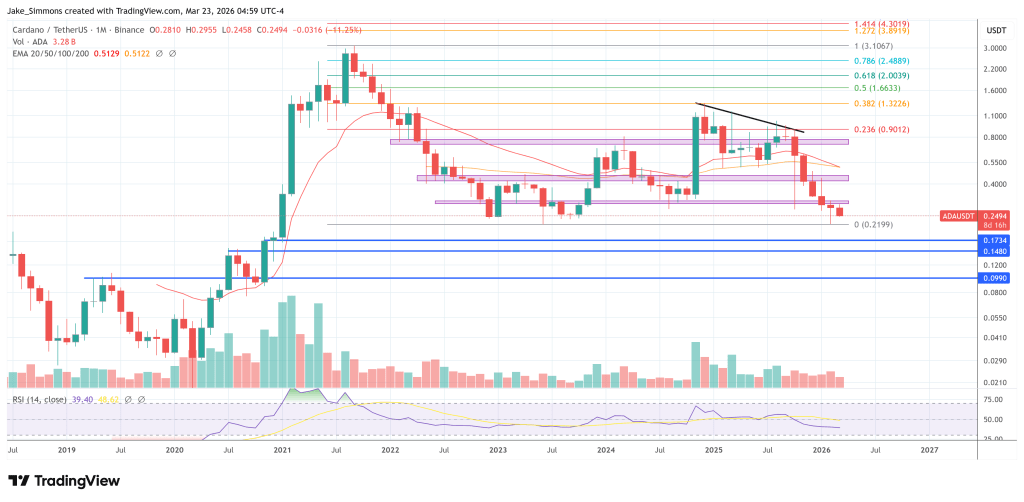
ADA hovers below key resistance, 1-monthly chart | Source: ADAUSDT on TradingView.com

Trending Cryptos

Related Questions

QWhat is the core thesis of Charles Hoskinson's March 19 livestream regarding the current global situation?

AThe core thesis is that the current market weakness and political dysfunction are symptoms of a deeper, more structural crisis where legacy systems—including monetary systems, governance, and shared social meaning—are breaking down and losing coherence, rather than being a crypto-specific failure.

QHow does Hoskinson position cryptocurrency in relation to the current global crisis?

AHe positions crypto as the essential infrastructure for whatever new system replaces the current failing order, framing it as a toolset for censorship-resistant money, non-custodial ownership, alternative governance, and digital identity that can bank the unbanked and create fair markets for everyone.

QWhat specific example did Hoskinson provide to demonstrate how AI is changing crypto development?

AHe stated that he used an AI-powered agentic workflow, built from Midnight and Sui source code and multiple language models, to generate a 40-page internal paper in about 90 minutes—a task that would have traditionally taken six weeks of architecture analysis.

QWhat is Midnight, and what update did Hoskinson provide about its launch?

AMidnight is Cardano's privacy-focused partner chain. Hoskinson announced that it is nearing launch, stating 'we're launching at the end of the month' after discussions with Shielded Technologies CEO Mike Ward about its consensus, performance, and architecture.

QAccording to Hoskinson, what is the fundamental social function of cryptocurrency?

AHe described crypto's social function as 'the control layer for those who cannot control themselves,' 'the trust layer for those who cannot trust each other,' and 'the mirror that keeps the dishonest honest,' enabling everyone to participate in the global economy, not just a select few.

Related Reads

From South Korea to the United States: Blue-Collar Jobs Are Becoming Increasingly Popular, Thanks to AI

AI is reshaping the labor market's value proposition. The traditional four-year college degree is losing its appeal as a guaranteed career path, while skilled blue-collar trades like electricians, welders, and plumbers are experiencing historic demand and wage premiums. This shift is driven by dual pressures: AI's displacement of certain white-collar roles and a booming need for physical infrastructure and data center construction. Data confirms the trend. In the U.S., vocational school revenue surged, and a significant portion of recent layoffs are AI-related. Surveys show a majority of Gen Z adults plan to pursue blue-collar work, citing better job security against AI automation. Vocational education interest has exploded recently. Experts cite a psychological shift as younger generations seek tangible, AI-resistant careers and avoid high student debt. In many cases, salaries for skilled trades now match or exceed those requiring a bachelor's degree. In South Korea, semiconductor vocational high schools boast near-total employment, with graduates securing high-paying roles at companies like Samsung. The shortage is structural, exacerbated by a retiring baby boomer workforce and massive infrastructure projects. Companies like JPMorgan Chase, Meta, and Lowe's are investing heavily in training programs. However, overcoming historical stigma and a "perception gap" around trade careers remains a key challenge to closing the talent gap.

marsbit37m ago

From South Korea to the United States: Blue-Collar Jobs Are Becoming Increasingly Popular, Thanks to AI

marsbit37m ago

Qualcomm: AI Hype Subsides, When Will Smartphones Emerge from the Gloom?

Qualcomm reported its Q3 FY2026 results (ending June 2026), with revenue of $9.95B, down 4% YoY but above expectations. Gross margin declined to 53.1%, pressured by rising costs across manufacturing and memory. Key business segments showed mixed performance: Handset revenue fell 19.6% YoY to $5.09B, dragged by an 11% decline in non-Apple Android shipments and weaker high-end mix. Conversely, Automotive revenue surged 61% to $1.59B, and IoT grew 9% to $1.83B. Core operating profit dropped 41% YoY due to margin compression and higher expenses. Management's Q4 FY2026 guidance projects revenue of $9.7B-$10.5B, in line with consensus, but Non-GAAP EPS guidance of $2.05-$2.25 fell short of expectations. Amidst persistent weakness in its core handset market, Qualcomm is pursuing growth in AI, focusing on Edge AI (smartphones, PCs, automotive) and Data Center AI. Its data center strategy includes four pillars: AI accelerators (e.g., AI200), commercial CPUs (Dragonfly C1000), custom silicon, and connectivity solutions. While these initiatives initially boosted its stock, concerns over AI capital expenditure sustainability have since erased those gains. The company targets $5B in data center revenue for FY2027 and $15B for FY2029. The report concludes that with the traditional handset business still under pressure, the data center opportunity is currently viewed as a longer-term option, and a more conservative valuation based on core operations may be warranted until AI contributions materialize.

marsbit42m ago

Qualcomm: AI Hype Subsides, When Will Smartphones Emerge from the Gloom?

marsbit42m ago

From TPU to Self-Evolving Agents: How Jeff Dean Predicts the Next Step in AI

At the 2026 YC Startup School, Jeff Dean outlined his vision for AI's next phase, shifting focus from simply scaling models to building intelligent, autonomous systems. He believes AI's progress is no longer just about creating smarter models, but about integrating them into systems capable of long-term, iterative work, automated experimentation, and continuous learning. This evolution moves the competition from "who has the bigger model" to "who can best organize intelligence." Dean suggests AI capabilities are now comparable to a junior engineer, enabling the automation of complex workflows. However, the true challenge and opportunity lie in managing these AI "workers" at scale. He emphasizes the importance of **context engineering**—structuring tools, memory, and feedback loops—over raw model power. For startups, this means building deep expertise in niche domains where general models currently fail (near 0-1% success rates), leveraging proprietary data, specialized tools, and domain-specific evaluators. A recurring theme is re-examining fundamental constraints. Dean's past work, like moving Google's search index to memory or creating the TPU, stemmed from questioning outdated assumptions about hardware and cost. He sees similar inflection points today, particularly in **specialized inference hardware** to drastically reduce latency and energy consumption for real-time Agent operation. Notably, he points out that in modern AI systems, the dominant cost is often not computation but **data movement**. Reliable, long-running Agents require robust system design, borrowing concepts from distributed computing like checkpointing, state management, and parallel exploration to handle failures and maintain progress over days or weeks. As AI automates execution, the scarcest human skills will shift to **defining clear specifications**, **judging what problems are worth solving** (taste), and designing effective feedback loops. Ultimately, Dean's framework prioritizes understanding the problem deeply, identifying the true bottlenecks, and systematically building closed-loop systems where AI can not only perform tasks but also improve AI itself.

marsbit42m ago

From TPU to Self-Evolving Agents: How Jeff Dean Predicts the Next Step in AI

marsbit42m ago

Trading

Spot

Hot Articles

Discussions

Welcome to the HTX Community. Here, you can stay informed about the latest platform developments and gain access to professional market insights. Users' opinions on the price of ADA (ADA) are presented below.

活动图片