Cardano Founder Says Midnight Could Eclipse All Privacy Projects Within A Year

bitcoinistPublished on 2026-01-27Last updated on 2026-01-27

Abstract

Cardano founder Charles Hoskinson introduced Midnight as the ecosystem's "crown jewel" and a critical privacy solution for mainstream crypto adoption. He argued that while existing blockchains perfected transparency, they lack a compliant privacy layer essential for real-world business. Midnight enables selective data disclosure for regulatory compliance (like KYC/AML) without sacrificing privacy, and supports hybrid applications across multiple blockchains. Hoskinson revealed that over 50% of Midnight’s tokens were distributed to ADA holders, and early trading volume exceeded $9 billion. He projected that Midnight will surpass all privacy-focused projects within a year, crediting Cardano’s deep research team, which includes pioneering computer scientists. At the time of writing, ADA was trading at $0.3512.

Cardano founder Charles Hoskinson used the opening of a Midnight workshop in Sapporo (Japan tour) on Jan. 25 to frame Midnight as Cardano’s “crown jewel” and a missing primitive for mainstream crypto adoption, arguing the privacy layer is positioned to outpace incumbent privacy-focused networks within 12 months.

Why Cardano’s Midnight ‘Eclipses’ All Privacy Projects

Hoskinson told attendees that while crypto spent the past decade perfecting transparent ledgers, it never built a first-class “private side” that real businesses and regulators can work with. “When you have the yin and yang, well, we only built one side of the yin and yang. We only built the transparent side. We didn’t build the private side,” he said. “So the challenge is that blockchains, every single one of them, they’re missing something. They’re missing a component that’s required for real-life business.”

In his telling, the gap sits at the intersection of privacy-enhancing technology (PET), compliance, and an emerging “abstraction” stack aimed at making crypto usable without forcing consumers to learn how blockchains work. Hoskinson argued that regulated activity like KYC/KYB/AML requires selective disclosure, but public chains force a tradeoff between compliance and privacy. “If you share information about yourself on a public network, everyone in the world, everywhere in the world, gets to see that,” he said. “That doesn’t make any sense. That doesn’t make sense to do commerce.”

He extended the same logic to intent-based execution and account abstraction-style UX, where users describe outcomes and a solver network routes liquidity and settlement across chains. “If I know your intentions, I can trade against you,” Hoskinson said, warning that revealing price bounds or execution constraints invites adverse selection. “Never tell me your intention because I can use it against you. So, intentions also require privacy.”

Midnight, he said, is designed to supply those primitives without demanding wholesale migration to a new Layer 1. Hoskinson described the network as built for “hybrid applications” across multiple ecosystems, claiming Midnight’s launch architecture connected it to “eight different ecosystems, seven different blockchains,” so users can stay on chains like Solana, Cardano, Bitcoin, or Ethereum while invoking Midnight’s privacy features.

He also positioned Midnight as a catalyst for Cardano’s DeFi ambitions, acknowledging a participation gap between staking and on-chain application usage. “There’s 1.4 million people staking, but only about 50,000 people participating on a monthly basis in our DeFi ecosystem,” Hoskinson said, adding that the next phase is to upgrade a subset of leading Cardano dApps so they can tap Midnight and market privacy-native products—such as private DEXs, prediction markets, or stablecoins—to users from other ecosystems.

On rollout, Hoskinson said the first stage of Midnight launched in December and that the first mainnet is “very soon” to follow. He highlighted what he characterized as an unusually retail-heavy distribution: “We never sold a single token. We just gave it away,” he said, claiming ADA holders received more than 50% of supply and that early trading activity surpassed $9 billion in volume and more than $1 billion in value.

Hoskinson closed with his boldest projection: “Within a year, Midnight is going to eclipse anybody in the privacy space because we know how to solve these problems,” he said, attributing the edge to the depth of Cardano’s research bench.

“Because we hired 168 scientists, and they happen to have spent the last four decades of their life chasing this. One of the guys working on this wrote the first computer game online. He was at Stanford when they were building the internet, [...]. He wrote Pong, and it was the first online game. That’s the legacy we have. Now, 40 years later, he’s a fellow in the Royal Society, the same society that Sir Isaac Newton was a member of. He’s working on this, as is that 22-year-old graduate student, as is the developer here in Japan, and everyone in between, and that’s why we’re going to win. It’s not a US cryptocurrency. It’s global,” Hoskison said.

At press time, ADA traded at $0.3512.
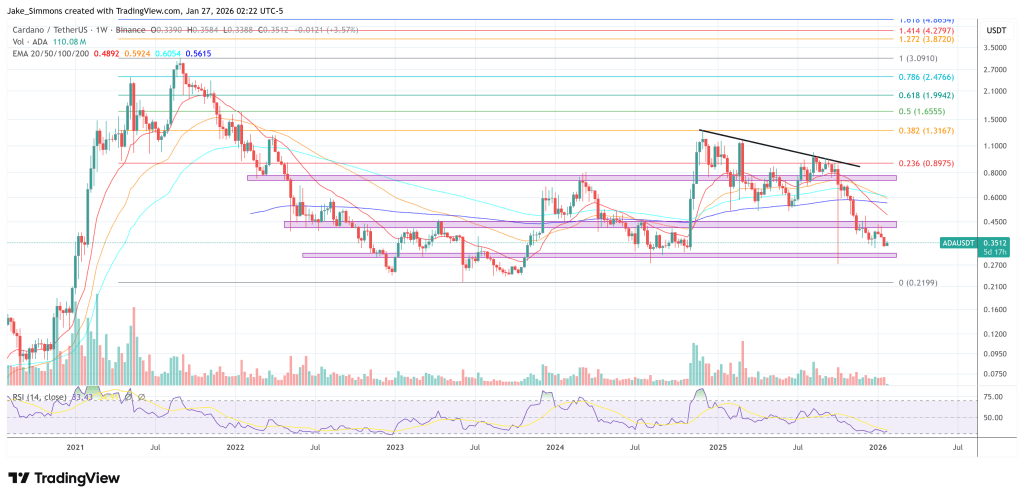
ADA hovers below key resistance, 1-week chart | Source: ADAUSDT on TradingView.com

Trending Cryptos

Related Questions

QWhat is the main argument Charles Hoskinson makes about Midnight in relation to other privacy projects?

ACharles Hoskinson argues that Midnight is positioned to outpace all incumbent privacy-focused networks within 12 months, calling it Cardano's 'crown jewel' and a missing primitive for mainstream crypto adoption.

QAccording to Hoskinson, what key component are current blockchains missing for real-life business?

AHoskinson states that current blockchains are missing a first-class 'private side' that allows for selective disclosure, which is necessary for regulated activities like KYC/KYB/AML and commerce, as public chains force a tradeoff between compliance and privacy.

QHow does Hoskinson describe the distribution of Midnight's tokens?

AHe describes it as an unusually retail-heavy distribution, claiming they never sold a single token but gave it away, with ADA holders receiving more than 50% of the supply, and early trading activity surpassed $9 billion in volume.

QWhat does Hoskinson cite as Midnight's key advantage in the privacy space?

AHe attributes Midnight's edge to the depth of Cardano's research bench, highlighting that they hired 168 scientists, including experienced professionals with decades of expertise in the field, such as a fellow in the Royal Society who wrote the first online game Pong.

QHow is Midnight designed to function in relation to other blockchain ecosystems?

AMidnight is built for 'hybrid applications' across multiple ecosystems, with its launch architecture connected to eight different ecosystems and seven different blockchains, allowing users to stay on chains like Solana, Cardano, Bitcoin, or Ethereum while invoking its privacy features.

Related Reads

In Jinjiang, Fujian, a Storage Super Unicorn Lies Quiet

In Fujian's Jinjiang, a city known for sportswear, lies a quiet semiconductor giant: Fujian Jinhua Integrated Circuit Co. (JHICC). Once a promising domestic DRAM manufacturer alongside Yangtze Memory and ChangXin Memory Technologies (CXMT), its journey was derailed in 2018 when the U.S. placed it on an Entity List and filed criminal charges for alleged trade secret theft. This halted production for years. A turning point came in February 2024 when a U.S. federal court found JHICC not guilty. However, it had lost crucial time. While CXMT soared to become a top-valued A-share company in 2024, JHICC, with an estimated valuation of 80 billion RMB, was just restarting. Its current output is primarily customized DDR4 chips, not the advanced DDR5/HBM demanded for AI, but it still benefits from the broader memory chip upcycle. JHICC's story is tied to Chen Zhengkun, a veteran engineer who left Micron to lead the venture. Founded in 2016 with state-backed funding, JHICC partnered with Taiwan's UMC to develop DRAM technology. Rapid progress was cut short by the U.S. actions, which Micron initiated, partly due to its heavy reliance on the Chinese market. Post-sanctions, Chen's team worked to rebuild the production line with reduced reliance on U.S. technology. According to its records, JHICC achieved small-scale production and revenue growth under immense pressure. It now focuses on the stable "niche" DRAM market (e.g., TVs, routers) with a monthly capacity of ~40,000 wafers, aiming for 60,000 by 2026. It holds over 1,000 patents but remains on the Entity List. For Jinjiang, investing in JHICC was a bold industrial leap. The local government provided unwavering financial and logistical support during the crisis, helping the company survive. JHICC has become the anchor for a growing local semiconductor cluster. Though its scale lags behind domestic peers, JHICC's persistence symbolizes a hard-won foothold in a global market long dominated by Samsung, SK Hynix, and Micron. Having missed one boom, it seeks a place in the new AI-driven memory supercycle.

marsbit1h ago

In Jinjiang, Fujian, a Storage Super Unicorn Lies Quiet

marsbit1h ago

Trading

Spot

Hot Articles

Discussions

Welcome to the HTX Community. Here, you can stay informed about the latest platform developments and gain access to professional market insights. Users' opinions on the price of ADA (ADA) are presented below.

活动图片