Cardano Founder Reveals Leios Solves The Blockchain Trilemma

bitcoinistPublished on 2026-02-10Last updated on 2026-02-10

Abstract

Cardano is developing a major layer-1 upgrade called Ouroboros Leios, aimed at significantly increasing the network's throughput from the current 10–15 transactions per second (TPS) to around 500 TPS initially, with a long-term goal of reaching 10,000 TPS. The upgrade, targeted for release in 2026, is designed to enhance scalability while maintaining decentralization and security—addressing the blockchain trilemma. Cardano founder Charles Hoskinson emphasized that Leios is the result of a decade of research and collaboration among numerous scientists and engineers. The protocol introduces a new block type called "endorser blocks" to bundle more transactions efficiently. Additionally, the upgrade is engineered to fail safely back to the current Ouroboros Praos consensus if needed. The development team plans a gradual rollout to avoid overburdening stake pool operators (SPOs), with a public testnet expected by the end of Q2 2026. Hoskinson also highlighted Cardano’s on-chain governance and treasury as key long-term advantages for funding future upgrades.

Cardano is preparing a layer-1 upgrade it says will push mainnet throughput from roughly 10–15 transactions per second to hundreds, while keeping the network’s decentralization and security profile intact. At a Tokyo community event on the Midnight Japan Tour, Input Output’s Michael Smolenski and Cardano founder Charles Hoskinson framed Ouroboros Leios as both a scaling step and a broader consensus breakthrough.

Smolenski, Cardano Core product manager at Input Output, told attendees Leios is “an upgrade to layer 1 to make Cardano faster,” with active development underway and a target release “this year in 2026.” He described the current throughput ceiling as suitable for proving out Ouroboros’ design, but insufficient for the next phase of adoption and for the economics of stake pool operators (SPOs).

Cardano’s Leios Eyes 50x Speed Boost In 2026

“Up until now the speed of the network has been around [...] 10 to 15 transactions per second,” Smolenski said. “But now we need to move on to higher transaction throughput in order to compete and drive further adoption. Another factor, SPOs, they in the long term need to support the cost of their operations from transaction fees instead of from block rewards [...] they need to see network usage of around 50 transactions per second.”

The initial Leios mainnet release is pitched as a “50 times improvement,” with Smolenski translating that into an early move from roughly 10 TPS to around 500 TPS. Rather than sticking to transactions-per-second as the headline metric, he emphasized “transaction kilobytes per second” to account for varied transaction sizes, calling out a target of “300 transaction kilobytes per second” and a confirmation window “between 20 to 80 seconds,” based on prototype results.

Smolenski described Leios as Cardano’s “next generation consensus protocol,” built around additional block types. “There’s a new block. It’s called an endorser block,” he said, adding that existing blocks would be referred to as “ranking blocks.” The practical consequence, in his telling, is the ability to “pack a whole lot more transactions” by bundling them into endorser blocks, alongside other prioritization mechanics he did not detail on stage.

He also stressed that scaling will be incremental to avoid overburdening node operators. The team plans to demonstrate higher throughput in steps, first targeting 500 TPS on mainnet, then proving 1,000 TPS in the near term, with an eventual ambition of 10,000 TPS. “We can’t just go from where we are [...] and go up to 10,000 transactions per second because this needs to be done in a strategic manner,” Smolenski said, repeatedly pointing to the need to “bring the SPOs along with us.”

On timeline, he said a first public Leios testnet is targeted “at the end of Q2 this year,” ahead of a mainnet hard fork.

Hoskinson: ‘Not Just TPS’ But The Trilemma

Hoskinson widened the frame, positioning Leios as the culmination of a decade-long research and engineering pipeline. “Ouroboros Leios didn’t begin in 2026 [...] Leios actually began in 2016, 10 years ago,” he said, describing “more than two dozen papers,” “dozens of protocols,” and contributions spanning “more than 15 engineering firms” and “168 scientists over a 10-year period.”

“Why Leios is special is it’s not TPS,” Hoskinson said. “It’s actually a resolution of the hardest problem in consensus and blockchain, the blockchain trilemma [...] you have decentralization, you have security, and you have scalability [...] we’re told you can only pick two.” He then made the core claim: “This protocol is decentralized, secure, and fast.”

Notably, Ethereum co-founder Vitalik Buterin also said the blockchain trilemma has effectively been solved, comments he made just a few weeks ago.

Hoskinson also argued the design is engineered to degrade safely. “If the protocol fails, the protocol fails to what we have today. It collapses to Ouroboros Praos,” he said, referencing a prior network incident he characterized as a soft fork in which “Cardano split into two networks” and later “came back together by itself.”

In the same remarks, Hoskinson repeatedly returned to governance capacity as the longer-horizon advantage, suggesting pure technical differentiation is transient. He pointed to Cardano’s on-chain governance and treasury — “a billion dollars in it [...] that you control [...] the ADA holders,” he said — as the mechanism to fund upgrades and coordinate change over time.

At press time, ADA traded at $0.2638.
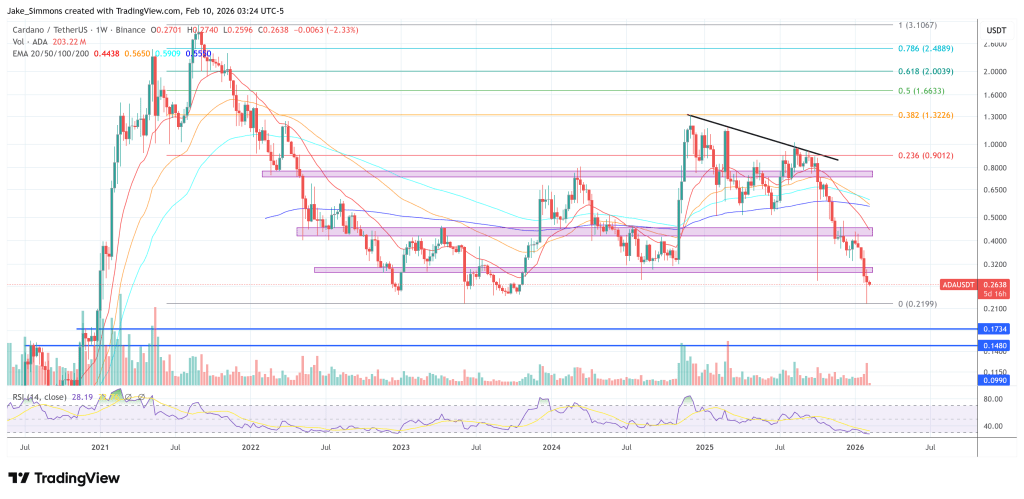
ADA hovers above key support, 1-week chart | Source: ADAUSDT on TradingView.com

Trending Cryptos

Related Questions

QWhat is the main goal of the Cardano Leios upgrade and when is it targeted for release?

AThe main goal of the Cardano Leios upgrade is to significantly increase the mainnet throughput from 10-15 transactions per second to hundreds, while maintaining decentralization and security. It is targeted for release in 2026.

QAccording to Michael Smolenski, what are the two key reasons Cardano needs higher transaction throughput?

AAccording to Michael Smolenski, Cardano needs higher transaction throughput to compete and drive further adoption, and to allow stake pool operators (SPOs) to support their operational costs from transaction fees, which requires a network usage of around 50 TPS.

QHow does Charles Hoskinson position the significance of Ouroboros Leios beyond just transaction speed?

ACharles Hoskinson positions Ouroboros Leios as a resolution to the blockchain trilemma, claiming it achieves decentralization, security, and scalability simultaneously, which is considered the hardest problem in consensus and blockchain.

QWhat is the safety mechanism described for the Leios protocol if it fails?

AIf the Leios protocol fails, it is engineered to degrade safely by collapsing back to the previous Ouroboros Praos protocol, as demonstrated in a past network incident where Cardano split and then recovered by itself.

QWhat longer-term advantage does Hoskinson suggest is more important than pure technical differentiation for Cardano?

AHoskinson suggests that Cardano's on-chain governance and treasury, controlled by ADA holders and containing about a billion dollars, is the longer-term advantage as it provides the mechanism to fund future upgrades and coordinate change.

Related Reads

Bitcoin Mining Farms Are Becoming AI Factories

Bitcoin mines are transforming into AI factories. This shift is driven by the convergence of three key assets from the previous crypto cycle: infrastructure, talent, and capital. Crypto mining companies like Crusoe, CoreWeave, and Bitdeer are repurposing their core competency—securing power, land, and grid connections in remote locations—to build data centers for AI clients. These firms are signing multi-billion dollar, long-term contracts with companies like Anthropic, AWS, and Microsoft, as AI's demand for reliable, high-capacity compute surpasses the profitability of Bitcoin mining. Simultaneously, crypto entrepreneurs and engineers are applying their skills to new AI ventures. Examples include OpenSea's co-founder launching OpenRouter (an AI model aggregator), and former Coinbase engineers building Fal.ai (a generative media infrastructure platform). Their experience in building scalable, global software networks translates effectively to the AI space. Furthermore, capital accumulated during the crypto boom is now fueling AI. Figures like Jed McCaleb (co-founder of Ripple) funded Voltage Park, a large-scale GPU cloud provider. Notably, some crypto investments, like FTX's early bets on Anthropic and Cursor, have generated astronomical paper returns, demonstrating how high-risk crypto capital flowed into AI before it became mainstream. The transition is not just about repurposing hardware, but about redirecting critical resources—power infrastructure, distributed systems expertise, and venture funding—to the next technological frontier: artificial intelligence.

链捕手10m ago

Bitcoin Mining Farms Are Becoming AI Factories

链捕手10m ago

Morpho Launches Fixed-Rate Product Midnight: Lenders and Borrowers Set Their Own Rates, Ending the Era of Interest Rate Models

Morpho Launches Fixed-Rate Product Midnight: Lenders and Borrowers Set Their Own Rates, Ending the Era of Algorithmic Interest Models On-chain lending has grown to $60 billion but remains minuscule compared to traditional finance's $200 trillion annual credit volume. Morpho identifies the lack of fixed rates and maturity dates as key bottlenecks. Institutions need predictability, not the passive floating rates set by algorithmic models. Midnight allows lenders and borrowers to directly quote rates, set terms, and become price makers, not takers. Fixed-rate lending is now viable due to cheaper, faster blockchains and the entry of institutions demanding control and certainty over returns, costs, and duration. Morpho Blue previously gave users control over risk; Midnight adds control over interest rates. Past attempts at on-chain fixed-rate lending failed primarily because they were built on top of floating-rate pools (creating unpredictability) or lacked sufficient active participants. Midnight avoids these pitfalls as a standalone primitive with fixed rates at its core, built upon Morpho Blue's existing large and active user base. Midnight offers distinct value: institutions gain predictable term structures and full control; fintech companies can offer tailored fixed-rate products; lenders/borrowers achieve predictability and efficiency; and curators can now differentiate by configuring both risk and interest rates. Morpho Midnight is not a replacement for Morpho Blue. The Morpho network will now feature two complementary market structures: floating-rate/open-term (Blue) for flexibility and fixed-rate/fixed-term (Midnight) for predictability. Liquidity can flow between them. The launch will be gradual, prioritizing security. Initially, it will support direct lending on Base network with one trading pair (cbBTC/USDC) and limited maturity dates. Advanced features like auto-rollovers will be introduced later.

marsbit11m ago

Morpho Launches Fixed-Rate Product Midnight: Lenders and Borrowers Set Their Own Rates, Ending the Era of Interest Rate Models

marsbit11m ago

human.tech Launches Clean SDK for Privacy-First Web3 Apps

human.tech has launched the Clean SDK, a toolkit enabling developers to build privacy-first Web3 applications with transparent accountability. Released alongside Aztec's version 5, the SDK provides components for integrating zero-knowledge identity verification, sanctions screening, and private transactions, without developers handling sensitive user data or building compliance infrastructure from scratch. It uses zero-knowledge proofs and programmable verification to allow apps to confirm user legitimacy and sanctions compliance while keeping identities confidential. The first application built on the SDK, Shield, a privacy bridge to Aztec, also launched. It allows users to transfer assets privately while proving a unique human is behind each transfer and that funds have passed sanctions checks, as verified by a May 2026 audit. The SDK offers three core verification techniques: Proof of Innocence (sanctions screening against 23 sources), Proof of Personhood (simpler verification via Human Passport), and Proof of Clean Hands (higher-assurance zero-knowledge government ID checks). This allows apps to authenticate users and transactions without exposing personal data. Designed for Aztec builders, the SDK lets developers add programmable privacy to decentralized apps, eliminating the need to create their own verification and ZK infrastructure. Shield demonstrates its practical use for private bridges, but the SDK aims to enable a wider ecosystem of private, accountable financial apps and services. The launch addresses growing demand for infrastructure that balances privacy and accountability. The SDK avoids traditional identity databases, storing encrypted data off-chain, screening at both entry and exit points, and including a gated disclosure mechanism for legal requests. human.tech's products, including the Clean SDK, focus on using zero-knowledge technology to enable verifiable personhood and privacy in digital systems.

TheNewsCrypto47m ago

human.tech Launches Clean SDK for Privacy-First Web3 Apps

TheNewsCrypto47m ago

Unlocking $100 Million in Liquidity? Pump.fun's New Policy Tests the 5-Minute Pump Technique

Pump.fun, a popular meme coin launchpad, has introduced a new standard mechanism called BOOST. It aims to address a significant capital efficiency issue: when a newly launched token graduates from its initial bonding curve to a liquidity pool (LP), roughly 20% of its liquidity becomes permanently locked as "dead liquidity," estimated to waste over $100 million annually. Instead of locking these funds permanently, BOOST repurposes them. Upon a token's migration, approximately 20% of the settlement funds (e.g., 17.6 SOL or ~$2516 USDC) are used to buy back the token on the open market over a 5-minute period via a Time-Weighted Average Price (TWAP) mechanism. All purchased tokens are immediately burned. This creates a brief, systematic buy pressure immediately after migration, potentially generating a short-term price surge ("pump") while permanently reducing the token's circulating supply. The goal is to enhance the immediate post-launch trading experience, potentially increasing trader retention and sustainable protocol revenue, which funds ongoing token buybacks. However, concerns exist that this artificial 5-minute boost could lower the barrier for launching low-quality tokens and lead to steeper price crashes once the buy pressure stops, if followed by large sell-offs. The feature automatically applies to tokens migrating after July 21, 2024, but not to previously migrated tokens or those launched via the Mayhem AI Agent lab.

marsbit55m ago

Unlocking $100 Million in Liquidity? Pump.fun's New Policy Tests the 5-Minute Pump Technique

marsbit55m ago

Trading

Spot

Hot Articles

Discussions

Welcome to the HTX Community. Here, you can stay informed about the latest platform developments and gain access to professional market insights. Users' opinions on the price of ADA (ADA) are presented below.

活动图片