Cardano Founder Reacts As NIGHT Token Crashes From $150 To $0.02

bitcoinistPublished on 2025-12-11Last updated on 2025-12-11

Abstract

Cardano founder Charles Hoskinson reacted to the extreme volatility of the newly launched NIGHT token, which surged to $150 before crashing to $0.02. Despite the sharp drop, Hoskinson defended the launch as Cardano’s strongest ever, highlighting its $1.5 billion fully diluted valuation and immediate listings on major exchanges like Binance Alpha and Kraken. He attributed the price plunge to speculative traders dumping tokens, not a structural failure, and emphasized that NIGHT’s retail-focused, fair launch—without VC involvement—was a return to crypto’s original principles. Hoskinson also positioned Midnight as Cardano’s first "partner chain" and a key competitive advantage for multi-ecosystem growth, aiming to expand the ecosystem to a $10 billion valuation.

Cardano founder Charles Hoskinson has hailed the launch of Midnight and its native token NIGHT as the strongest in the network’s history, arguing that it proves Cardano can now host and distribute multi-billion-dollar assets at scale.

NIGHT Token Plunges After Midnight Launch

In his December 10 livestream “Midnight Launch AAR,” Hoskinson opened with the volatile price action that dominated social media. NIGHT initially spiked to what he called an “insane” level: “It launched at almost a $150, which is just insane [...] it just went way, way, way up.” Once trading opened on Binance Alpha, the move reversed violently. “As soon as it got on Binance Alpha – oh god, why, why, oh why – all the way down to two cents. They dumped on us. That’s what they do. That’s what the DGENs over in that market do.”

He framed this as typical exchange-distribution dynamics, not a structural failure: recipients with no real connection to the ecosystem “regardless of the price, they just dump the token. They probably didn’t even know what NIGHT was.”

According to Hoskinson, such launches usually endure 48–72 hours of “high volatility” before a stable range emerges. He reiterated that he had expected NIGHT to trade in a “5 cents to 15 cents” band and said it was sitting around 6–6.5 cents with a fully diluted valuation of roughly $1.5 billion and around $150 million in trading volume. For a brand-new Cardano-native asset in current conditions, he called that “a really solid launch.”

What made the debut historically significant in his view was the combination of tier-one listings and on-chain metrics. “This is the first time in history that Cardano right out the gate can launch a $1.5 billion product, be listed on Binance Alpha and Kraken and OKX and everybody else at the start,” he said, stressing that much of the required infrastructure “wasn’t there” and had to be built during the run-up.

Cardano’s Best Launch Ever

On Cardano itself, he highlighted that Midnight immediately became the dominant token by trading activity. Citing TapTools, he said NIGHT was “sitting [at] an overwhelming level of volume, and it’s actually greater than the volume of every other Cardano native token combined,” adding that its FDV is “worth more than all the other CNTs combined as well.”

For the first time, he argued, DEXs such as Minswap and SundaeSwap carried a “meaningful percentage of trading volume [...] with respect to large exchanges,” helping “prime the pump on Cardano DEXes” and pull more stablecoins into the ecosystem.

Distribution was another focal point. Hoskinson praised the Glacier Drop mechanism and its gradual “thawing,” saying it creates “a nice steady emission and a nice steady flow for the system as opposed to a jagged thing where the insiders all dump.”

He contrasted Midnight’s retail-heavy, exchange-plus-airdrop distribution with VC-led launches elsewhere: “This is the first time since Bitcoin that a launch has been done the way that Midnight did it. It was complete retail, completely fair, and none of those damn VCs got their grubby hands on it. Instead, it went right to you, the people.”

He tied that to a broader “return to first principles,” arguing that 2026 should reward projects with fair launches and fixed-supply, deflationary monetary policies: “There’s a fixed supply NIGHT, by the way [...] it’s going to be a good year for everybody who’s betting on you, the consumer, and not betting on the banks.”

Looking forward, Hoskinson positioned Midnight as Cardano’s first “partner chain” and the “tip of the spear” for a hybrid DApp model spanning multiple ecosystems: “You talk about Midnight Cardano, Midnight Ethereum, Midnight Solana, Midnight Avalanche, Midnight Binance.” He said that after the first four phases of the roadmap, “every two months a new ecosystem gets activated,” with recurring feature drops “every six to eight weeks.”

He also cast Midnight as a competitive wedge for Cardano DApps. With tier-one integrations and privacy-preserving capabilities, he argued, “we have privacy before [Ethereum and Solana] do,” giving Cardano–Midnight hybrid apps a differentiator that can help grow TVL, MAU and transaction volume.

Hoskinson insisted that the launch pressure-tested and validated the base protocol: “Cardano network handled it. The exchanges handled it. And Midnight is here to stay.” The ambition from here is explicit. “We’re going to march Midnight up as an ecosystem to that $10 billion mark. That’s the goal. Let’s keep going. Let’s get her done,” he said, adding that “these are the best numbers we’ve ever seen in the history of Cardano” – and, in his view, only the beginning.

At press time, ADA traded at $0.4325.
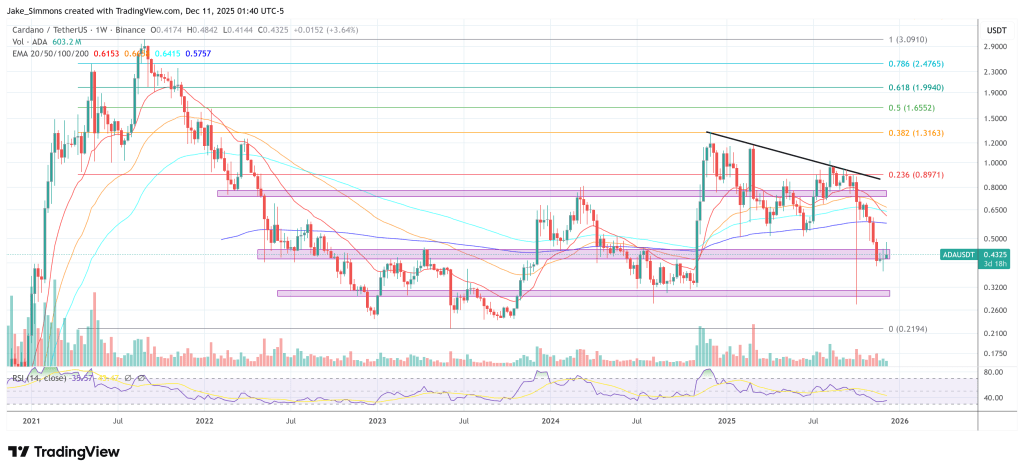
ADA bounces from key support, 1-week chart | Source: ADAUSDT on TradingView.com

Trending Cryptos

Related Reads

DRAM ETF Issuer: Samsung, SK Hynix, Micron All Surpass $1 Trillion, the AI Era of Memory Chips Has Only Just Begun

Authors: Dave Mazza, Thomas DiFazio | Source: Deep Tide TechFlow The article, written by Roundhill Investments (issuer of the DRAM ETF), responds to Morningstar's caution about investing in memory chip stocks. Morningstar warns of the sector's history of boom-bust cycles, a lack of economic moats, and potential momentum-driven overvaluation. Roundhill argues the current situation is structurally different due to AI. Key points in Roundhill's rebuttal include: * **Changed Demand & Supply Dynamics:** AI infrastructure, not consumer electronics, is now the primary growth driver for memory demand. New, strict long-term supply agreements with hyperscalers reflect the high capital intensity of advanced manufacturing. * **Existence of a Moat:** High-Bandwidth Memory (HBM), essential for AI, has extremely high manufacturing barriers. The market is dominated by Samsung, SK Hynix, and Micron, with new entrants blocked by technological complexity and long lead times for equipment like ASML's EUV machines. * **Strong Fundamental Outlook:** Analyst consensus projects the three companies will rank among the world's most profitable by 2027, with combined profits of $704 billion on over $1 trillion in revenue. Their operating margins have already reached record highs. * **Valuation Re-rating:** Despite significant stock price gains, memory stocks trade at attractive valuations (e.g., a median NTM P/E of 8.37x for the DRAM ETF) relative to projected explosive EPS growth. Roundhill suggests historical valuation frameworks may no longer apply given the new profitability paradigm. Conclusion: Roundhill contends the rally is justified by fundamentals, marking a structural shift for the memory industry into a new era of sustained, AI-driven demand against constrained supply, rather than a repeat of past cycles.

marsbit17m ago

DRAM ETF Issuer: Samsung, SK Hynix, Micron All Surpass $1 Trillion, the AI Era of Memory Chips Has Only Just Begun

marsbit17m ago

EF's Epic Reorganization: 20% Layoffs, Budget Halved, Is Ethereum Gearing Up for a Leaner Future?

The Ethereum Foundation (EF) has announced a major organizational restructuring, involving a 20% staff reduction (approx. 54 employees) and a division into functional clusters like Protocol, Access, User, Community, and Institutional layers. Co-founder Vitalik Buterin further revealed plans to cut the EF's budget by around 40% over the coming years, aiming to reduce its annual spending rate from about 15% to roughly 5% by 2030, transitioning to an endowment-driven model. This overhaul is seen as a long-overdue correction to the EF's ambiguous role. As Ethereum grew, the foundation faced persistent criticism over ETH sales, perceived lack of execution, and unclear strategy, often becoming a focal point for community frustration amid ETH's price stagnation. The reform aims to redefine the EF's boundaries, narrowing its focus to core protocol research, public goods funding, and ecosystem coordination, while offloading more applied development work to the broader market. Concurrently, ecosystem forces like the newly formed Ethlabs (founded by ex-EF researchers) and other independent groups are stepping in to fill the space, signaling a shift from a centralized model to a more distributed, collaborative ecosystem structure. The move was notably praised by Solana co-founder toly, who viewed a "leaner" EF as potentially more decisive and agile.

Odaily星球日报58m ago

EF's Epic Reorganization: 20% Layoffs, Budget Halved, Is Ethereum Gearing Up for a Leaner Future?

Odaily星球日报58m ago

Dragonfly Partner Haseeb: The Fastest-Growing Companies of the Future May All Get Stuck at 149 Employees

Dragonfly partner Haseeb explores the distorted economics of AI model pricing, drawing parallels to tax policy. He notes that startups and small teams (under 150 users) enjoy heavily subsidized, fixed-price AI subscriptions (like Claude Code), where the marginal cost of an additional token is effectively zero. This creates a powerful incentive for them to maximize token usage ("token-maxxing") and innovate aggressively with AI automation. In contrast, large enterprises (over 150 users) are forced onto "Enterprise" plans, paying per-token API fees with high (~75%) markups. This acts like a steep "tax" on AI-powered labor, disincentivizing marginal automation and experimental use, and encouraging them to retain more human workers. Haseeb argues this pricing creates a "150-person cliff," a regulatory notch similar to labor laws in France that discourage firms from growing past 50 employees. He predicts the fastest-growing future companies may deliberately cap their headcount at 149 to avoid the punitive enterprise pricing. This would foster an "AI-first" management philosophy obsessed with automation and outsourcing to stay lean. While not intentionally designed, this bifurcated pricing could become one of the most influential de facto tax policies, shaping how AI replaces labor—not through mass layoffs at big firms, but through agile, AI-native startups outcompeting them.

marsbit1h ago

Dragonfly Partner Haseeb: The Fastest-Growing Companies of the Future May All Get Stuck at 149 Employees

marsbit1h ago

Trading

Spot
Futures

Hot Articles

Discussions

Welcome to the HTX Community. Here, you can stay informed about the latest platform developments and gain access to professional market insights. Users' opinions on the price of ADA (ADA) are presented below.

活动图片