Cardano Founder Praises ShieldUSD Milestone On Midnight

bitcoinistPublished on 2026-03-17Last updated on 2026-03-17

Abstract

Cardano founder Charles Hoskinson highlights the significance of privacy-preserving stablecoins, particularly praising the recent deployment of a minimum-viable ShieldUSD contract on Midnight's preview environment. Developed by W3i, ShieldUSD is a private stablecoin designed for confidential financial use cases like payroll and institutional DeFi, while supporting regulatory compliance through selective disclosure. This aligns with Midnight's core vision of a privacy-first blockchain using zero-knowledge proofs. Hoskinson's endorsement echoes his previous support for Moneta's USDM stablecoin, positioning ShieldUSD as an extension of regulated, privacy-focused digital dollars. The project remains in development, serving as an early proof-of-concept for Midnight's upcoming production phase.

Charles Hoskinson is again spotlighting privacy-preserving stablecoins as one of Cardano’s most consequential bets, this time tying his praise directly to fresh progress on Midnight.

In a post on X on March 16, the Cardano founder called the effort “one of the most exciting initiatives” and said it was “a bellwether for the growing utility of Midnight as a development platform.” That matters because Midnight has been positioned by its builders as a privacy-first chain built around zero-knowledge proofs and selective disclosure, with production-grade financial applications viewed as one of its core targets.

Why The Cardano Founder Is Bullish On ShieldUSD

The immediate trigger was an update from CTO at W3i Andrew Westberg, who said, “A minimum-viable shieldUSD contract has been deployed to the Midnight preview environment,” and added: “Right now, the constraints on contract size are limiting what we can do and requires a lot of consolidation transactions. We’re working closely with Midnight Foundation. We are able to successfully perform private transfers with selective disclosure for regulatory auditors.”

For Midnight, that is not some secondary feature. The network’s own documentation describes selective disclosure as a core design principle, allowing builders to prove validity or compliance without exposing the full underlying data on-chain. In practice, the idea is straightforward: transactions, balances, or identities can remain confidential to the public, while authorized parties can be shown only the information they are entitled to see. Midnight has framed that balance as essential for real-world financial use cases rather than purely crypto-native privacy experiments.

The stablecoin effort itself has been taking shape in public for months. In January, W3i Software announced shieldUSD, a privacy-preserving USD stablecoin for the Midnight Network, saying it would be co-issued by Moneta Digital and Norwegian Block Exchange. According to that announcement, shieldUSD is being built for financial workflows where confidentiality matters, including payroll, B2B settlement and institutional DeFi, while still supporting “compliance, auditability, and selective disclosure.” Midnight repeated that positioning in its January network update, presenting shieldUSD as one of the ecosystem projects intended to bring privacy-preserving finance into practical use.

That also helps explain why Hoskinson’s latest comment echoes his earlier rhetoric around Moneta’s USDM. Back in July 2025, he wrote that “Moneta’s USDM is becoming the most advanced stablecoin ever built.” Moneta describes USDM as a Cardano-native, fiat-backed stablecoin backed 1:1 by US dollar reserves, with Moneta Digital acting as issuer and redeemer. The latest Midnight work appears to extend that broader push from a regulated Cardano dollar into a privacy-preserving environment designed for more sensitive transaction flows.

Still, Westberg’s post made clear that the project is not presenting a finished product. The contract is only in Midnight’s Preview environment, which the network documents position as a development stage for builders migrating applications and testing new tooling rather than a live production venue. Midnight’s January roadmap update said the network is moving through its Hilo phase toward Kūkolu, the stage meant to introduce the first wave of production applications on a federated mainnet. In that context, the ShieldUSD deployment looks less like a launch and more like an early proof that Midnight’s compliance-friendly privacy model can be made concrete.

At press time, Cardano traded at $0.287.
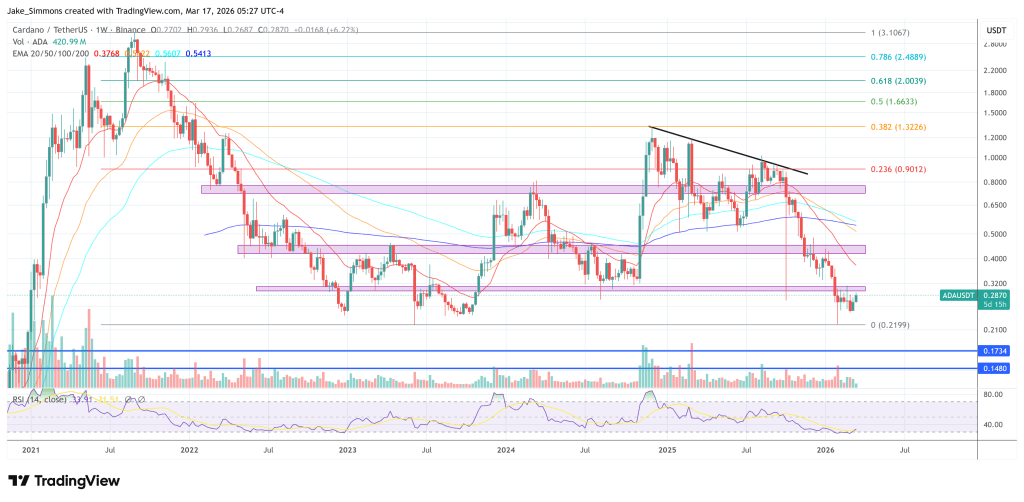
ADA hovers below key resistance, 1-week chart | Source: ADAUSDT on TradingView.com

Trending Cryptos

Related Questions

QWhat is the Cardano founder praising in his recent post on X?

ACharles Hoskinson is praising the progress on ShieldUSD, a privacy-preserving stablecoin, as a significant milestone for the Midnight development platform.

QAccording to the article, what is a core design principle of the Midnight network?

AA core design principle of the Midnight network is selective disclosure, which allows builders to prove compliance without exposing all the underlying on-chain data.

QWhich companies are co-issuing the shieldUSD stablecoin?

AThe shieldUSD stablecoin is being co-issued by Moneta Digital and Norwegian Block Exchange (NBX).

QIn what environment was the minimum-viable shieldUSD contract deployed?

AThe minimum-viable shieldUSD contract was deployed to the Midnight preview environment, which is a development stage for testing, not a live production venue.

QHow does the article describe the broader significance of ShieldUSD for Midnight?

AThe article describes ShieldUSD as a bellwether for Midnight's growing utility and a key project intended to bring privacy-preserving finance into practical use for real-world financial workflows.

Related Reads

Bitcoin Mining Farms Are Becoming AI Factories

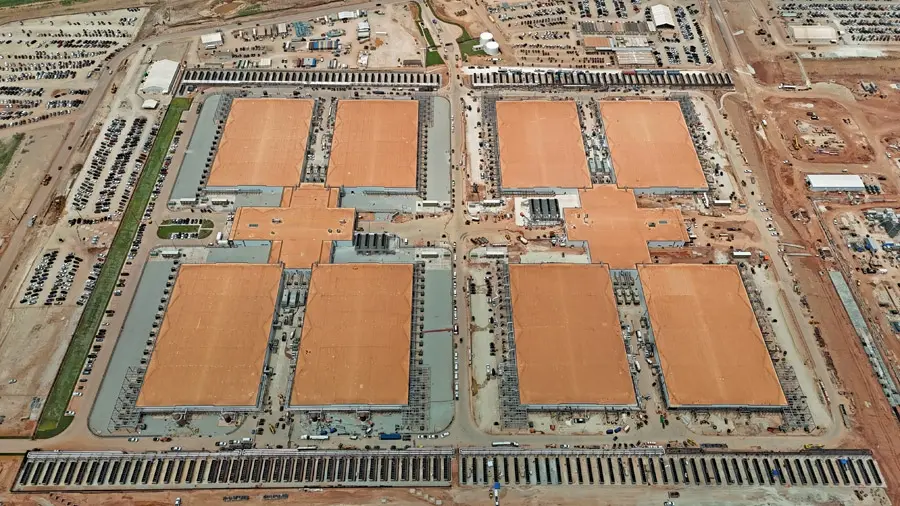
Bitcoin mines are transforming into AI factories. This shift is driven by the convergence of three key assets from the previous crypto cycle: infrastructure, talent, and capital. Crypto mining companies like Crusoe, CoreWeave, and Bitdeer are repurposing their core competency—securing power, land, and grid connections in remote locations—to build data centers for AI clients. These firms are signing multi-billion dollar, long-term contracts with companies like Anthropic, AWS, and Microsoft, as AI's demand for reliable, high-capacity compute surpasses the profitability of Bitcoin mining. Simultaneously, crypto entrepreneurs and engineers are applying their skills to new AI ventures. Examples include OpenSea's co-founder launching OpenRouter (an AI model aggregator), and former Coinbase engineers building Fal.ai (a generative media infrastructure platform). Their experience in building scalable, global software networks translates effectively to the AI space. Furthermore, capital accumulated during the crypto boom is now fueling AI. Figures like Jed McCaleb (co-founder of Ripple) funded Voltage Park, a large-scale GPU cloud provider. Notably, some crypto investments, like FTX's early bets on Anthropic and Cursor, have generated astronomical paper returns, demonstrating how high-risk crypto capital flowed into AI before it became mainstream. The transition is not just about repurposing hardware, but about redirecting critical resources—power infrastructure, distributed systems expertise, and venture funding—to the next technological frontier: artificial intelligence.

链捕手19m ago

Bitcoin Mining Farms Are Becoming AI Factories

链捕手19m ago

Morpho Launches Fixed-Rate Product Midnight: Lenders and Borrowers Set Their Own Rates, Ending the Era of Interest Rate Models

Morpho Launches Fixed-Rate Product Midnight: Lenders and Borrowers Set Their Own Rates, Ending the Era of Algorithmic Interest Models On-chain lending has grown to $60 billion but remains minuscule compared to traditional finance's $200 trillion annual credit volume. Morpho identifies the lack of fixed rates and maturity dates as key bottlenecks. Institutions need predictability, not the passive floating rates set by algorithmic models. Midnight allows lenders and borrowers to directly quote rates, set terms, and become price makers, not takers. Fixed-rate lending is now viable due to cheaper, faster blockchains and the entry of institutions demanding control and certainty over returns, costs, and duration. Morpho Blue previously gave users control over risk; Midnight adds control over interest rates. Past attempts at on-chain fixed-rate lending failed primarily because they were built on top of floating-rate pools (creating unpredictability) or lacked sufficient active participants. Midnight avoids these pitfalls as a standalone primitive with fixed rates at its core, built upon Morpho Blue's existing large and active user base. Midnight offers distinct value: institutions gain predictable term structures and full control; fintech companies can offer tailored fixed-rate products; lenders/borrowers achieve predictability and efficiency; and curators can now differentiate by configuring both risk and interest rates. Morpho Midnight is not a replacement for Morpho Blue. The Morpho network will now feature two complementary market structures: floating-rate/open-term (Blue) for flexibility and fixed-rate/fixed-term (Midnight) for predictability. Liquidity can flow between them. The launch will be gradual, prioritizing security. Initially, it will support direct lending on Base network with one trading pair (cbBTC/USDC) and limited maturity dates. Advanced features like auto-rollovers will be introduced later.

marsbit19m ago

Morpho Launches Fixed-Rate Product Midnight: Lenders and Borrowers Set Their Own Rates, Ending the Era of Interest Rate Models

marsbit19m ago

Trading

Spot

Hot Articles

Discussions

Welcome to the HTX Community. Here, you can stay informed about the latest platform developments and gain access to professional market insights. Users' opinions on the price of ADA (ADA) are presented below.

活动图片