Cardano Founder Hoskinson Signals Reset For 2026, Not An Exit

bitcoinistPublished on 2026-01-01Last updated on 2026-01-01

Abstract

Charles Hoskinson, founder of Cardano, has announced a significant shift in his public engagement for 2026, clarifying it is not an exit from the cryptocurrency space. He stated he is stepping back from day-to-day activity on X (Twitter), which he has "outgrown," to reduce the "weaponization" of his persona, which he sees as a liability for Cardano and its privacy-focused protocol, Midnight. Instead, he will focus on long-form writing, AMAs, and new media formats to maintain community connection with less toxicity. Hoskinson emphasized a return to "deep focus" on product development, including working on a zkVM specification, adding privacy to intents, and chain abstraction. His primary goal is to build scalable technology, targeting a billion users and a trillion dollars in transactions on Midnight by 2030. He also cited personal changes, intending to travel less after 260 days on the road in 2025, prioritize health, and spend more time at his ranch. He concluded with a critique on price obsession, stating, "If all you can think about is the price, you’ve already lost."

Charles Hoskinson rang in 2026 from his Wyoming ranch with a message that sounded, at first blush, like an exit. It wasn’t. The Cardano founder said he is “not leaving the cryptocurrency space,” but he is walking away from day-to-day life on X and retooling how he shows up publicly, arguing that his visibility has become a liability for Cardano and Midnight adoption.

Cardano Founder Plans To Move Into The Background

Hoskinson opened the New Year’s livestream titled “Happy New Year and Farewell” with a post-mortem on 2025, framing it as a year in which parts of the industry chased success faster than it built systems capable of delivering on crypto’s broader promises. In his telling, the space “lost our way” by letting incentives and spectacle override first principles.

He was also explicit about what the “farewell” refers to and what it does not. “So, to get this right off the bat, I’m not leaving the cryptocurrency space,” Hoskinson said. “I’m cognizant and aware that every single time I make a live stream or I say something, it gets misconstrued. So, let’s just definitively put that on the table. I’m not going anywhere. I’m not leaving.”

Instead, he described a strategic retreat from hyper-online discourse, claiming that the “weaponization” of his persona creates a barrier for would-be users who might otherwise participate in Cardano or Midnight.

The problem, he argued, is that public perception increasingly substitutes for product evaluation: “We don’t ask what it do. We ask who made it... If we hate them, what that thing is is evil and wrong. If we love them, what that thing is must be good.”

The clearest operational change is his decision to step back from X entirely. “I’ve outgrown X,” he said. “So it’s my farewell to that platform and I’ll turn it over to curators and AI. It’ll go into silent mode for probably a few weeks to a few months as we build up that infrastructure because I have more important things to do, but I’m going to uninstall the app and never think of it again.”

Hoskinson said he plans to focus instead on “long form writing,” AMAs, livestreams, and experimenting with new media formats, floating Twitch as one possible outlet. The goal, as he framed it, is to preserve community connection while reducing the surface area for what he described as increasingly hostile, toxic cycles during down markets.

Beyond the social pivot, Hoskinson emphasized a shift into “deep focus,” saying he has returned to a level of product specificity he hasn’t had “in a very long time.” He cited drafting a “specification for a zkVM,” working on “adding privacy to intents,” and thinking through “chain abstraction” and the roles across “application and permission and solver and settlement” layers.

He repeatedly anchored that renewed focus to scale targets, explicitly tying his 2026 mindset to Midnight’s longer-term arc. “Every day I wake up and I ask, ‘How do I build something a million people can use?’ And then I ask, ‘How do I build something a billion people can use?’” he said, adding that he has been thinking through what it would take for Midnight to reach “a billion users and a trillion dollars of transactions on the platform by 2030.”

Personal Changes For 2026

Hoskinson also made the personal operational changes unusually concrete. He said he traveled “more than 260 days” in 2025, averaged “only five and a half hours of sleep a night,” and described that pace as unsustainable. After Japan and Hong Kong, he said, he intends to travel less and spend more time at his ranch or farm, focusing on health, reading, and calmer reflection.

The closing stretch blended motivation with ecosystem-specific claims about the year ahead: he said “we finally launched Midnight,” pointed to RealFi efforts that “gave out a million loans over the last 18 months” in Uganda and Kenya, and framed 2026 as the year “Leios ships,” “Hydra gets good,” and Cardano’s “decentralized governance becomes hardened” as the community gains “full agency.”

But he also delivered a blunt cultural critique that doubles as a signal to his audience about what he wants his next chapter to optimize for. “If all you can think about is the price, you’ve already lost,” Hoskinson said. “Even if it goes up, you’ve lost. Not just at crypto, but at life.”

At press time, ADA traded at $0.34.
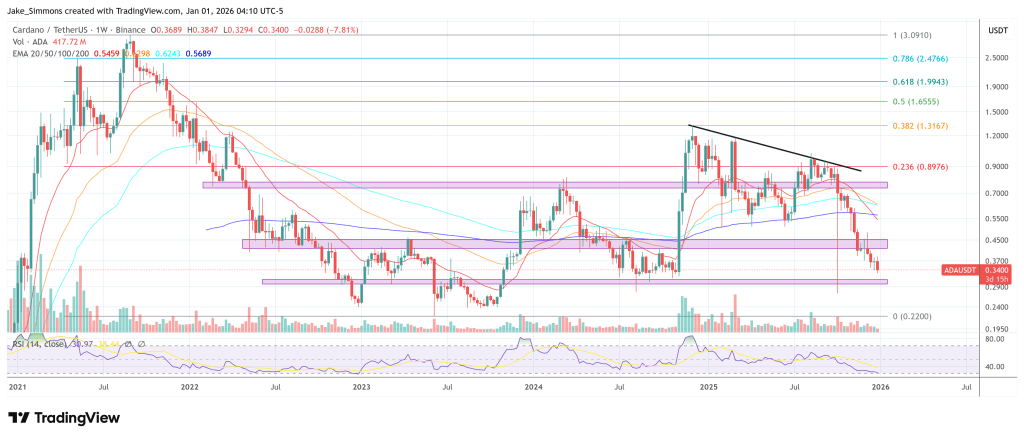
ADA almost lost its entire late-2024 gains, 1-week chart | Source: ADAUSDT on TradingView.com

Trending Cryptos

Related Questions

QWhat did Charles Hoskinson announce regarding his future role in the cryptocurrency space and his presence on social media?

ACharles Hoskinson announced that he is not leaving the cryptocurrency space but is stepping back from day-to-day activity on X (Twitter) and retooling his public presence. He stated that his visibility has become a liability for Cardano and Midnight adoption, and he plans to move into the background.

QWhat specific operational change did Hoskinson mention regarding his use of the platform X?

AHoskinson stated that he is stepping back from X entirely, uninstalling the app, and turning the account over to curators and AI. It will go into silent mode for a few weeks to months while they build the infrastructure, as he has outgrown the platform.

QWhat new focus did Hoskinson outline for his work in 2026?

AHoskinson emphasized a shift into 'deep focus' on product development, including drafting a specification for a zkVM, working on adding privacy to intents, and thinking through chain abstraction and the roles across application, permission, solver, and settlement layers.

QWhat personal changes did Hoskinson say he would make to his lifestyle in 2026?

AHe plans to travel less after being on the road for more than 260 days in 2025, spend more time at his ranch or farm, focus on his health, get more sleep (after averaging only 5.5 hours per night), and engage in reading and calmer reflection.

QWhat large-scale user and transaction goals did Hoskinson set for Midnight by 2030?

AHoskinson stated that he is focused on building something that a billion people can use, with the goal for Midnight to reach 'a billion users and a trillion dollars of transactions on the platform by 2030'.

Related Reads

Global Stock Market's Storm Center: South Korea's Stock Market De-leveraging Is Largely Complete

Storm's Eye: South Korean Market De-leveraging Nears Completion The recent sharp correction in South Korean equities, with the KOSPI index dropping 32% from its June high, has been a key trigger for global tech stock volatility. The core driver was not a fundamental shift but a forced de-leveraging process within the market's unique structure, which is now largely complete. Two main leverage channels amplified the sell-off: 1. **Leveraged ETFs:** Their size, proportionally four times larger than in the U.S., peaked near $50 billion. Their mandatory daily rebalancing mechanism created a vicious cycle of "price drop → forced selling → further drop." Approximately 75% of this excess has been unwound, shrinking to $26 billion, with regulatory curbs now blocking new inflows. 2. **Hedge Fund Leverage:** Using swaps to magnify exposure, hedge funds saw their net long positioning fall by over 50% from peak levels. The most intense phase of this institutional de-leveraging is over. In contrast, **retail margin debt** poses minimal systemic risk. At 0.5% of market cap, it is far lower than in the U.S. or China, lacks automatic triggers, and is concentrated in smaller stocks. The conclusion: the high-leverage structures most prone to "chain-reaction selling" have been substantially cleared. The market is transitioning from a liquidity-driven crash to one priced more on fundamentals. The article argues that the AI trend—centered on Korean memory chips—remains intact. This episode represents a painful but necessary clearing of crowded trades, not the end of the AI revolution. For investors, the key question is conviction in the long-term AI direction; if the trend is real, current volatility is a cost of entry, not a terminal risk.

链捕手39m ago

Global Stock Market's Storm Center: South Korea's Stock Market De-leveraging Is Largely Complete

链捕手39m ago

The Eternal Fragments of Money: Third-Party Payment Has No First Principle

"The Enduring Fragments of Money: Third-Party Payments Lack a First Principle" Stripe is reportedly attempting to acquire PayPal, marking a significant shift reminiscent of PayPal's merger with the original X.com 30 years ago. The article analyzes Stripe's strategic challenges and the broader payments industry landscape. Despite its initial success with a developer-friendly API model, Stripe missed its optimal IPO window during the pandemic and has since seen its valuation decline. Its attempts to expand through acquisitions and new ventures, particularly in stablecoins (like its OUSD project) and Agent-focused payments (ACP/MPP protocols), have faced headwinds. The author argues that the payment industry remains highly fragmented and is ultimately an adjunct to the traditional banking system. This structure limits the potential for any single player, including Stripe, to achieve complete dominance. While stablecoins and the future rise of autonomous Agent economies present potential growth avenues, they are not yet mainstream and still require integration with the existing financial system. For now, Agent-based transactions are largely used for speculative "volume boosting" rather than substantive business applications. Stripe's current move to acquire PayPal is seen as an attempt to bolster its weak consumer-facing (C-side) business after its stablecoin-focused strategies faltered. Meanwhile, PayPal is described as structurally outdated, unable to revive itself through new products like Venmo or PYUSD. The future of payments may lie not in payments themselves but in value-added services like more efficient settlement networks. The author suggests that companies like Stripe and Circle, which are building their own blockchains (Tempo, Arc) and stablecoins, are positioning themselves to eventually profit from high-efficiency settlement systems. These new networks could potentially bypass some traditional banking layers. In conclusion, the article posits that third-party payment is a perpetually fragmented battlefield where scale alone cannot ensure victory. Players must find new models, focusing on efficiency to compete with the entrenched banking system. Stripe's acquisition of PayPal represents a bet on this uncertain future.

链捕手1h ago

The Eternal Fragments of Money: Third-Party Payment Has No First Principle

链捕手1h ago

Trading

Spot

Hot Articles

Discussions

Welcome to the HTX Community. Here, you can stay informed about the latest platform developments and gain access to professional market insights. Users' opinions on the price of ADA (ADA) are presented below.

活动图片