Cardano Founder Hoskinson Says Midnight Mainnet Is Now Live

bitcoinistPublished on 2026-04-01Last updated on 2026-04-01

Abstract

Cardano founder Charles Hoskinson announced the mainnet launch of Midnight, a privacy-focused blockchain within the Cardano ecosystem. The network, which has already produced over 163,000 blocks, is currently in a controlled "guarded era" with federated node operators ensuring stability. It features programmable privacy through zero-knowledge proofs, allowing selective data sharing. The ecosystem uses a dual-token model: NIGHT for governance and DUST for renewable transaction fees. Institutional partners include Worldpay, Google Cloud, and eToro. Hoskinson also released a free book on zero-knowledge proofs and confirmed upcoming Lace wallet updates.

Cardano founder Charles Hoskinson said Monday that Midnight is now live, marking the mainnet debut of the privacy-focused network that has been one of the highest-profile infrastructure bets tied to the broader Cardano ecosystem. In his March 30 livestream, Hoskinson said the chain had already been running for a while, with average block times holding at roughly six seconds, more than 163,000 blocks produced, and a finality gap of about two blocks.

Midnight Launch Marks Major Cardano Ecosystem Milestone

The launch itself was formally announced by Midnight via X. The project said the genesis block had been produced and that developers, partners and institutions would now be able to deploy applications and migrate assets onto the network. The release lands on the timeline the team had previously outlined in February, when Midnight said mainnet was scheduled for late March 2026. It also follows the December 2025 launch of NIGHT, the network’s native token, on Cardano.

Hoskinson framed the current phase as a controlled production launch rather than an instant jump to open decentralization. He described Midnight as being in a “guarded era,” with a strong federated network and an active post-launch bug-fix queue already numbering more than 130 items. None, he said, were showstoppers, but the team expects to spend the next two to three weeks hardening the system while partners and developers begin building against a live environment.

That characterization matches Midnight’s official rollout plan. The foundation said the network is entering production through a phased application deployment period designed to prioritize operational stability and security before later stages of decentralization. In this initial setup, federated node operators run the core infrastructure under explicit participation rules, with the longer-term goal of progressing toward a more decentralized and permissionless model.

Midnight’s launch post highlights a roster of federated node partners that includes Worldpay, Bullish, MoneyGram, Pairpoint by Vodafone, eToro, AlphaTON Capital, Google Cloud, Blockdaemon and Shielded Technologies. That institutional mix is central to Midnight’s pitch: a privacy-preserving public blockchain intended to support live applications without asking enterprises to accept the data exposure typical of fully transparent ledgers.

Midnight’s technical proposition is built around programmable privacy. According to the project’s launch materials, the network combines public and private data through a hybrid ledger architecture, uses client-side generation of zero-knowledge proofs so sensitive data remains on user devices, and supports both shielded and unshielded assets depending on the application’s needs. The protocol also supports selective disclosure, allowing counterparties, auditors or regulators to view specific records when application logic requires it, without exposing all underlying transaction data by default.

Economically, Midnight is also trying to differentiate itself from conventional gas-token networks. The chain uses a dual-component model in which NIGHT acts as the unshielded governance and utility token, while DUST functions as the renewable transaction resource consumed by applications. Midnight says DUST regenerates over time based on NIGHT holdings, with a full recharge reached over seven days, a design meant to make transaction costs more predictable for businesses and allow developers to subsidize usage for end users.

Hoskinson used the livestream to pair the launch announcement with a broader educational push. He said he has published a free book, Proving Nothing: A Complete Guide to Zero-Knowledge Proof Systems, aimed at non-technical readers who want a comprehensive overview of how ZK systems work.

On the product side, Hoskinson said Lace would receive an update tied to Midnight mainnet support, with version 136.2 already submitted for approval at the browser extension store. He added that Lace v2 and a mobile release are both expected in April.

At press time, Cardano traded at $0.24.
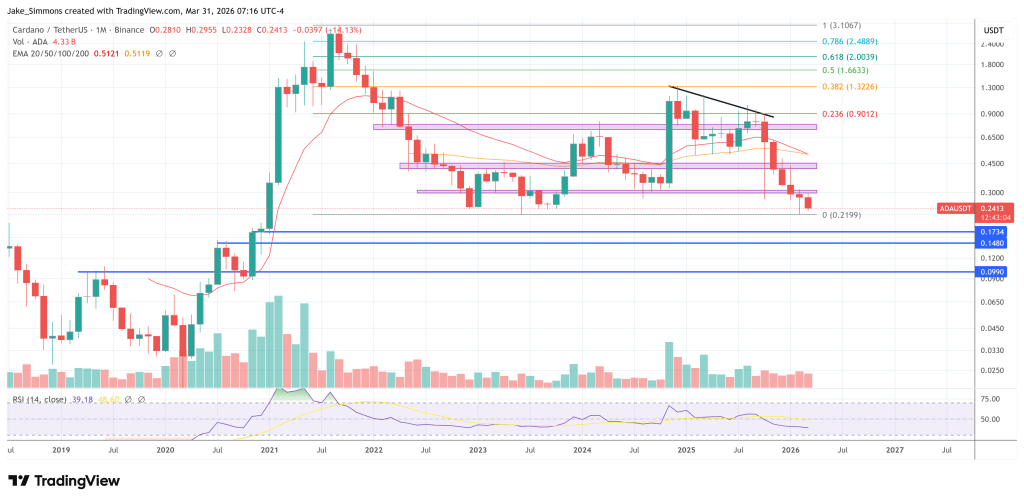
Cardano hovers below key resistance, 1-monthly chart | Source: ADAUSDT on TradingView.com

Related Questions

QWhat is the significance of the mainnet launch for Midnight, as announced by Charles Hoskinson?

AThe mainnet launch marks the debut of the privacy-focused network Midnight, a high-profile infrastructure project within the Cardano ecosystem, and represents a major milestone for the broader Cardano ecosystem.

QHow does Midnight's initial 'guarded era' phase operate, according to the announcement?

AIn the initial 'guarded era,' Midnight operates with a strong federated network of node operators under explicit participation rules, prioritizing operational stability and security. This controlled production phase includes an active bug-fix queue and is designed to harden the system before progressing toward a more decentralized model.

QWhat key technical feature does Midnight use to ensure privacy for its users?

AMidnight uses a hybrid ledger architecture that combines public and private data, employs client-side generation of zero-knowledge proofs to keep sensitive data on user devices, and supports selective disclosure for authorized viewing of specific records without exposing all transaction data.

QWhat is the economic model of Midnight, and how does it differ from conventional blockchain networks?

AMidnight uses a dual-token model: NIGHT acts as the unshielded governance and utility token, while DUST functions as a renewable transaction resource that regenerates over time based on NIGHT holdings. This design aims to make transaction costs more predictable and allow developers to subsidize end-user usage, differentiating it from conventional gas-token networks.

QWhat did Charles Hoskinson announce alongside the mainnet launch to support broader education on the technology?

ACharles Hoskinson announced the publication of a free book titled 'Proving Nothing: A Complete Guide to Zero-Knowledge Proof Systems,' aimed at providing a comprehensive overview of ZK systems for non-technical readers.

Related Reads

Fei-Fei Li's Team Clarifies the Concept of 'World Models', Sora Merely a Renderer

"World Models" has become a widely used yet confusing term in AI. To address this, a team led by Fei-Fei Li and World Labs proposed a functional taxonomy based on the Partially Observable Markov Decision Process framework. This taxonomy categorizes systems called "world models" into three distinct projections: Renderers, Simulators, and Planners. Renderers, like OpenAI's Sora and other video generation models, focus on producing photorealistic visual outputs for human perception. They prioritize visual fidelity over physical accuracy. Simulators, such as NVIDIA Omniverse, aim to compute precise future environmental states for computational tasks like engineering analysis or digital twins. Planners, like Vision-Language-Action models, take in observations and goals to output executable actions for robots or agents. The article clarifies that most current "world models," including Sora, are primarily Renderers. They generate convincing visuals but lack the core ability to simulate state transitions based on actions, a key requirement for a true world model in classic reinforcement learning definitions. This conceptual confusion has practical implications, leading to potential misalignment in technology selection, investment, and public understanding of AI capabilities. Clear categorization is crucial. It helps enterprises avoid costly mistakes (e.g., using a renderer for robot training), allows investors to accurately assess markets, and enables researchers to build comparable benchmarks. While future systems may integrate these functions, recognizing current boundaries is essential for honest assessment and progress.

marsbit1h ago

Fei-Fei Li's Team Clarifies the Concept of 'World Models', Sora Merely a Renderer

marsbit1h ago

Bloomberg Uncovered: How Do China's Wealthy Circumvent the Annual $50,000 Limit to Transfer Assets?

**Summary: How Wealthy Chinese Circumvent $50,000 Annual Foreign Exchange Limits** Despite China's strict capital controls, including an annual $50,000 per person foreign exchange quota, an estimated $150 billion in funds still leaves the country annually via various gray and underground channels. This report outlines the evolution of China's "capital wall" and the methods used to bypass it. **The Evolving Capital Controls:** * **Foundation (1994):** The system of "current account convertibility with strict capital account controls" was established. * **Quota Set (2007):** The $50,000 individual annual forex purchase limit was formalized. * **Crackdown Begins (2015-2017):** Following market volatility, enforcement tightened. Banks were required to scrutinize transactions, and channels like using UnionPay cards for Hong Kong insurance premiums or buying overseas property were blocked. * **Digital & Legal Upgrades (2024-2026):** Enhanced algorithms now flag suspicious patterns (e.g., "smurfing"). The Common Reporting Standard (CRS) provides Chinese tax authorities with data on citizens' offshore accounts. Unlicensed cross-border brokers have been targeted. **Five Primary Methods for Moving Capital:** 1. **Underground Banking / "Hawala" (Duiqiao):** The largest-scale method. No money crosses borders. Clients pay RMB to a domestic account; an overseas associate deposits equivalent foreign currency into the client's offshore account. Risks include high fees, account freezes, and legal penalties. 2. **"Smurfing" or "Ant Moving":** Using multiple individuals' $50,000 quotas to pool funds for one offshore recipient. Increasingly detected by anti-money laundering algorithms. 3. **Trade Invoice Manipulation:** Businesses over-invoice imports or under-invoice exports via offshore shell companies, creating a pretext to transfer excess funds abroad under the guise of trade. 4. **Channel Migration:** After a crackdown on internet brokers, funds flow toward more compliant but costly channels like major banks' cross-border wealth management services or Qualified Domestic Institutional Investor (QDII) quotas. 5. **Structural Arrangements:** High-net-worth individuals use complex, high-cost legal structures involving offshore trusts, insurance, and investment migration programs to transfer asset ownership. **Regulatory Response: Focusing on People, Not Just Money** The current strategy extends oversight from enterprises to **individual residents**. Tools like CRS allow retroactive visibility into offshore assets. Cryptocurrencies, once seen as a potential loophole, are now actively monitored and prosecuted as an illegal channel. The underlying driver remains: with significant wealth concentrated among millions of affluent households seeking diversification amid domestic economic shifts, the incentive to move assets offshore persists despite regulatory barriers.

marsbit1h ago

Bloomberg Uncovered: How Do China's Wealthy Circumvent the Annual $50,000 Limit to Transfer Assets?

marsbit1h ago

Trading

Spot
Futures

Hot Articles

Discussions

Welcome to the HTX Community. Here, you can stay informed about the latest platform developments and gain access to professional market insights. Users' opinions on the price of ADA (ADA) are presented below.

活动图片