Cardano Founder Explains Why Not Sell ADA For NIGHT

bitcoinistPublished on 2025-12-24Last updated on 2025-12-24

Abstract

Cardano founder Charles Hoskinson addressed questions about whether to sell ADA for the new NIGHT token, explaining that Midnight is designed to complement, not replace, Cardano. He described Midnight as a privacy-focused blockchain that enhances Cardano applications with privacy features, helping them compete in DeFi. Hoskinson argued that Cardano's UTXO model makes it a prime destination for Bitcoin capital seeking yield, and that Midnight's privacy tools could attract flows from other chains like XRP. He emphasized that ADA holders receive preferential access to NIGHT airdrops and that Cardano secures the Midnight network. Hoskinson also discussed a "value leakage" theory where Bitcoin DeFi yield, rather than direct selling, could drive capital to Cardano if it offers institutional-grade yield products.

After the successful Midnight (NIGHT) token airdrop, Cardano founder Charles Hoskinson is getting a familiar question from ADA holders: if NIGHT is the new token tied to Cardano’s privacy network, why not sell ADA and move across? In a Dec. 21 appearance on the Discover Crypto podcast, he argued the premise is flawed because Midnight is designed to extend ADA, not replace it.

Why Not Sell Cardano For NIGHT

“They’re complimentary. They do different things,” Hoskinson said. “Midnight is the ChatGPT of privacy. That’s its job. It’s a blockchain to blockchain infrastructure module. So, what Midnight does is it actually makes Cardano applications have privacy.”

That distinction is central to his pitch: Midnight is positioned less as a liquidity siphon and more as an infrastructure module that gives Cardano-native apps a feature set they can use to differentiate in an increasingly crowded DeFi landscape. Hoskinson argued that early adopters are more likely to be Cardano applications precisely because they need a lever to compete for users, rather than larger incumbents elsewhere that tend to be slower-moving.

“Which ones do you think are going to adopt privacy first? Uniswap and PancakeSwap and all these giant things that are slow moving and they’re very conservative because they have a lot of users of value flow,” he said. “No, it’ll be Cardano applications. Because they need to gain users and so this is how they leapfrog the competition.”

From there, Hoskinson broadened the argument into a cross-chain liquidity thesis, leaning heavily on Bitcoin DeFi as a source of potential inflows. He described Bitcoin as relatively “agnostic” capital that will route to wherever yield, credit, and utility are most accessible, and claimed Cardano’s UTXO model makes it a more natural destination than account-based chains.

“When you look at Bitcoin... it doesn’t care if it goes to Ethereum or Solana or Cardano or other places to get yield,” he said. “It’s going to go to the closest continent and the closest continent is Cardano because it’s a UTXO system and Bitcoin is UTXO system. So through Cardano DeFi in particular upgraded with Midnight suddenly Bitcoin’s going to get privacy preserving yield and credit.”

He added that the same privacy-preserving yield concept could extend beyond Bitcoin. “And it’s the same for XRP and these other things,” Hoskinson said, arguing that Midnight’s privacy tooling is intended to “hybridize” on-chain and off-chain infrastructure rather than “steal TVL or steal luster from other systems.”

In practical terms, Hoskinson also tied the ADA-versus-NIGHT decision to distribution and security. He emphasized that Cardano “launched Midnight,” framing it as evidence the ecosystem can execute large-scale initiatives while positioning ADA holders for preferential participation.

“If you’re an ADA holder, you get first access to all of these things and you get the largest proportion of the airdrop,” he said. “And also, Cardano secures Midnight. So, that means ADA holders get NIGHT tokens.”

How High Can ADA Go?

Hoskinson was also pressed on Cardano price expectations. While he refrained to name any price targets, he used that moment to lay out what he described as a “value leakage” theory tied to Bitcoin’s institutional bid. He said Bitcoin is the only asset he feels comfortable forecasting with any confidence, arguing that large allocators are structurally “stuck” in Bitcoin exposure via ETFs and buy-and-hold mandates, which changes the old cycle mechanic where retail would rotate profits from BTC into alts.

In that setup, he suggested the main route for capital to spill from Bitcoin into other ecosystems is not spot rotation, but Bitcoin DeFi yield: if Cardano can offer yield and credit inside a risk profile that institutional holders can tolerate, demand can “leak” outward from BTC without investors selling BTC outright. That is the basis for his view that chains embracing Bitcoin DeFi could move more in sync with Bitcoin, while others could remain decorrelated, even if Bitcoin continues higher.

The broader message was less about discouraging trading behavior and more about presenting a structural rationale for staying exposed to ADA. In Hoskinson’s framing, Midnight is not meant to displace ADA; it is meant to expand the set of use cases Cardano applications can offer, while keeping ADA holders economically involved through security ties and token distribution.

At press time, ADA traded at $0.36.
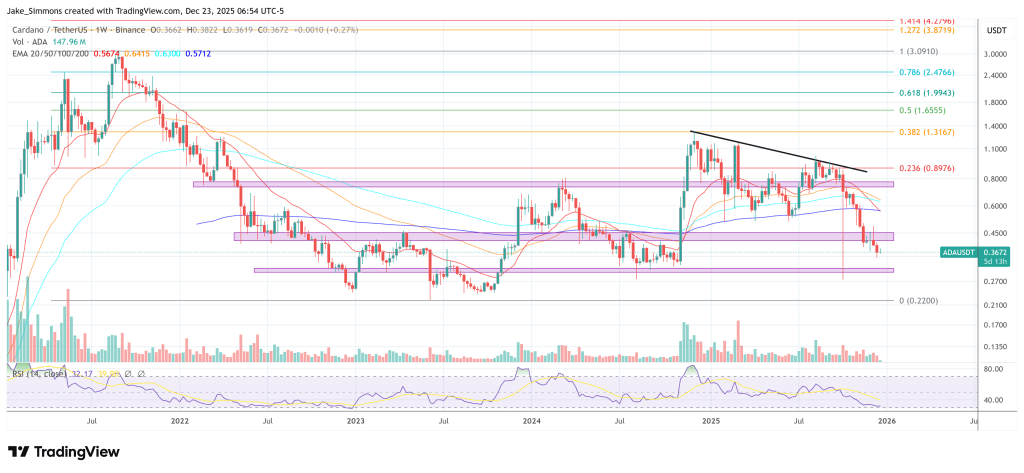
ADA turns support into resistance, 1-week chart | Source: ADAUSDT on TradingView.com

Trending Cryptos

Related Questions

QAccording to Charles Hoskinson, why is it a flawed premise to sell ADA for NIGHT?

AHe argues the premise is flawed because Midnight is designed to extend the Cardano ecosystem, not replace it. They are complimentary systems that do different things, with Midnight acting as a privacy module for Cardano applications.

QWhat analogy does Hoskinson use to describe the Midnight network?

AHoskinson describes Midnight as 'the ChatGPT of privacy,' positioning it as a blockchain-to-blockchain infrastructure module that provides privacy features.

QHow does Hoskinson connect Cardano's UTXO model to attracting Bitcoin capital?

AHe states that Bitcoin's capital is 'agnostic' and will go to wherever yield is most accessible. He claims Cardano is the 'closest continent' for Bitcoin because both use a UTXO model, making it a more natural destination for Bitcoin's yield-seeking capital than account-based chains.

QWhat advantages does Hoskinson say ADA holders have regarding the Midnight (NIGHT) token?

AHe states that ADA holders get first access to all ecosystem initiatives and the largest proportion of the NIGHT airdrop. He also emphasizes that Cardano secures the Midnight network, meaning ADA holders are economically involved and receive NIGHT tokens.

QWhat is Hoskinson's 'value leakage' theory concerning Bitcoin and other cryptocurrencies like ADA?

AHis theory is that large institutional investors are structurally 'stuck' in Bitcoin via ETFs and hold mandates. Therefore, capital spills into other ecosystems not through spot rotation (selling BTC for alts), but through Bitcoin DeFi yield. If Cardano can offer yield in a risk profile institutions tolerate, demand can 'leak' from BTC without investors having to sell their Bitcoin.

Related Reads

In Jinjiang, Fujian, a Storage Super Unicorn Lies Quiet

In Fujian's Jinjiang, a city known for sportswear, lies a quiet semiconductor giant: Fujian Jinhua Integrated Circuit Co. (JHICC). Once a promising domestic DRAM manufacturer alongside Yangtze Memory and ChangXin Memory Technologies (CXMT), its journey was derailed in 2018 when the U.S. placed it on an Entity List and filed criminal charges for alleged trade secret theft. This halted production for years. A turning point came in February 2024 when a U.S. federal court found JHICC not guilty. However, it had lost crucial time. While CXMT soared to become a top-valued A-share company in 2024, JHICC, with an estimated valuation of 80 billion RMB, was just restarting. Its current output is primarily customized DDR4 chips, not the advanced DDR5/HBM demanded for AI, but it still benefits from the broader memory chip upcycle. JHICC's story is tied to Chen Zhengkun, a veteran engineer who left Micron to lead the venture. Founded in 2016 with state-backed funding, JHICC partnered with Taiwan's UMC to develop DRAM technology. Rapid progress was cut short by the U.S. actions, which Micron initiated, partly due to its heavy reliance on the Chinese market. Post-sanctions, Chen's team worked to rebuild the production line with reduced reliance on U.S. technology. According to its records, JHICC achieved small-scale production and revenue growth under immense pressure. It now focuses on the stable "niche" DRAM market (e.g., TVs, routers) with a monthly capacity of ~40,000 wafers, aiming for 60,000 by 2026. It holds over 1,000 patents but remains on the Entity List. For Jinjiang, investing in JHICC was a bold industrial leap. The local government provided unwavering financial and logistical support during the crisis, helping the company survive. JHICC has become the anchor for a growing local semiconductor cluster. Though its scale lags behind domestic peers, JHICC's persistence symbolizes a hard-won foothold in a global market long dominated by Samsung, SK Hynix, and Micron. Having missed one boom, it seeks a place in the new AI-driven memory supercycle.

marsbit44m ago

In Jinjiang, Fujian, a Storage Super Unicorn Lies Quiet

marsbit44m ago

Must-Watch Events Next Week|CLARITY Act Could Face Senate Vote; SpaceX, Circle to Report Earnings (8.3-8.9)

**Summary: Key Events and Developments to Watch (August 3-9)** The upcoming week is marked by significant financial disclosures, key legislative deadlines, and notable product updates. **Major Financial Events:** Several companies are scheduled to release their Q2 2026 earnings. American Bitcoin (ABTC) will report on August 3, followed by SpaceX and Hut 8 Mining Corp. on August 4, and Circle on August 5. Notably, a significant portion of SpaceX shares (up to 12% of total shares) will be unlocked on August 6 following their earnings release. **Key Legislative Deadline:** The U.S. Senate faces an August 7 deadline to secure 60 votes for the CLARITY Act, a bipartisan bill aiming to establish a federal regulatory framework for cryptocurrencies. The Senate may hold a full vote on the bill during the week. **Economic Data:** The U.S. July Non-Farm Payrolls report will be released on August 7, providing crucial labor market data. **Technology & Product Updates:** * **Shutdowns:** DeFi portfolio tracker Zapper and wallet app Ctrl Wallet will cease operations on August 3. * **Upgrades:** LayerZero will deprecate its v1 relayers on August 3. XRP Ledger's new version 3.3.0, featuring five new functions, is expected next week. * **AI:** Elon Musk announced that the advanced Grok 4.6 AI model is set for release around August 7. * **Bitcoin:** The BIP-110 forced signaling for a potential Bitcoin network change is scheduled to begin around August 8. **Other Notable Events:** Chinese robotics firm Unitree Tech has set its preliminary price inquiry for its IPO for August 5. South Korean exchange Upbit will delist AQT and AERGO tokens on August 3.

marsbit2h ago

Must-Watch Events Next Week|CLARITY Act Could Face Senate Vote; SpaceX, Circle to Report Earnings (8.3-8.9)

marsbit2h ago

Trading

Spot

Hot Articles

Discussions

Welcome to the HTX Community. Here, you can stay informed about the latest platform developments and gain access to professional market insights. Users' opinions on the price of ADA (ADA) are presented below.

活动图片