Cardano Enters New Phase, Hoskinson Touts ‘ChatGPT For Privacy’

bitcoinistPublished on 2025-12-19Last updated on 2025-12-19

Abstract

Charles Hoskinson announced that Cardano is entering a new phase centered on Midnight, a project he describes as a "ChatGPT for privacy." Midnight is positioned as a cross-ecosystem application layer designed to make advanced cryptography usable at scale, enabling privacy-first hybrid applications that can integrate with Ethereum, Solana, Bitcoin, and other chains. Hoskinson emphasized that Midnight is not merely a privacy coin but a platform for selective disclosure, intents, dual tokenomics, and multi-resource consensus, targeting real-world applications capable of handling trillions in transactions. He highlighted Midnight's early traction, citing a $1 billion market cap and $1.8 billion trading volume, attributing this success to a fair distribution model that allocated tokens to 1.5 million users rather than venture capitalists. Hoskinson argued that Cardano can differentiate itself by prioritizing privacy-enabled financial primitives like private DEXs and prediction markets, rather than competing solely on transaction cost. He outlined plans to roll out Midnight across major ecosystems in 2026, aiming to unify crypto markets and eliminate the distinction between DeFi and TradFi.

Charles Hoskinson says Cardano is entering a new phase centered on what he described as a “ChatGPT for privacy,” positioning the Midnight project as a cross-ecosystem application layer designed to make advanced cryptography usable at scale.

Cardano Is Entering A New Phase

Speaking in a Dec. 18 livestream titled “Rays of Sunshine in 2026,” the Cardano founder argued that Midnight marks a shift away from incremental performance battles toward privacy-first, hybrid applications that can plug into Ethereum, Solana, Bitcoin, and beyond.

“I wanted to make a video to talk about the good stuff and talk about the fact that we’re leading the market for the first time in a long time,” Hoskinson said. “And it feels right. This time really does.”

The heart of the pitch was that Midnight’s early traction is not just a hype spike, but a sign the market is tired of the usual crypto incentive loop and looking for a new “paradigm.” “People deep down inside, they know that a new generation is starting,” he said. “We need a new paradigm and we have to have a reset and we have to launch things and do things differently. And they’re just tired of the way things have happened before. They’re tired of it.”

Hoskinson spent time distinguishing Midnight from the category it will inevitably be filed under. “When you looked at Midnight, Midnight is not a privacy coin,” he said. “Midnight is what will enable rational privacy and selective disclosure, but it’s so much more. It’s the platform for intents. It’s the platform for hybrid applications. It’s the platform for capacity exchange, for dual tokenomics. It’s the platform for multi-resource consensus.”

He acknowledged the underlying toolkit—“snarks,” “roll-ups,” “recursion and folding”—but argued those buzzwords miss the point. “It’s never been about roll-ups, recursion, folding, snarks from a scalability perspective,” he said. “It’s about real world applications.” The claim, in his telling, is that Midnight is one of the few projects positioned to handle “trillions of dollars worth of transactions,” precisely because it targets applications where selective disclosure and privacy are features, not trade-offs.

To make the case that Midnight is already outperforming comparable narratives, Hoskinson cited market-cap and volume figures for other ZK and privacy-adjacent projects and contrasted them with Midnight’s reported activity. He cited Starkware at $410 million market cap with $72 million volume, zkSync at $279 million market cap with $29 million volume, and Mina at $97 million market cap—before highlighting his own project: “Midnight, $1 billion market cap, $1.8 billion trading. It doesn’t even have Binance Spot yet.”

A major reason he believes the market has leaned in, Hoskinson argued, is launch structure—specifically, avoiding the standard fear that insiders will overwhelm liquidity. “And they said, well, can I believe in it? Is there an ICO? Is there an insider? Who the f*** is going to dump on me?” he said. “They just gave it away. Eight different ecosystems, seven chains. All the VCs wanted in, they got nothing. They didn’t get in. We gave it to the people.”

He later tied distribution directly to observed trading intensity. “We have about 1.5 million people that got night tokens,” he said. “That’s why the volume is so f***ing high.”

Midnight Is The ‘ChatGPT For Privacy’

For Cardano itself, Hoskinson’s most pointed strategic claim was that “better, faster, cheaper” is not a durable wedge—even if upcoming upgrades land. “Let’s say Leios ships and Hydra ships and we’re better, faster, and cheaper. Great,” he said. “What reason does someone have to leave Solana? And what reason does someone have to leave Ethereum? Because the transaction fee is 3% less. Okay.”

Instead, he argued Cardano can win by being first to build hybrid applications that route through Midnight and unlock privacy-first financial primitives. “They could go through midnight to Cardano and they get privacy,” he said. “They do something new and different [...] private prediction markets, private DEXs, private stablecoins.”

He extended that thinking to Bitcoin-adjacent flows: “Maybe just maybe all those Bitcoin people are going to want to trade on a private DEX instead of a public DEX,” he said. “And maybe we’ll have volumes in the billions of dollars of turnaround every single day.”

Hoskinson repeatedly returned to a simplifying metaphor: Midnight as an abstraction layer that makes heavy cryptography usable. “Everybody else gets jealous. So they’ll go use Midnight too because it’s the ChatGPT of privacy,” he said. “Just send stuff and stuff comes out.” He later described a product-like cadence of improvement: “You basically just have this API. You send something in, you get something back. And every six months it gets better.”

He also framed 2026 as an execution year, sketching an outward-facing expansion plan where Midnight is integrated across major ecosystems in tight succession: “We’re going to do Cardano Midnight. Show them how it’s done. Then we’re gonna do Midnight Ethereum. Two months later, three months later, Midnight Solana... Midnight Avalanche... Midnight Bitcoin.”

The broader ambition, he said, is to move crypto past siloed tribal finance toward one interoperable market. “This is the last generation,” Hoskinson said. “It’s gonna unify the marketplaces and it’s gonna get rid of DeFi and TradFi. And there’s just going to be Fi.”

At press time, Cardano traded at $0.36.
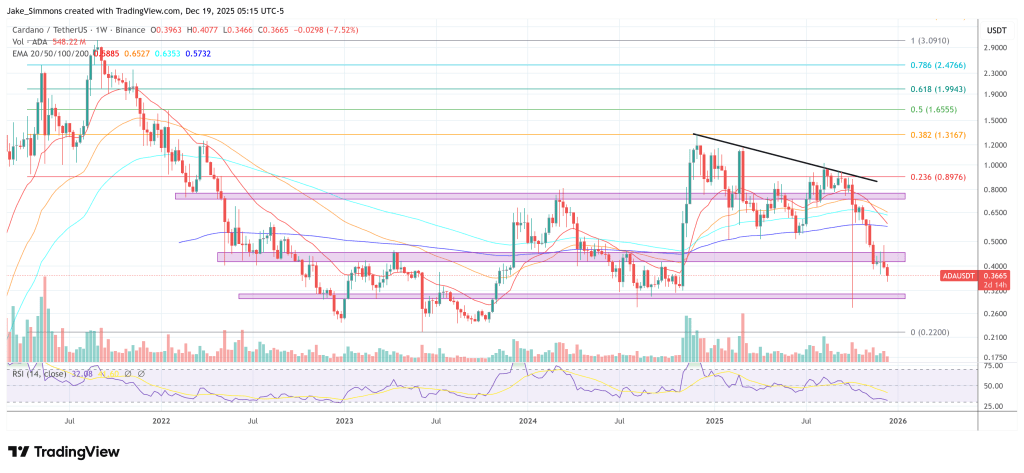
Cardano falls below key support, 1-week chart | Source: ADAUSDT on TradingView.com

Related Questions

QWhat is the main focus of Cardano's new phase as announced by Charles Hoskinson?

AThe main focus is on the Midnight project, described as a 'ChatGPT for privacy,' which serves as a cross-ecosystem application layer designed to make advanced cryptography usable at scale.

QHow does Hoskinson distinguish Midnight from being categorized as a privacy coin?

AHoskinson states that Midnight is not a privacy coin but a platform that enables rational privacy and selective disclosure, supporting intents, hybrid applications, capacity exchange, dual tokenomics, and multi-resource consensus.

QWhat market cap and trading volume did Hoskinson cite for Midnight compared to other ZK and privacy-adjacent projects?

AHoskinson cited Midnight with a $1 billion market cap and $1.8 billion trading volume, contrasting it with Starkware ($410M market cap, $72M volume), zkSync ($279M market cap, $29M volume), and Mina ($97M market cap).

QWhy does Hoskinson believe the market has responded positively to Midnight's launch structure?

AHe attributes the positive response to the distribution model, where tokens were given away to 1.5 million people across eight ecosystems and seven chains, avoiding insider advantages and VC allocations, which built trust and liquidity.

QWhat is the broader ambition Hoskinson envisions for Midnight and the crypto market?

AThe broader ambition is to unify the marketplaces by integrating Midnight across major ecosystems like Ethereum, Solana, Bitcoin, and Avalanche, moving beyond siloed tribal finance to create one interoperable market, eliminating the distinction between DeFi and TradFi.

Related Reads

Blocked Its Own Treasure, WeChat AI Steps Up

Tencent's stock surged over 10% on June 2nd amid reports that WeChat, with 1.43 billion monthly users, is finalizing tests for a native AI Agent. The reported feature, accessible by swiping right from the main interface, allows users to issue commands in natural language. The AI then decomposes tasks and automatically calls upon relevant Mini Programs within WeChat to complete actions like ordering food, booking tickets, or making payments, creating a closed-loop service execution system. This strategic shift follows the internal conflict and subsequent "blocking" of Tencent's standalone AI app, Yuanbao, by WeChat for violating sharing rules during a 2026 Spring Festival promotion. The incident highlighted a lack of internal consensus and exposed the weakness of competing in the standalone AI assistant arena against rivals like ByteDance's Doubao (345M MAU) and Alibaba's Qianwen. The new WeChat AI Agent aims to leverage WeChat's unique assets—its massive user base, standardized Mini Program APIs, WeChat Pay, and identity system—to move from simple content generation to actual task execution. Analysts note this changes the competitive landscape from model benchmarks to which AI can connect to more real-world services. However, success depends on key variables: the capability of Tencent's underlying Hunyuan model, managing massive inference costs, and redesigning incentives for Mini Program developers whose traffic might be bypassed. The move is seen as an attempt to keep user service intent within WeChat's ecosystem as AI begins to redefine how users access services.

marsbit16m ago

Blocked Its Own Treasure, WeChat AI Steps Up

marsbit16m ago

ByteDance Adopts Arm CPUs, Jensen Huang: So Sad I Didn't Buy Arm

**Summary:** At Computex 2026, Arm CEO Rene Haas announced that ByteDance and Oracle have adopted Arm's self-designed Arm AGI data center CPU. The company expects significant revenue growth from this product, projecting $20 billion in demand for the 2027/2028 fiscal years. Haas noted that restricting AI-capable CPUs from the US to China is nearly impossible due to their widespread applications. Arm's stock has surged dramatically this year, notably rising 16% after NVIDIA's Arm-based Vera CPU and RTX Spark announcements. A highlight was the informal, humorous on-stage conversation between Haas and NVIDIA CEO Jensen Huang. Huang joked about NVIDIA's failed attempt to acquire Arm and playfully lamented selling his Arm shares. Both executives showed a clear sense of camaraderie and shared regret over the missed merger. Key technical topics were discussed: 1. **AI PC Design:** Huang explained NVIDIA's RTX Spark superchip (with a 20-core Arm CPU) is designed for future AI agents that will autonomously run and use tools on PCs, blending local and cloud processing. 2. **Agent vs. OS:** Huang emphasized the operating system remains crucial, as AI agents rely on its APIs and tools to function. 3. **Growth Constraints:** He identified the shift to "useful AI" that generates profitable tokens as a primary driver for immense, almost limitless, computational demand. Haas outlined Arm's strategy across PC and data centers. For PCs, Arm collaborates with partners like NVIDIA and MediaTek, offering its compute subsystem (CSS) for custom SoCs. In data centers, its Arm AGI CPU (built on TSMC's 3nm process) has gained major partners including OpenAI, Meta, and now ByteDance and Oracle. Arm presented a multi-year roadmap for its in-house CPU line. The article concludes that while GPUs dominated the AI training race, the explosion of AI agents is shifting significant focus to CPUs for inference, state management, and tool orchestration. The industry is trending towards vertical integration, with companies like cloud providers designing chips and chip/IP firms offering full solutions, all competing to deliver more efficient computing per watt.

marsbit36m ago

ByteDance Adopts Arm CPUs, Jensen Huang: So Sad I Didn't Buy Arm

marsbit36m ago

New Wall Street Play: Yen Shorts Still Adding, But Japan Stocks Don't Rely on Carry Trade Unwinding

On June 3rd, USD/JPY hit 160.44, its highest level since July 2024, while the Nikkei 225 surged past 68,000 points. Contrary to popular narratives of an imminent "carry trade unwind" akin to August 2024, data reveals a more complex picture. Speculative net short positions in yen futures have actually increased, reaching -114,667 contracts by late May, suggesting traders are doubling down rather than retreating. Meanwhile, Japan's Finance Ministry conducted its largest-ever single-round FX intervention (11.73 trillion yen) in April-May but failed to hold the 160 yen line. The Nikkei's rally is not driven by carry trade dynamics. Foreign investors are aggressively buying Japanese stocks, with net purchases in 2026 running nearly 16 times higher than 2025 levels. This inflow is concentrated in AI and semiconductor-related stocks like SoftBank and Socionext, fueled by positive sector outlooks, rather than being a flight from unwinding yen shorts. Furthermore, the Nikkei has continued climbing despite the Bank of Japan's (BOJ) rate hikes to 0.75%. This disconnect exists because the current equity boom is fueled by AI-driven foreign investment, not reliant on cheap yen funding. However, this relationship remains fragile. Should the BOJ hike rates further (e.g., to 1.0%) while dollar weakness increases carry trade costs, the trajectories of the yen and Japanese stocks could reconverge, potentially triggering volatility.

marsbit41m ago

New Wall Street Play: Yen Shorts Still Adding, But Japan Stocks Don't Rely on Carry Trade Unwinding

marsbit41m ago

Broadcom's Q3 Guidance Misses Expectations by $12 Billion, After-Hours Trading Plummets Over 13%, AI Narrative "Cooling"?

On June 3, Broadcom released record Q2 FY26 results with revenue of $22.19B, up 48% YoY, and AI chip sales of $10.8B, up 143%. Adjusted EPS of $2.44 beat estimates. However, its Q3 AI semiconductor revenue guidance of $16B, while up over 200% YoY, fell roughly $1.2B (7%) short of analyst consensus expectations of $17.2B. This miss, coupled with slightly weaker-than-expected software revenue, triggered a severe market reaction. CEO Hock Tan maintained the FY26 AI revenue outlook of over $100B but did not raise it, disappointing investors who had priced in more robust growth. The stock plummeted over 13% in after-hours trading, erasing roughly $270B in market cap. The sell-off extended to peers like Marvell. A key concern for markets, particularly for Chinese optical module suppliers, was Tan's comment that the contribution of AI networking (e.g., Ethernet switches, optical interconnect chips) to AI revenue, currently near 40%, is expected to normalize to around 30% over time, signaling a potential peak in growth for that segment. Despite the guidance shortfall, Tan reiterated that AI demand remains "insatiable" and reaffirmed the long-term target of exceeding $100B in AI revenue by FY27. The reaction highlights the heightened sensitivity and premium valuation placed on AI-exposed stocks, where anything less than stellar guidance can prompt significant profit-taking. The broader question is whether this represents a cooling AI narrative or a correction in overstretched valuations.

marsbit41m ago

Broadcom's Q3 Guidance Misses Expectations by $12 Billion, After-Hours Trading Plummets Over 13%, AI Narrative "Cooling"?

marsbit41m ago

Trading

Spot
Futures

Hot Articles

Discussions

Welcome to the HTX Community. Here, you can stay informed about the latest platform developments and gain access to professional market insights. Users' opinions on the price of ADA (ADA) are presented below.

活动图片