Bybit Regains Ground In 2025 After Historic Hack, CoinGecko Finds

bitcoinistPublished on 2026-01-30Last updated on 2026-01-30

Abstract

Bybit made a significant recovery in 2025, handling $1.5 trillion in trades and capturing 8% market share despite a historic $1.5 billion hack in February. The exchange's decision to keep withdrawals open and cover user losses helped rebuild trust and maintain liquidity. CEO Ben Zhou's public reassurances and transparent communication were key to its comeback. Overall, trading volumes rose across major exchanges, with MEXC seeing 90% growth due to zero-fee promotions. Binance remained the largest exchange with $7.3 trillion in volume, despite a slight 0.5% decline.

Bybit’s return to heavy trading was one of the stranger comeback stories of last year. Reports say the exchange moved back toward the top of the leaderboard after a massive security breach, and traders kept coming. That did not happen by accident. Quick decisions and public reassurances played a big role.

Bybit Bounces Back

According to CoinGecko, Bybit handled $1.5 trillion in trades during 2025 and ended the year with about 8% of total market share.

That is a solid showing given what happened in February, when attackers made off with $1.5 billion worth of Ether after finding a hole in the exchange’s cold wallet setup.

The theft has been linked to North Korean actors by several sources, and it stands as one of the largest losses in crypto history.

Many firms that face breaches do not recover. Reports note nearly eight out of 10 projects hit by hacks never fully bounce back.

Bybit’s choice to keep withdrawals open and to honor user balances changed the math. That move reduced panic and kept liquidity flowing.
Market Movers And Volume Gains

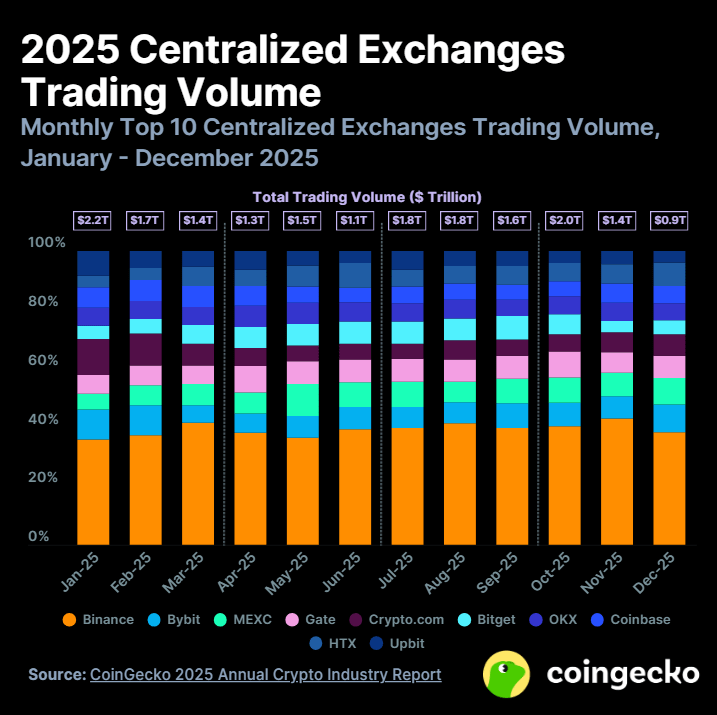
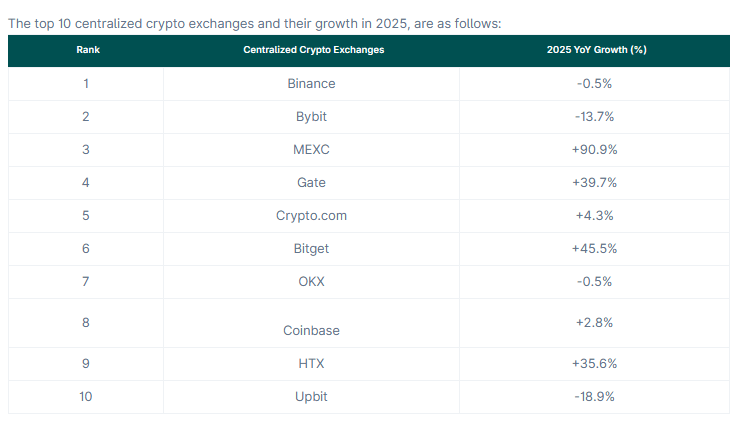
Trading volumes rose across multiple venues in 2025. CoinGecko’s research points out that six of the top 10 exchanges grew their yearly volume, and the total extra trades equaled about $1.3 trillion.

MEXC jumped sharply, reportedly rising 90% over the prior year, a gain blamed largely on aggressive zero-fee spot trading that pulled in high-frequency traders and new retail users.

Bullish price action for Bitcoin and several altcoins also pushed activity up; several coins reached fresh all-time highs during the year, which always sparks more trading and more headlines. For some platforms, promotions and fee policies had more immediate effect than brand reputation.

BTCUSD currently trading at $82,654. Chart: TradingView

How Bybit Handled The Crisis

The exchange’s leadership was visible. Ben Zhou, Bybit’s CEO, addressed customers on camera and promised the platform would cover losses and secure additional liquidity quickly.

Some of those promises were acted on behind the scenes, where external support was arranged to shore up funds.

Trust was not rebuilt overnight. It was rebuilt in small steps, transaction by transaction, and in public statements that reassured users their capital was safe.

The combination of keeping services running and having clear communication changed investor behavior.
Source: Coingecko

Binance And Rival Trends

Binance stayed the largest by a wide margin, with CoinGecko estimating about $7.3 trillion in annual volume. That massive figure hides a small drop from the prior year — a 0.5% decline — which analysts tied to a major liquidation event on October 10 that rattled markets.

Still, Binance’s user base was said to be over 300 million, and its ecosystem handles a vast range of products beyond spot trading.

Featured image from Pexels, chart from TradingView

Related Questions

QWhat was the total trading volume handled by Bybit in 2025, according to CoinGecko?

ABybit handled $1.5 trillion in trades during 2025.

QWhat key action did Bybit take to reduce panic and maintain liquidity after the hack?

ABybit chose to keep withdrawals open and honor user balances, which reduced panic and kept liquidity flowing.

QWhich exchange saw a 90% increase in yearly volume, and what was the primary reason for this growth?

AMEXC jumped 90% over the prior year, a gain largely attributed to its aggressive zero-fee spot trading that attracted high-frequency traders and new retail users.

QHow did Bybit's CEO, Ben Zhou, respond to the security breach crisis?

ABen Zhou addressed customers on camera, promising that the platform would cover losses and secure additional liquidity quickly.

QWhat was Binance's estimated annual trading volume in 2025, and what minor change did it experience from the prior year?

ACoinGecko estimated Binance's annual volume at about $7.3 trillion, which represented a small 0.5% decline from the prior year.

Related Reads

380,000 Apps Exposed, 2,000+ Apps Leaked Secrets: AI Programming Turns 'Intranet' into Public Internet

Israeli cybersecurity firm RedAccess uncovered a severe data exposure trend linked to "vibe coding" or AI-powered software development tools. Their research found approximately 38,000 publicly accessible web applications built with platforms like Lovable, Base44, Netlify, and Replit. Of these, an estimated 2,000 apps exposed sensitive corporate and personal data, including medical records, financial information, internal strategic documents, and customer chat logs. In some cases, access even granted administrative privileges. The core issue stems from default privacy settings that make applications public by default, combined with a lack of built-in security controls (like authentication) in the AI-generated code. This allows employees without security expertise—"citizen developers"—to easily create and deploy applications that bypass standard corporate security reviews. The exposed apps, often indexed by search engines, are trivially discoverable. While some platform providers (Replit, Lovable, Wix/Base44) argue that security configuration is the user's responsibility and question the validity of some findings, security researchers confirm the widespread reality of such exposures. This pattern, also noted in prior studies, highlights a critical security gap as AI democratizes app creation, potentially leading to massive, unintentional data leaks.

marsbit8m ago

380,000 Apps Exposed, 2,000+ Apps Leaked Secrets: AI Programming Turns 'Intranet' into Public Internet

marsbit8m ago

Attracting Global Capital, Asia's New 'Super Cycle' Is Unfolding

Investors are turning to Asia as the next frontier for global equity growth, with a new "super cycle" unfolding across the region. Driven by the AI revolution, Asian markets, particularly South Korea, have seen significant rallies. According to Morgan Stanley analysis, the underlying drivers of Asia's industrial cycle are shifting from traditional sectors like real estate and manufacturing to massive investments in AI infrastructure, energy security and transition, and supply chain resilience. Fixed asset investment in Asia is projected to grow from around $11 trillion in 2025 to $16 trillion by 2030, with a 7% annual growth rate from 2026-2030. The AI wave is a primary catalyst, driving immense capital expenditure for chips, servers, data centers, and power systems. Asia is central to this hardware supply chain. In China, AI investment is focused on building a full-system domestic capability, with the local AI chip market potentially reaching $86 billion by 2030. Beyond AI, China's export story is expanding from EVs and batteries to robotics. The country already captures about half of new global industrial robot demand and over 90% of humanoid robot shipments. This growth phase mirrors the early stages of China's EV export boom. Simultaneously, energy security investments, spurred by AI's massive power needs, are rising, with China benefiting from its leadership in solar, batteries, and EVs. Regional defense spending is also increasing structurally, supporting demand for advanced manufacturing. The main beneficiaries are China, South Korea, and Japan, positioned in core supply chain areas. However, risks remain, including potential overcapacity, profit margin pressures from competition, persistent technological restrictions, geopolitical friction, and workforce displacement due to AI-driven automation. Market volatility is also expected to increase as investor expectations diverge on the realization of these capital investment and export themes.

marsbit9m ago

Attracting Global Capital, Asia's New 'Super Cycle' Is Unfolding

marsbit9m ago

Funding Weekly Report | 14 Public Funding Events, Kalshi Completes $10B New Funding Round at $220B Valuation Led by Coatue Management

Weekly Funding Roundup: 14 Deals and $10.49B+ in Total Funding, Led by Kalshi's $1B Round Last week (5.4-5.10) saw 14 notable funding events in the global blockchain ecosystem, raising over $10.49 billion in total. Key highlights include Kalshi, a prediction market platform, securing a $1 billion round led by Coatue Management, reaching a $22 billion valuation. The platform now boasts ~2 million MAUs and $178B in annualized trading volume. In DeFi, regulated on-chain reinsurer OnRe raised $5 million in Series A funding, and Bitcoin-backed credit protocol Saturn Credit completed a $2 million seed round. For Infrastructure & Tools, OpenTrade raised $17 million to expand its stablecoin yield infrastructure, and RWA platform Balcony secured $12.7 million to deploy its property settlement service in the US. Centralized Finance saw one deal: AI-driven trading platform Stockcoin.ai completed a seed round led by Amber Group. In the prediction market sector alongside Kalshi, AI-powered platform Elastics raised $2 million. Other notable deals include SC Ventures' strategic investment in crypto market maker GSR and Centrifuge securing a "seven-figure" investment from Coinbase to become a core RWA partner for Base. On the investor side, Haun Ventures raised a new $1 billion fund targeting crypto and AI, and Multi Investment raised ~$616 million to focus on blockchain and Web3 investments.

marsbit1h ago

Funding Weekly Report | 14 Public Funding Events, Kalshi Completes $10B New Funding Round at $220B Valuation Led by Coatue Management

marsbit1h ago

Trading

Spot
Futures

Hot Articles

How to Buy ONE

Welcome to HTX.com! We've made purchasing Harmony (ONE) simple and convenient. Follow our step-by-step guide to embark on your crypto journey.Step 1: Create Your HTX AccountUse your email or phone number to sign up for a free account on HTX. Experience a hassle-free registration journey and unlock all features.Get My AccountStep 2: Go to Buy Crypto and Choose Your Payment MethodCredit/Debit Card: Use your Visa or Mastercard to buy Harmony (ONE) instantly.Balance: Use funds from your HTX account balance to trade seamlessly.Third Parties: We've added popular payment methods such as Google Pay and Apple Pay to enhance convenience.P2P: Trade directly with other users on HTX.Over-the-Counter (OTC): We offer tailor-made services and competitive exchange rates for traders.Step 3: Store Your Harmony (ONE)After purchasing your Harmony (ONE), store it in your HTX account. Alternatively, you can send it elsewhere via blockchain transfer or use it to trade other cryptocurrencies.Step 4: Trade Harmony (ONE)Easily trade Harmony (ONE) on HTX's spot market. Simply access your account, select your trading pair, execute your trades, and monitor in real-time. We offer a user-friendly experience for both beginners and seasoned traders.

3.4k Total ViewsPublished 2024.03.29Updated 2025.06.04

How to Buy ONE

Discussions

Welcome to the HTX Community. Here, you can stay informed about the latest platform developments and gain access to professional market insights. Users' opinions on the price of ONE (ONE) are presented below.

活动图片