By The Numbers: How Do Bitcoin, Ethereum, & Dogecoin Compare In Addresses?

bitcoinistPublished on 2025-12-20Last updated on 2025-12-20

Abstract

Santiment's on-chain analysis reveals Ethereum leads in total number of addresses with non-zero balances at 167.96 million, significantly ahead of Bitcoin's 57.62 million. This gap is attributed to Ethereum's robust ecosystem of layer two blockchains and DeFi applications. USDT stablecoin ranks third with 9.63 million addresses, followed by Dogecoin (8.13 million) and XRP (7.41 million). While Bitcoin's holder count has remained relatively flat over the past year, Ethereum has continued to grow, further extending its lead. This growth is supported by a spike in Ethereum's Network Growth metric, which now averages 163,000 new addresses per day compared to 124,000 in July. At the time of writing, Bitcoin was trading around $87,500, down 2% over the week.

On-chain analytics firm Santiment has shared the data about how Bitcoin, Ethereum, and other top coins compare in Total Amount of Holders.

Ethereum Beats Bitcoin, Dogecoin, & Others In Total Amount Of Holders

In a new post on X, Santiment has talked about where the Total Amount of Holders indicator stands for Bitcoin, Dogecoin, and other coins in the cryptocurrency sector today. This metric measures, as its name suggests, the total number of addresses carrying a non-empty balance on a given network.

When the value of this indicator rises, it can be a sign that new investors are joining the blockchain and/or old investors who sold earlier are making a return. The trend can also arise from existing holders creating multiple wallets for accounting or privacy purposes.

In general, all of these factors can be assumed to simultaneously be in action whenever the Total Amount of Holders registers an increase. As such, some net adoption of the cryptocurrency can be considered to have occurred.

On the other hand, the metric going down implies some investors have cleaned out their wallet balances, potentially because they have decided to exit the blockchain.

Now, here is the chart shared by Santiment that shows the trend in the Total Amount of Holders for eight different cryptocurrencies:
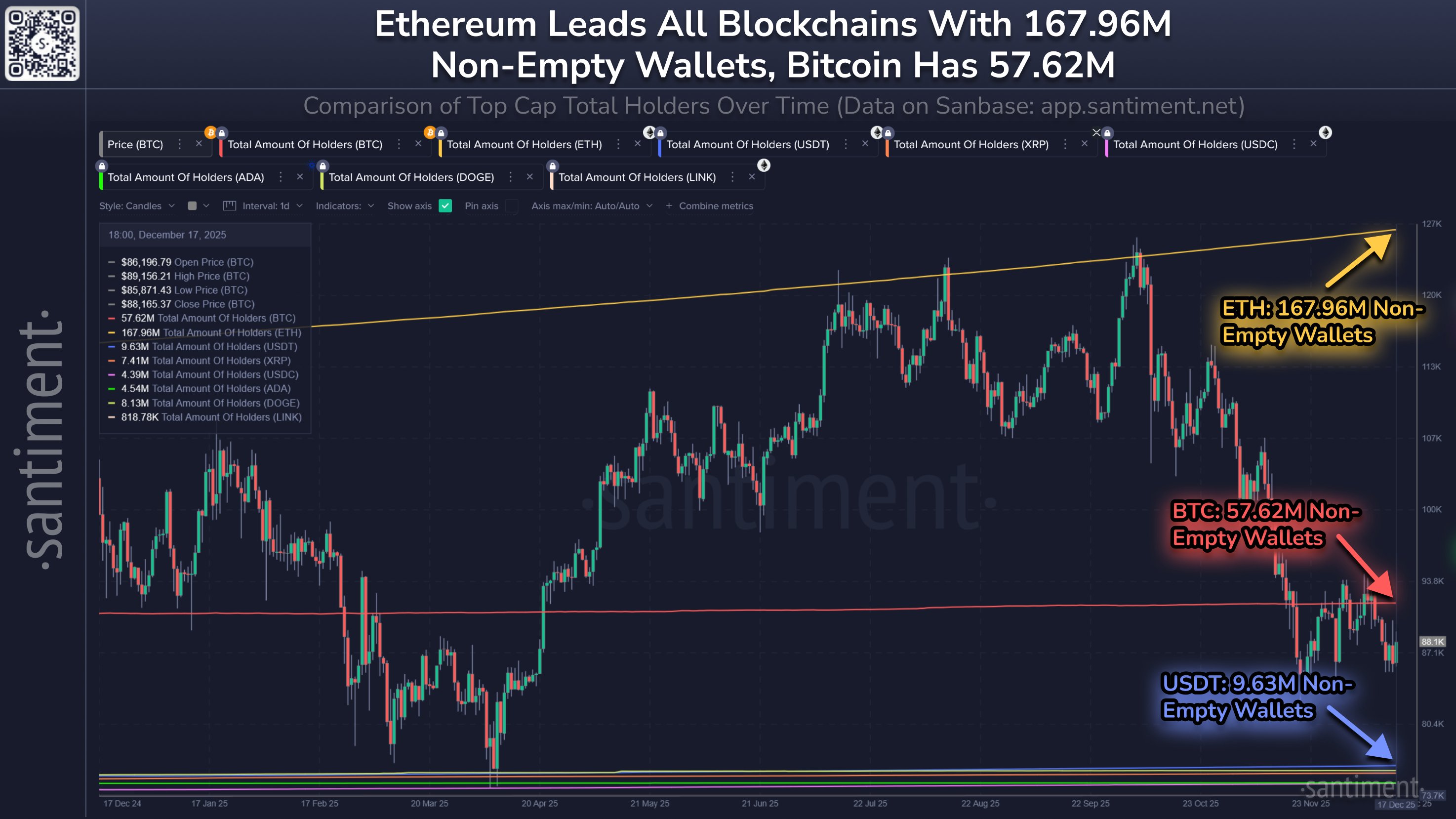
The metric's value appears to be the highest for ETH right now | Source: Santiment on X

As displayed in the above graph, Ethereum is the most dominant cryptocurrency in terms of the Total Amount of Holders, with the metric sitting at 167.96 million. Bitcoin, the next largest network, only hosts a userbase that’s a third of ETH’s (about 57.62 million addresses).

Ethereum’s dominance could be down to the fact that the blockchain hosts a vibrant ecosystem of layer two blockchains and decentralized finance (DeFi) applications, made possible by its smart-contracts system.

The gulf between Bitcoin and third place is again massive, with the stablecoin USDT having 9.63 million non-empty wallets. From USDT on, however, the altcoins are much closer to each other.

Dogecoin and XRP are the cryptocurrencies with the fourth and fifth largest holder counts on the list with the indicator having a value of 8.13 million and 7.41 million, respectively.

From the chart, it’s visible that while Bitcoin has seen a more or less flat trajectory in the Total Amount of Holders during the last year, Ethereum has only been witnessing growth, extending its lead.

The adoption trend for ETH is also visible from another indicator shared by the analytics firm, known as the Network Growth. This metric keeps track of the new addresses appearing on the blockchain.
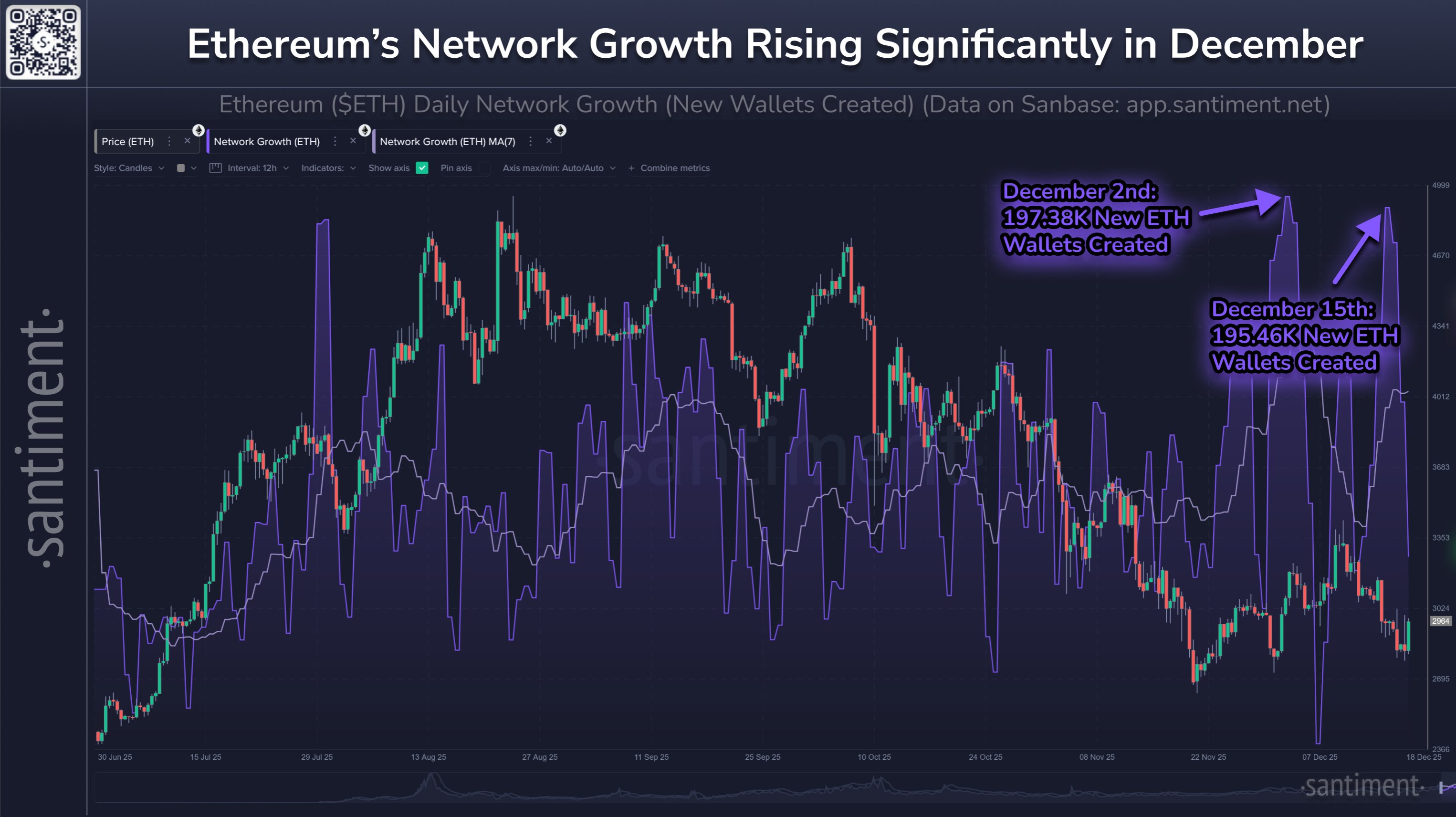
The trend in the ETH Network Growth over the last few months | Source: Santiment on X

As is apparent from the chart, the Ethereum Network Growth has spiked recently. “The #2 market cap is seeing an average of 163K new addresses per day, compared to 124K in July,” noted Santiment.

BTC Price

At the time of writing, Bitcoin is trading around $87,500, down 2% over the last week.

Looks like the price of the coin has consolidated recently | Source: BTCUSDT on TradingView


Related Questions

QWhich cryptocurrency has the highest Total Amount of Holders according to Santiment's data?

AEthereum has the highest Total Amount of Holders with 167.96 million addresses.

QWhat is the Total Amount of Holders for Bitcoin and how does it compare to Ethereum?

ABitcoin has 57.62 million non-empty addresses, which is about one-third of Ethereum's total.

QWhat does an increase in the Total Amount of Holders metric typically indicate?

AAn increase suggests new investors are joining, old investors are returning, or existing holders are creating multiple wallets for accounting or privacy purposes, indicating net adoption.

QHow does Dogecoin rank in terms of Total Amount of Holders among the mentioned cryptocurrencies?

ADogecoin ranks fourth with 8.13 million non-empty addresses, behind Ethereum, Bitcoin, and USDT.

QWhat recent trend has been observed in Ethereum's Network Growth metric?

AEthereum's Network Growth has spiked recently, with an average of 163,000 new addresses per day compared to 124,000 in July.

Related Reads

BIP-110 Controversy Intensifies: Bitcoin May Face Its Most Divisive Hard Fork Battle in Years

Bitcoin is approaching a critical block height of 961,632, which could activate the controversial BIP-110 proposal. This proposal aims to restrict the amount of non-financial data, such as inscriptions and other large data payloads, within Bitcoin transactions. Supporters, including some node operators and Bitcoin purists, argue that BIP-110 is necessary to preserve Bitcoin's core function as a monetary settlement layer by reducing network congestion and node operational burdens caused by non-essential data. They frame it as a correction to keep the network true to its original purpose. However, critics, including prominent figures like Blockstream's Adam Back and developer Jameson Lopp, warn that the proposal's implementation mechanism is dangerously flawed. They highlight that its low 55% miner signaling threshold, coupled with a contentious enforcement mechanism allowing nodes to unilaterally reject non-compliant blocks, significantly increases the risk of a chain split. Opponents argue this sets a dangerous precedent for transaction censorship, undermines Bitcoin's protocol neutrality, and creates excessive uncertainty for developers and businesses, especially since the rule is proposed as a temporary one-year measure. Market analysts, such as those from Bitfinex, suggest a full-scale network split is unlikely due to a lack of broad economic consensus. Major mining pools remain neutral, and adoption of the new rules is minimal. They view the situation more as a governance stress test. The primary risk is operational disruption: if a minority chain persists, major exchanges and custodians may need to temporarily suspend Bitcoin deposits and withdrawals to manage security and liquidity, potentially unsettling newer institutional investors. While BIP-110 is not expected to succeed in overtaking the main chain, its approach has ignited a significant debate about Bitcoin's governance, core values, and resilience.

Foresight News2m ago

BIP-110 Controversy Intensifies: Bitcoin May Face Its Most Divisive Hard Fork Battle in Years

Foresight News2m ago

Crypto Market Makers Are Collectively Seeking Change as Money Becomes Harder to Earn

**Summary: Crypto Market Makers Adapt as Margins Shrink** Leading crypto market maker GSR exemplifies a broader industry shift, moving beyond traditional market-making to become a full-service "Web3 investment bank." Its recent strategic acquisitions—including an SEC-registered broker-dealer, rebranded as GSR Securities—and purchases of token advisory firms aim to create an integrated platform covering token design, fundraising, listing, liquidity provision, and asset management. This includes launching an ETF and investing in tokenization platforms like Libeara, backed by a strategic investment from Standard Chartered's SC Ventures. This transformation is not unique to GSR. Other major players like Keyrock, B2C2, Wintermute, and DWF Labs are also expanding geographically, pursuing regulatory licenses (especially under frameworks like MiCA in the EU), and diversifying into over-the-counter (OTC) trading, asset management, and real-world asset tokenization. The driving force behind this collective pivot is a rapidly changing market. Profits from traditional altcoin market-making are declining due to fewer viable projects, reduced client budgets, increased competition, and smarter, more demanding clients. Simultaneously, regulatory pressures are mounting, making compliance a baseline cost. Extreme market events further expose teams lacking robust risk controls. Consequently, the crypto market-making business model is evolving from one reliant on information asymmetry and volatility to a more institutionalized, regulated, and service-diverse industry. Survival now depends on building systemic capabilities beyond mere liquidity provision.

marsbit1h ago

Crypto Market Makers Are Collectively Seeking Change as Money Becomes Harder to Earn

marsbit1h ago

Market Adjusts Following Google's $84.7 Billion Fundraising, AI Valuations Now Focus on Payback Speed

After Alphabet's announcement of an $84.75 billion equity financing round, market focus for AI investment is shifting from pure growth narratives to capital efficiency and payback periods. The core argument is that AI is being re-priced from a software-like growth story into a heavy-asset infrastructure cycle, requiring massive capital expenditure (CapEx) on chips, data centers, and power grids. While Alphabet's financing itself is not a distress signal—part of it is for administrative purposes like tax obligations on stock compensation—it highlights the enormous capital demands of AI infrastructure. This demand extends beyond tech giants to pure-play AI model companies (like OpenAI, Anthropic), data center REITs, and utilities. Major tech firms are projected to spend heavily on AI data centers in 2026, signaling a broad-based capital cycle the market must absorb. Consequently, valuation logic is changing. Investors are moving away from questions about who has the strongest AI narrative and are now prioritizing clear visibility into orders, stable cash flows, and the cost of capital. This has led to recent pressure on high-multiple AI software and semiconductor stocks, while "picks-and-shovels" hardware, data center, and power assets with firmer near-term demand may see relative support. The key going forward will be monitoring whether rising CapEx guidance across companies is matched by a timely monetization of AI investments into revenue and cash flow. The market's tolerance for high spending depends on demonstrable returns. While the long-term AI thesis remains intact, the valuation framework has fundamentally shifted to emphasize capital discipline and payback speed.

marsbit1h ago

Market Adjusts Following Google's $84.7 Billion Fundraising, AI Valuations Now Focus on Payback Speed

marsbit1h ago

Trading

Spot
Futures

Hot Articles

What is $BITCOIN

DIGITAL GOLD ($BITCOIN): A Comprehensive Analysis Introduction to DIGITAL GOLD ($BITCOIN) DIGITAL GOLD ($BITCOIN) is a blockchain-based project operating on the Solana network, which aims to combine the characteristics of traditional precious metals with the innovation of decentralized technologies. While it shares a name with Bitcoin, often referred to as “digital gold” due to its perception as a store of value, DIGITAL GOLD is a separate token designed to create a unique ecosystem within the Web3 landscape. Its goal is to position itself as a viable alternative digital asset, although specifics regarding its applications and functionalities are still developing. What is DIGITAL GOLD ($BITCOIN)? DIGITAL GOLD ($BITCOIN) is a cryptocurrency token explicitly designed for use on the Solana blockchain. In contrast to Bitcoin, which provides a widely recognized value storage role, this token appears to focus on broader applications and characteristics. Notable aspects include: Blockchain Infrastructure: The token is built on the Solana blockchain, known for its capacity to handle high-speed and low-cost transactions. Supply Dynamics: DIGITAL GOLD has a maximum supply capped at 100 quadrillion tokens (100P $BITCOIN), although details regarding its circulating supply are currently undisclosed. Utility: While precise functionalities are not explicitly outlined, there are indications that the token could be utilized for various applications, potentially involving decentralized applications (dApps) or asset tokenization strategies. Who is the Creator of DIGITAL GOLD ($BITCOIN)? At present, the identity of the creators and development team behind DIGITAL GOLD ($BITCOIN) remains unknown. This situation is typical among many innovative projects within the blockchain space, particularly those aligning with decentralized finance and meme coin phenomena. While such anonymity may foster a community-driven culture, it intensifies concerns about governance and accountability. Who are the Investors of DIGITAL GOLD ($BITCOIN)? The available information indicates that DIGITAL GOLD ($BITCOIN) does not have any known institutional backers or prominent venture capital investments. The project seems to operate on a peer-to-peer model focused on community support and adoption rather than traditional funding routes. Its activity and liquidity are primarily situated on decentralized exchanges (DEXs), such as PumpSwap, rather than established centralized trading platforms, further highlighting its grassroots approach. How DIGITAL GOLD ($BITCOIN) Works The operational mechanics of DIGITAL GOLD ($BITCOIN) can be elaborated on based on its blockchain design and network attributes: Consensus Mechanism: By leveraging Solana’s unique proof-of-history (PoH) combined with a proof-of-stake (PoS) model, the project ensures efficient transaction validation contributing to the network's high performance. Tokenomics: While specific deflationary mechanisms have not been extensively detailed, the vast maximum token supply implies that it may cater to microtransactions or niche use cases that are still to be defined. Interoperability: There exists the potential for integration with Solana’s broader ecosystem, including various decentralized finance (DeFi) platforms. However, the details regarding specific integrations remain unspecified. Timeline of Key Events Here is a timeline that highlights significant milestones concerning DIGITAL GOLD ($BITCOIN): 2023: The initial deployment of the token occurs on the Solana blockchain, marked by its contract address. 2024: DIGITAL GOLD gains visibility as it becomes available for trading on decentralized exchanges like PumpSwap, allowing users to trade it against SOL. 2025: The project witnesses sporadic trading activity and potential interest in community-led engagements, although no noteworthy partnerships or technical advancements have been documented as of yet. Critical Analysis Strengths Scalability: The underlying Solana infrastructure supports high transaction volumes, which could enhance the utility of $BITCOIN in various transaction scenarios. Accessibility: The potential low trading price per token could attract retail investors, facilitating wider participation due to fractional ownership opportunities. Risks Lack of Transparency: The absence of publicly known backers, developers, or an audit process may yield skepticism regarding the project's sustainability and trustworthiness. Market Volatility: The trading activity is heavily reliant on speculative behavior, which can result in significant price volatility and uncertainty for investors. Conclusion DIGITAL GOLD ($BITCOIN) emerges as an intriguing yet ambiguous project within the rapidly evolving Solana ecosystem. While it attempts to leverage the “digital gold” narrative, its departure from Bitcoin's established role as a store of value underscores the need for a clearer differentiation of its intended utility and governance structure. Future acceptance and adoption will likely depend on addressing the current opacity and defining its operational and economic strategies more explicitly. Note: This report encompasses synthesised information available as of October 2023, and developments may have transpired beyond the research period.

363 Total ViewsPublished 2025.05.13Updated 2025.05.13

What is $BITCOIN

Discussions

Welcome to the HTX Community. Here, you can stay informed about the latest platform developments and gain access to professional market insights. Users' opinions on the price of BTC (BTC) are presented below.

活动图片














