Buterin Says Ethereum Must Rethink Its Future: Here’s Why

bitcoinistPublished on 2026-03-07Last updated on 2026-03-07

Abstract

Vitalik Buterin urges the Ethereum ecosystem to embrace bold innovation at the application layer while maintaining uncompromising core guarantees at the base layer. He emphasizes that censorship resistance, open source, privacy, and security (CROPS) are non-negotiable for Ethereum's L1. Buterin calls for a fundamental rethink of applications, wallets, and culture, suggesting AI will play a major role in next-generation wallets—though high-value transactions should still require user confirmation. He also highlights the need for privacy-first design, rethinking L2 scaling solutions, and breaking away from "respectable" cultural norms to unlock greater creativity. Buterin challenges builders to imagine Ethereum's application layer from a blank slate, free from current path dependencies.

Vitalik Buterin is urging the Ethereum ecosystem to get bolder about what it builds on top of the chain—while drawing a hard line around the base layer’s core guarantees—arguing that a first-principles reset on applications, wallets, and even culture could be necessary for Ethereum’s next phase.

In a post on X, the Ethereum co-founder said “it’s healthy for us in the Ethereum world to have a more bold and open mindset,” especially on the application layer and “how we see ourselves in the world.” That openness, he argued, should not drift into ambiguity about what Ethereum’s L1 is supposed to protect.

“We should not compromise on core properties: censorship resistance, open source, privacy, security (CROPS),” Buterin wrote. “We should not have ‘open mindedness’ of the type that leaves people with no confidence of what security properties the L1 will still have one year from now.” He added that Ethereum should not backslide into questioning fundamentals like whether “light clients” should “trustlessly verify correctness of the chain.”

Where the rethink should happen, in his framing, is the interface between Ethereum and users: the application stack, its assumptions, and the social conventions that shape what builders consider “serious” work.

Ethereum AI Wallets, But With Guardrails

Buterin tied part of the shift to AI, floating a scenario where “wallets as browser extensions and mobile extensions are dead within a year?” On Farcaster, he made the point more directly: “Pretty obvious that the next iteration of wallets will heavily involve AI.”

Still, he stressed that higher-value usage can’t simply outsource trust to a model. “I would not trust an LLM with multi-million transactions or funds,” he wrote, describing what he sees as the “optimal workflow” for large transfers: “AI proposes a plan, local light client simulates it, you see the action and the simulated outcome and manually confirm it.”

The pay-off, he suggested, is that moving away from today’s dapp-heavy interaction model could reduce risk. If done “conservatively with lots of emphasis on security,” Buterin argued, removing dapp UIs “from the picture completely” could eliminate “a large number of attack vectors (for both theft and privacy).”

‘Rip Off The Suit And Tie’

Buterin pointed to privacy as a recent example of Ethereum changing its priorities at the application layer. He described last year’s “shift to thinking about privacy as a first-class consideration,” which, he argued, implies “a radically different Ethereum application stack” because “the entire stack so far has not been built around privacy.” This year, he said, that has expanded into “growing work on the networking side of privacy, both inside the EF and outside.”

He also sketched more provocative app-layer thought experiments, including whether “the rest of defi is basically just universal futures markets on top of a good decentralized oracle and letting users self-organize on top of that,” and even whether “the ideal decentralized oracle is just a SNARK over M-of-N small LLMs over zk-TLSes of some major news sites?” In his view, AI pushes “applications” away from discrete products with discrete UIs and toward a continuous space—making “build fewer apps and rely on users to self-organize around them” a pattern that could expand.

On scaling, he said Ethereum is also “rethinking from zero the role of L2s, and what kind of L2s are actually most synergistic and additive to Ethereum,” framing it as another area where past assumptions may no longer hold.

Buterin framed culture as a non-technical constraint that can quietly narrow what gets built. Referencing “the whole milady thing,” he argued the subtext is to “rip off the suit and tie,” describing a deliberately irreverent break from “respectable” postures: “Take the preconception that you are ‘respectable’, write it down on a piece of paper, crumble it up and burn it. The psychological baptism of doing this leads to the intellectual baptism of unlocking greater creativity and expanding overton windows.”

He closed his X post with a challenge to builders: stop iterating one step at a time from today’s usage patterns and instead imagine Ethereum’s application layer as if starting from a blank page. “If YOU had to write the section of the 2014 Ethereum whitepaper that talked about applications... what would you write?” he asked, urging people to “mark all path-dependence concerns down to zero” and see what new designs emerge.

At press time, ETH traded at $2,050.
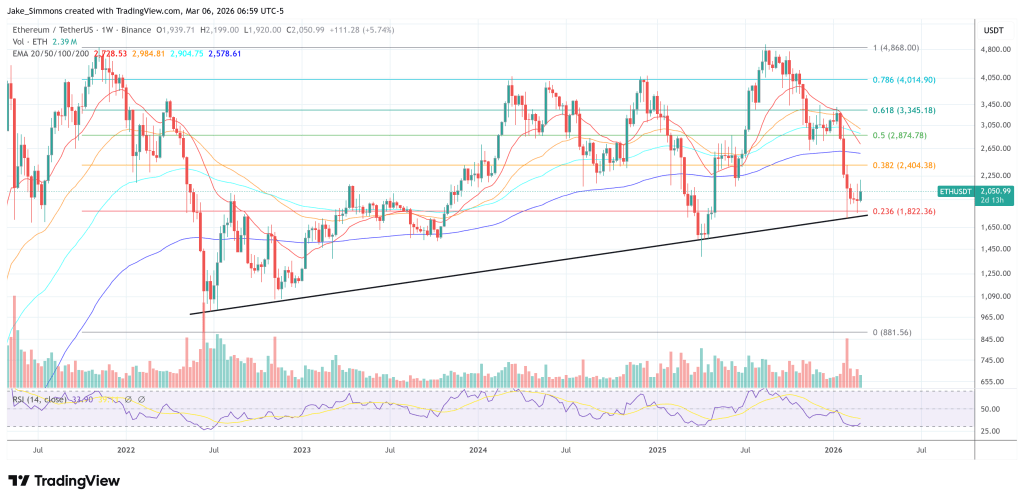
ETH remains above the black trendline, 1-week chart | Source: ETHUSDT on TradingView.com

Trending Cryptos

Related Questions

QWhat core properties does Vitalik Buterin say Ethereum should not compromise on?

AButerin stated that Ethereum should not compromise on censorship resistance, open source, privacy, and security, which he refers to as 'CROPS'.

QHow does Buterin propose integrating AI into Ethereum wallets for large transactions?

AButerin suggests an optimal workflow where AI proposes a transaction plan, a local light client simulates it, and the user manually confirms after reviewing the action and simulated outcome, rather than fully trusting an LLM with high-value transactions.

QWhat cultural shift does Buterin advocate for in the Ethereum ecosystem?

AButerin advocates for a cultural shift away from 'respectable' postures, encouraging builders to 'rip off the suit and tie' by discarding preconceptions of respectability to unlock greater creativity and expand Overton windows.

QAccording to Buterin, what area of Ethereum is being 'rethought from zero' regarding its role and synergy?

AButerin mentioned that Ethereum is rethinking the role of Layer 2s (L2s) from zero, including what kinds of L2s are most synergistic and additive to the ecosystem.

QWhat challenge does Buterin pose to builders at the end of his post?

AButerin challenges builders to imagine Ethereum's application layer from a blank slate, asking what they would write in the applications section of the 2014 whitepaper if they ignored path-dependence and current usage patterns.

Related Reads

The Verdict in Choi Tae-won's Divorce Case: Revealing the Inheritance Undercurrent Behind SK Hynix's Trillion-Won Empire

SK Group Chairman Chey Tae-won's high-profile divorce case, involving a record 1.38 trillion won settlement, has drawn attention to the succession plans for Korea's second-largest conglomerate, especially its crown jewel, SK hynix. Unlike traditional chaebol scripts centered on the eldest son, Chey's three children from his marriage to former President Roh Tae-woo's daughter, Roh Soh-yeong, are carving distinct, non-traditional paths. Eldest daughter Chey Yun-jung (b. 1989) is seen as the most evident successor. With a scientific and consulting background, she holds executive roles at SK bioscience and SK Inc.'s growth support department, focusing on future strategy and biopharma. Her marriage is to an AI infrastructure entrepreneur, not a traditional business alliance. Second daughter Chey Min-jung (b. 1991) took a unique route, voluntarily serving as a South Korean naval officer, including an anti-piracy deployment. She later worked on policy and strategy for SK hynix in Washington D.C. before co-founding an AI-driven healthcare startup. She married a former U.S. Marine Corps officer, connecting her to U.S. defense and policy circles—networks crucial for a global semiconductor giant. The only son, Chey In-geun (b. 1995), who studied physics like his father, worked briefly at SK E&S before joining McKinsey. Despite fitting the traditional "heir" profile as the eldest son, he remains silent and holds no public position or shares in SK, suggesting the old succession playbook is obsolete. As SK hynix's valuation soars, becoming a geopolitical asset in the AI era, the heirs' legitimacy is no longer automatic. They must prove themselves in fields like AI biotech, global policy, and strategic consulting. Their marriages also reflect new elite networks in tech and defense, not old political alliances. Their inheritance is the complex challenge of navigating a globalized, tech-driven world, not just a corporate throne.

marsbitYesterday 09:06

The Verdict in Choi Tae-won's Divorce Case: Revealing the Inheritance Undercurrent Behind SK Hynix's Trillion-Won Empire

marsbitYesterday 09:06

From OpenSea to OpenRouter: Is Alex Atallah Repeating His 'Exit at the Peak' Playbook?

From OpenSea to OpenRouter: Is Alex Atallah Repeating His "Exit at the Peak" Playbook? According to the Wall Street Journal, payments giant Stripe is in talks to acquire the AI model aggregation platform OpenRouter in a potential deal valuing the company near $100 billion. This would mark founder Alex Atallah's second creation of a company reaching a $100 billion valuation, following his co-founding of NFT marketplace OpenSea. OpenRouter, founded just over three years ago, has grown rapidly by acting as a unified gateway for developers to access over 400 AI models. It currently has about 10 million users and processes over 200 trillion tokens monthly. While the platform's annualized revenue is around $50 million, its valuation has skyrocketed from $1.3 billion in March 2026. The potential acquisition by Stripe, a company OpenRouter's founder once likened it to, represents a major expansion into AI infrastructure for the payments leader. This move echoes Atallah's previous timing with OpenSea, where he departed before the NFT market's significant downturn. For OpenRouter, selling now may be strategic. Despite its scale, its business model—charging a 5-5.5% fee on AI inference calls—faces pressure from competition, open-source models, and potential price wars among model providers, limiting its profitability narrative for an IPO. A key asset for potential acquirers like Stripe is OpenRouter's vast repository of real-world AI usage data, which offers unique insights into model performance and developer preferences that are difficult to replicate. Whether this potential deal signifies a new valuation benchmark for AI infrastructure or another market peak signal remains to be seen.

链捕手Yesterday 08:42

From OpenSea to OpenRouter: Is Alex Atallah Repeating His 'Exit at the Peak' Playbook?

链捕手Yesterday 08:42

Trading

Spot

Hot Articles

Discussions

Welcome to the HTX Community. Here, you can stay informed about the latest platform developments and gain access to professional market insights. Users' opinions on the price of ETH (ETH) are presented below.

活动图片
















