Buterin Puts Ethereum On Notice: Pass The ‘Walkaway Test’

bitcoinistPublished on 2026-01-13Last updated on 2026-01-13

Abstract

Vitalik Buterin argues that Ethereum's long-term credibility depends on passing the "walkaway test," meaning the blockchain must remain usable and secure even if its core developers abandon it. He emphasizes that Ethereum should not rely on continuous human-managed upgrades to stay competitive. Instead, the protocol must reach a state where it can "ossify" without losing value, ensuring it remains a trustless base for applications. Key prerequisites include achieving quantum resistance, scalability through ZK-EVM and PeerDAS, managing state growth via statelessness and expiry, and hardening proof-of-stake economics. Buterin stresses addressing these issues now to avoid perpetual redesign and ensure decentralization and censorship resistance endure.

Vitalik Buterin is arguing that Ethereum’s long-term credibility hinges on a standard usually applied to applications, not base layers: the chain should remain meaningfully usable even if its stewards “walk away.” In a Jan. 12 post on X, the Ethereum co-founder framed the “walkaway test” as a requirement for a settlement layer meant to host “trustless and trust-minimized applications” across finance, governance, and beyond.

Buterin’s premise is that Ethereum’s core promise breaks down if the protocol itself depends on continuous, human-managed upgrades to stay safe and competitive. “But building such applications is not possible on a base layer which itself depends on ongoing updates from a vendor in order to continue being usable — even if that ‘vendor’ is the all core devs process,” he wrote. “Ethereum the blockchain must have the traits that we strive for in Ethereum’s applications. Hence, Ethereum itself must pass the walkaway test.”

Ethereum Can’t Rely on Endless Upgrades

The post lands amid a broader, recurring tension in Ethereum’s culture: the desire to keep evolving versus the benefits of stability. Buterin’s formulation doesn’t call for freezing the protocol immediately. Instead, he argues Ethereum should reach a position where it could “ossify” without sacrificing its value proposition.

“This means that Ethereum must get to a place where we can ossify if we want to,” Buterin said. “We do not have to stop making changes to the protocol, but we must get to a place where Ethereum’s value proposition does not strictly depend on any features that are not in the protocol already.” In other words, Ethereum can continue to improve—but it should not need to, in order to remain a credible base for durable, user-owned systems.

From there, Buterin lays out the technical and economic conditions he views as prerequisites for passing the test. The most time-sensitive in his framing is cryptography. “Full quantum-resistance” should not be treated as an upgrade to postpone until the last possible moment, he argues, warning against “the trap” of delaying in exchange for short-term efficiency.

The protocol, in his view, should be able to make a straightforward claim about long-lived safety: being able to say Ethereum “as it stands today, is cryptographically safe for a hundred years.”

Scalability is presented as an architectural destination rather than a perpetual series of feature-driven forks. Buterin points to “ZK-EVM validation and data sampling through PeerDAS” as key components, and suggests an ideal end-state where improvements increasingly come via “parameter only” changes—potentially implemented through validator voting mechanisms akin to how the gas limit can be adjusted.

He also emphasizes state growth as a durability risk that must be addressed at the protocol level. The goal, as he describes it, is a “state architecture that can last decades,” including “partial statelessness and state expiry” so that sustaining thousands of transactions per second over long periods doesn’t make syncing or hardware requirements untenable. Alongside that, he flags future-proofing storage structures to match that environment.

Other items in the framework target known fault lines for decentralized execution: moving toward a more general-purpose account model via “full account abstraction,” ensuring the gas schedule is resilient against denial-of-service risks in both execution and ZK-proving, and hardening proof-of-stake economics so the system “can last and remain decentralized for decades,” including ETH’s role as “trustless collateral.”

Finally, Buterin highlights block building as a centralization pressure point, arguing Ethereum needs a model that can “resist centralization pressure and guarantee censorship resistance even in unknown future environments.”
Buterin’s closing message is less about a single roadmap item than a governance and engineering posture: do the heavy lifting now so later progress can be dominated by client optimization and parameter tuning, not perpetual redesign.

At press time, ETH traded at $3,132.
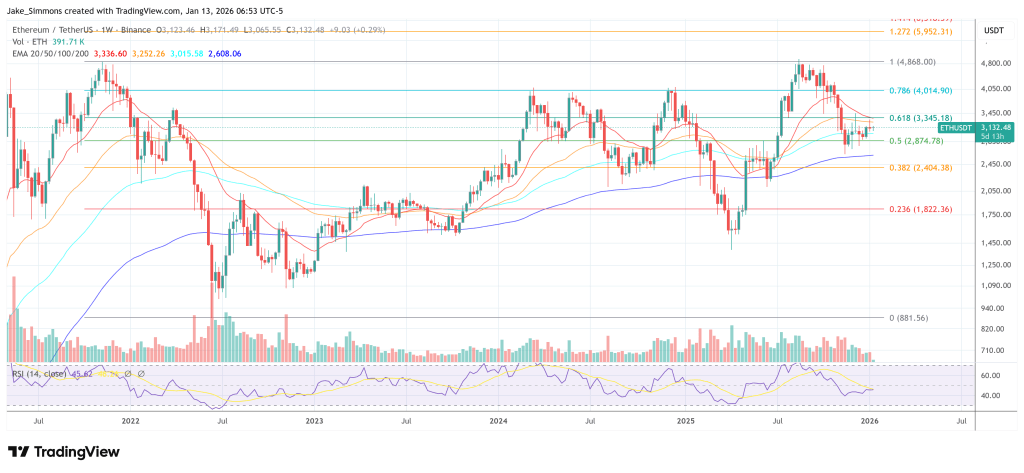
ETH faces the 0.618 Fib, 1-week chart | Source: ETHUSDT on TradingView.com

Trending Cryptos

Related Questions

QWhat is the 'walkaway test' that Vitalik Buterin is proposing for Ethereum?

AThe 'walkaway test' is a standard Buterin argues Ethereum must pass, meaning the blockchain should remain meaningfully usable and maintain its value proposition even if its core developers and stewards were to completely 'walk away' and stop providing ongoing updates.

QAccording to Buterin, why is achieving 'full quantum-resistance' a time-sensitive priority for Ethereum?

AButerin warns against delaying quantum-resistance for short-term efficiency gains, arguing it should not be postponed until the last moment. He believes the protocol must be able to claim it is 'cryptographically safe for a hundred years' in its current state.

QWhat technical solution does Buterin point to as key for achieving scalability without perpetual hard forks?

AButerin points to 'ZK-EVM validation and data sampling through PeerDAS' as key components. He suggests an ideal end-state where future improvements come via 'parameter only' changes, potentially implemented through validator voting mechanisms.

QWhat governance and engineering posture does Buterin advocate for in his closing message?

AButerin's closing message advocates for doing the heavy lifting now so that future progress can be dominated by client optimization and parameter tuning, rather than requiring perpetual, fundamental redesigns of the protocol.

QBesides cryptography and scalability, what other durability risk does Buterin identify that must be addressed at the protocol level?

AButerin identifies state growth as a major durability risk. The goal is a 'state architecture that can last decades,' which includes implementing solutions like 'partial statelessness and state expiry' to prevent syncing and hardware requirements from becoming untenable.

Related Reads

Bitcoin Withdrawals Continue: 8 Years of Storage in a Coldcard Cold Wallet Ended in Zero

Coldcard Hardware Wallet Hacked: Losses Mount Due to Vulnerable Seed Generation A critical vulnerability in Coldcard hardware wallets has led to a continued wave of fund thefts. According to Galaxy Research, the total stolen has reached 1,367.05 BTC (approx. $88.6 million) from 4,585 addresses, a significant increase from the initial 594.5 BTC reported on July 30, 2026. Most of the stolen funds remain on the attackers' addresses. The issue is not with the current firmware, which Coinkite has updated, but with seed phrases generated on vulnerable devices between March 2021 and the release of fixed firmware versions. Due to a programmer error, devices switched from using a hardware random number generator to the software-based Yasmarang generator, which was initialized with publicly accessible data like the chip's serial number. This made the seed phrases predictable through offline brute-force attacks, meaning wallets remain at risk until funds are moved to a new wallet generated with the patched firmware. Affected devices include Mk2/Mk3 with firmware 4.0.1–4.1.9 (and up to 5.0.3), Mk4/Mk5 up to version 5.6.0, and Q models up to 1.5.0Q. The only exceptions are seeds created with a high-entropy method like at least 50 independent dice rolls or a strong unique BIP-39 passphrase. All other owners must generate a new seed on the fixed firmware and transfer their assets. A case highlighting the human impact involves a 39-year-old long-term investor who lost 2 BTC (approx. $130,000) in minutes. He had accumulated the Bitcoin over eight years through physical labor, viewing it as a financial lifeline and a retirement plan in a country suffering from hyperinflation. His story underscores that even conservative "buy and hold in cold storage" strategies can be compromised by such underlying technical flaws. From a technical perspective, this incident echoes historical failures where weak random number generators undermined cryptographic security, challenging the assumption that offline storage is automatically foolproof.

cryptonews.ru4h ago

Bitcoin Withdrawals Continue: 8 Years of Storage in a Coldcard Cold Wallet Ended in Zero

cryptonews.ru4h ago

Trading

Spot

Hot Articles

Discussions

Welcome to the HTX Community. Here, you can stay informed about the latest platform developments and gain access to professional market insights. Users' opinions on the price of ETH (ETH) are presented below.

活动图片















