Author: Darko, IOSG
ETF inflows are often seen as a "thermometer" of institutional faith in Bitcoin. But week by week, they measure something else more closely: a hidden rate trade being turned on and off. This article explains how to spot it, how big it truly is, and why it's quietly leaving.
TL;DR
-
Week by week, ETF flows are driven by a hidden arbitrage trade, not by conviction. Cash-and-carry traders buy the ETF while simultaneously shorting futures on the CME, hedging away price risk, but are indistinguishable in the data from true bulls. About half the weekly flow volatility can be explained by hedge funds' new futures shorts alone, with a correlation as high as 0.70.
-
The weekly change in Bitcoin's price explains almost nothing about the flows. Using price returns to predict ETF flows yields results statistically indistinguishable from zero. The weekly flows aren't chasing performance; they move in sync with a hedged rate trade.
-
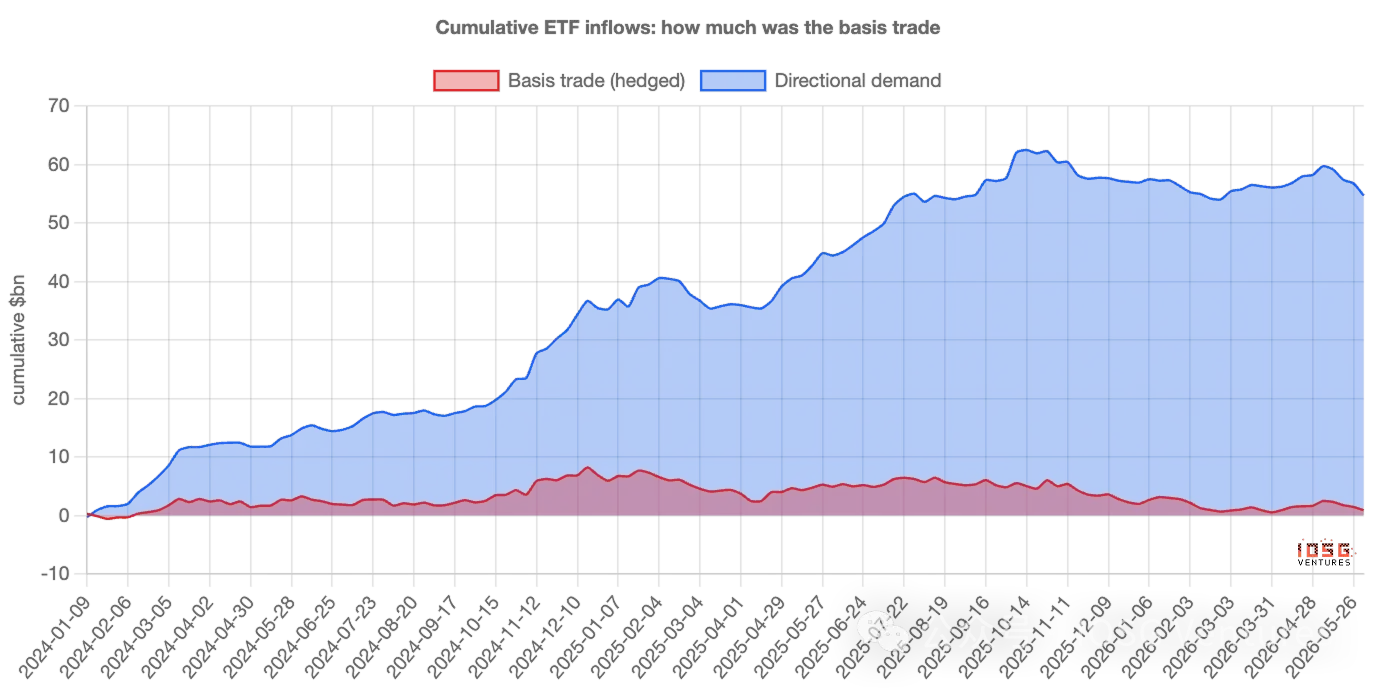
Arbitrage dominates the weekly "volatility," but has never been the majority of the "stock." Of the roughly $55 billion cumulatively flowed into ETFs, the arbitrage trade's current net is only about $1 billion; the rest is stable, directional buying, around $400 million weekly, compounding over two years to form almost the entire "mountain."
-
The correct statement is: ETF flows overstate the "volatility" of faith, not its "level." The weekly ups and downs are mostly "borrowed" – arbitrage capital coming and going; the assets that truly settle are mostly "owned."
-
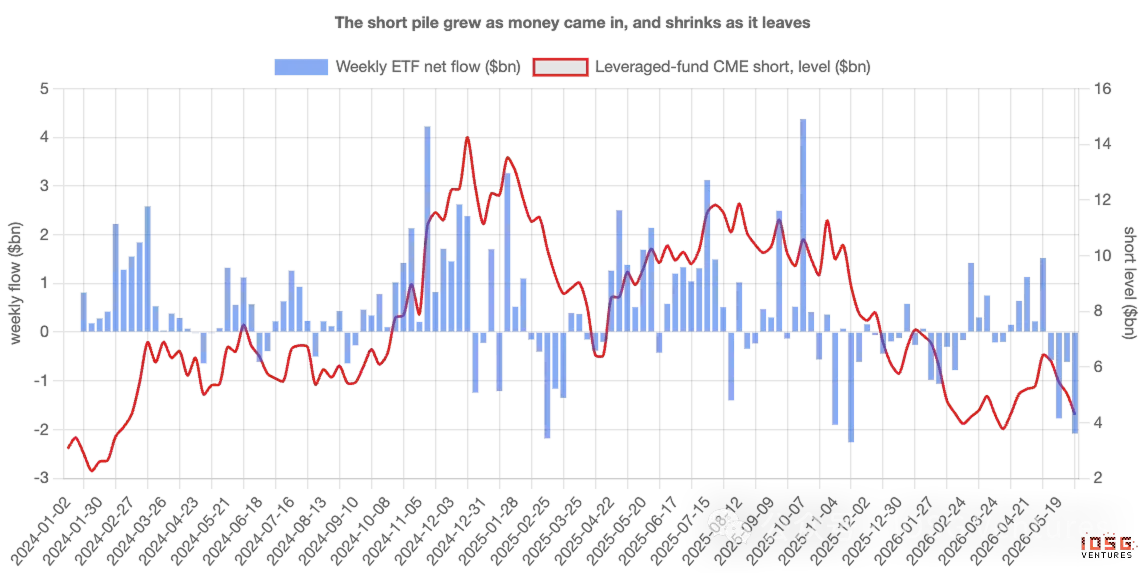
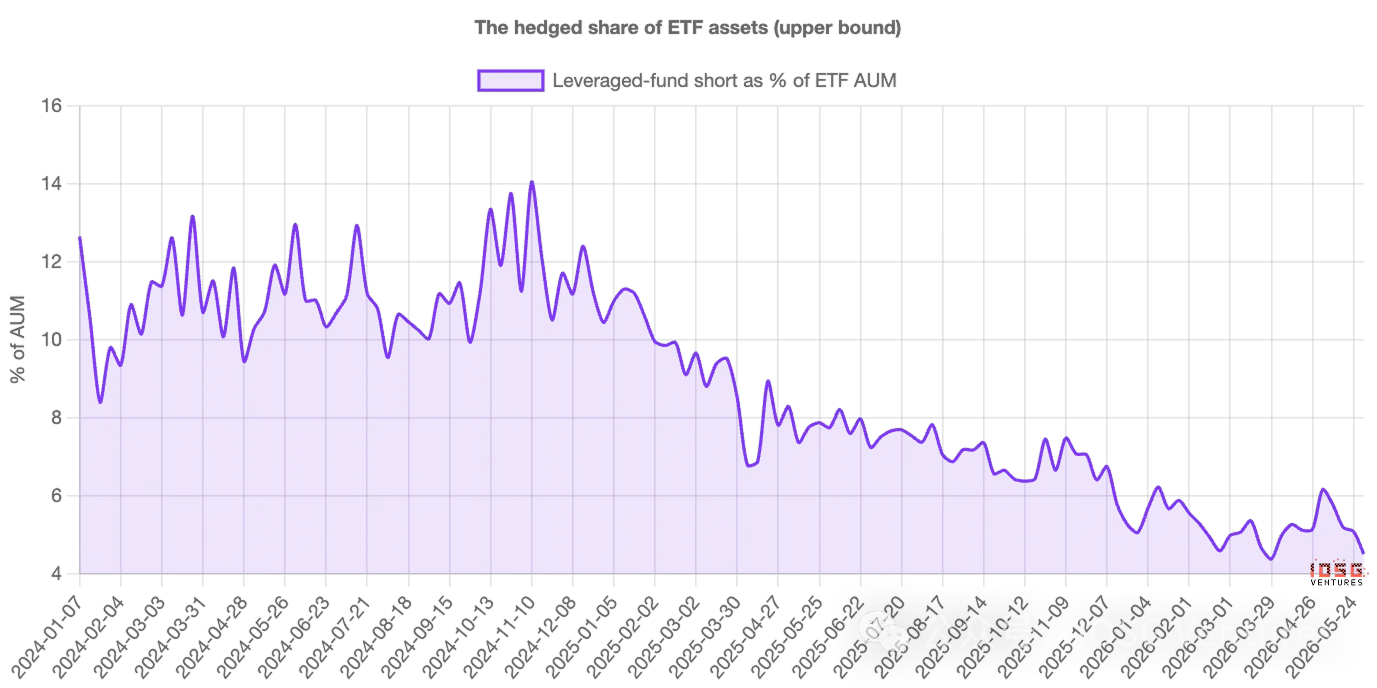
This trade is leaving, and has been for two years. Leveraged funds' short positions grew from about $3 billion at launch to roughly $14 billion by late 2024, then steadily retreated to about $4.5 billion. Once the basis compresses to unprofitability, inflows and shorts will recede in unison – don't mistake the resulting outflows for a verdict on Bitcoin.
1. The Number Everyone Watches
Every week, Bitcoin ETFs report how much money flowed in or out, and this number is often treated as a verdict. Big inflows mean institutions are piling in; outflows signal shaken confidence. Flow data has quietly become the headline metric for market faith.
The problem is, not everyone buying an ETF is betting on Bitcoin. Some of the biggest buyers don't care which way the price goes – and once you account for them, the weekly flow number measures their activity more than anyone's belief. To understand why, you first need to meet a different kind of buyer.
A Buyer Who Doesn't Care About Price
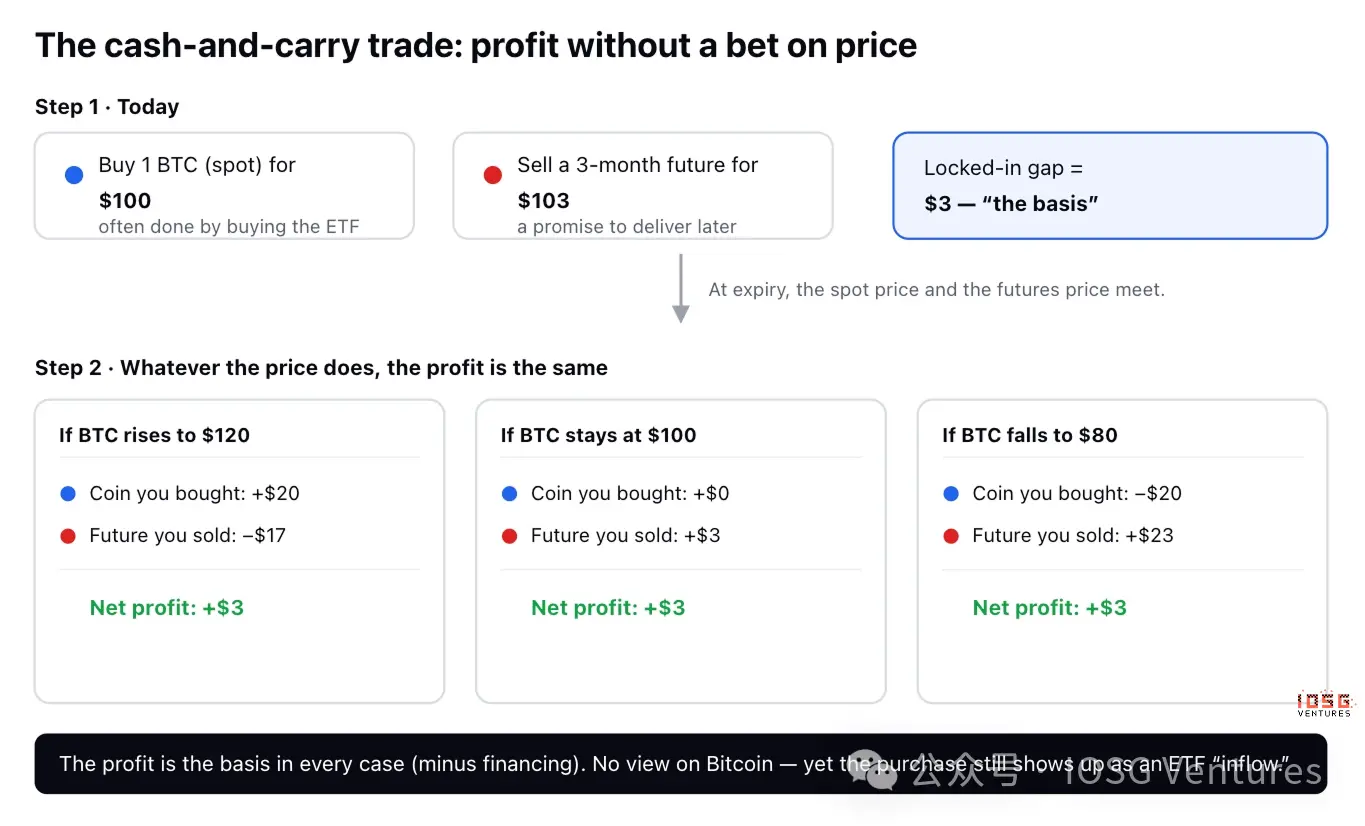
There's a classic, boring trade called cash-and-carry arbitrage. A Bitcoin "future" is just a contract to buy or sell Bitcoin at a set price on a future date, and most of the time, the futures price trades slightly above the current spot price – say Bitcoin is $100 now, but a contract expiring in three months sells for $103.
A trader can pocket that $3 difference without any view on price:
-
Buy 1 Bitcoin today for $100 (often by buying the ETF).
-
Sell the future at $103, promising to deliver in three months.
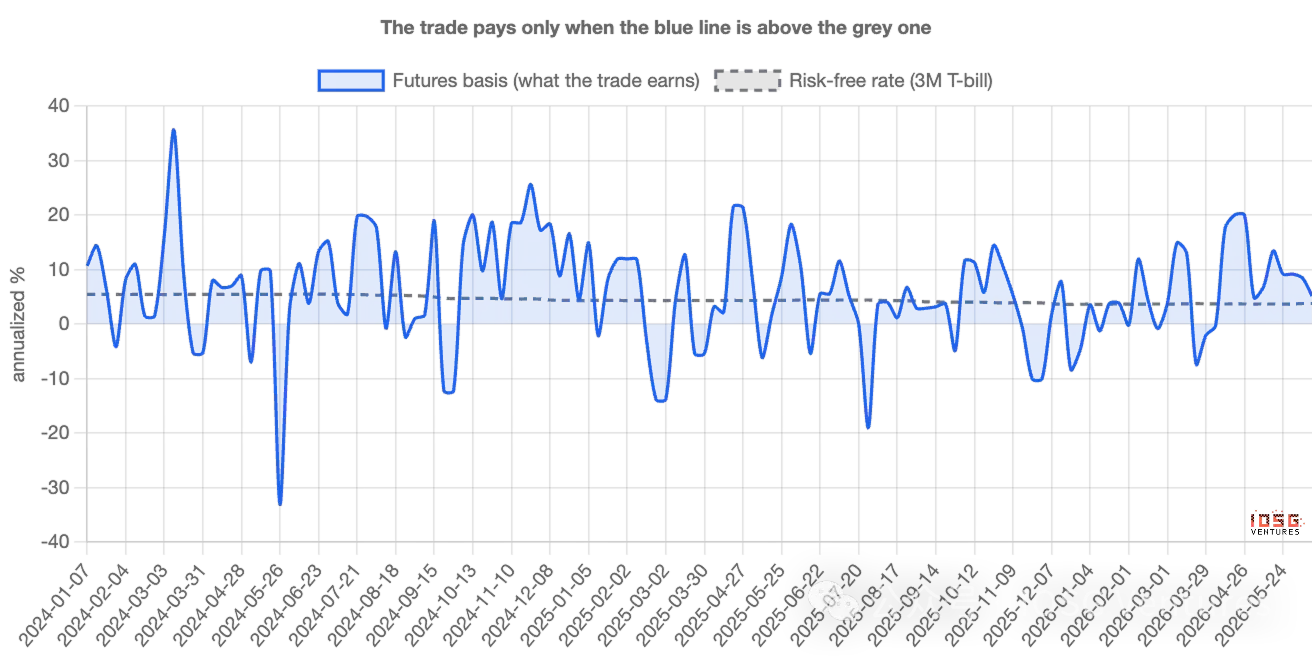
See what happens at expiry. If Bitcoin surges to $120, the trader makes $20 on the coin but loses $17 on the contract – a net gain of $3. If it crashes to $80, they lose $20 on the coin but make $23 on the contract – still a net gain of $3. If it stays flat, it's $3. The profit is the same in every scenario. The direction is hedged away; traders call this "delta neutral." That $3 spread, expressed annualized, is the basis – essentially an interest rate the trader earns for parking capital in this trade; as long as it's above the risk-free return from putting money in a U.S. Treasury bill (T-bill), the trade is worth doing.
Why This Pollutes the Headline Number
The key is here. The first leg – buying 1 Bitcoin – is very commonly done by buying the ETF. Thus, a trader with no view on Bitcoin, doing a delta-neutral trade, appears in the data as an ETF inflow, indistinguishable on the surface from a true believer.
When lots of cash-and-carry is put on, inflows look strong, and the story of "institutions adding" writes itself – even though this capital is hedged and will reverse the moment the trade ceases to be profitable. In other words, the flow number measures not just faith, it measures arbitrage desk activity. The question is how to separate the two – and how big each one really is.
How to Tell Them Apart
Cash-and-carry traders leave a second footprint. For every $1 of Bitcoin they buy, they go short $1 of futures on the CME (the regulated U.S. exchange where institutions trade Bitcoin futures). The true believer leaves only the first footprint; the arbitrageur leaves both.
And that second footprint is public. The U.S. derivatives regulator publishes a weekly report detailing how much long and short exposure different trader types hold on the CME. One category – leveraged funds, essentially hedge funds – is where the cash-and-carry crowd congregates. So you can line up, week by week, the money flowing into ETFs with the new short positions these funds put on. If the "demand" were really conviction, the two shouldn't move together much; if a large chunk of it is that hidden trade, they should march in step.
2. What the Data Says: Week by Week, Flows Follow Futures, Not Price
They march tightly together. For every week since the ETF launch, the week with more new futures shorting also saw more ETF inflows – almost one-for-one. About half of all weekly flow volatility can be explained by this one thing alone: how much shorting funds did. The correlation is 0.70, the kind of strength you'd see between two things obviously related, not coincidental.
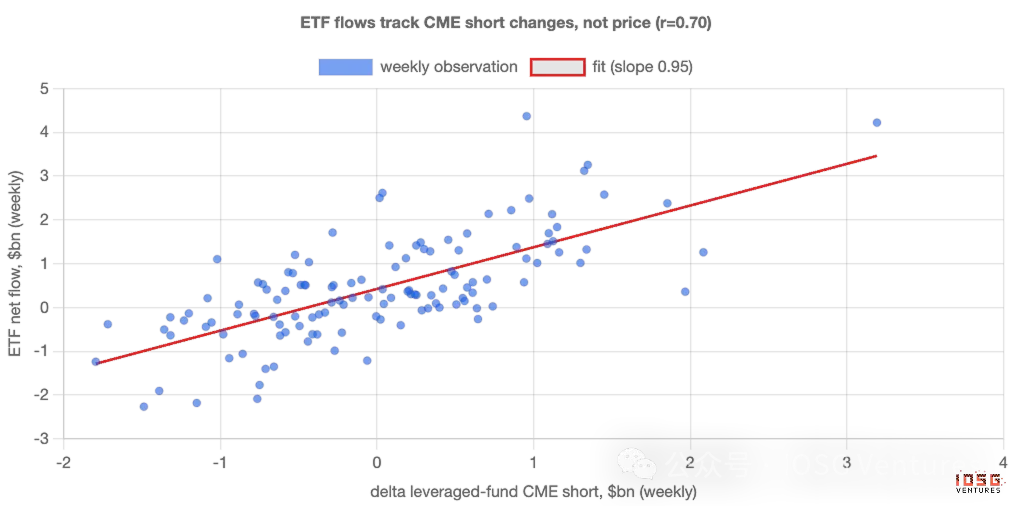
What should sober believers most: price itself explains almost nothing. Testing whether the week's Bitcoin return predicts ETF flows yields results statistically indistinguishable from zero. The weekly money isn't chasing performance; it marches in lockstep with a hedged rate trade.
So, as a weekly signal, ETF "demand" is mostly arbitrage. The flow number is a poor thermometer of faith because its swings are the result of the basis trade being turned on and off, not anyone changing their mind about Bitcoin.
But How Much of the Money Is This Trade?
This is where the simplistic take – "it's all fake" – breaks down, and the real story gets more interesting. The basis trade dominates the weekly volatility, but has never been the majority of the stock of money.
Break each week's inflow into the part explained by futures shorting (hedged) and the rest (directional), and accumulate from launch. Of the roughly $55 billion that has cumulatively flowed into ETFs, the basis trade's current net is only about $1 billion – the rest is stable, directional buying. That buying, around $400 million weekly, week in and week out, regardless of basis or price, compounding over two years, is almost the entire mountain.
Looking at asset share rather than flows, the picture is the same: the hedged portion approached 14% of ETF assets in 2024, now it's about 4%–5%. At its peak, a meaningful minority; today, a sliver.
So, the more precise statement is: ETF flows overstate the volatility of faith, not its level. The weekly ups and downs are mostly "borrowed" – arbitrage capital coming and going; but the assets that truly settle are mostly "owned." This trade churns in the flow data but has never been the majority of the balance.
And This Trade Is Leaving
The hedged portion isn't just small – it's been shrinking for two years. Leveraged funds' short positions grew from about $3 billion at launch, piled up to roughly $14 billion by late 2024, then steadily retreated to about $4.5 billion. This arbitrage trade has been unwinding across the entire period, not just recently.
This matters for interpreting the present. Entering June, the hedged position roughly halved again – funds' shorts fell from ~$6.4 billion to $4.3 billion – while ETFs saw $300–500 million of daily outflows. On the surface, that looks like panic capitulation. But paired with the futures data, it's just the routine cleanup of an interest-rate trade no longer worth doing. The same outflow number, two starkly different stories.
When the Basis Compresses, Demand Recedes
The cleanest proof is what happens when the trade ceases to be profitable. When that $3 spread narrows close to what a trader can earn risk-free, the trade isn't worth doing. If a big chunk of the weekly demand really is this trade, then weekly demand should weaken precisely when the spread compresses – and it does. Detrend each series and look at moments around a compression: ETF inflows dip below their normal rhythm, while funds cover shorts, both in sync. Demand breathes with the trade.
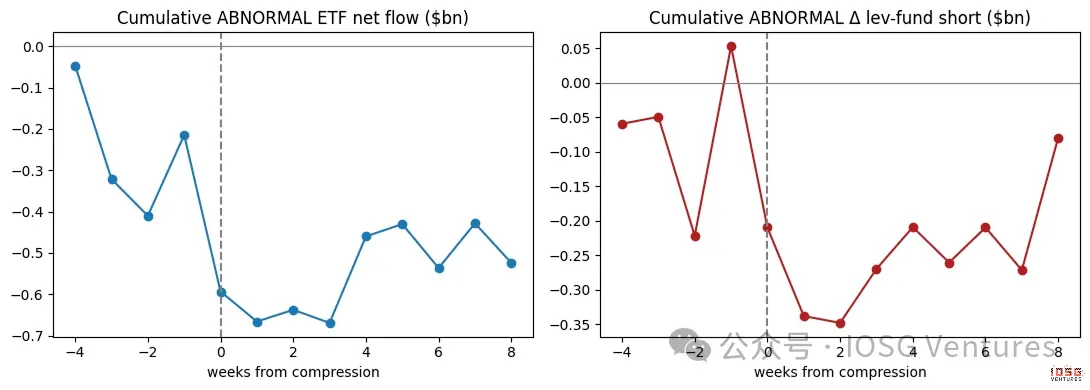
True believers don't care about futures basis. This weekly "demand" clearly does.
3. Which Comes First, and Who's Really Operating It
First, the relationship is contemporaneous – tightest within the same week, with no clear lead or lag; and the little directional evidence there is actually points the opposite way: ETF flows lead the shorts, not the other way around. This fits the logic of a paired trade: buy the ETF first, the futures hedge follows, rather than shorting magically "creating" inflows. Second, the arbitrage crowd isn't the only mover. Flows track leveraged funds' shorts most closely, but also resonate with directional institutions' positioning – both types of buyers are active. The claim here isn't that every inflow is hedged; it's that the hedge trade is the tightest, most reliable driver of weekly volatility.
Ethereum: The Same Trade, But the Math Barely Works
Applying the same test to Ethereum ETFs, the signature is there but weaker – a looser link to futures shorting, and that underlying stable directional buying is nearly absent. The reason is clear. Holding spot Ethereum instead of a futures contract means forgoing the staking yield Ethereum offers, around 3%–4% annually. After subtracting that, Ethereum's basis is often negative – the arbitrage trade often can't clear its hurdle rate. So Ethereum ETFs lack both a strong conviction bid and a robust arbitrage position propping them up; they're just smaller, noisier versions of their Bitcoin counterparts.
4. How to Read ETF Flows From Now On
The takeaway isn't a call on price, but a way to read flows. When the basis is rich, expect "institutional demand" to look strong, and largely hedged – don't mistake that strength for faith. When the basis compresses, expect inflows and shorts to recede together – don't mistake the resulting outflows for a market verdict on Bitcoin. Two numbers worth watching: the level of the annualized basis yield relative to T-bill rates, and the net short of leveraged funds in the weekly CME report. They'll tell you how much of the next "demand" headline is real.
How We Measured It
A few honest limitations. The basis is built from the front-month CME futures contract versus spot, excluding the last few days before each expiry (its extremely short tenor turns rounding errors into false spikes); building series contract-by-contract makes the exact numbers sharper but doesn't change the conclusion. The relationship between flows and shorts is one of strong co-movement, not proof one causes the other – the point is, they're two halves of the same trade. The futures short number is an upper bound on how much ETF buying is hedged, as some shorting hedges coins held elsewhere.
None of this changes the core. Week by week, Bitcoin ETF "demand" is mostly a hidden rate trade, not faith – the flows measure participation in arbitrage far more accurately than they measure belief. And that real buying is genuine, patient, and now the vast majority of what's left, because the "borrowed" part has been going home for two years.