BNY Partners with Key Companies to Expand Crypto Custody in the UAE

bitcoinistPublished on 2026-05-08Last updated on 2026-05-08

Abstract

BNY, the world's largest custodian bank, has announced a strategic collaboration with Finstreet Limited and ADI Foundation to establish regulated, institutional-grade digital asset custody infrastructure in the Abu Dhabi Global Market (ADGM). This marks the first time a U.S. global systemically important bank has introduced crypto custody services to the UAE. The initiative will begin with Bitcoin and Ethereum custody, with plans to expand into stablecoins, tokenized assets, and other regulated digital instruments, subject to final agreements and regulatory approvals. BNY provides its global custody expertise, Finstreet contributes its licensed digital market ecosystem within ADGM, and ADI Foundation supplies sovereign-grade blockchain infrastructure via its ADI Chain. Choosing ADGM as the anchor jurisdiction underscores its institutional-grade regulatory framework under English common law. The move aligns with the UAE's broader efforts to build sovereign digital currency infrastructure, including a regulated dirham-backed stablecoin. BNY's entry signals that regulated digital asset infrastructure in the Gulf is now a present reality, positioning Abu Dhabi as a key hub for institutional crypto adoption and future financial innovation.

BNY, the world’s largest custodian bank overseeing $59.4 trillion in assets, has announced a strategic collaboration with Finstreet Limited and ADI Foundation to build regulated, institutional-grade digital asset custody infrastructure anchored in the Abu Dhabi Global Market (ADGM) — marking the first time a US global systemically important bank has brought crypto custody to the UAE.

The announcement, made on May 7 via BNY’s official newsroom, positions Abu Dhabi as the geographic anchor for an initiative that begins with Bitcoin and Ethereum custody before expanding into stablecoins, tokenized real-world assets, and other regulated digital instruments. All efforts remain subject to definitive agreements and relevant regulatory approvals, per the official release.
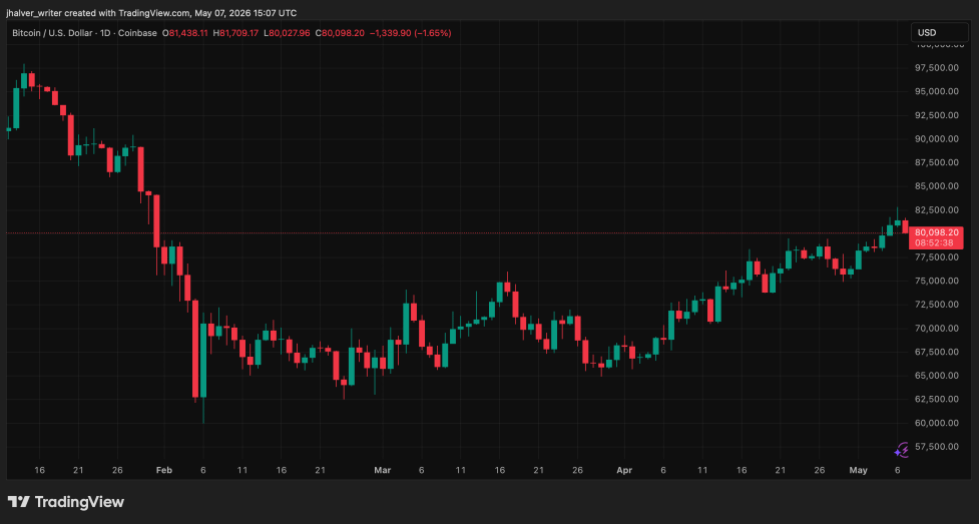
Bitcoin's price trends to the upside on the daily chart. Source: BTCUSD on Tradingview

Three Institutions, Three Distinct Roles

The architecture of the collaboration reflects three distinct layers of infrastructure, each contributed by a different partner. BNY brings its globally recognized custody backbone — the institution has offered digital asset custody to a select group of US clients since 2022, and obtained a Category 4 license in ADGM ahead of this expansion.

Finstreet Limited, a subsidiary of International Holding Company (IHC) through Sirius International Holding and based within ADGM, contributes its digital market ecosystem. Its licensed subsidiaries cover multilateral trading, custody and depository services, and investment advisory — giving the partnership a direct plug into Abu Dhabi’s institutional capital markets infrastructure.

ADI Foundation provides what it describes as sovereign-grade blockchain infrastructure through ADI Chain, a Layer 2 blockchain also founded under the IHC umbrella. Ajay Bhatia, Principal Council Member at ADI Foundation, noted in the release that ADI Chain is designed to unlock new opportunities in custody, trade finance, and lending from Abu Dhabi to the world.

Abu Dhabi’s Crypto Institutional Bet

The choice of ADGM as the anchor jurisdiction is deliberate. While Dubai’s VARA framework has attracted retail exchanges and Web3 startups, ADGM has built its reputation on institutional-grade licensing under English common law — a framework that has drawn Galaxy Digital, Circle, and Tether’s USDt to the market in recent months, per CryptoTimes.

IHC separately announced the launch of DDSC, a dirham-backed stablecoin fully regulated by the Central Bank of the UAE, which is currently in early-stage government and institutional adoption, according to the FX News Group. That context matters: BNY is entering a market that is actively building its own sovereign-grade digital currency infrastructure, not merely accommodating crypto adoption from the outside.

Hani Kablawi, Executive Vice Chair at BNY, characterized the move in the official release as a commitment to building financial infrastructure for the future — noting that the UAE is entering a new phase marked by deeper markets, greater digital sophistication, and stronger global connectivity.

This development marks a critical juncture for the nascent sector’s institutional custody landscape. As the world’s largest custodian plants its flag in Abu Dhabi, the signal to other global financial institutions considering Middle East expansion is clear: regulated digital asset infrastructure in the Gulf is no longer a future consideration — it is being built now.

Cover image from Grok, BTCUSD chart from Tradingview

Related Questions

QWhat is the significance of BNY's collaboration in Abu Dhabi for the crypto custody sector?

AIt marks the first time a US global systemically important bank has brought crypto custody to the UAE, signaling a major institutional commitment and building regulated digital asset infrastructure in the region now, not in the future.

QWhich three companies are partnering with BNY, and what unique role does each play?

ABNY provides its global custody backbone and ADGM license; Finstreet Limited contributes its licensed digital market ecosystem (trading, custody, advisory) within ADGM; and ADI Foundation supplies sovereign-grade blockchain infrastructure through its ADI Chain.

QWhy was Abu Dhabi Global Market (ADGM) chosen as the anchor jurisdiction for this initiative?

AADGM has built a reputation for institutional-grade licensing under English common law, attracting firms like Galaxy Digital and Circle, unlike Dubai's VARA which focuses more on retail and Web3 startups.

QWhat digital assets will the custody service initially support, and what is the planned expansion?

AThe service will begin with Bitcoin and Ethereum custody, with plans to expand into stablecoins, tokenized real-world assets, and other regulated digital instruments.

QHow does the recent launch of a dirham-backed stablecoin (DDSC) relate to BNY's market entry?

AIt shows BNY is entering a market that is actively building its own sovereign-grade digital currency infrastructure, not just accommodating external crypto adoption, indicating deeper local market development.

Related Reads

From Banning Doubao to Embracing Honor: Why Did WeChat Suddenly 'Change Its Face'?

The article explores the sudden shift in WeChat's strategy towards AI assistants from mobile phone manufacturers, transitioning from strict opposition to active collaboration. For over a year, WeChat fiercely resisted attempts by phone AI assistants (like ByteDance's Doubao in late 2025) to control its features via GUI automation ("simulated clicking"), citing security and data control concerns. This stance created a significant barrier for system-level AI integration. Now, Tencent has initiated A2A (Agent-to-Agent) partnerships with major phone brands like Honor, Xiaomi, OPPO, and vivo. This model allows a phone's system AI (e.g., Honor's YOYO) to parse a user's voice command and send a structured request directly to WeChat's own internal AI agent via secure APIs. WeChat then executes the action (e.g., sending a message) and returns the result. The article attributes Tencent's "change of face" to strategic pressure. While leading in social app usage, Tencent trails rivals like ByteDance and Alibaba in standalone AI app popularity. WeChat, with its vast mini-program ecosystem, is Tencent's key asset for an AI comeback. The upcoming WeChat AI agent aims to handle tasks like booking and payments within the app. However, phone system assistants remain the primary AI entry point for most users. The A2A collaboration allows Tencent to extend WeChat's AI reach to this crucial system layer while maintaining control over its core functions and data. For phone manufacturers, embracing A2A is a pragmatic move. The GUI route proved unviable due to WeChat's blocks. A2A offers a compliant path to integrate a vital service, enhancing their AI assistants' usefulness. It allows them to focus on developing their own AI ecosystems for other services while cooperating on WeChat access. The collaboration is framed as a mutual, strategic necessity: Tencent gains a distribution channel, and manufacturers gain a key functionality. The partnership relies on a "dual authorization" mechanism for security, requiring both user and app consent for each action. While questions about long-term data privacy practices remain, experts note A2A is more secure and compliant than GUI automation. Ultimately, this cooperation is seen as a tentative, calculated truce. Tencent's long-term goal is to make WeChat an AI-powered "service OS." Phone manufacturers aim to make their system AI the central user interface. Their paths may converge or clash in the future, but for now, the A2A deal represents the opening chapter in the battle for the AI-era user入口, driven by necessity and strategic calculus on both sides.

marsbit48m ago

From Banning Doubao to Embracing Honor: Why Did WeChat Suddenly 'Change Its Face'?

marsbit48m ago

On-Chain Figures on the Eve of Kickoff: 1.6 Billion Traded Before the World Cup Even Begins

"On-Chain Numbers on the Eve of the World Cup: $1.6 Billion Traded Before Kick-off" Analysis of on-chain markets before the 2026 FIFA World Cup reveals significant crypto integration into football. The most striking figure is the approximately **$1.6 billion** in total trading volume on the single "World Cup Winner" contract on the Polymarket prediction market platform, accumulated before a single match was played. This represents explosive growth for a sector whose annual volume surged from ~$16B in 2024 to ~$64B in 2025. The ecosystem is maturing beyond speculation. Key developments include: 1) **Infrastructure upgrades** like Polymarket's migration to native, regulated USDC stablecoin for settlements; 2) **Reliable data oracles**, such as Chainlink, being used to resolve real-world match outcomes on-chain; and 3) **Official recognition**, with FIFA appointing its first-ever "Prediction Markets" partner. Over 100 contracts now cover everything from the outright winner to individual match results and even non-sporting risks like venue relocation. This evolution marks a fundamental shift. While crypto firms are absent from FIFA's top-tier sponsor list, the technology has deeply penetrated the tournament's financial and predictive infrastructure through regulated stablecoin settlements, decentralized oracles, and new official partnership categories. The regulatory landscape remains complex and varies by jurisdiction, but on-chain markets for the World Cup are already a multi-billion-dollar reality.

marsbit1h ago

On-Chain Figures on the Eve of Kickoff: 1.6 Billion Traded Before the World Cup Even Begins

marsbit1h ago

From SpaceX's IPO to the Future of Crypto: Which Crypto Sectors Will Host the Trillion-Dollar Narrative?

From the SpaceX IPO, which targets a $750 billion raise at a $1.77 trillion valuation, we can extrapolate capital flow trends relevant to crypto. The focus shifts from speculative narratives to foundational infrastructure and real-world asset (RWA) integration. Key crypto sectors poised to benefit include: 1. **AI Infrastructure**: The narrative is moving from consumer-facing AI applications to underlying, scarce resources like compute power and decentralized GPU networks (e.g., TAO, RENDER, AKT, IO). These protocols are positioning as the essential "picks and shovels" providers for the AI economy. 2. **Real-World Assets (RWA)**: Beyond tokenized treasury bonds, RWA's future lies in on-chain equity and pre-IPO assets like SpaceX. This could democratize access to high-growth assets and reshape global capital flows, benefiting infrastructure projects like ONDO, LINK, and Plume that facilitate issuance, data, and liquidity. 3. **Core Financial Infrastructure**: Stablecoins, payment networks, and DePIN (Decentralized Physical Infrastructure Networks) are critical for settling the future on-chain economy. Their role expands from internal trading tools to foundational layers for global finance, AI systems, and real-world asset networks, leading to potential value reassessment. In summary, the next cycle may prioritize long-term infrastructure value—AI compute, asset tokenization networks, and settlement layers—over short-lived application hype, mirroring the broader market's shift towards funding the foundational systems of the future.

marsbit2h ago

From SpaceX's IPO to the Future of Crypto: Which Crypto Sectors Will Host the Trillion-Dollar Narrative?

marsbit2h ago

Trading

Spot
Futures

Hot Articles

What is $BANK

Bank AI: A Revolutionary Step in the Future of Banking Introduction In an era marked by rapid advancements in technology, Bank AI stands at the intersection of artificial intelligence (AI) and banking services. This innovative project seeks to redefine the financial landscape, enhancing operational efficiency, security measures, and customer experiences through the power of AI. As we embark on this exploration of Bank AI, we will delve into what the project entails, its operational dynamics, its historical context, and significant milestones. What is Bank AI? At its core, Bank AI represents a transformative initiative aimed at integrating artificial intelligence into various banking operations. This project harnesses the capabilities of AI to automate processes, improve risk management protocols, and enhance customer interaction through personalised services. The primary objectives of Bank AI include: Automation of Banking Functions: By leveraging AI technologies, Bank AI aims to automate routine tasks, reducing the burden on human resources and enhancing efficiency. Enhanced Risk Management: The project utilises AI algorithms to predict and identify risks, thereby fortifying security measures against fraud and other threats. Personalisation of Banking Services: Bank AI focuses on offering tailored financial products and services by analysing customer data and behaviours. Improving Customer Experience: The implementation of AI-driven solutions, such as chatbots and virtual assistants, aims to provide users with more human-like interactions, revolutionising the way customers engage with banks. With these goals, Bank AI positions itself as a crucial player in rendering banking more efficient, secure, and user-centric. Who is the Creator of Bank AI? Details regarding the creator of Bank AI remain unknown. As such, no specific individual or organisation has been identified in the available information. The anonymity surrounding the project's inception raises questions but does not detract from its ambitious vision and objectives. Who are the Investors of Bank AI? Similar to the project's creator, specific information regarding the investors or supporting organisations of Bank AI has not been disclosed. Without this information, it is challenging to outline the financial backing and institutional support that might be propelling the project forward. Nevertheless, the importance of having a robust investment foundation is pivotal for sustaining development in such an innovative field. How Does Bank AI Work? Bank AI operates on several innovative fronts, focusing on unique factors that differentiate it from traditional banking frameworks. Below are key operational features: Automation: By applying machine learning algorithms, Bank AI automates various manual processes within banks. This results in reduced operational costs and allows human workers to redirect their efforts towards more strategic activities. Advanced Risk Management: The integration of AI into risk management practices equips banks with tools to accurately predict potential threats such as fraud, ensuring that customer information and assets remain secure. Tailored Financial Recommendations: Through continuous learning from customer interactions, the AI systems develop a nuanced understanding of user needs, enabling them to offer tailored advice on financial decisions. Enhanced Customer Interactions: Utilizing chatbots and virtual assistants powered by AI, Bank AI enables a more engaging customer experience, allowing users to have their queries resolved quickly, thus reducing wait times and improving satisfaction levels. Together, these operational features position Bank AI as a pioneer in the banking sector, establishing new benchmarks for service delivery and operational excellence. Timeline of Bank AI Understanding the trajectory of Bank AI requires a look at its historical context. Below is a timeline highlighting important milestones and developments: Early 2010s: The conceptualisation of AI integration into banking services began to gain attention as banking institutions recognised the potential benefits. 2018: A marked increase in the implementation of AI technologies occurred when banks started using AI tools like chatbots for basic customer service and risk management systems for improved security handling. 2023: The sophistication of AI continued to advance, with generative AI being introduced for more complex tasks such as document processing and real-time investment analysis. This year marked a significant leap in the capabilities afforded to banks by AI technology. 2024-Current Status: As of this year, Bank AI is on an upward trajectory, with ongoing research and developments poised to further enhance capabilities in banking operations. Continued exploration of AI applications hints at exciting developments yet to come. Key Points About Bank AI Integration of AI in Banking: Bank AI focuses on adopting artificial intelligence to streamline banking processes and improve user experiences. Automation and Risk Management Focus: The project strongly emphasises these areas, aiming to shift the burden of routine tasks while enhancing security frameworks through predictive analytics. Personalised Banking Solutions: By harnessing customer data, Bank AI enables tailored banking services that cater to individual user needs. Commitment to Development: Bank AI remains committed to ongoing research and development efforts, ensuring its adaptability and ongoing relevance as technology continues to evolve. Conclusion In summary, Bank AI exemplifies a crucial step forward in the banking industry, leveraging artificial intelligence to reshape operational paradigms, enhance security, and promote customer satisfaction. Despite gaps in information surrounding the creator and investors, the clear objectives and functional mechanisms of Bank AI provide a strong foundation for its ongoing evolution. As AI technology continues to advance and merge with the banking sector, Bank AI is well-positioned to significantly impact the future of financial services, enhancing the way we understand and interact with banking.

152 Total ViewsPublished 2024.04.06Updated 2024.12.03

What is $BANK

Discussions

Welcome to the HTX Community. Here, you can stay informed about the latest platform developments and gain access to professional market insights. Users' opinions on the price of BANK (BANK) are presented below.

活动图片