Bitwise crypto index fund moves from over-the-counter to NYSE Arca for trading

cointelegraphPublished on 2025-12-09Last updated on 2025-12-09

Abstract

Bitwise Asset Management's 10 Crypto Index Fund (BITW) is transitioning from the over-the-counter market to NYSE Arca, marking a significant step toward mainstream adoption. The fund, which offers diversified exposure to the top 10 cryptocurrencies like Bitcoin and Ethereum, will now trade as an exchange-traded product on a major regulated securities exchange. This move is expected to reduce investment friction and provide a safer, more accessible entry point for investors hesitant about direct crypto exposure. Bitwise, an early issuer of a spot Bitcoin ETF, has seen growing institutional interest amid regulatory developments and market volatility, including recent large liquidations and subsequent inflows into crypto ETPs.

Bitwise Asset Management’s 10 Crypto Index Fund (BITW) is moving from the over-the-counter market to NYSE Arca, a shift that brings crypto exposure further into mainstream trading infrastructure.

Beginning Tuesday, BITW is officially uplisted to NYSE Arca — one of the New York Stock Exchange’s electronic markets for exchange-traded products — where it will trade as an exchange-traded product, the company announced.

Launched in 2017, BITW offers diversified exposure to the 10 largest cryptocurrencies by market capitalization, including Bitcoin (BTC), Ether (ETH), Solana (SOL) and XRP (XRP). The fund rebalances monthly to reflect changes in the broader crypto market.

Listing on NYSE Arca places a crypto-linked product on a major regulated securities exchange, the same type of venue where traditional exchange-traded funds (ETFs) trade. The move is expected to reduce friction for investors who may be hesitant to navigate crypto exchanges.

“Most investors we meet are convinced crypto is here to stay, but they don't know who the winners will be or how many will succeed," said Bitwise CIO Matt Hougan. “The index approach is a way for people to invest in the thesis without having to predict the future.”

Source: Matt Hougan

Bitwise was among the first issuers to receive approval for a spot Bitcoin ETF in January 2024. Its Bitwise Bitcoin ETF Trust (BITB) was one of the fastest 25 exchange-traded products to reach $1 billion in assets, hitting the milestone roughly a month after launch.

Related: Bitwise files for stablecoin, tokenization ETF with US SEC

Institutional adoption and market volatility

Institutional interest in digital assets has expanded rapidly since the approval of US spot Bitcoin ETFs in early 2024. The arrival of the more crypto-friendly Trump administration has further accelerated adoption through increased regulatory attention, new legislation and a federal mandate to support the industry’s development.

At the same time, institutional investors have been reminded of the sector’s inherent volatility, which remains elevated even as larger and more established participants enter the market.

Crypto markets saw their largest-ever liquidation event on Oct. 10, when roughly $19 billion in positions were wiped out. The resulting turbulence over the following month triggered sharp withdrawals and significant outflows from crypto exchange-traded products.

However, inflows have resumed in the last two weeks, with ETP inflows exceeding $1.7 billion over that period, according to CoinShares data.
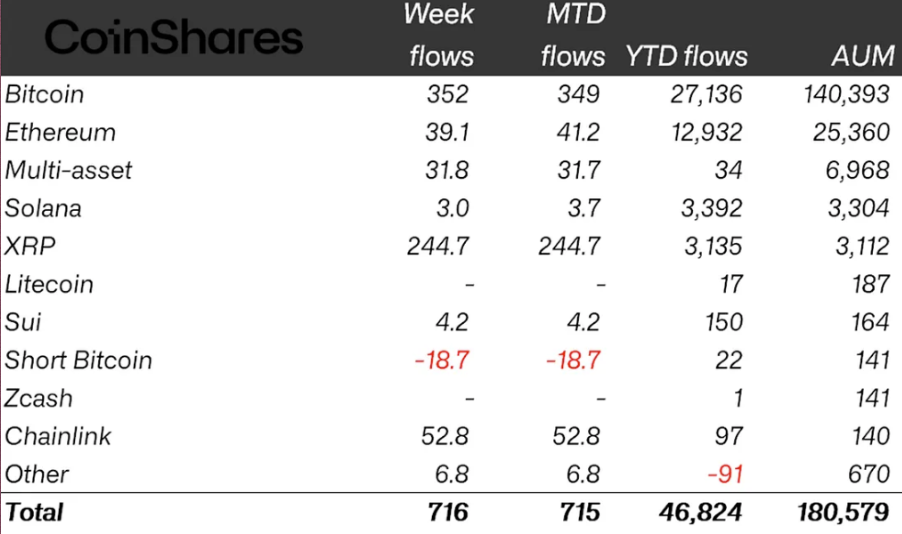
Inflows into crypto ETPs flip positive for two consecutive weeks. Source: CoinShares


Magazine: Decade after Ethereum ICO: Blockchain forensics end double-spending debate

Related Reads

ECB's Schnabel says central bank money 'should move to blockchain'

ECB Executive Board member Isabel Schnabel stated that central bank money "must move onto the blockchain." She argued that stablecoins lack the independent ability to scale liquidity during financial stress—a gap only a central bank can fill. Her proposed solution involves tokenization, which she says can make transactions faster, safer, and more programmable, but only if the safest asset (central bank money) is on the same "rails" as other tokenized assets. This marks a notable shift for the Eurosystem, which had previously viewed Distributed Ledger Technology (DLT) mainly as a tool for regulating stablecoins and crypto, not as infrastructure to adopt directly. The first step is Project Pontes, launching in September. It will initially synchronize the ECB’s existing TARGET services with private DLT platforms. Eventually, it aims to enable settlement finality on a Eurosystem-managed DLT platform with smart contract functionality and 24/7 operation. The long-term strategy is Project Appia, tasked with developing the architecture, standards, and legal framework for a genuine European tokenized asset market by 2028. Trials have already processed around €1.6 billion, and since March 2026, the ECB accepts DLT-based assets as collateral. While not directly impacting Bitcoin's price, these developments signal that a major G7 central bank is preparing to settle transactions on-chain, lending legitimacy to the underlying infrastructure of crypto markets. The ECB's move to avoid "disintermediation" by private tokenization shows that debates in central bank boardrooms are now aligning with discussions long followed in the crypto space.

cryptonews.ru27m ago

ECB's Schnabel says central bank money 'should move to blockchain'

cryptonews.ru27m ago

Ripple Labs Warns of a New Challenge for Blockchains

Ripple Labs is preparing the XRP Ledger for quantum threats but now emphasizes a broader challenge: ensuring financial infrastructure can adapt simultaneously to quantum computing and artificial intelligence. Senior Director of Engineering Ayo Akinyele states the goal is not merely anticipating a "Q-Day" but building infrastructure capable of preemptively adopting new security mechanisms without network disruption. The shift to post-quantum cryptography involves more than swapping algorithms; it requires flexible infrastructure, improved key management, and clear upgrade paths. Financial systems were not designed with quantum computers in mind, necessitating a rethink of transaction, identity, asset, and data protection. This is underscored by significant investments, such as the $2 billion U.S.-IBM quantum factory initiative and a 2030 U.S. government mandate for post-quantum cryptography adoption. AI introduces distinct risks by driving automation and autonomous economic activity, increasing demand for an always-on, internet-oriented payment infrastructure. AI agents could soon conduct transactions independently, creating new security requirements. Ripple Labs advocates for proactive, orderly preparation rather than a crisis-driven transition, having outlined a four-phase strategy aiming for a full XRP Ledger transition by 2028, now expanded to address both quantum and AI-driven challenges.

cryptonews.ru27m ago

Ripple Labs Warns of a New Challenge for Blockchains

cryptonews.ru27m ago

Trading

Spot
活动图片