Bitmine Expands Ethereum Holdings: Adds 32,938 ETH And Stakes Nearly 119K ETH

bitcoinistPublished on 2026-01-01Last updated on 2026-01-01

Abstract

Despite a struggling Ethereum market marked by apathy and persistent selling pressure, institutional entity Bitmine has significantly expanded its long-term commitment. Acquiring 32,938 ETH (worth ~$97.6 million) and staking an additional 118,944 ETH (~$352.16 million), Bitmine now holds approximately 3.357 million ETH valued at around $10 billion. This large-scale staking removes substantial ETH from liquid circulation, tightening supply. While the broader market remains cautious and ETH price action is weak, Bitmine's actions signal strong long-term confidence, contrasting with the current bearish sentiment. Analysts are divided on whether this indicates early positioning for a recovery or if macro headwinds will prolong the current consolidation.

Ethereum continues to struggle to regain bullish momentum as apathy and persistent selling pressure dominate the broader crypto market. Price action remains subdued, with ETH failing to sustain moves above key resistance levels, reinforcing the perception that investors are still cautious.

Many analysts argue that the market has yet to fully reset, pointing to weak risk appetite, declining liquidity, and a lack of strong spot demand. As a result, Ethereum, like most major assets, remains trapped in a consolidation phase marked by hesitation rather than conviction.

Despite this gloomy backdrop, a growing group of optimists believes Ethereum could be approaching a cyclical bottom. Their view is based less on short-term price action and more on structural and behavioral signals that tend to emerge during late-stage bearish phases. One of the most notable developments comes from on-chain data.

According to data from Arkham shared by Lookonchain, Bitmine acquired another 32,938 ETH worth approximately $97.6 million just a few hours ago. Bitmine is a large institutional Ethereum-focused entity known for accumulating ETH at scale and deploying it across staking and long-term strategies rather than short-term trading. With this latest purchase, Bitmine now holds roughly 3.357 million ETH, valued at around $10 billion, making it one of the largest known Ethereum holders.

Bitmine Deepens Long-Term Commitment

Ethereum’s near-term price action remains fragile, but institutional behavior continues to diverge from market sentiment. Over the past few hours, Bitmine staked an additional 118,944 ETH, worth approximately $352.16 million, according to data from Arkham reported by Lookonchain. This move follows Bitmine’s recent spot accumulation and reinforces its long-term positioning strategy rather than a short-term speculative approach.
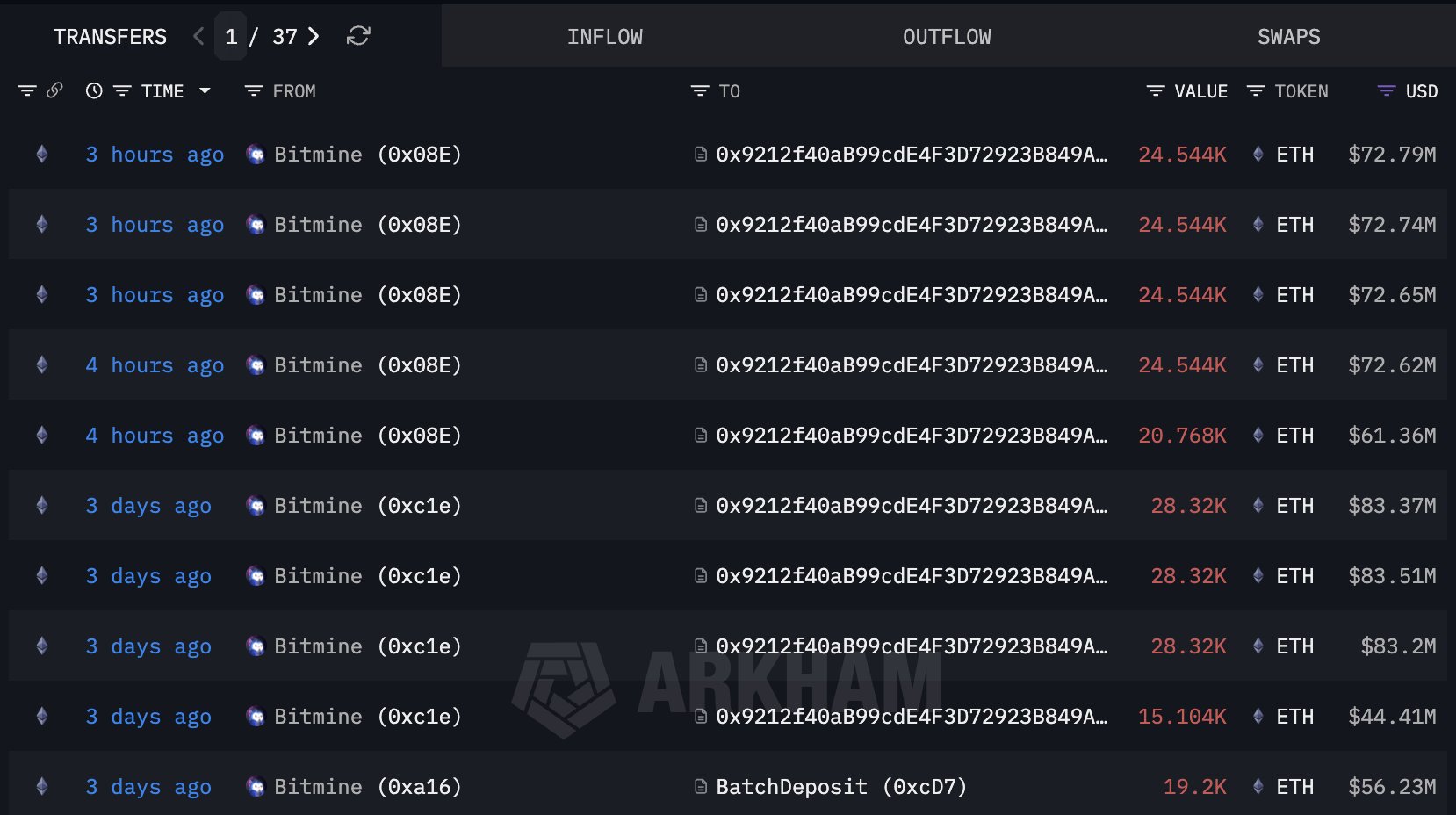
Bitmine Ethereum Transfers | Source: Arkham

Staking at this scale effectively removes a significant amount of ETH from liquid circulation, tightening available supply on exchanges. Unlike transfers to centralized platforms, staking reflects a high-conviction view that prioritizes yield generation and long-term network participation over immediate liquidity.

For analysts tracking structural supply dynamics, this behavior contrasts sharply with the current price trend, which continues to show limited bullish follow-through.

Despite these developments, the broader market remains unconvinced. Ethereum has struggled to reclaim key resistance levels, and momentum indicators still point to weakness. As a result, analysts are increasingly divided when assessing the outlook for 2026.

Some interpret ongoing institutional accumulation and staking as early positioning ahead of a longer-term recovery cycle. Others caution that macro uncertainty, muted demand, and persistent risk aversion could keep ETH range-bound or under pressure for longer than expected.

In this context, Bitmine’s actions stand out as a signal of long-term confidence, but not necessarily an immediate catalyst. For now, Ethereum’s price remains weak, while the strategic behavior beneath the surface continues to quietly reshape the supply landscape.


Trending Cryptos

Related Questions

QWhat is the total amount of ETH that Bitmine acquired in its recent purchase, and what is its approximate value?

ABitmine acquired 32,938 ETH, worth approximately $97.6 million.

QHow much ETH has Bitmine staked recently, and what is the estimated value of this staking action?

ABitmine staked an additional 118,944 ETH, valued at around $352.16 million.

QWhat is Bitmine's total Ethereum holdings after its latest acquisition, and what is the total value?

ABitmine now holds roughly 3.357 million ETH, valued at approximately $10 billion.

QHow does Bitmine's staking activity impact the supply of Ethereum on exchanges?

AStaking at this scale removes a significant amount of ETH from liquid circulation, tightening the available supply on exchanges.

QWhat is the current market sentiment towards Ethereum, and how does Bitmine's behavior contrast with it?

AThe market sentiment is cautious and bearish, with apathy and selling pressure dominating, while Bitmine's accumulation and staking reflect a long-term, high-conviction strategy rather than short-term speculation.

Related Reads

The Clarity Act's Journey Through Congress: The Thorny Path of Bipartisan Compromise in the U.S.

The U.S. Congress is struggling to advance the crypto market structure bill known as the Clarity Act, with bipartisan compromise proving difficult. Key hurdles include unresolved disputes over "yield" products and, more critically, the inclusion of strong ethics provisions for elected officials—a non-negotiable demand for many Democrats. While a compromise on yield was reached in May, securing only limited Democratic support in committee, the separate Senate Agriculture Committee version later passed with no Democratic votes due to the ethics impasse. As Republicans push for a full Senate vote in July, demands for ethics rules have expanded, and other contentious issues like developer protections and concerns from law enforcement and large banks further complicate negotiations. Despite consensus on the need for legislation, the path forward is unclear. Recent discussions between senators and White House officials aim to find acceptable ethics language. Some lawmakers question whether a compromise text can garner enough bipartisan support, with one Democrat stating the current proposal lacks the strong ethics provisions required for their vote. Potential short-term goals for the crypto community include symbolic Senate action before the August recess, a longer-term aim for passage by 2026, or establishing a detailed framework that addresses ethics and other compromises. The process remains arduous, relying on the traditional, vote-by-vote effort to build bipartisan support.

marsbit18m ago

The Clarity Act's Journey Through Congress: The Thorny Path of Bipartisan Compromise in the U.S.

marsbit18m ago

Are Kalshi and Polymarket Founders at Odds? This Business Rivalry Is More Brutal Than You Think

"The Rivalry Between Kalshi and Polymarket Founders Turns Bitter and Litigious" The intense feud between Tarek Mansour, CEO of Kalshi, and Shayne Coplan, founder of Polymarket, has escalated far beyond typical business competition into personal animosity and regulatory battles. Both lead billion-dollar prediction market platforms, but their approaches differ sharply. Kalshi positions itself as the compliant operator, securing U.S. regulatory approval before launching. In contrast, Polymarket initially operated offshore, allowing U.S. users to access its platform via VPN, which drew regulatory scrutiny. The conflict reached a peak in November 2024 when FBI agents raided Coplan's New York apartment. While Coplan publicly blamed political motives, his team privately suspected Kalshi was involved. According to sources, Kalshi's lawyers had previously reported Polymarket's operations to federal prosecutors, highlighting its accessibility to U.S. users despite a ban. This incident fueled mutual accusations and underhanded tactics, including social media smear campaigns and attempts to sabotage each other's major business deals. Their rivalry also played out in Washington, influencing regulatory debates. Kalshi actively lobbied against Polymarket's practices, framing them as illegal and unethical. Polymarket, after facing a CFTC fine and investigation, later acquired a licensed U.S. firm to launch a domestic app, regaining a foothold. Despite the hostility, both companies have seen massive growth, with combined trading volumes soaring. However, increased regulatory scrutiny, particularly around insider trading on Polymarket's platform, continues to pose challenges. The founders' deep-seated mutual disdain ensures their battle for market dominance remains as much a personal vendetta as a commercial one.

marsbit26m ago

Are Kalshi and Polymarket Founders at Odds? This Business Rivalry Is More Brutal Than You Think

marsbit26m ago

Trading

Spot

Hot Articles

Discussions

Welcome to the HTX Community. Here, you can stay informed about the latest platform developments and gain access to professional market insights. Users' opinions on the price of ETH (ETH) are presented below.

活动图片