Bitmine Deepens Ethereum Bet With $514M ETH Staking Move – Staking Exposure Reaches $5.6B

bitcoinistPublished on 2026-01-16Last updated on 2026-01-16

Abstract

Ethereum has reclaimed the $3,300 level but faces resistance at $3,400, a key short-term inflection point. Market sentiment is divided between skeptics viewing the rebound as a temporary relief rally and more constructive analysts seeing early recovery signs. Amid this uncertainty, Bitmine staked an additional 154,304 ETH (worth $514 million), bringing its total staked ETH to 1.685 million (valued at $5.62 billion). This represents nearly 80% of its total ETH holdings, signaling a long-term, yield-focused strategy and strong institutional confidence. Large-scale staking reduces liquid supply, potentially supporting prices. ETH's weekly chart shows stabilization above key moving averages, but a clear break above $3,400 is needed to confirm a bullish shift and target higher resistance levels.

Ethereum has reclaimed the $3,300 level after weeks of choppy and uncertain price action, offering bulls a brief sense of relief. However, upside momentum remains fragile, as buyers continue to struggle against the $3,400 zone, a level that has repeatedly capped recent advances. This area now stands as a clear short-term inflection point, separating a potential recovery phase from what some analysts still describe as a broader bearish structure.

Market participants remain divided. On one side, skeptics argue that the latest rebound resembles a classic relief rally, driven by short covering and temporary sentiment improvement rather than a genuine shift in trend.

From this perspective, Ethereum may still be vulnerable to renewed downside if macro conditions tighten or risk appetite fades. On the other side, more constructive analysts believe the stabilization above $3,300 could mark the early stages of a recovery, with higher levels coming into focus if resistance is convincingly reclaimed.

Adding complexity to the narrative, on-chain developments continue to draw attention. Just a few hours ago, Bitmine staked an additional 154,304 ETH, worth roughly $514 million, signaling sustained confidence from large players despite market uncertainty. As price compresses below resistance, Ethereum now sits at a critical juncture where conviction from both bulls and bears is being tested.
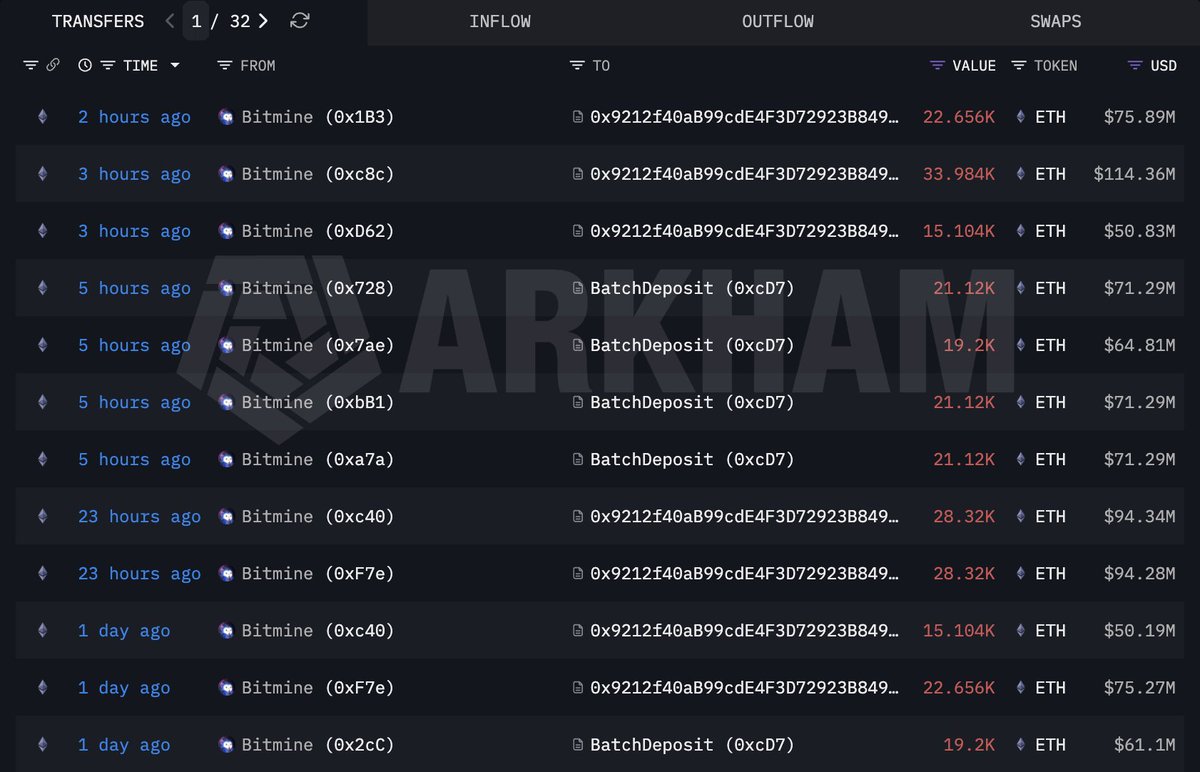
Bitmine Ethereum Transfers | Source: Arkham

According to data reported by Lookonchain, Bitmine’s Ethereum exposure has reached a notable scale. In total, the firm has now staked approximately 1,685,088 ETH, valued at around $5.62 billion at current prices. This places Bitmine among the largest single staking participants in the Ethereum ecosystem, underscoring the growing role of institutional and quasi-institutional actors in securing the network.

What makes this positioning particularly relevant is Bitmine’s overall balance. The company reportedly holds about 2.133 million ETH in total, meaning that close to 80% of its Ether reserves are actively staked rather than sitting idle. This allocation suggests a long-term, yield-oriented strategy rather than a short-term trading approach. By committing such a large portion of its holdings to staking, Bitmine is effectively signaling confidence in Ethereum’s medium- to long-term outlook, despite ongoing price volatility and macro uncertainty.

From a market perspective, large-scale staking reduces the amount of ETH that is readily liquid and available for sale. While this does not eliminate selling pressure entirely, it can contribute to a tighter circulating supply during periods of demand recovery.

At the same time, concentrated staking activity highlights how network security and yield generation are increasingly influenced by large holders. As Ethereum trades near key resistance levels, Bitmine’s positioning reinforces the narrative that some major players remain structurally committed, even as short-term price direction remains contested.

Ethereum’s price action on the weekly chart shows a market attempting to stabilize after a volatile multi-year cycle. ETH has reclaimed the $3,300 area and is now trading just below a clearly defined resistance zone near $3,400. This level has repeatedly capped upside during prior rallies, making it a critical area for bulls to reclaim with conviction.
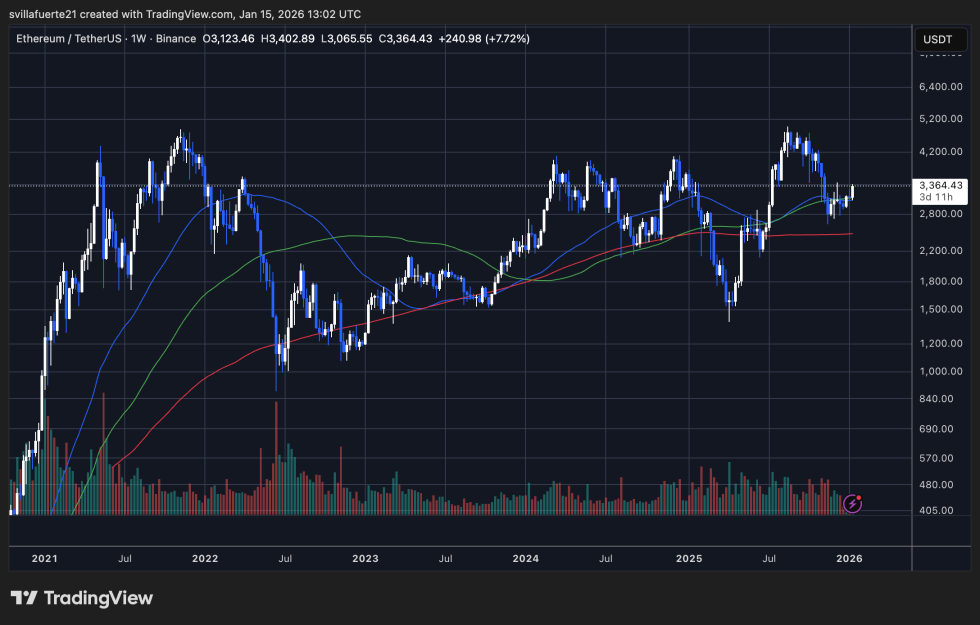
ETH consolidates around critical liquidity level | Source: ETHUSDT chart on TradingView

From a trend perspective, Ethereum remains above its long-term moving averages, including the 200-week line, which continues to slope upward. This suggests that despite recent drawdowns, the broader structural uptrend has not been invalidated. However, price is still trading below the previous cycle highs near $4,200–$4,400, highlighting that ETH is in a recovery phase rather than a confirmed breakout.

Momentum has improved compared to late 2025, with higher lows forming after the sharp sell-off toward the $1,600–$1,800 region. Volume during the rebound has been moderate, signaling participation without clear signs of speculative excess. This supports the idea of controlled accumulation rather than euphoric chasing.

Still, the inability to cleanly break above $3,400 keeps downside risk relevant. A rejection here could lead to renewed consolidation toward the $2,800–$3,000 zone. For bullish continuation, ETH needs a sustained weekly close above resistance, which would shift market structure and open the path toward higher liquidity zones above $3,800.

Featured image from ChatGPT, chart from TradingView.com

Related Reads

Lowering Expectations for BTC's Next Bull Market

The author, Alex Xu, explains his decision to significantly reduce his Bitcoin holdings (from full to ~30% of his portfolio) during the current bull cycle, citing a lowered long-term outlook for BTC's price appreciation in the next cycle. He outlines six key reasons for this reduced expectation: 1. **Diminished Growth Drivers:** The narrative of exponential user adoption has largely played out with institutional ETF adoption. The next major growth phase—adoption by sovereign national reserves or central banks—seems unlikely in the near future. 2. **Personal Opportunity Cost:** More attractive investment opportunities have emerged in other assets, such as undervalued companies. 3. **Industry-Wide Contraction:** The broader crypto industry is struggling, with most Web3 business models (SocialFi, GameFi, DePIN) failing. This overall萧条 (depression) reduces the fundamental demand and consensus for Bitcoin. 4. **Strain on Major Buyer:** MicroStrategy, a major corporate buyer of BTC, faces rising financing expenses for its debt, which could slow its purchasing rate and create significant marginal pressure on the market. 5. **Increased Competition from Gold:** The emergence of "tokenized gold" has closed the functional gap (portability, divisibility) between physical gold and Bitcoin, offering a strong competitor in the non-sovereign store-of-value space. 6. **Security Budget Concerns:** The block reward halving continues to exacerbate the long-standing issue of funding Bitcoin's network security, with new fee source explorations like Ordinals and L2s largely failing. The author's decision to hold a significant (though reduced) position reflects a cautious, not bearish, outlook. He remains open to increasing his exposure if the fundamental reasons for his skepticism change or if new positive catalysts emerge.

marsbit15m ago

Lowering Expectations for BTC's Next Bull Market

marsbit15m ago

Can Iran 'Control' the Strait of Hormuz?

Iran has announced a comprehensive plan to assert control over the strategic Strait of Hormuz, a critical global oil shipping chokepoint. The proposed measures include requiring all vessels to obtain Iranian permission for passage, imposing fees for security, environmental protection, and navigation management—preferably paid in Iranian rials—and absolutely banning Israeli ships. Vessels from countries deemed hostile by Iran’s top security bodies may also be barred. Analysts suggest Iran’s motives are multifaceted: increasing pressure on the U.S. and Israel by leveraging control over oil transit to influence global prices and inflation; creating a new revenue stream, potentially exceeding $7.7 billion annually, to counter Western sanctions and support postwar reconstruction; and using transit permissions as bargaining chips in future negotiations, notably with the U.S. However, the plan faces significant practical and diplomatic challenges. Enforcing comprehensive interception and fee collection in the busy waterway, patrolled by international military forces, would be difficult. The U.S. has already countering with a blockade of Iranian ports and threats to intercept any ship paying fees, potentially strangling Iran’s oil exports and fee revenue. Broad international opposition, led by European and Gulf states, and legal controversies further complicate implementation. The proposal may ultimately serve more as a negotiating tactic than a feasible policy, with its execution remaining highly uncertain.

marsbit1h ago

Can Iran 'Control' the Strait of Hormuz?

marsbit1h ago

Trading

Spot
Futures

Hot Articles

Discussions

Welcome to the HTX Community. Here, you can stay informed about the latest platform developments and gain access to professional market insights. Users' opinions on the price of ETH (ETH) are presented below.

活动图片















