BitMine Buys Over 40,000 ETH As Sell-Off Deepens, Shrugs Off Massive Paper Losses

bitcoinistPublished on 2026-02-11Last updated on 2026-02-11

Abstract

BitMine Immersion Technologies acquired 40,613 ETH (worth $83–84 million) during a market downturn, increasing its total holdings to approximately 4.32–4.33 million ETH. Despite facing an estimated $7.5–8 billion in unrealized paper losses due to Ether's price decline, Executive Chairman Tom Lee defended the strategy, viewing the dip as a buying opportunity and predicting a V-shaped recovery. The company’s stock (BMNR) fell roughly 5% following the announcement, reflecting investor concern over the immediate impact on net asset value. BitMine continues to stake part of its ETH to generate yield, betting on long-term price appreciation. The outcome hinges on Ether’s price trajectory and the firm’s ability to manage short-term losses through staking returns and strategic patience.

BitMine Immersion Technologies kept buying as prices fell, scooping up 40,613 ETH during last week’s sell-off. Reports say the purchase totaled roughly $83–$84 million, made when Ether traded near $2,020 per token.

BitMine’s Growing Stake And The Man At The Helm

According to recent coverage, the move pushed BitMine’s total Ethereum holdings to around 4.32–4.33 million ETH, a stash worth billions at current prices. Executive chairman Tom Lee has framed the dip as an attractive entry point and has voiced confidence in a bounce back.

Paper Losses Widen As Prices Slide

Reports note that the firm’s large cost basis for its accumulated ETH has left its treasury sitting on multibillion-dollar unrealized losses.

Estimates in the latest pieces place those paper losses between about $7.5 billion and $8 billion, depending on which price is used to mark the holdings. That gap widened as Ether fell from higher levels into the low-$2Ks.
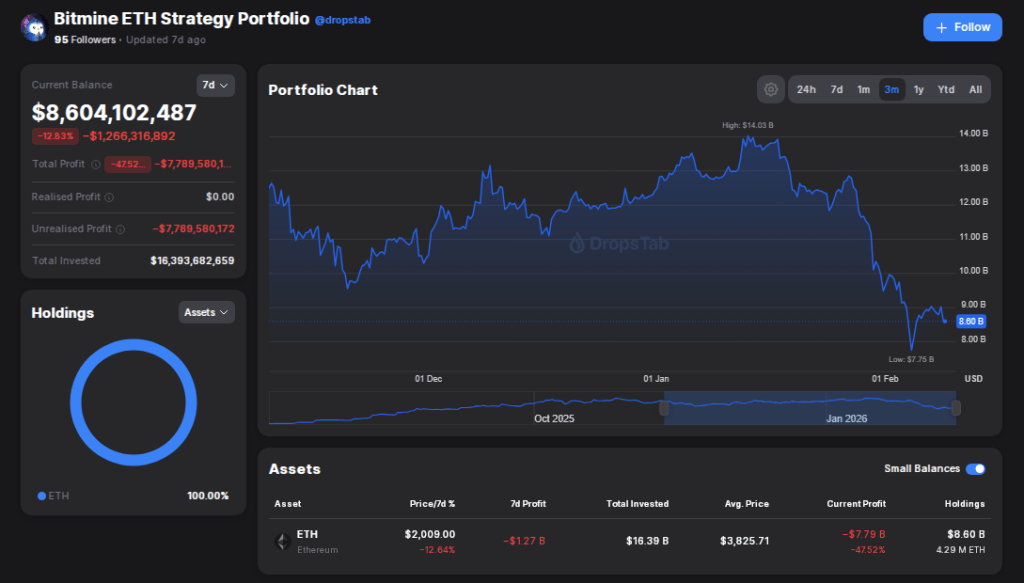
BitMine faces an estimated $7.7 billion paper loss on its ETH holdings. Source: DropsTab

Market And Shareholder Response

BitMine’s aggressive buying did not calm all investors. News outlets tracked a drop in the company’s stock (BMNR), which was reported down roughly 5% in pre-market trading around the same time the ETH buy was disclosed.

Traders appear to be weighing the long-term thesis against the immediate hit to the company’s net asset value.
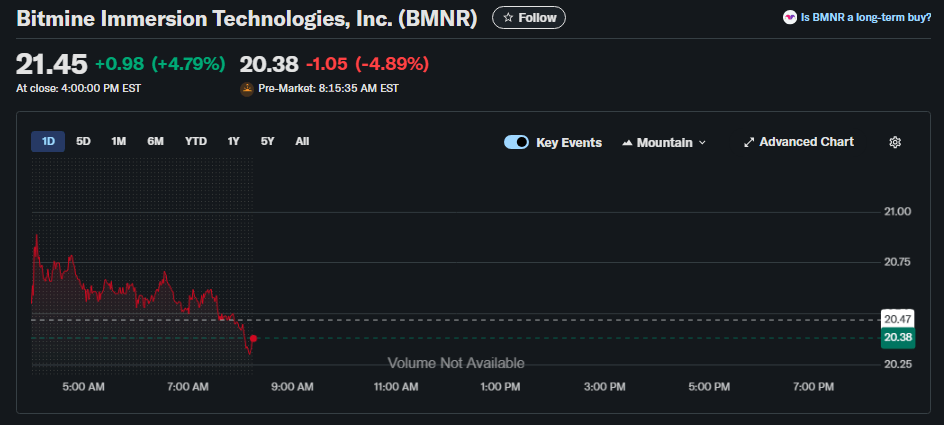
Six‐month performance of BitMine (BMNR) stock. Source: Yahoo Finance

Why The Company Is Still Adding

Reports say BitMine sees this as part of an intentional treasury play. Some of the firm’s ETH is staked, which generates yield and can help offset paper losses over time.

Tom Lee has forecast a strong rebound, calling for a V-shaped recovery in ether. That kind of outlook explains why purchases came even while the market was weak.

ETHUSD trading at $2,012 on the 24-hour chart: TradingView

What To Watch Next

Short term, price moves in ether and shifts in investor sentiment will be the clearest signals. If ETH stages a steady climb, the unrealized losses will shrink quickly.

If the token continues to trade lower, the company’s paper loss metrics will remain a headline for shareholders and analysts.

Reports say details such as financing, staking returns, and any further disclosed buys will shape how investors view the firm’s risk profile.

BitMine’s choice to keep buying at lower levels is a clear bet on future price recovery. Whether that bet pays off for shareholders depends on the market’s next moves, and on whether patience and staking income can outweigh a large short-term drawdown.

Featured image from Thomas Fuller/SOPA Images/LightRocket via Getty Images, chart from TradingView


Trending Cryptos

Related Questions

QHow much ETH did BitMine purchase during the recent sell-off and at what approximate price?

ABitMine purchased 40,613 ETH during the sell-off at a price near $2,020 per token, totaling roughly $83–$84 million.

QWhat is the estimated value of the paper losses on BitMine's ETH holdings, and why did this gap widen?

AThe estimated paper losses on BitMine's ETH holdings are between $7.5 billion and $8 billion. This gap widened as the price of Ether fell from higher levels into the low-$2,000s.

QHow did the market and shareholders initially react to BitMine's aggressive ETH purchase?

AThe market reaction was negative, with BitMine's stock (BMNR) dropping roughly 5% in pre-market trading. Traders were weighing the long-term investment thesis against the immediate hit to the company's net asset value.

QWhat are the two main reasons provided for why BitMine continued to buy ETH despite the market weakness?

ABitMine views this as an intentional treasury play. First, some of the ETH is staked, generating yield to help offset paper losses over time. Second, Executive Chairman Tom Lee has forecast a strong V-shaped recovery for Ether.

QWhat future factors will shape how investors view the risk profile of BitMine's strategy?

AKey factors include short-term price moves in Ether, shifts in investor sentiment, details on how the purchases were financed, the returns from staking, and any further disclosed cryptocurrency buys.

Related Reads

Qualcomm: AI Hype Subsides, When Will Smartphones Emerge from the Gloom?

Qualcomm reported its Q3 FY2026 results (ending June 2026), with revenue of $9.95B, down 4% YoY but above expectations. Gross margin declined to 53.1%, pressured by rising costs across manufacturing and memory. Key business segments showed mixed performance: Handset revenue fell 19.6% YoY to $5.09B, dragged by an 11% decline in non-Apple Android shipments and weaker high-end mix. Conversely, Automotive revenue surged 61% to $1.59B, and IoT grew 9% to $1.83B. Core operating profit dropped 41% YoY due to margin compression and higher expenses. Management's Q4 FY2026 guidance projects revenue of $9.7B-$10.5B, in line with consensus, but Non-GAAP EPS guidance of $2.05-$2.25 fell short of expectations. Amidst persistent weakness in its core handset market, Qualcomm is pursuing growth in AI, focusing on Edge AI (smartphones, PCs, automotive) and Data Center AI. Its data center strategy includes four pillars: AI accelerators (e.g., AI200), commercial CPUs (Dragonfly C1000), custom silicon, and connectivity solutions. While these initiatives initially boosted its stock, concerns over AI capital expenditure sustainability have since erased those gains. The company targets $5B in data center revenue for FY2027 and $15B for FY2029. The report concludes that with the traditional handset business still under pressure, the data center opportunity is currently viewed as a longer-term option, and a more conservative valuation based on core operations may be warranted until AI contributions materialize.

marsbit2m ago

Qualcomm: AI Hype Subsides, When Will Smartphones Emerge from the Gloom?

marsbit2m ago

From TPU to Self-Evolving Agents: How Jeff Dean Predicts the Next Step in AI

At the 2026 YC Startup School, Jeff Dean outlined his vision for AI's next phase, shifting focus from simply scaling models to building intelligent, autonomous systems. He believes AI's progress is no longer just about creating smarter models, but about integrating them into systems capable of long-term, iterative work, automated experimentation, and continuous learning. This evolution moves the competition from "who has the bigger model" to "who can best organize intelligence." Dean suggests AI capabilities are now comparable to a junior engineer, enabling the automation of complex workflows. However, the true challenge and opportunity lie in managing these AI "workers" at scale. He emphasizes the importance of **context engineering**—structuring tools, memory, and feedback loops—over raw model power. For startups, this means building deep expertise in niche domains where general models currently fail (near 0-1% success rates), leveraging proprietary data, specialized tools, and domain-specific evaluators. A recurring theme is re-examining fundamental constraints. Dean's past work, like moving Google's search index to memory or creating the TPU, stemmed from questioning outdated assumptions about hardware and cost. He sees similar inflection points today, particularly in **specialized inference hardware** to drastically reduce latency and energy consumption for real-time Agent operation. Notably, he points out that in modern AI systems, the dominant cost is often not computation but **data movement**. Reliable, long-running Agents require robust system design, borrowing concepts from distributed computing like checkpointing, state management, and parallel exploration to handle failures and maintain progress over days or weeks. As AI automates execution, the scarcest human skills will shift to **defining clear specifications**, **judging what problems are worth solving** (taste), and designing effective feedback loops. Ultimately, Dean's framework prioritizes understanding the problem deeply, identifying the true bottlenecks, and systematically building closed-loop systems where AI can not only perform tasks but also improve AI itself.

marsbit2m ago

From TPU to Self-Evolving Agents: How Jeff Dean Predicts the Next Step in AI

marsbit2m ago

Trading

Spot

Hot Articles

Discussions

Welcome to the HTX Community. Here, you can stay informed about the latest platform developments and gain access to professional market insights. Users' opinions on the price of ETH (ETH) are presented below.

活动图片














