Bitcoiners push for quantum-resistant BIP-360 upgrade as debate heats up

cointelegraphPublished on 2025-12-18Last updated on 2025-12-18

Abstract

A group of Bitcoin advocates and fund managers is urging the network to accelerate the adoption of quantum-resistant cryptography, citing BIP-360 as a potential solution. Proponents like Charles Edwards of Capriole warn that a significant portion of Bitcoin could be vulnerable to quantum attacks within years and argue for a migration deadline by 2028. However, critics including Adam Back of Blockstream dismiss these concerns as premature, stating quantum threats are “decades away” and emphasizing that Bitcoin doesn’t rely on encryption vulnerable to near-term quantum breaks. Debate continues as Taproot adoption declines, possibly reflecting user anxiety, while alternative quantum-resistant signature schemes like hash-based proposals from Blockstream Research gain attention.

A small but growing group of Bitcoin advocates and crypto fund managers is urging the network to accelerate work on quantum-resistant signatures, arguing that the perception of a future “quantum threat” could become a market risk long before it becomes a practical one.

Some supporters are pointing to a draft Bitcoin Improvement Proposal known as BIP-360, which would introduce a post-quantum signature option for Bitcoin addresses that could be vulnerable to future advances in quantum computing.

The implementation must be finalized and deployed in 2026, said Charles Edwards, the founder of quantitative Bitcoin (BTC) and digital asset fund Capriole.

However, the implementation of the new standard would require wider consensus among hardware wallet providers, node operators and cryptocurrency exchanges, added Capriole in a Thursday X post. Around “20-30% of Bitcoin will be taken by a quantum hacker in the next few years,” Edwards said. “I believe we should burn all coins that do not migrate to BIP-360 by 2028.”
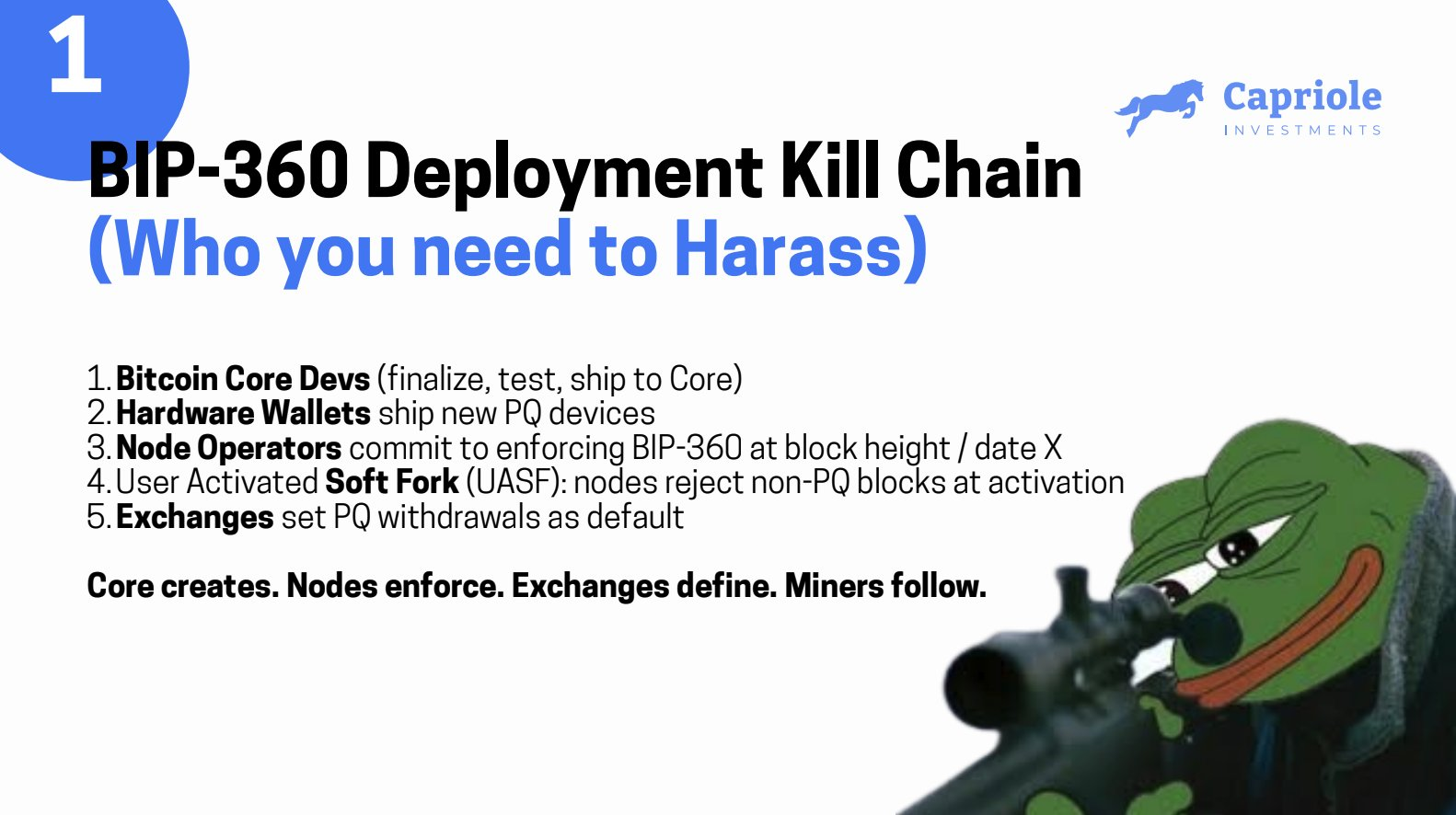
Source: Charles Edwards

Related: Bitcoin treasuries stall in Q4, but largest holders keep stacking sats

However, other industry watchers see quantum computing as a short-term risk for Bitcoin’s price.

“Pro-tip for quantum FUD promoters. Bitcoin does not use encryption. Get your basics right, or it’s a tell,” wrote Adam Back, co-founder and CEO of Blockstream, and the inventor of Hashcash, in a Thursday X post, adding that the quantum computing threat is still “decades away.”

Samson Mow, the CEO of Bitcoin technology company Jan3, also mocked the idea of early quantum computing threatening the Bitcoin network.

“Quantum computing can’t even factor 21, yet people are panic selling because they think it will kill Bitcoin,” wrote Mow in a Wednesday X post.

Related: Bitcoin investor loses retirement fund in AI-fueled romance scam

Taproot questions and competing proposals

Bitcoin’s latest Taproot format, which is perceived as quantum vulnerable, is declining in usage, from 42% of transactions in 2024 to just 20%, signaling that users may be worried about Bitcoin's quantum threat.
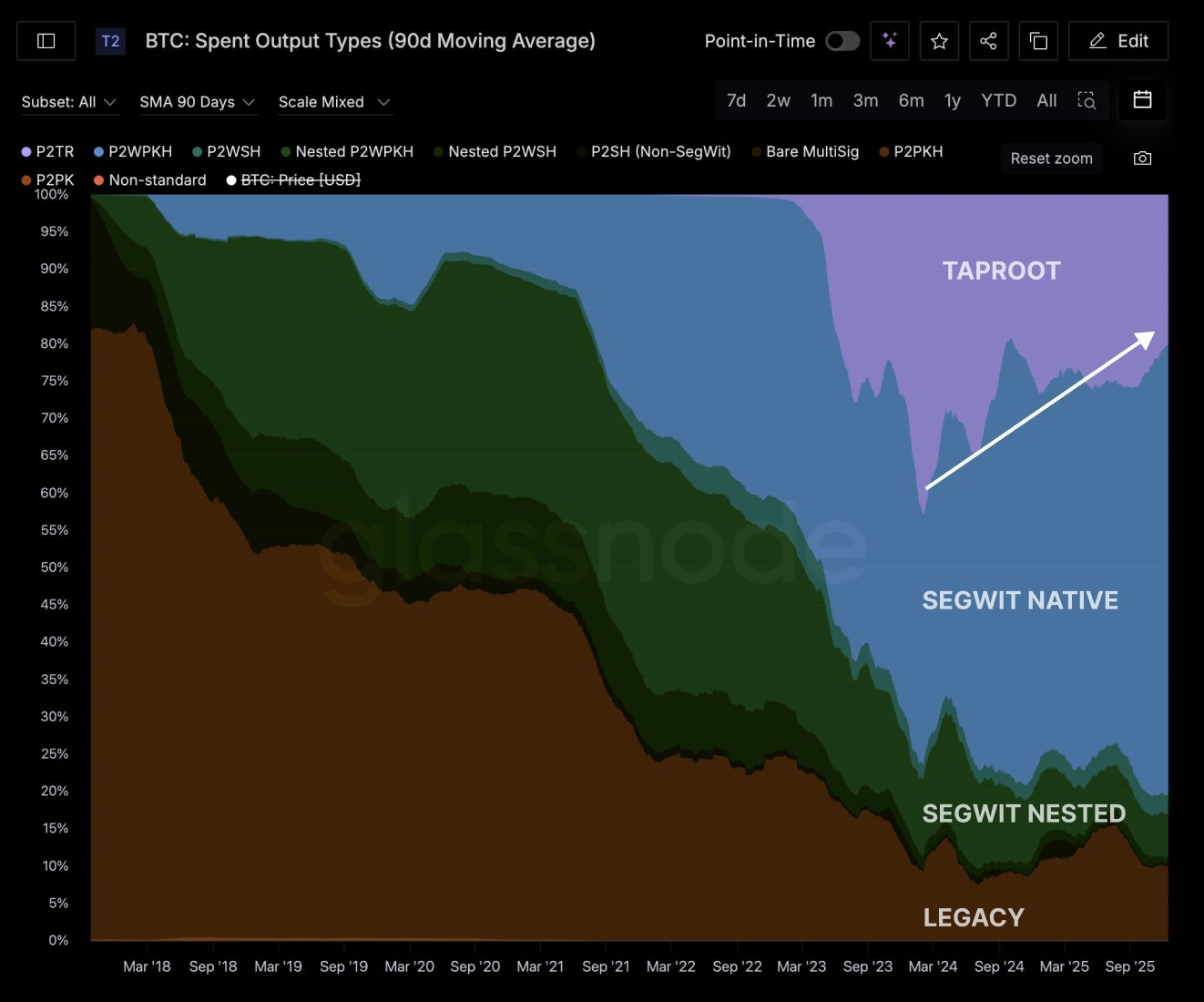
Source: Willy Woo

“I’ve NEVER seen the latest format losing adoption before. Taproot is Quantum Vulnerable, while older SegWit and Legacy are not,” wrote Bitcoin analyst Willy Woo, in a Wednesday X post.

Bitcoin’s Taproot update is the most important upgrade the cryptocurrency has experienced since 2017, when Segregated Witness (SegWit) was activated. Taproot aimed to upgrade the privacy and efficiency of the Bitcoin network.

Meanwhile, Back, one of the leading cryptographers, proposed a new hash-based signature scheme as a promising post-quantum alternative for Bitcoin, where security would rely solely on hash function assumptions similar to the ones currently used in the Bitcoin network’s design.
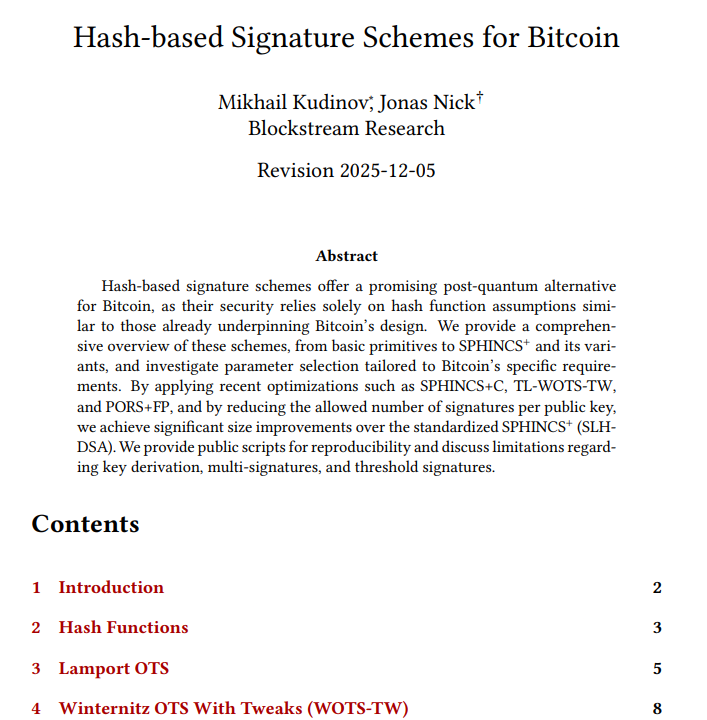
Hash-based signature schemes for Bitcoin, research paper. Source: Blockstream Research

Hash-based signature schemes like ECDSA and Schnorr signatures “offer a promising path for securing Bitcoin in a post-quantum world,” according to the paper released by Back’s Blockstream Research on Dec. 5.

The Elliptic Curve Digital Signature Algorithm (ECDSA) uses elliptic-curve cryptography to verify the authenticity and integrity of a message. Schnorr signatures are another signature scheme praised for enhancing privacy and reducing data size, due to their ability to combine multiple signatures into one.

Magazine: Bitcoin vs. the quantum computer threat — Timeline and solutions (2025–2035)

Related Questions

QWhat is the main purpose of the proposed BIP-360 upgrade for Bitcoin?

AThe main purpose of the proposed BIP-360 upgrade is to introduce a post-quantum signature option for Bitcoin addresses, making them resistant to potential future attacks from advanced quantum computers.

QAccording to Charles Edwards, by when must the quantum-resistant implementation be deployed, and what is his proposal for non-migrated coins?

ACharles Edwards stated that the implementation must be finalized and deployed by 2026, and he proposed that all coins not migrated to BIP-360 by 2028 should be burned.

QWhy is Bitcoin's Taproot format considered a decline in usage significant, as noted by Willy Woo?

AThe decline in Taproot usage, from 42% of transactions in 2024 to just 20%, is significant because it is the first time a newer Bitcoin format has lost adoption. This signals that users may be concerned about Taproot's vulnerability to quantum threats, unlike older SegWit and Legacy formats.

QWhat alternative post-quantum solution did Adam Back and Blockstream Research propose for Bitcoin?

AAdam Back and Blockstream Research proposed a new hash-based signature scheme as a post-quantum alternative. This scheme's security relies solely on hash function assumptions, similar to those already used in Bitcoin's design, with ECDSA and Schnorr signatures being highlighted as promising paths.

QWhat are the differing views on the immediacy of the quantum computing threat to Bitcoin, as presented in the article?

AThe article presents differing views: Charles Edwards and others see it as a near-term market risk, urging immediate action. In contrast, Adam Back and Samson Mow consider the quantum threat to be decades away or currently insignificant, with Mow mocking the idea that quantum computing, which 'can't even factor 21,' is a reason for panic selling.

Related Reads

Fu Peng's First Public Speech in 2026: What Exactly Are Crypto Assets? Why Did I Join the Crypto Asset Industry?

Fu Peng, a renowned macroeconomist and now Chief Economist at New火 Group, delivered his first public speech of 2026 at the Hong Kong Web3 Festival. He explained his perspective on crypto assets and why he joined the industry, framing it within the context of macroeconomic trends and financial evolution. Fu emphasized that crypto assets are transitioning from an early, belief-driven phase to a mature, institutionally integrated asset class. He drew parallels to the 1970s-80s, when technological advances (like computing) revolutionized traditional finance, leading to the rise of FICC (Fixed Income, Currencies, and Commodities). Similarly, current advancements in AI, data, and blockchain are reshaping finance, with crypto assets becoming part of a new "FICC + C" (C for Crypto) framework. He noted that institutional capital, including traditional hedge funds, avoided early crypto due to its speculative nature but are now engaging as regulatory clarity emerges (e.g., stablecoin laws, CFTC classifying crypto as a commodity). Fu predicted that 2025-2026 marks a turning point where crypto becomes a standardized, financially viable asset for diversified portfolios, akin to commodities or derivatives in traditional finance. Fu defined Bitcoin not as "digital gold" in a simplistic sense but as a value-preserving, financially tradable asset. He highlighted that crypto's future lies in regulated, institutional adoption, moving away from retail-dominated trading. His entry into crypto signals this maturation, where traditional finance integrates crypto into mainstream asset management.

marsbit53m ago

Fu Peng's First Public Speech in 2026: What Exactly Are Crypto Assets? Why Did I Join the Crypto Asset Industry?

marsbit53m ago

Justin Sun Sues Trump Family: What $75 Million Bought Was Only a Blacklist

Justin Sun, founder of Tron, has filed a lawsuit in federal court against World Liberty Financial (WLF), alleging he was made the "primary target of a fraudulent scheme" after investing $75 million. Sun claims the investment secured him an advisor title and WLFI tokens, which were later frozen by WLF, causing "hundreds of millions in losses." The dispute began in late 2024 when Sun's investment helped revive WLF's struggling token sale, which ultimately raised $550 million. Shortly after, the SEC dropped its lawsuit against Sun following Donald Trump's inauguration. However, relations soured when Sun refused WLF's demands for additional funding. In August 2025, WLF added a "blacklist" function to its smart contract, allowing it to unilaterally freeze tokens. Sun's holdings, worth approximately $107 million, were frozen, and he was threatened with token destruction. The lawsuit highlights WLF's structure, which directs 75% of token sale profits to the Trump family, who had earned $1 billion by December 2025. WLF's CEO is Zach Witkoff, son of U.S. Middle East envoy Steve Witkoff. The project faces scrutiny for opaque operations, including a controversial loan arrangement on the Dolomite platform, co-founded by a WLF advisor. Despite Sun's history with the SEC, the case underscores centralization risks within DeFi, as WLF controls governance and holds powers to freeze assets arbitrarily. Sun's tokens remain frozen as legal proceedings begin.

marsbit1h ago

Justin Sun Sues Trump Family: What $75 Million Bought Was Only a Blacklist

marsbit1h ago

$500 to Buy OpenAI Stock: Silicon Valley's Most Respectable Liquidity Invitation

Silicon Valley's largest venture capital platform, AngelList, has launched a new fund called USVC, allowing U.S. retail investors to buy into high-profile AI companies like OpenAI, Anthropic, and xAI with a minimum investment of $500—no accredited investor status required. Promoted by AngelList co-founder Naval Ravikant, the fund is framed as an opportunity for ordinary people to access high-growth private tech investments traditionally reserved for VCs. However, critics argue it functions more like an exit vehicle for early insiders. USVC acquires shares not through primary rounds but largely via secondary transactions—purchasing stakes from early investors, VC funds, and employees looking to cash out at peak valuations. With companies like xAI heavily weighted in the portfolio, the fund effectively channels retail money into providing liquidity for insiders who entered at much lower valuations. The fund’s structure raises concerns: shares are illiquid, with no secondary market, and buybacks are limited and discretionary. The actual annual fee reaches 3.61%, far above the advertised 1% management fee. This model parallels the "low float, high fully diluted valuation" strategy seen in crypto, where early investors profit by selling to latecomers at inflated prices. The timing—alongside similar moves by platforms like Robinhood—suggests that Silicon Valley’s sudden interest in retail inclusion may be less about democratizing access and more about securing exits for insiders.

marsbit1h ago

$500 to Buy OpenAI Stock: Silicon Valley's Most Respectable Liquidity Invitation

marsbit1h ago

Trading

Spot
Futures

Hot Articles

How to Buy PUSH

Welcome to HTX.com! We've made purchasing Push Protocol (PUSH) simple and convenient. Follow our step-by-step guide to embark on your crypto journey.Step 1: Create Your HTX AccountUse your email or phone number to sign up for a free account on HTX. Experience a hassle-free registration journey and unlock all features.Get My AccountStep 2: Go to Buy Crypto and Choose Your Payment MethodCredit/Debit Card: Use your Visa or Mastercard to buy Push Protocol (PUSH) instantly.Balance: Use funds from your HTX account balance to trade seamlessly.Third Parties: We've added popular payment methods such as Google Pay and Apple Pay to enhance convenience.P2P: Trade directly with other users on HTX.Over-the-Counter (OTC): We offer tailor-made services and competitive exchange rates for traders.Step 3: Store Your Push Protocol (PUSH)After purchasing your Push Protocol (PUSH), store it in your HTX account. Alternatively, you can send it elsewhere via blockchain transfer or use it to trade other cryptocurrencies.Step 4: Trade Push Protocol (PUSH)Easily trade Push Protocol (PUSH) on HTX's spot market. Simply access your account, select your trading pair, execute your trades, and monitor in real-time. We offer a user-friendly experience for both beginners and seasoned traders.

3.3k Total ViewsPublished 2024.03.29Updated 2025.04.02

How to Buy PUSH

Discussions

Welcome to the HTX Community. Here, you can stay informed about the latest platform developments and gain access to professional market insights. Users' opinions on the price of PUSH (PUSH) are presented below.

活动图片