Bitcoin slips below $70K, but is BTC’s $45K crash call overblown?

ambcryptoPublished on 2026-03-22Last updated on 2026-03-22

Abstract

Bitcoin recently declined below $70,000, influenced by rising geopolitical tensions and shifting political narratives, including U.S. policy changes regarding Iran. While some predictions on Polymarket suggest a potential crash to $45,000, deeper analysis indicates stronger confidence in Bitcoin reaching the $75,000–$80,000 range, with solid support expected around $55,000. Market analysts view the correction as a typical post-halving reset rather than a major crash, noting significant institutional buy support near $55,000. Despite short-term volatility and “Extreme Fear” in sentiment indicators, Bitcoin’s dominance remains high at around 58.76%, and ETF outflows are decreasing, suggesting potential stabilization. The market is likely to remain uncertain until Bitcoin decisively breaks above $74,000 or stabilizes near $65,000.

During the week ending 21st of March, Bitcoin looked strong and was changing hands near the $74,000 price level. Rising global tensions also pushed the idea that it could act as a safe asset, but that idea has weakened this week.

Bitcoin has now fallen to around $69,173, down over 2% in a day and nearly 4% in a week. As tensions around the Strait of Hormuz push oil prices up, investors are now questioning Bitcoin’s volatility.

Polymarket predicts Bitcoin’s next move

In fact, a recent post by Polymarket has caught attention, with bettors starting to predict,

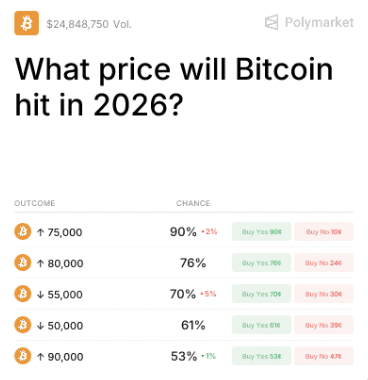
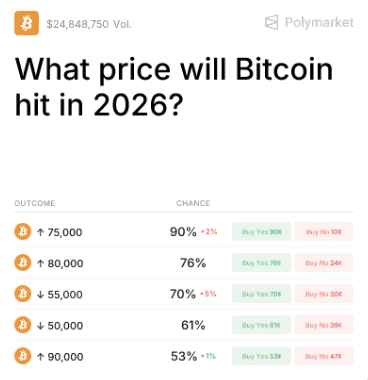
Bitcoin is now more likely to crash below $45,000 than to reclaim $100,000 this year.
Source: Polymarket

However, a closer look at the data suggests the opposite. There is a strong consensus that Bitcoin [BTC] could trade in the $75,000–$80,000 range, with high confidence among traders reflected in these probabilities.

In fact, lower levels like $55,000 and $50,000 are seen as strong support. Still, the $90,000 level remains low and uncertain, showing the market agrees on moderate growth but is divided on a move beyond $90K.

What’s behind this drop?

Zooming out, Bitcoin’s recent drop makes more sense when you look at the political twists over the past 24 hours.

Just a day ago, Polymarket traders were expecting tensions to ease after U.S. President Donald Trump hinted at slowing down the Iran conflict.

However, that optimism faded quickly.

Source: Truth Social

As soon as the White House shifted its tone and issued more serious threats, Bitcoin reacted sharply, dropping and even slipping below the $68,000 level.

At the same time, this drop may not just be about war news.

Community backs Bitcoin

Some analysts believe this is part of a normal market cycle. After Bitcoin halving events, big corrections, often around 30%, are common as over-leveraged traders get wiped out.

Rather than a crash, this acts as a reset, clearing short-term speculation and building a stronger base for the next rally.

The analyst further added,

Calling for a crash to $45k drastically underestimates the massive, silent buy walls Wall Street has already stacked at the $55k threshold.

Echoing similar sentiments, another X user said,

Source: Pulkit Mehra/X

Bitcoin’s metrics stand firm amidst “Extreme Fear”

Even though Bitcoin’s price is moving up and down a lot, its deeper data shows strength. Bitcoin dominance is around 58.76%, which means more money is moving into Bitcoin compared to altcoins during uncertain times.

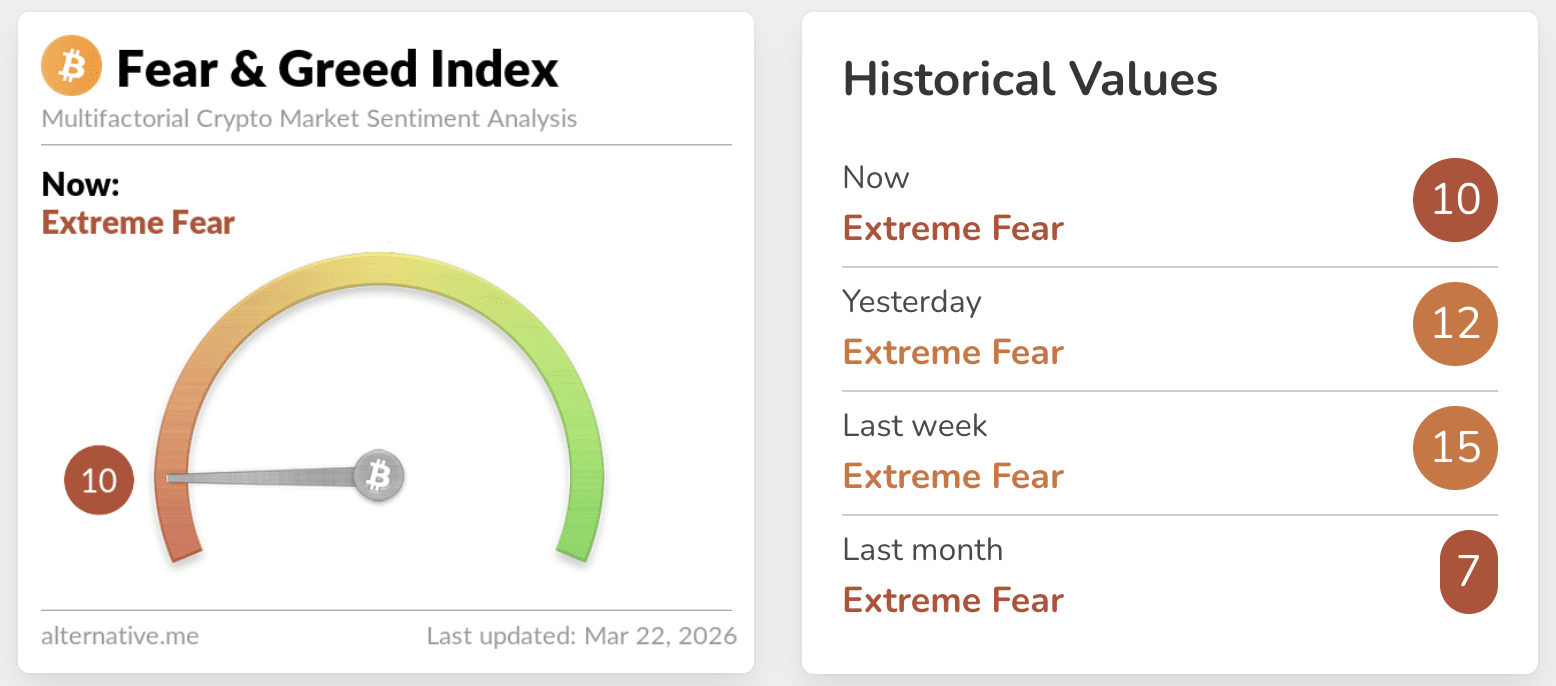
However, at the same time, the Crypto Fear & Greed Index sitting in the “Extreme Fear” zone raises questions that something is cooking.
Source: Alternative

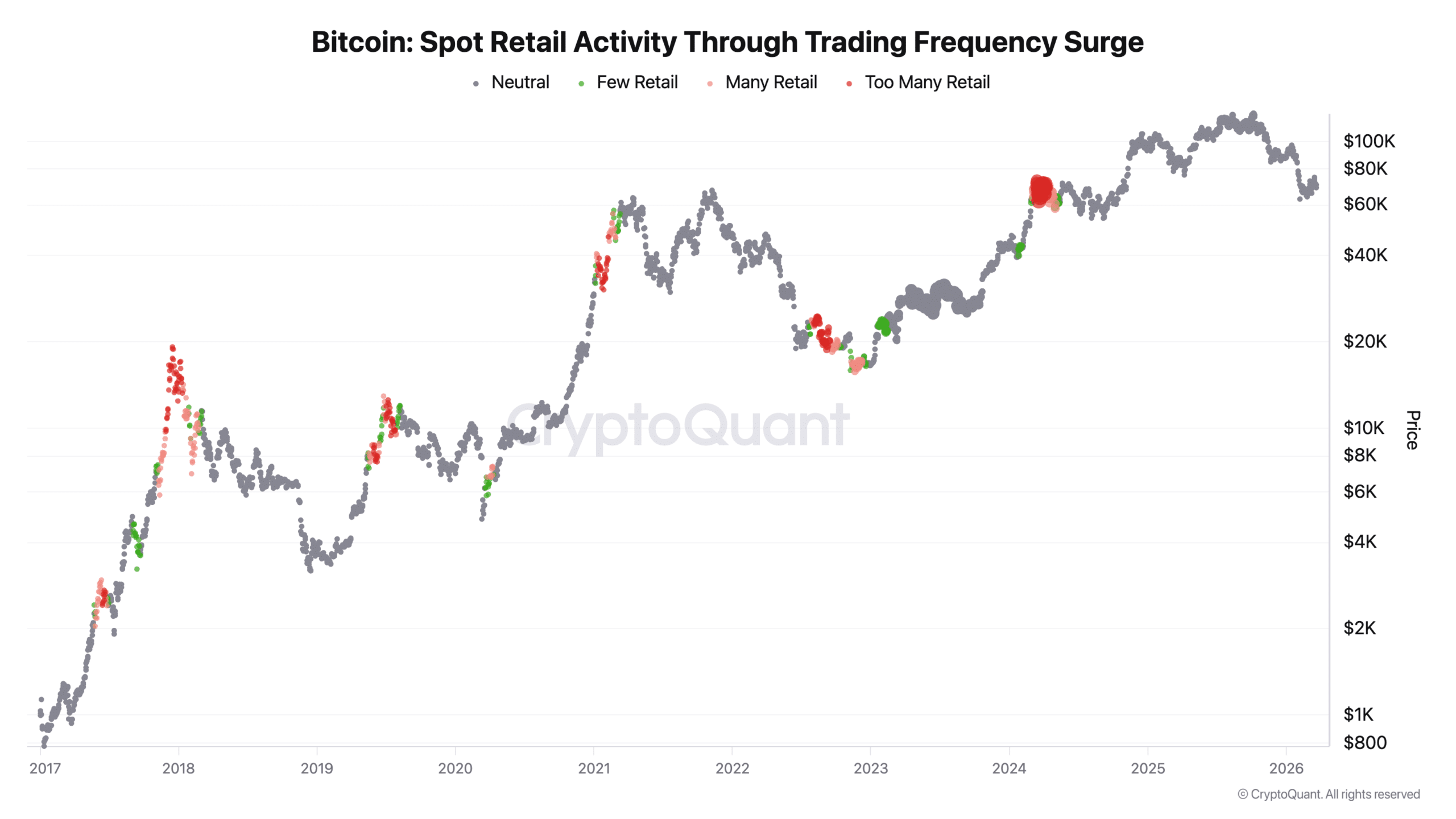
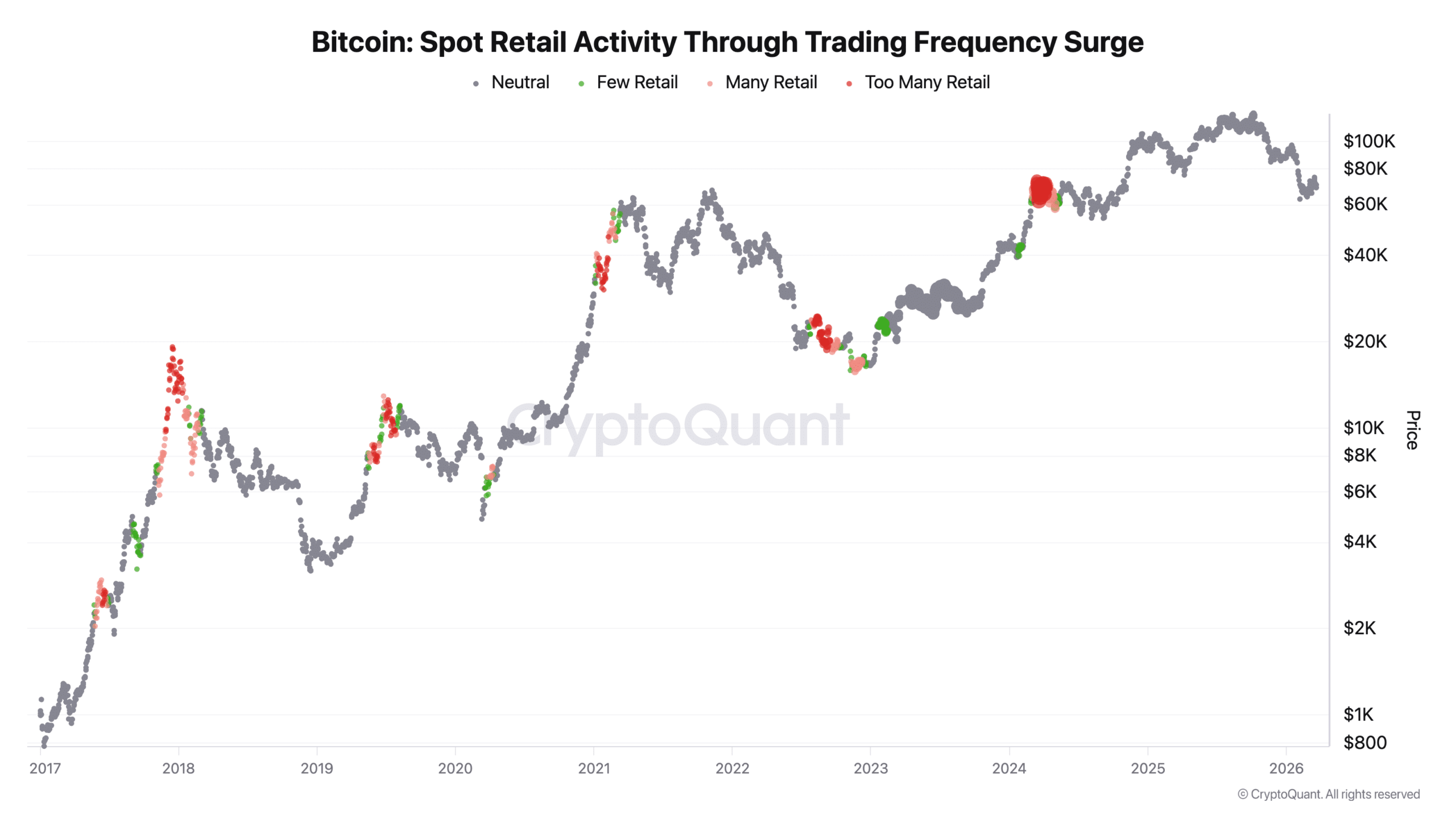
The market appears to be following a familiar pattern. Retail investors tend to enter at higher prices due to FOMO, like in 2017, 2021, and recently near $74,000.
Source: CryptoQuant

However, right now, retail activity is low, suggesting smaller investors are stepping back, a phase that historically aligns with quiet accumulation by larger players.

Meanwhile, on the institutional side, Bitcoin ETFs have seen recent outflows, $163.5 million on the 18th of March, $90.2 million on the 19th of March, and $52 million on the 20th of March.

However, these outflows are steadily decreasing, indicating that selling pressure from institutions may be slowing, potentially pointing toward market stabilization.

What to expect?

All in all, right now, Bitcoin’s data is giving mixed signals, making the situation unclear.

Overall, Bitcoin is stuck between positive factors like strong dominance and slowing ETF outflows, and negative factors like global tensions and uncertain investor behavior.

Therefore, until Bitcoin clearly moves above $74,000 or drops and stabilizes near $65,000, the market will likely remain uncertain.


Final Summary

  • Bitcoin’s recent drop is not just random; it reflects how strongly global political events are influencing market behavior.
  • Despite short-term fear, key indicators like dominance and slowing ETF outflows suggest underlying strength.


Related Questions

QWhat is the current Bitcoin price and how much has it fallen recently?

ABitcoin has fallen to around $69,173, down over 2% in a day and nearly 4% in a week.

QAccording to the Polymarket data, what is the consensus on Bitcoin's potential trading range?

AThere is a strong consensus that Bitcoin could trade in the $75,000–$80,000 range, with $55,000 and $50,000 seen as strong support levels.

QWhat is one major external factor cited as contributing to Bitcoin's price drop?

AThe shift in tone and more serious threats from the White House regarding global tensions, particularly around the Strait of Hormuz and Iran, contributed to the price drop.

QWhat does the 'Extreme Fear' reading on the Crypto Fear & Greed Index suggest about the market?

AThe 'Extreme Fear' reading raises questions that something significant might be happening, but it occurs during a phase of low retail activity, which historically aligns with accumulation by larger players.

QWhat is the trend in Bitcoin ETF flows, and what might it indicate?

ABitcoin ETFs have seen recent outflows, but the amounts are steadily decreasing ($163.5M, $90.2M, then $52M on consecutive days), indicating that institutional selling pressure may be slowing and the market could be stabilizing.

Related Reads

The Value Distribution of Stablecoins

**Summary: The Value Distribution of Stablecoins** The article argues that stablecoins are evolving from mere trading tools into broader channels for dollar access. It divides the stablecoin ecosystem into four layers to analyze how value is distributed: 1. **Issuance Layer:** Mints stablecoins, holds reserve assets, and captures the spread between reserve yield and user costs (e.g., Tether, Circle). This layer currently earns the largest profit margin. 2. **Infrastructure Layer:** Connects stablecoins to the traditional financial system, handling fiat on/off-ramps, banking integration, compliance (KYC/AML), and asset management (e.g., Bridge, BVNK). This is the "unglamorous" but critical work, building the essential bridges between crypto and real-world finance. 3. **Acquiring/Distribution Layer:** Integrates stablecoins into merchant systems, manages payment flows, and provides enterprise financial software (e.g., Stripe, Coinbase). They act as the access point for businesses. 4. **Application Layer:** The end-users and businesses that ultimately use stablecoins for payments, settlements, or as a store of value. They benefit from convenience but have little pricing power. The core thesis is that while the issuance layer currently dominates profits, the often-overlooked **infrastructure layer holds significant long-term potential**. The real challenge and barrier to mass adoption is not the on-chain transfer of stablecoins (which is simple), but the complex "last mile" integration into existing business workflows, banking systems, and regulatory frameworks across different countries. Companies in this layer are currently in a "land grab" phase, investing heavily to build networks, secure bank partnerships, and establish compliance pathways. While their position is currently pressured by the profitable issuers above and distribution platforms below, the article suggests that if stablecoins become a default financial rail for businesses, the infrastructure providers who have done the hard work of integration will ultimately gain strong pricing power and become entrenched, essential players.

marsbit5h ago

The Value Distribution of Stablecoins

marsbit5h ago

The Value Distribution of Stablecoins

The Value Distribution of Stablecoins The article argues that stablecoins are evolving from a mere trading tool into a broad "dollar channel." It analyzes the industry's value chain through four layers: 1. **Issuance Layer (e.g., Tether, Circle):** The top layer that mints stablecoins, holds reserve assets, and captures the thickest interest rate spread. 2. **Infrastructure Layer (e.g., Bridge, BVNK):** Connects stablecoins to the traditional financial system, handling critical but complex "dirty work" like fiat on/off-ramps, banking integration, compliance (KYC/AML), and cross-border settlement. 3. **Acquiring/Distribution Layer (e.g., Stripe, Coinbase):** Embeds stablecoins into merchant systems, manages payment flows, and integrates with enterprise software. 4. **Application Layer:** End-users and businesses that ultimately use stablecoins for payments, settlement, or storing value. The author posits that while the issuance layer currently captures the most profit, the most overlooked and potentially critical layer is infrastructure. The core challenge for stablecoin adoption isn't the on-chain transfer (which is simple), but bridging the gap between blockchain and the real-world financial system. This involves solving practical problems for businesses: fiat conversion, reconciliation, tax handling, and user onboarding. Infrastructure companies are currently in a difficult "land-grab" phase—building networks, securing banking relationships, and achieving compliance country-by-country. They face pressure from both the profitable issuance layer above and distribution platforms below. However, the author suggests this layer is building a crucial moat. Once stablecoins become a default business rail, the infrastructure players who have done the hard work of integration may gain significant, durable value and pricing power.

链捕手5h ago

The Value Distribution of Stablecoins

链捕手5h ago

Trading

Spot
Futures

Hot Articles

What is $BITCOIN

DIGITAL GOLD ($BITCOIN): A Comprehensive Analysis Introduction to DIGITAL GOLD ($BITCOIN) DIGITAL GOLD ($BITCOIN) is a blockchain-based project operating on the Solana network, which aims to combine the characteristics of traditional precious metals with the innovation of decentralized technologies. While it shares a name with Bitcoin, often referred to as “digital gold” due to its perception as a store of value, DIGITAL GOLD is a separate token designed to create a unique ecosystem within the Web3 landscape. Its goal is to position itself as a viable alternative digital asset, although specifics regarding its applications and functionalities are still developing. What is DIGITAL GOLD ($BITCOIN)? DIGITAL GOLD ($BITCOIN) is a cryptocurrency token explicitly designed for use on the Solana blockchain. In contrast to Bitcoin, which provides a widely recognized value storage role, this token appears to focus on broader applications and characteristics. Notable aspects include: Blockchain Infrastructure: The token is built on the Solana blockchain, known for its capacity to handle high-speed and low-cost transactions. Supply Dynamics: DIGITAL GOLD has a maximum supply capped at 100 quadrillion tokens (100P $BITCOIN), although details regarding its circulating supply are currently undisclosed. Utility: While precise functionalities are not explicitly outlined, there are indications that the token could be utilized for various applications, potentially involving decentralized applications (dApps) or asset tokenization strategies. Who is the Creator of DIGITAL GOLD ($BITCOIN)? At present, the identity of the creators and development team behind DIGITAL GOLD ($BITCOIN) remains unknown. This situation is typical among many innovative projects within the blockchain space, particularly those aligning with decentralized finance and meme coin phenomena. While such anonymity may foster a community-driven culture, it intensifies concerns about governance and accountability. Who are the Investors of DIGITAL GOLD ($BITCOIN)? The available information indicates that DIGITAL GOLD ($BITCOIN) does not have any known institutional backers or prominent venture capital investments. The project seems to operate on a peer-to-peer model focused on community support and adoption rather than traditional funding routes. Its activity and liquidity are primarily situated on decentralized exchanges (DEXs), such as PumpSwap, rather than established centralized trading platforms, further highlighting its grassroots approach. How DIGITAL GOLD ($BITCOIN) Works The operational mechanics of DIGITAL GOLD ($BITCOIN) can be elaborated on based on its blockchain design and network attributes: Consensus Mechanism: By leveraging Solana’s unique proof-of-history (PoH) combined with a proof-of-stake (PoS) model, the project ensures efficient transaction validation contributing to the network's high performance. Tokenomics: While specific deflationary mechanisms have not been extensively detailed, the vast maximum token supply implies that it may cater to microtransactions or niche use cases that are still to be defined. Interoperability: There exists the potential for integration with Solana’s broader ecosystem, including various decentralized finance (DeFi) platforms. However, the details regarding specific integrations remain unspecified. Timeline of Key Events Here is a timeline that highlights significant milestones concerning DIGITAL GOLD ($BITCOIN): 2023: The initial deployment of the token occurs on the Solana blockchain, marked by its contract address. 2024: DIGITAL GOLD gains visibility as it becomes available for trading on decentralized exchanges like PumpSwap, allowing users to trade it against SOL. 2025: The project witnesses sporadic trading activity and potential interest in community-led engagements, although no noteworthy partnerships or technical advancements have been documented as of yet. Critical Analysis Strengths Scalability: The underlying Solana infrastructure supports high transaction volumes, which could enhance the utility of $BITCOIN in various transaction scenarios. Accessibility: The potential low trading price per token could attract retail investors, facilitating wider participation due to fractional ownership opportunities. Risks Lack of Transparency: The absence of publicly known backers, developers, or an audit process may yield skepticism regarding the project's sustainability and trustworthiness. Market Volatility: The trading activity is heavily reliant on speculative behavior, which can result in significant price volatility and uncertainty for investors. Conclusion DIGITAL GOLD ($BITCOIN) emerges as an intriguing yet ambiguous project within the rapidly evolving Solana ecosystem. While it attempts to leverage the “digital gold” narrative, its departure from Bitcoin's established role as a store of value underscores the need for a clearer differentiation of its intended utility and governance structure. Future acceptance and adoption will likely depend on addressing the current opacity and defining its operational and economic strategies more explicitly. Note: This report encompasses synthesised information available as of October 2023, and developments may have transpired beyond the research period.

366 Total ViewsPublished 2025.05.13Updated 2025.05.13

What is $BITCOIN

Discussions

Welcome to the HTX Community. Here, you can stay informed about the latest platform developments and gain access to professional market insights. Users' opinions on the price of BTC (BTC) are presented below.

活动图片