Bitcoin: Rising oil prices keep BTC in check – Long-term holders in limbo

ambcryptoPublished on 2026-07-21Last updated on 2026-07-21

Abstract

Bitcoin faces mixed signals as it tests $64,500. While traditional investors added modest inflows, long-term holders (those holding coins for 155+ days) remain a focal point of caution. On-chain data shows this group is still selling at a loss, with their Spent Output Profit Ratio (SOPR) at 0.94, indicating 6% losses—a significant improvement from earlier 27% losses but not yet a sign of full conviction. Market activity is currently dominated by short-term holders, as indicated by the Exchange Coin Days Destroyed (CDD) metric, suggesting a more relaxed selling phase. Exchange reserves have also declined slightly. However, macroeconomic risks pose a headwind. Rising oil prices, driven by Middle East tensions, threaten to reignite inflation concerns. This could dampen the risk-on sentiment crucial for Bitcoin and potentially lead US investors to reduce exposure via spot Bitcoin ETFs. The market's recovery hinges on balancing these improving on-chain dynamics against persistent external economic pressures.

Bitcoin [BTC] has absorbed a run of blows, and although sentiment looks steadier with the asset testing $64,500 again, the market has yet to earn a bullish label.

Traditional investors appear to be circling back, adding $75.76 million in inflows between the 13th and the 17th of July, yet several forces keep the market in a cautious state. Long-term holders remain at the center of that caution.

Bitcoin long-term holders still need watching

Long-term holders are investors who have held their coins for no less than 155 days without moving them, and on-chain data shows this group selling at a loss rather than a profit.

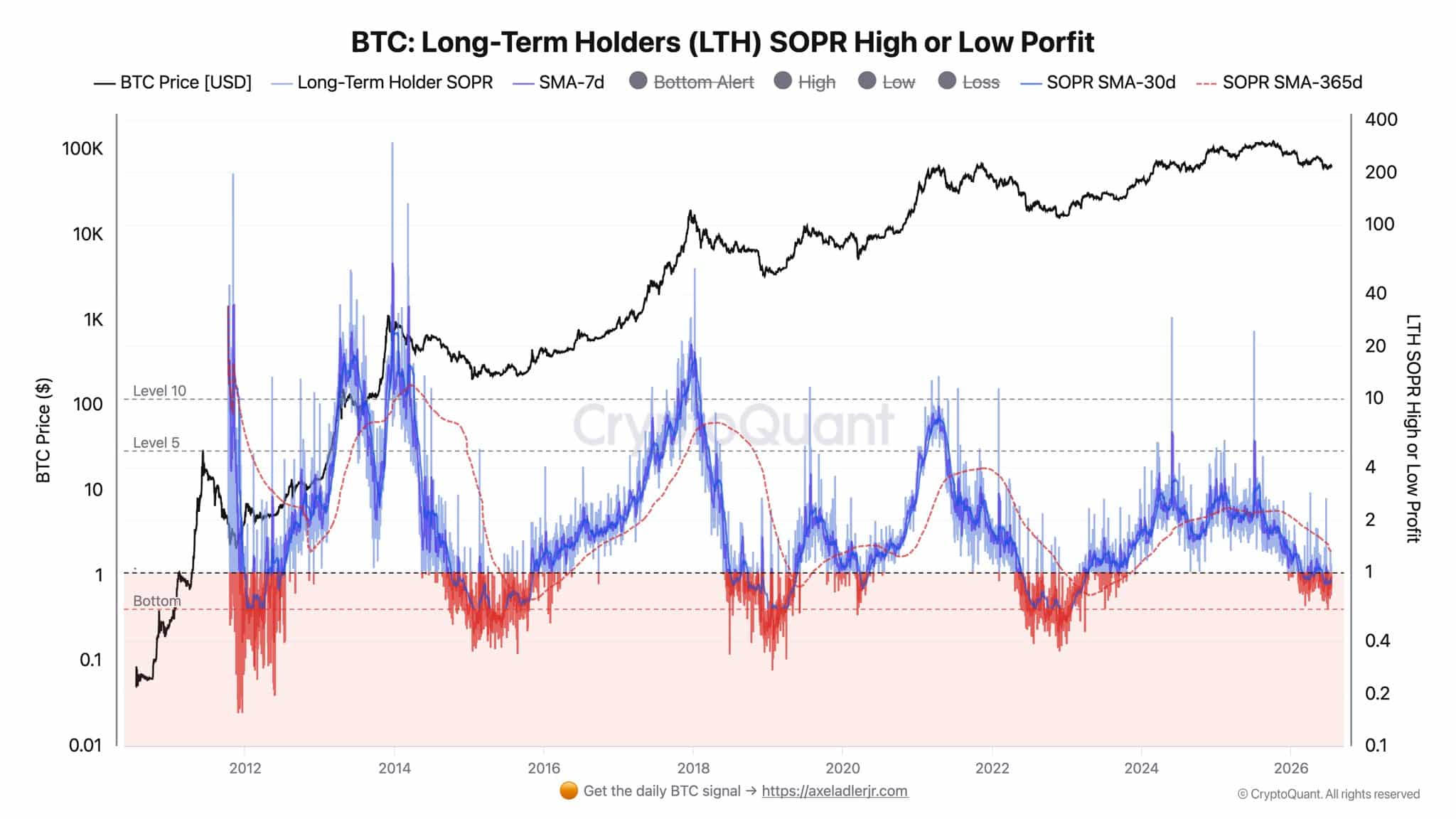
The 7-day moving average of the long-term holder SOPR – the Spent Output Profit Ratio (SOPR), which measures whether coins move at a profit or a loss – sits at 0.94 at press time, below the breakeven mark of 1.

That reading tells us long-term holders have parted with their Bitcoin at roughly a 6% loss so far.
Source: CryptoQuant

The figure marks a sharp improvement from earlier in the cycle, when the group sold at a 27% loss and the LTH SOPR fell to 0.73.

Less selling does not translate to full conviction, and the improvement does not mean the market has locked in a rebound, so long-term holders remain exposed to further price swings.

The monthly picture reinforces that caution, with the LTH SOPR showing these investors selling at a 12% loss since June.

History still offers a counterweight, as prolonged stretches of loss-taking have often preceded Bitcoin rallies, including the 2020 and 2023 runs to fresh all-time highs after the market exited similar phases.

Exchange CDD points to short-term holder dominance

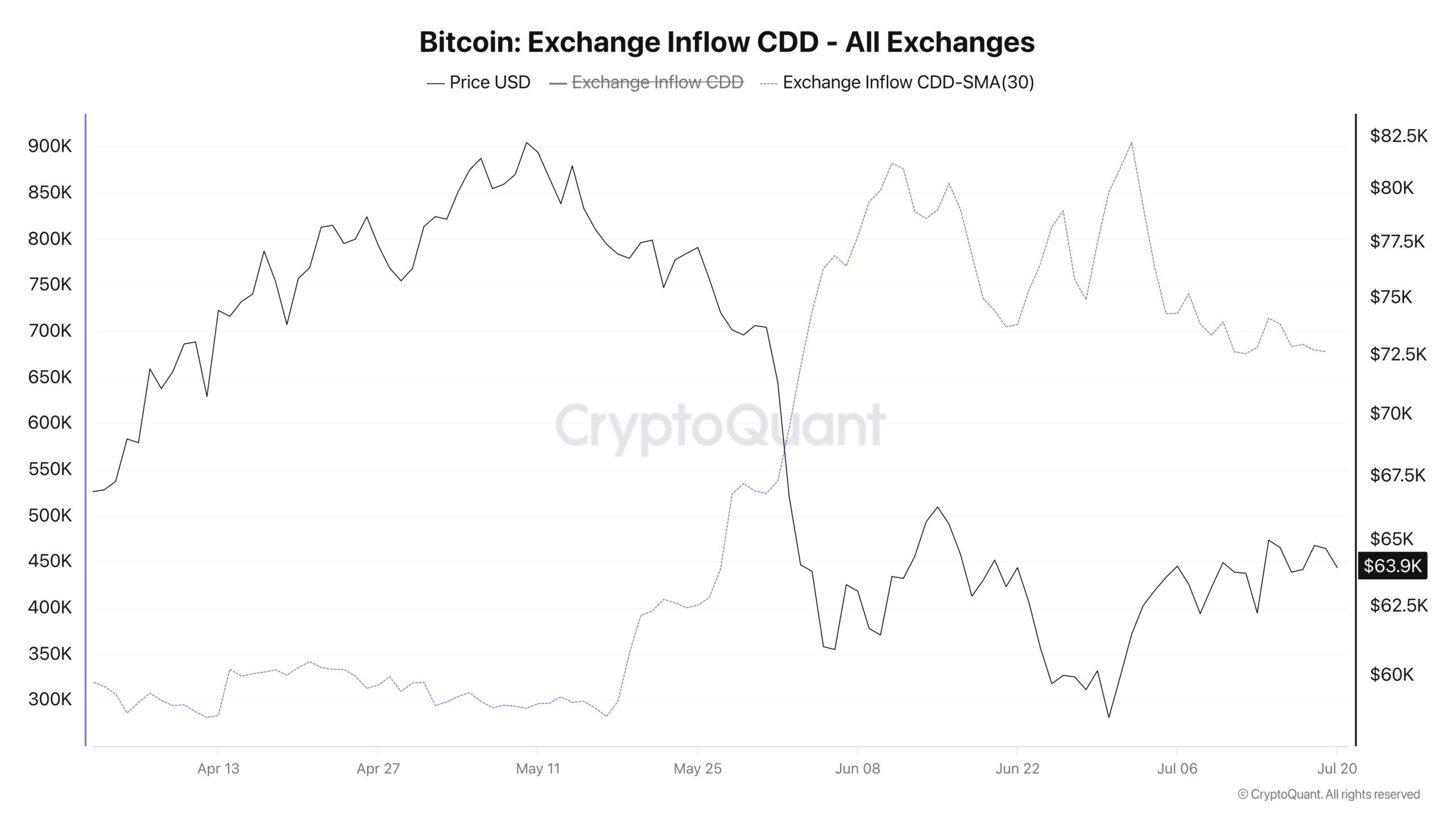
Exchange Coin Days Destroyed (CDD) weights each moving coin by how long it stayed dormant, which lets analysts see whether long-term or short-term holders drive the coins landing on exchanges, and the metric currently marks short-term, active participants as the dominant force.

An elevated Exchange CDD normally signals that sellers control the market as selling pressure builds, a classic bearish read, yet the opposite is playing out here and points to a more relaxed phase.
Source: CryptoQuant

Fewer long-term holders are moving coins, and with that group nursing losses of only about 6%, the setup leans constructive and raises the odds of a faster recovery from current levels.

The exchange reserve reflects that shift, and although long-term holders do not dominate the reserve, they contribute to a decline that has carried it from a high of 2.718 million BTC to 2.704 million BTC.

That drop returns the reserve to its late-June footing, around the 24th of June.

Will US investors keep funding?

Economic pressures and the threat of resurgent inflation still weigh on the market.

Inflation cooled over the past week on official readings, yet concern has climbed as the conflict involving the US, Iran, and Israel has escalated. Oil has answered the tension, with WTI crude climbing to $85.59 at Monday’s open, its highest level since the 12th of June.

The inflation worry runs largely through oil, since rising crude lifts production costs across the economy and increases the risk-off mood—and Bitcoin depends on risk-on appetite. Should oil continue to climb, US investors may reduce their exposure through spot US Bitcoin ETFs.


Final Summary

  • Long-term holders have eased their selling, now offloading at a 6% loss versus 27% earlier.
  • Bitcoin still needs a risk-on appetite, so rising oil and fresh inflation fears could push US investors to trim exposure.


Trending Cryptos

Related Questions

QWhat is the current state of long-term Bitcoin holders' selling behavior according to the LTH SOPR metric?

ALong-term Bitcoin holders are currently selling at a loss, with the 7-day moving average of the LTH SOPR at 0.94, indicating they are parting with their Bitcoin at roughly a 6% loss.

QWhat does a low Exchange Coin Days Destroyed (CDD) reading indicate about the current market participants?

AA low Exchange CDD indicates that short-term, active participants are the dominant force moving coins to exchanges, rather than long-term holders, which points to a more relaxed market phase.

QWhat external economic factor is mentioned as a potential threat to Bitcoin's risk-on appetite and US investor funding?

ARising oil prices are mentioned as a key threat, as they lift production costs and increase a risk-off mood. This could lead US investors to reduce their exposure through spot Bitcoin ETFs.

QHow does the article describe the potential historical significance of long-term holders selling at a loss?

AThe article notes that history shows prolonged periods of long-term holders selling at a loss have often preceded significant Bitcoin rallies, such as the runs to all-time highs in 2020 and 2023.

QWhat is the trend mentioned for Bitcoin's exchange reserves, and what does it signify?

ABitcoin's exchange reserves have declined from a high of 2.718 million BTC to 2.704 million BTC, returning to levels seen in late June. This decline, while long-term holders are not the dominant sellers, is viewed as a constructive, positive sign for the market.

Related Reads

Bitcoin Withdrawals Continue: 8 Years of Storage in a Coldcard Cold Wallet Ended in Zero

Coldcard Hardware Wallet Hacked: Losses Mount Due to Vulnerable Seed Generation A critical vulnerability in Coldcard hardware wallets has led to a continued wave of fund thefts. According to Galaxy Research, the total stolen has reached 1,367.05 BTC (approx. $88.6 million) from 4,585 addresses, a significant increase from the initial 594.5 BTC reported on July 30, 2026. Most of the stolen funds remain on the attackers' addresses. The issue is not with the current firmware, which Coinkite has updated, but with seed phrases generated on vulnerable devices between March 2021 and the release of fixed firmware versions. Due to a programmer error, devices switched from using a hardware random number generator to the software-based Yasmarang generator, which was initialized with publicly accessible data like the chip's serial number. This made the seed phrases predictable through offline brute-force attacks, meaning wallets remain at risk until funds are moved to a new wallet generated with the patched firmware. Affected devices include Mk2/Mk3 with firmware 4.0.1–4.1.9 (and up to 5.0.3), Mk4/Mk5 up to version 5.6.0, and Q models up to 1.5.0Q. The only exceptions are seeds created with a high-entropy method like at least 50 independent dice rolls or a strong unique BIP-39 passphrase. All other owners must generate a new seed on the fixed firmware and transfer their assets. A case highlighting the human impact involves a 39-year-old long-term investor who lost 2 BTC (approx. $130,000) in minutes. He had accumulated the Bitcoin over eight years through physical labor, viewing it as a financial lifeline and a retirement plan in a country suffering from hyperinflation. His story underscores that even conservative "buy and hold in cold storage" strategies can be compromised by such underlying technical flaws. From a technical perspective, this incident echoes historical failures where weak random number generators undermined cryptographic security, challenging the assumption that offline storage is automatically foolproof.

cryptonews.ru4h ago

Bitcoin Withdrawals Continue: 8 Years of Storage in a Coldcard Cold Wallet Ended in Zero

cryptonews.ru4h ago

Trading

Spot

Hot Articles

How to Buy CHECK

Welcome to HTX.com! We've made purchasing Checkmate (CHECK) simple and convenient. Follow our step-by-step guide to embark on your crypto journey.Step 1: Create Your HTX AccountUse your email or phone number to sign up for a free account on HTX. Experience a hassle-free registration journey and unlock all features.Get My AccountStep 2: Go to Buy Crypto and Choose Your Payment MethodCredit/Debit Card: Use your Visa or Mastercard to buy Checkmate (CHECK) instantly.Balance: Use funds from your HTX account balance to trade seamlessly.Third Parties: We've added popular payment methods such as Google Pay and Apple Pay to enhance convenience.P2P: Trade directly with other users on HTX.Over-the-Counter (OTC): We offer tailor-made services and competitive exchange rates for traders.Step 3: Store Your Checkmate (CHECK)After purchasing your Checkmate (CHECK), store it in your HTX account. Alternatively, you can send it elsewhere via blockchain transfer or use it to trade other cryptocurrencies.Step 4: Trade Checkmate (CHECK)Easily trade Checkmate (CHECK) on HTX's spot market. Simply access your account, select your trading pair, execute your trades, and monitor in real-time. We offer a user-friendly experience for both beginners and seasoned traders.

4.8k Total ViewsPublished 2026.01.19Updated 2026.06.02

How to Buy CHECK

Discussions

Welcome to the HTX Community. Here, you can stay informed about the latest platform developments and gain access to professional market insights. Users' opinions on the price of CHECK (CHECK) are presented below.

活动图片