Bitcoin Rebounds to $78.5K, But Technicals Suggest No Long-Term Support Yet

bitcoinistPublished on 2026-02-03Last updated on 2026-02-03

Abstract

Bitcoin has rebounded to $78,500, but technical analysis indicates the rally lacks strong long-term support. The price increase appears driven by derivatives leverage rather than organic spot demand, creating a fragile structure vulnerable to sudden sell-offs. Order books show a significant liquidity gap below the current price, suggesting high volatility risk. Meanwhile, capital is rotating toward Bitcoin scaling solutions like Bitcoin Hyper ($HYPER), a Layer 2 protocol integrating Solana's Virtual Machine for faster transactions and smart contracts. It has raised over $31.2 million in its presale, attracting significant whale investment, as investors hedge Bitcoin's scalability issues and seek exposure to infrastructure built on Bitcoin’s secure base layer.

Bitcoin has managed to claw its way back to $78.5K, a psychological level that has bulls calling for a run to six figures. But pop the champagne just yet? Probably not.

A closer look at the order books reveals a troubling divergence: price is rising, but conviction is thinning.

The bounce looks driven largely by derivatives leverage rather than spot demand. Order block analysis suggests a massive liquidity gap between $72,000 and the current price. Meaning? Any sudden selling pressure could cascade rapidly without structural support to catch the falling knife. It’s a fragile setup where volatility is the only guarantee.

While price action remains choppy, the underlying ecosystem is shifting gears. Smart money is looking past the daily candles—often noise anyway, and focusing on the structural limitations plaguing the network. Every time Bitcoin rallies, fees spike and confirmation times drag.

That bottleneck has catalyzed a rotation of capital into infrastructure plays designed to solve these exact friction points.
Investors are increasingly hedging their spot exposure by moving into high-performance Layer 2 protocols. The logic is sound: if Bitcoin succeeds, the network needs scaling; if it stalls, innovation happens on the layers above.

Leading this charge is Bitcoin Hyper, a project that’s becoming a focal point for institutional-grade interest by integrating Solana’s speed directly onto Bitcoin’s security layer.

Buy $HYPER today.

Bitcoin Hyper Merges SVM Speed With Bitcoin Security

The market has long debated whether Bitcoin should remain a store of value or evolve into a programmable platform. Bitcoin Hyper ($HYPER) renders that debate moot by offering both. As the first Bitcoin Layer 2 to integrate the Solana Virtual Machine (SVM), it delivers technical prowess that legacy sidechains just haven’t achieved.
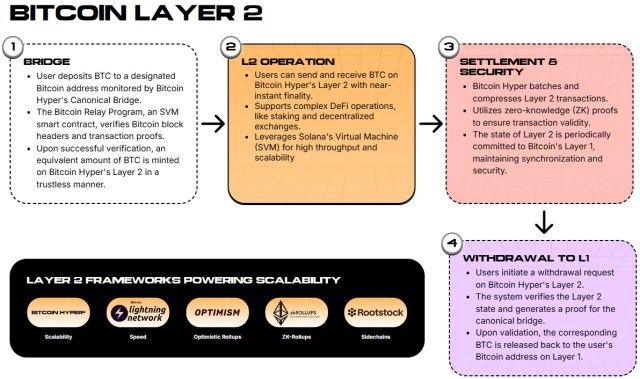
That matters. Ethereum’s dominance in DeFi stemmed largely from Bitcoin’s inability to handle complex smart contracts. By using the SVM, Bitcoin Hyper introduces low-latency execution to the Bitcoin ecosystem. The architecture is modular: it uses Bitcoin L1 for final settlement and a real-time SVM L2 for execution. The result? Sub-second finality, a stark contrast to the main chain’s 10-minute crawl.

Developers (usually the first to spot technical breakouts) are eyeing the ‘Decentralized Canonical Bridge.’ This infrastructure unlocks high-speed payments in wrapped BTC and enables sophisticated DeFi applications, from lending protocols to NFT platforms, all built with Rust-based SDKs. It solves the “trilemma” by keeping the base layer secure while outsourcing the heavy lifting to a hyper-efficient execution layer.

Check out the Bitcoin Hyper ecosystem.

Smart Money Rotates Into $31M Presale Event

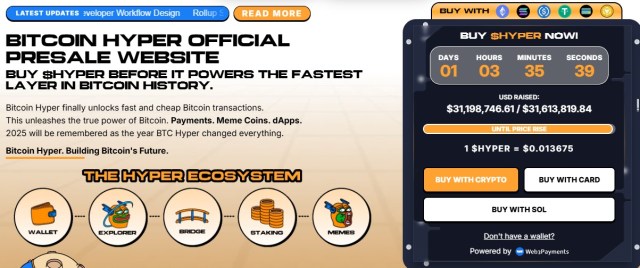
While the broader market stays tentative about short-term price action, capital allocators are aggressively positioning themselves in the $HYPER presale. The project has raised over $31.2M, a figure that underscores the demand for scalable Bitcoin infrastructure.
On-chain metrics back this up. According to Etherscan records, two whale wallets have accumulated over $1M in $HYPER tokens.

The largest single transaction ($500K) hit the chain on Jan 15, 2026, signaling that high-net-worth individuals are securing positions well before public trading starts. With tokens currently priced at $0.013675, these early entries suggest a belief that the asset is undervalued relative to its utility.

The tokenomics look designed to incentivize long-term holding. The protocol offers high APY staking immediately after the Token Generation Event (TGE), with a modest 7-day vesting period for presale stakers. That structure mitigates the risk of immediate post-launch dumping while rewarding governance participants. For investors weary of Bitcoin’s current chop at $78.5K, the $HYPER presale represents a calculated bet on the future of scalability.

Visit the official presale site.

Disclaimer This article is for informational purposes only and does not constitute financial advice. Cryptocurrency investments carry high risks, including the potential for total loss. Always verify presale details independently.


Trending Cryptos

Related Questions

QWhat is the current price of Bitcoin mentioned in the article, and what does it represent?

AThe current price of Bitcoin mentioned is $78.5K, which is described as a psychological level that has bulls calling for a run to six figures.

QAccording to the article, what is the primary driver behind Bitcoin's recent price bounce?

AThe bounce is described as being driven largely by derivatives leverage rather than genuine spot demand.

QWhat is the main technical problem with the Bitcoin network that the article highlights?

AThe article highlights that every time Bitcoin rallies, transaction fees spike and confirmation times drag, creating a bottleneck.

QWhat project is presented as a solution to Bitcoin's scaling issues, and how does it work?

ABitcoin Hyper ($HYPER) is presented as the solution. It is a Bitcoin Layer 2 that integrates the Solana Virtual Machine (SVM) to deliver sub-second finality for execution while using Bitcoin L1 for final settlement.

QWhat evidence does the article provide to show institutional interest in the $HYPER presale?

AThe article states the presale has raised over $31.2M and cites on-chain metrics from Etherscan showing two whale wallets accumulating over $1M in tokens, with the largest single transaction being $500K.

Related Reads

The Changing Landscape: What Are Crypto VCs Experiencing?

Title: The Shifting Landscape of Crypto Venture Capital The era of dedicated crypto venture capital funds is undergoing a significant transformation. Once essential for navigating the sector's complexity and high risk, these specialized funds are now facing an identity crisis as the market matures. This shift mirrors historical patterns in other specialized investment classes like cleantech and SPACs, where initial information advantages dissipate as technologies become mainstream and integrated into existing industry frameworks. The article argues that crypto is reaching a critical inflection point, transitioning from a "building phase" to an "integration phase." Major players like Stripe, BlackRock, and Visa now engage with crypto not for its novel mechanics but as a foundational financial infrastructure. Their needs—regulatory compliance, banking partnerships, distribution channels—align with traditional fintech, a domain easily understood by large, generalist funds like Sequoia and Founders Fund. This evolution creates a "barbell effect" within the VC landscape. On one end are massive, diversified platforms that can incorporate crypto as one vertical among many. On the other are small, nimble funds focused on niche, experimental projects. The middle ground—medium-sized dedicated crypto funds—is being squeezed out. Their typical fund size makes it impossible to generate sufficient returns solely from early-stage crypto bets, yet they cannot compete with giants for later-stage deals. Consequently, leading crypto-native firms like Paradigm and Framework Ventures are expanding into AI, robotics, and other sectors, driven partly by LP pressure for better returns amid a broader VC DPI crisis. Others, like Dragonfly and a16z, have narrowed their crypto focus predominantly to financial infrastructure like stablecoins, reframing the sector's core narrative. For crypto entrepreneurs, this consolidation presents challenges. While generalist funds offer larger checks and broader resources, crypto projects now compete fiercely with AI for attention and capital within these firms. Furthermore, the long-term, non-commercial foundational work that built the ecosystem—funded by dedicated crypto VCs—is less likely to attract generalist capital focused on direct returns. The conclusion is that "crypto investor" as a standalone category is becoming obsolete, akin to "internet investor." Crypto is becoming a baseline infrastructure layer. The future will see a barbell structure: large-scale growth financing handled by generalist funds, while pioneering, speculative projects are funded by small, specialized vehicles. The dedicated crypto funds of the 2017-2021 boom, which incubated core infrastructure, are giving way to this new, bifurcated reality.

Foresight News4m ago

The Changing Landscape: What Are Crypto VCs Experiencing?

Foresight News4m ago

As Consensus Accelerates, What Are Young Investors Betting On?

Title: As Consensus Forms Faster, What Are Young Investors Betting On? In the rapid evolution of tech investment, a new generation of young investors is navigating a landscape where AI, robotics, commercial aerospace, and quantum computing are advancing simultaneously. Traditional investment logic based on financial models is giving way to a need for deep technical understanding and the ability to act before industry consensus forms. An analysis of trends from the "WAIC FUTURE TECH" list of young investment leaders reveals key shifts in focus. The first major trend is the movement of AI from the digital screen into the physical world. Investment is shifting from large language models and chatbots towards embodied AI, robotics, AI hardware, and edge computing. While demonstrations generate excitement, the real challenge lies in achieving scalable, reliable, and cost-effective delivery in complex real-world environments like factories and logistics. Success depends not just on algorithms but on the integration of sensors, actuators, and control systems. Second, the competitive focus for large models is moving beyond raw capability toward building an "intelligence flywheel." The goal is to create self-reinforcing systems where user interaction generates data, improving the model, which in turn enhances the user experience and attracts more engagement. Companies that successfully embed AI into workflows to create these closed-loop systems can build lasting value that isn't easily erased by the next model upgrade. Third, facing a potential bottleneck in high-quality human-generated data, investors are looking at new underlying technologies. Reinforcement learning and self-play, as demonstrated by AlphaGo Zero, offer paths for AI to generate its own experience. Scientific foundation models, which aim to build general AI capabilities for fields like life sciences and materials discovery, represent a non-consensus direction that could unlock new frontiers of knowledge and data. Finally, in deep-tech areas like quantum computing, commercial aerospace, and space-based infrastructure, patient capital is essential. These fields have long, uncertain development and validation cycles involving complex engineering, supply chains, and regulations. Investment here requires a long-term view, focusing on foundational team capabilities and the eventual emergence of market demand, even if commercial returns are distant. Collectively, these trends illustrate how young investors are adapting to a new era. They are learning to make earlier, technically-informed judgments, balance hype with real-world viability, and provide the patient capital needed to build the deep-tech foundations of the future.

marsbit32m ago

As Consensus Accelerates, What Are Young Investors Betting On?

marsbit32m ago

Can Japan Buy Growth with AI? Will the Bond Market Believe It?

Japan's cabinet has introduced the 2026 Basic Policy on Economic and Fiscal Management and Reform, shifting its primary fiscal target. The new framework moves away from the traditional annual primary balance goal and instead prioritizes a stable reduction of the debt-to-GDP ratio. This change is tied to a strategy of increased "responsible proactive fiscal" spending, aiming to boost long-term growth through investments in strategic sectors like AI, semiconductors, energy, and robotics. The government estimates total public and private investment in 62 key technologies could exceed 370 trillion yen by 2040. The market reaction has been mixed and cautious. While equity markets may respond to policy signals, bond markets are focused on fiscal credibility. Concerns center on whether the weakening of the clear primary balance anchor could lead to looser fiscal discipline. If investors doubt that these strategic investments will generate sufficient productivity gains, tax revenue, and nominal growth to outpace rising interest costs, they may demand higher yields on Japanese Government Bonds (JGBs). Recent volatility in the yen and JGB yields, with the 10-year yield briefly reaching 2.9%, reflects this skepticism. The success of this new framework hinges on two factors: whether Japan can achieve a nominal growth rate consistently higher than its long-term interest rates, and whether future budgets demonstrate disciplined control over bond issuance. The government's narrative is that strategic investment is essential to break Japan's cycle of low growth, aging, and labor shortages. However, the bond market will continuously assess the credibility of this plan, pricing the risk that it may represent fiscal expansion rather than a viable growth strategy.

marsbit1h ago

Can Japan Buy Growth with AI? Will the Bond Market Believe It?

marsbit1h ago

Trading

Spot

Hot Articles

What is $BITCOIN

DIGITAL GOLD ($BITCOIN): A Comprehensive Analysis Introduction to DIGITAL GOLD ($BITCOIN) DIGITAL GOLD ($BITCOIN) is a blockchain-based project operating on the Solana network, which aims to combine the characteristics of traditional precious metals with the innovation of decentralized technologies. While it shares a name with Bitcoin, often referred to as “digital gold” due to its perception as a store of value, DIGITAL GOLD is a separate token designed to create a unique ecosystem within the Web3 landscape. Its goal is to position itself as a viable alternative digital asset, although specifics regarding its applications and functionalities are still developing. What is DIGITAL GOLD ($BITCOIN)? DIGITAL GOLD ($BITCOIN) is a cryptocurrency token explicitly designed for use on the Solana blockchain. In contrast to Bitcoin, which provides a widely recognized value storage role, this token appears to focus on broader applications and characteristics. Notable aspects include: Blockchain Infrastructure: The token is built on the Solana blockchain, known for its capacity to handle high-speed and low-cost transactions. Supply Dynamics: DIGITAL GOLD has a maximum supply capped at 100 quadrillion tokens (100P $BITCOIN), although details regarding its circulating supply are currently undisclosed. Utility: While precise functionalities are not explicitly outlined, there are indications that the token could be utilized for various applications, potentially involving decentralized applications (dApps) or asset tokenization strategies. Who is the Creator of DIGITAL GOLD ($BITCOIN)? At present, the identity of the creators and development team behind DIGITAL GOLD ($BITCOIN) remains unknown. This situation is typical among many innovative projects within the blockchain space, particularly those aligning with decentralized finance and meme coin phenomena. While such anonymity may foster a community-driven culture, it intensifies concerns about governance and accountability. Who are the Investors of DIGITAL GOLD ($BITCOIN)? The available information indicates that DIGITAL GOLD ($BITCOIN) does not have any known institutional backers or prominent venture capital investments. The project seems to operate on a peer-to-peer model focused on community support and adoption rather than traditional funding routes. Its activity and liquidity are primarily situated on decentralized exchanges (DEXs), such as PumpSwap, rather than established centralized trading platforms, further highlighting its grassroots approach. How DIGITAL GOLD ($BITCOIN) Works The operational mechanics of DIGITAL GOLD ($BITCOIN) can be elaborated on based on its blockchain design and network attributes: Consensus Mechanism: By leveraging Solana’s unique proof-of-history (PoH) combined with a proof-of-stake (PoS) model, the project ensures efficient transaction validation contributing to the network's high performance. Tokenomics: While specific deflationary mechanisms have not been extensively detailed, the vast maximum token supply implies that it may cater to microtransactions or niche use cases that are still to be defined. Interoperability: There exists the potential for integration with Solana’s broader ecosystem, including various decentralized finance (DeFi) platforms. However, the details regarding specific integrations remain unspecified. Timeline of Key Events Here is a timeline that highlights significant milestones concerning DIGITAL GOLD ($BITCOIN): 2023: The initial deployment of the token occurs on the Solana blockchain, marked by its contract address. 2024: DIGITAL GOLD gains visibility as it becomes available for trading on decentralized exchanges like PumpSwap, allowing users to trade it against SOL. 2025: The project witnesses sporadic trading activity and potential interest in community-led engagements, although no noteworthy partnerships or technical advancements have been documented as of yet. Critical Analysis Strengths Scalability: The underlying Solana infrastructure supports high transaction volumes, which could enhance the utility of $BITCOIN in various transaction scenarios. Accessibility: The potential low trading price per token could attract retail investors, facilitating wider participation due to fractional ownership opportunities. Risks Lack of Transparency: The absence of publicly known backers, developers, or an audit process may yield skepticism regarding the project's sustainability and trustworthiness. Market Volatility: The trading activity is heavily reliant on speculative behavior, which can result in significant price volatility and uncertainty for investors. Conclusion DIGITAL GOLD ($BITCOIN) emerges as an intriguing yet ambiguous project within the rapidly evolving Solana ecosystem. While it attempts to leverage the “digital gold” narrative, its departure from Bitcoin's established role as a store of value underscores the need for a clearer differentiation of its intended utility and governance structure. Future acceptance and adoption will likely depend on addressing the current opacity and defining its operational and economic strategies more explicitly. Note: This report encompasses synthesised information available as of October 2023, and developments may have transpired beyond the research period.

972 Total ViewsPublished 2025.05.13Updated 2025.05.13

What is $BITCOIN

Discussions

Welcome to the HTX Community. Here, you can stay informed about the latest platform developments and gain access to professional market insights. Users' opinions on the price of BTC (BTC) are presented below.

活动图片














